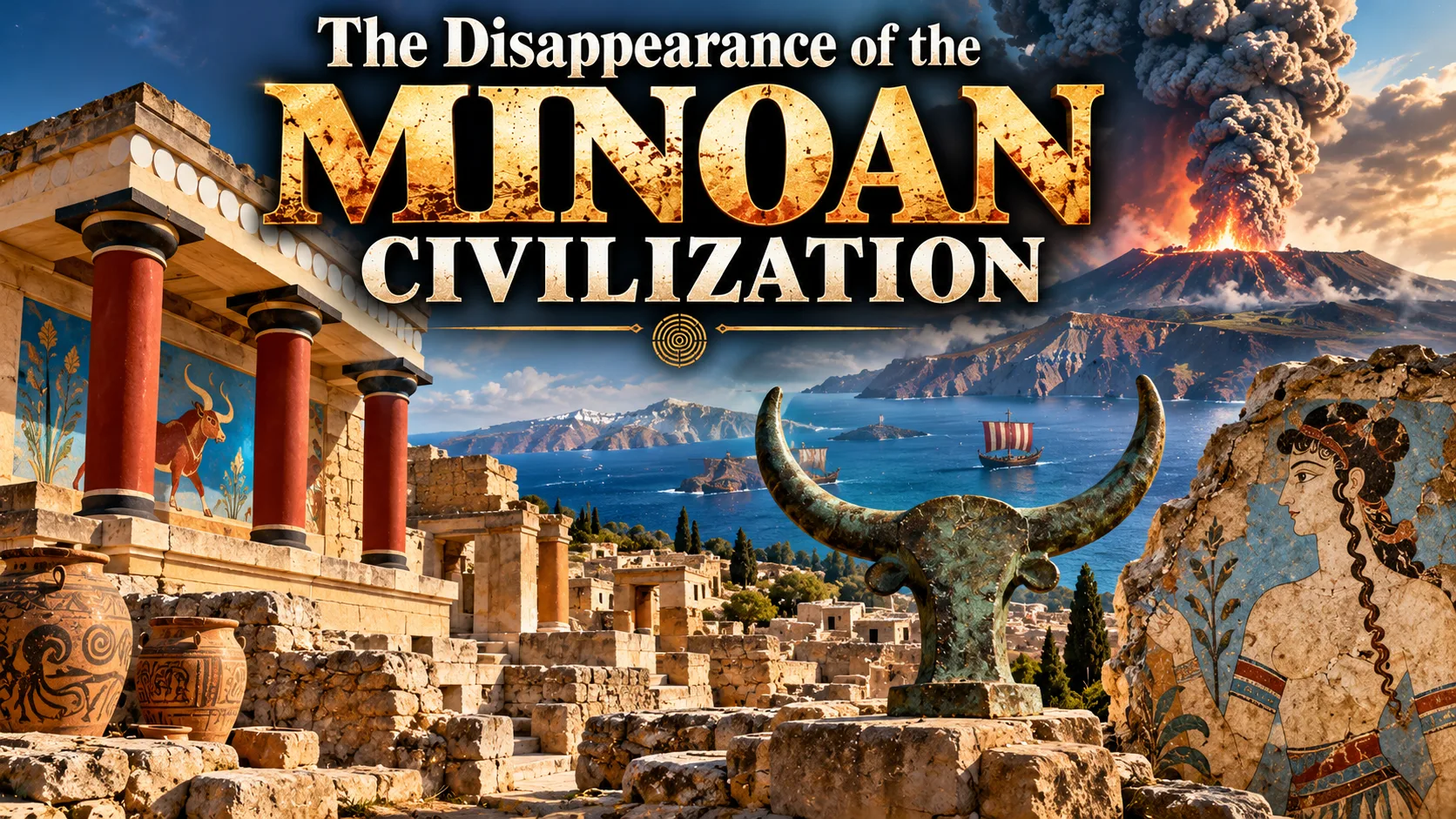
The Disappearance of the Minoan Civilization
The Minoans built remarkable palaces, developed extensive maritime trade networks, and created one of the ancient Mediterranean's most distinctive cultures. Discover what happened to their civilization and why volcanic eruptions, invasions, and political upheaval remain central to the debate.
The Disappearance of the Minoan Civilization
Imagine a civilization whose people built enormous palaces, decorated their walls with spectacular paintings, traded across the Mediterranean, and developed a writing system thousands of years ago.
Its merchants traveled by sea. Its craftsmen created remarkable pottery and jewelry. Its religious world revolved around symbols such as bulls, double axes, and sacred natural spaces. Its political centers accumulated wealth and influence.
And then, over time, its great palaces were destroyed, its administrative system changed, and its distinctive culture lost the prominence it had once enjoyed.
No surviving document tells us exactly why.
No eyewitness left a clear account of the final days. No ancient historian provided a reliable explanation for the transformation of this Bronze Age society.
The civilization was the Minoans of ancient Crete.
Did a colossal volcanic eruption destroy their world? Did a tsunami devastate their coastal settlements? Were they conquered by warriors from mainland Greece? Did their trading networks collapse? Or did several generations of political and environmental upheaval gradually transform their society?
The popular version of the story is simple.
A volcanic island exploded.
The waves arrived.
The Minoans disappeared.
Unfortunately, archaeology tells a considerably more complicated story.
The volcanic eruption was real. Its consequences were serious. Minoan palaces experienced major destruction, and mainland Greek political influence eventually expanded across Crete. But these events did not necessarily happen simultaneously, and the eruption alone cannot explain every stage of the civilization's decline.
The central mystery is not how an entire people vanished overnight. It is how a powerful Bronze Age society lost its distinctive political and cultural position.
To understand that transformation, we need to return to the beginning, when Crete was not the setting of a historical mystery but the center of a remarkable Mediterranean civilization.
1. An Island at the Center of the Mediterranean
Crete occupies a strategically important position in the eastern Mediterranean, between mainland Greece, the Aegean islands, Anatolia, Cyprus, and the eastern Mediterranean coast.
For ancient seafarers, this geography offered enormous opportunities.
Ships traveling between regions could exchange copper, tin, gold, silver, ivory, pottery, textiles, wine, olive oil, and other valuable goods. They also carried ideas, technologies, artistic styles, religious practices, and knowledge.
Crete was not an isolated island at the edge of civilization. It was positioned within a network of maritime connections that linked distant societies.
During the Bronze Age, these connections helped support the growth of complex settlements and political centers.
The civilization now called Minoan developed on Crete during this period, with major palatial centers emerging around the beginning of the second millennium BCE.
This was the world from which the Minoan palaces emerged.
And it was this world that would eventually undergo profound changes.
2. Who Were the Minoans?
The name Minoan comes from King Minos, a legendary ruler associated with Crete in later Greek mythology.
The term was popularized by British archaeologist Arthur Evans, who excavated the palace at Knossos in the early twentieth century.
Evans believed he was uncovering the historical foundations of Greek traditions surrounding Minos and the Labyrinth.
But there is an important distinction.
We do not know what the Minoans called themselves.
The name describes a civilization reconstructed by modern researchers. It does not come from a surviving Minoan record identifying the people by that name.
The Minoans left behind architecture, pottery, frescoes, seals, tools, and written records. Yet their own language remains incompletely understood.
Their principal script, Linear A, has not been deciphered securely. A related script, Linear B, was later used to record an early form of Greek, demonstrating that Greek-speaking administration became established at important Cretan centers.
That difference between the two scripts would become one of the most important clues in reconstructing what happened to Minoan society.
3. The Palaces That Ruled the Island
The Minoan world contained several major palatial centers.
Among the most important were:
Knossos
Phaistos
Malia
Zakros
These were not simply royal residences in the modern sense.
They were large complexes associated with storage, administration, craft production, ceremonies, and elite power.
Their rooms, courtyards, staircases, storerooms, workshops, and decorated walls formed the physical infrastructure of a complex society.
The palaces could collect and redistribute goods, coordinate labor, and organize important communal activities.
Their architecture also communicated authority.
A monumental complex was an expression of resources and organization. Building and maintaining one required a substantial workforce and a political system capable of coordinating it.
The palaces therefore provide evidence for more than wealth.
They show how Minoan society organized itself.
And because the palatial system was so important, its eventual destruction and transformation are central to the story of the Minoan decline.
4. Knossos: The Greatest Symbol of Minoan Civilization
Knossos, located near modern Heraklion on Crete, is the most famous Minoan archaeological site.
Its ruins reveal a complex architectural environment with courtyards, corridors, staircases, storerooms, workshops, and ceremonial spaces.
The palace became the focus of Arthur Evans's excavations beginning in 1900. His discoveries transformed our understanding of Bronze Age Crete and demonstrated that an elaborate urban and administrative society had flourished in the Aegean long before classical Athens.
Knossos also produced large quantities of material that reveal the development of Minoan culture.
Yet its story contains an important warning.
The colorful palace visible to modern visitors is partly a reconstruction based on Evans's interpretations. Some of his decisions remain controversial, and visitors must distinguish surviving ancient structures from modern additions.
The palace is a major archaeological site, but not every colorful column or reconstructed room is an untouched Bronze Age survival.
5. A Society of Artists, Builders, and Traders
Minoan material culture is remarkable for its craftsmanship.
Their world included fine pottery, carved seals, metal objects, jewelry, painted walls, stone vessels, and elaborate architecture.
Frescoes depict landscapes, marine animals, plants, processions, and human figures. Bulls appear repeatedly in Minoan art and ritual imagery.
One famous example is the image of bull-leaping, in which figures interact with a bull in a stylized physical scene.
Its precise ritual or social meaning remains debated, but the image illustrates the distinctive visual culture of Bronze Age Crete.
Minoan artistic traditions were also connected to the wider Mediterranean. Objects, motifs, and materials moved between Crete and other regions, reflecting a world of exchange rather than cultural isolation.
The Minoans were not simply making beautiful objects for their own amusement.
Art, religious practice, administration, and political power were intertwined.
Their surviving objects allow us to reconstruct parts of that world. What they cannot provide by themselves is a complete explanation of why the palatial system eventually changed.
6. The Bull, the Labyrinth, and the Minotaur
Few ancient civilizations are as strongly associated with mythology as the Minoans.
Greek stories described King Minos, the Labyrinth, the Minotaur, Theseus, and Ariadne.
The stories were recorded in later Greek traditions, not in a surviving Minoan account that explains precisely what happened at Knossos.
Nevertheless, the imagery and architecture discovered on Crete encouraged scholars to investigate possible connections between mythology and the Bronze Age past.
Bulls were important in Minoan art. The palace at Knossos was complex enough to inspire later ideas of an elaborate labyrinth. And the civilization existed long before the classical Greek world that preserved these stories.
But there is a limit to what can be inferred.
The presence of bull imagery does not prove that every detail of the Minotaur legend describes a real historical event.
Nor does the palace prove that a literal labyrinth once imprisoned a half-human monster.
The myths and the archaeological record are connected through a long history of cultural memory, interpretation, and storytelling.
They should not be treated as interchangeable sources.
7. The Minoans Did Not Build Their World Alone
The Minoan civilization was deeply involved in trade across the eastern Mediterranean.
Crete's maritime position made it possible to connect with the Cyclades, mainland Greece, Anatolia, Cyprus, Egypt, and the Levant.
These connections brought materials, ideas, and influences into Cretan communities.
The Minoan world was therefore part of a larger Bronze Age system.
That system depended on the continued functioning of ports, routes, political relationships, and specialized production.
The same connectivity that made Crete prosperous also created dependencies.
When neighboring societies changed, Crete could not remain unaffected.
And when disasters struck elsewhere, their effects could travel through trade networks.
This becomes especially important when considering the famous volcanic eruption on the nearby island of Thera.
8. The Volcano That Changed the Aegean
<AsyncImage query="Santorini Thera volcanic caldera dramatic aerial view steep cliffs Aegean Sea" aspectRatio="16:9" width="100%" alt="The volcanic caldera of Santorini, the island known in antiquity as Thera." />
Modern Santorini is a beautiful group of islands in the Aegean Sea.
But in the Bronze Age, the volcanic island of Thera, now known as Santorini, experienced one of the largest volcanic eruptions of the past several thousand years.
The eruption devastated the settlement at Akrotiri, burying buildings beneath volcanic deposits.
The event is often called the Minoan eruption, although this name can be misleading if it suggests that the eruption itself destroyed the entire Minoan civilization.
It did not.
The eruption occurred on Thera, north of Crete.
Its effects extended into the surrounding region, and it may have had serious consequences for coastal communities on Crete.
But the precise relationship between the eruption and the later destruction of Minoan palaces remains a matter of archaeological investigation.
Scientific dating places the eruption broadly in the late seventeenth to sixteenth centuries BCE, although the exact calendar date remains debated.
This uncertainty matters because the timing of the eruption must be compared with the archaeological evidence for destruction on Crete.
And those events were not necessarily simultaneous.
9. Akrotiri: The City Buried by the Eruption
The settlement at Akrotiri, on Santorini, is one of the most extraordinary Bronze Age archaeological sites in the Mediterranean.
Before the eruption, it contained substantial buildings, decorated rooms, streets, and material evidence of trade and daily life.
Volcanic deposits preserved important remains, providing a detailed picture of a settlement interrupted by catastrophe.
Its destruction demonstrates how a natural disaster can transform an entire community.
Yet Akrotiri was a settlement on Thera, not the palace at Knossos on Crete.
That distinction is frequently lost in popular retellings.
The destruction of Akrotiri is direct archaeological evidence for the catastrophe on Santorini.
It is not direct proof that the eruption destroyed every major Minoan center.
The eruption may have affected Crete through ash fallout, tsunami waves, and other environmental disturbances, but each proposed effect must be evaluated using evidence from Cretan sites.
10. Could a Tsunami Have Reached Crete?
This is one of the most important questions in the entire story.
A major volcanic eruption can generate tsunami waves through the displacement of water, collapse of volcanic material, or related processes.
Crete lies south of Santorini, making its northern coastal settlements potential recipients of tsunami impacts.
Researchers have identified deposits at Palaikastro in northeastern Crete that have been interpreted as evidence of a tsunami associated with the Thera eruption. The deposits contain marine material, volcanic ash, and archaeological debris consistent with a high-energy inundation.
Other research at Malia, another Minoan center on Crete, identified evidence of a tsunami reaching the outskirts of the palatial town and flooding areas inland.
However, the evidence does not demonstrate that the tsunami destroyed the main settlement or palace.
This distinction is crucial.
A tsunami reached parts of Crete. That does not establish that the tsunami destroyed Minoan civilization.
The evidence suggests genuine environmental impacts, but the scale of damage varied by location.
11. The Ash Cloud
The eruption also released vast quantities of volcanic ash and other material into the atmosphere.
Ash can affect agriculture, water quality, air quality, animal health, and transportation.
In severe circumstances, ash deposition may damage crops or make living conditions difficult.
It is therefore reasonable to investigate whether ash fallout contributed to disruption on Crete.
But the effects of an eruption depend on wind direction, distance, ash distribution, and the vulnerability of local communities.
The existence of a massive eruption does not automatically tell us how much ash fell at each Cretan settlement or how long agricultural production was disrupted.
Researchers need local evidence to connect the eruption with particular episodes of hardship.
12. The Volcano Was Not the Same as the Collapse
The popular narrative often compresses a long sequence into one event:
Thera erupts.
The waves arrive.
The Minoans lose their fleet.
Their trade collapses.
Their palaces burn.
Their civilization disappears.
That is dramatic.
But the archaeological chronology is not nearly so neat.
The eruption occurred earlier than some major destruction horizons identified at Minoan centers.
Research on Cretan tsunami deposits and the destruction layers at sites such as Malia indicates that the tsunami's impact and the later destruction of important buildings must be distinguished chronologically.
In other words, the volcano may have weakened or disrupted the Minoan world without directly causing every subsequent destruction.
The distinction between a contributing factor and a single cause is essential.
13. The Date Dispute
Dating the eruption has been difficult because different scientific and archaeological methods do not always produce identical timelines.
Radiocarbon dating provides one set of estimates.
Archaeological chronology, including pottery sequences and comparisons with Egypt and the eastern Mediterranean, provides another.
Researchers continue to debate how best to reconcile these forms of evidence.
Scientific analyses have supported dates in the late seventeenth century BCE, while some traditional archaeological chronologies place the eruption later.
The precise dating matters because an eruption that occurred generations before a palace's destruction cannot simply be treated as the direct cause of that destruction without additional evidence.
Chronology is not a minor technical issue.
It determines which explanations are possible.
14. The Palaces Were Destroyed
The next major part of the mystery concerns the destruction of Minoan palatial centers.
Archaeologists have identified substantial destruction episodes at several Cretan sites during the Late Bronze Age.
Buildings were damaged or burned.
Administrative systems changed.
Some centers lost their earlier functions.
Yet these events were not necessarily one simultaneous catastrophe.
Researchers continue to debate whether the destruction horizons represent a single coordinated episode or multiple episodes over a period of years or generations.
The palaces were therefore not simply swallowed by the sea.
They were damaged, rebuilt, altered, or abandoned under different circumstances.
The physical evidence points toward several linked but distinct episodes of change.
15. Why Did the Palaces Burn?
Fire is one of archaeology's most common forms of evidence.
A burning building can leave charcoal, heat-altered materials, collapsed structures, damaged pottery, and burned timber.
Sometimes tablets or other objects survive because the fire hardens or bakes them.
But a burned building does not automatically tell archaeologists who started the fire.
Possible causes include accidental fire, conflict, deliberate destruction, earthquake-related damage followed by fire, or a broader political crisis.
Sometimes the evidence cannot distinguish among these possibilities.
This is why the destruction of the Minoan palaces has not yielded one universally accepted explanation.
A burned palace is a fact.
An invading army is an interpretation that requires further support.
16. Was There an Earthquake?
Earthquakes are another possible contributing factor.
The Aegean region is tectonically active, and earthquakes have repeatedly affected settlements in the eastern Mediterranean.
An earthquake can damage walls, collapse roofs, destabilize buildings, and disrupt infrastructure.
But archaeology must be careful here.
A damaged palace does not automatically indicate an earthquake.
Nor does evidence for an earthquake at one site mean it caused every destruction elsewhere.
Earthquake damage can be difficult to distinguish from human destruction without a detailed examination of structural failures, damage patterns, and the surrounding archaeological context.
It is possible that earthquakes contributed to disruption at some sites.
But there is no definitive evidence that one earthquake destroyed the entire Minoan civilization.
17. The Mycenaeans Enter the Story
<AsyncImage query="Mycenae Greece Bronze Age citadel Lion Gate massive stone walls archaeological ruins" aspectRatio="16:9" width="100%" alt="The fortified citadel of Mycenae, associated with the Mycenaean civilization of mainland Greece." />
The Minoans were not the only major society in the Bronze Age Aegean.
On the Greek mainland, the Mycenaeans developed powerful centers of their own.
Mycenaean society shared some artistic and material traditions with Minoan Crete while also developing distinctive political and military institutions.
Their culture eventually extended across mainland Greece, the Aegean islands, and Crete.
This is important because the Minoan decline coincided with increasing Mycenaean influence.
The question is whether this influence emerged through conquest, political takeover, elite migration, gradual integration, or some combination of processes.
18. Linear A and Linear B: The Written Evidence
One of the strongest clues to the political transformation of Crete comes from its writing systems.
Linear A was used in Minoan administrative contexts but remains undeciphered.
Linear B, by contrast, has been deciphered and records an early form of Greek.
The presence of Linear B tablets at Knossos indicates that Greek-speaking administrators used the palace's record-keeping system during a later phase of its history.
This is powerful evidence for a change in the political and administrative environment.
But it does not automatically reveal the precise process that produced that change.
A writing system can spread through conquest, administration, elite integration, or changing political relationships.
The tablets show that Greek-speaking administration existed.
They do not supply a complete account of how that administration came to dominate Knossos.
19. Was Crete Conquered?
One leading explanation is that Mycenaean groups from mainland Greece took control of important Cretan centers.
This theory fits several lines of evidence:
The presence of Linear B.
Changes in material culture.
Alterations in administrative practices.
The growing influence of mainland Greek political traditions.
The destruction of several earlier palatial centers.
But the exact sequence remains debated.
Some researchers interpret the changes as evidence of conquest or mainland domination. Others emphasize the complexity of political transformation, including the possibility that some local elites continued to operate within a new administrative system.
The archaeology does not support treating the entire island as though it was conquered in one uniform campaign.
Different communities could have experienced change differently.
Some centers may have been attacked.
Others may have been absorbed into new political structures.
Still others may have continued local traditions under changing authority.
20. The Palace at Knossos Survived Longer Than Others
The story becomes particularly interesting when we look at Knossos.
The palace was not simply destroyed in the same way as every other Minoan center.
Its later history includes the use of Linear B, indicating that it remained an important administrative center under a Greek-speaking system.
The precise date of its final destruction remains a subject of archaeological debate, partly because the dating of Linear B tablets and associated pottery has been disputed.
This matters because it undermines the simple story of a single catastrophe wiping out all Minoan political life at once.
Knossos continued to function after major changes elsewhere.
Its later destruction belongs to a separate stage in the historical sequence.
21. Did the Minoans Lose Their Fleet?
This is one of the most frequently repeated explanations for the Minoan decline.
The theory suggests that the volcanic eruption damaged or destroyed Minoan ships, weakening the maritime network that had supported their prosperity.
It is plausible that a tsunami or other environmental disruption could have damaged ships and coastal facilities in affected locations.
However, the more sweeping claim that the eruption destroyed the entire Minoan fleet and immediately ended Minoan power is not established.
The archaeological evidence does not provide a complete inventory of Minoan ships before and after the eruption.
Nor does it demonstrate that all maritime trade stopped at once.
The maritime system likely changed over time, shaped by environmental disturbance and the wider political environment.
The loss of some ships or coastal facilities could have been serious without ending all trade.
22. Trade Networks Can Weaken Without Disappearing
A major maritime society depends on more than ships.
It needs safe routes, reliable ports, trading partners, political agreements, access to raw materials, production centers, and demand for goods.
If a few parts of the network become unstable, the consequences can spread.
A damaged harbor may delay shipments.
A political crisis may disrupt trade agreements.
A new power may control a route.
A trading partner may shift its interests elsewhere.
The result can be reduced wealth, uncertainty, and pressure on the institutions that depend on trade.
This is a more realistic model than assuming the Minoan economy collapsed instantly because one disaster destroyed its ships.
23. Was Climate Change a Factor?
Environmental change is another important part of the debate.
The Minoan world relied on agriculture, and agricultural output depended on rainfall, soil, water availability, and seasonal conditions.
A prolonged change in climate could have affected harvests, food storage, population distribution, trade demand, and political stability.
The relationship between the Thera eruption and the broader eastern Mediterranean environment remains complex rather than conclusively explained by one climate event.
Climate change should therefore be treated as a potential pressure, not a complete explanation.
24. The Danger of Environmental Determinism
There is a tempting narrative in which nature destroys civilizations.
A volcano erupts.
A drought arrives.
A river changes course.
The people fail.
But ancient societies were not passive victims.
They could respond through migration, trade, changes in farming, new political alliances, religious adaptation, and reorganization of settlements.
Some responses succeeded.
Others failed.
The impact of environmental stress depends on how societies respond to it.
In the Minoan case, the eruption may have created new challenges, but the later history also involved human political decisions and social changes.
25. Disease: Another Possible Explanation
Disease is sometimes proposed as a contributing factor to the decline of ancient societies.
Dense populations, maritime travel, and trade could provide pathways for infectious disease.
But a responsible historical argument requires evidence.
There is no firm basis for declaring that one specific epidemic was the decisive cause of the Minoan decline.
Disease may have contributed to instability, but the evidence does not establish it as the explanation for the destruction of the palaces or the transformation of Minoan administration.
Ancient societies encountered many risks.
Not every risk can be assigned a leading role in a particular historical event.
26. The Collapse Was Not the Disappearance of a People
This may be the most important correction to the popular narrative.
The Minoan civilization did not disappear because its entire population vanished.
People continued living on Crete.
Settlements continued to exist.
Craft traditions persisted in altered forms.
The island became increasingly integrated into Mycenaean political and cultural networks.
The decline concerned the distinctive political and administrative system that had characterized earlier Minoan society.
It was not a sudden extinction of everyone who had lived in the earlier period.
The Minoan world changed.
It was transformed by new political relationships and cultural developments.
27. A Civilization Can End While Its People Continue
This phenomenon appears repeatedly throughout history.
A kingdom can end while its inhabitants remain.
A capital can be abandoned while its residents move elsewhere.
A language can lose administrative importance while people continue using it in daily life.
A political elite can be replaced while local traditions continue.
The end of a civilization is rarely a single biological event.
It is usually a transformation in institutions, identity, political authority, and the way people organize their lives.
The Minoan story fits this broader pattern.
28. Why the Legend of Atlantis Became Attached to the Minoans
The Minoan civilization is often associated with the legendary lost city of Atlantis.
The comparison is understandable.
There was a real Bronze Age civilization.
There was a massive volcanic eruption nearby.
There were wealthy palaces, maritime connections, and episodes of destruction.
Plato's Atlantis story describes a powerful island society that was ultimately destroyed.
The similarities have encouraged modern writers to propose a connection between Atlantis and the Minoan world.
However, the evidence does not establish that Atlantis was a historical description of the Minoan civilization.
Plato's account appears in his dialogues Timaeus and Critias, written much later than the Bronze Age events being discussed.
The Minoan eruption is real.
The Minoan palaces are real.
The Atlantis narrative is real as a literary tradition.
But identifying the Minoans as Atlantis requires additional evidence that has not been established.
29. Why the Atlantis Theory Is So Attractive
It offers a clean story.
A prosperous maritime civilization.
A catastrophic natural disaster.
A destroyed island settlement.
A memory preserved in legend.
It sounds like a perfect explanation.
But it combines several different questions into one.
Did the Minoans exist? Yes.
Did a massive volcanic eruption affect the region? Yes.
Did Minoan palatial society later change dramatically? Yes.
Does that prove Plato's Atlantis was the Minoan civilization? No.
The similarity between two stories can make a hypothesis worth investigating.
It does not prove the hypothesis.
30. The Archaeological Timeline
The broad sequence is more useful than a dramatic single-event narrative.
Around 2000 BCE
Major palatial centers develop on Crete, supporting complex administration, craft production, and ceremonial activity.
Late seventeenth to sixteenth century BCE
The Thera eruption devastates Akrotiri and has environmental effects in parts of the Aegean. Its exact calendar date remains debated.
Around the mid-fifteenth century BCE
Major destruction affects several Minoan centers. The relationship between individual destruction events and the eruption is not straightforward.
Later Bronze Age
Linear B records an early Greek language at Knossos, evidence of a changed administrative and political environment.
Later second millennium BCE
Minoan palatial institutions no longer function in their earlier form, while Cretan society continues within a changing Aegean world.
The dates are deliberately broad because the chronology of the eruption and the destruction phases remains debated.
The important point is that the eruption, palace destructions, and the spread of Mycenaean administration should not automatically be treated as one event.
🟢 Established Evidence
Several conclusions are strongly supported by archaeology.
The Minoans developed a complex Bronze Age civilization on Crete.
Major palatial centers existed at Knossos, Phaistos, Malia, and Zakros.
Crete participated in extensive Mediterranean trade.
Minoan art and craft production were highly developed.
The Thera eruption was a major volcanic catastrophe.
Tsunami evidence has been identified at locations on Crete.
Several Minoan palatial centers experienced destructive episodes.
Linear B tablets provide evidence of Greek-speaking administration at Knossos.
The distinctively Minoan political and administrative world was transformed over time.
🟡 What Remains Debated
Researchers continue to debate:
The precise calendar date of the Thera eruption.
How severely the eruption affected different Cretan settlements.
Whether specific destruction episodes were caused by earthquakes, fire, conflict, or several factors.
How the destructions of different palaces relate chronologically.
When and how Mycenaean political authority became established on Crete.
How much the Minoan decline resulted from environmental stress versus political transformation.
Whether any part of the Atlantis tradition preserves a historical memory of the Minoan world.
These are related questions, but no single answer resolves all of them.
🔴 Popular Myths
"The Minoan civilization was wiped out by one volcanic eruption."
The eruption was real and significant, but it does not explain every later destruction or the complete transformation of the Minoan political system.
"Every Minoan palace was destroyed simultaneously."
The archaeological sequence is more complicated, with differing interpretations of the destruction horizons and the later history of Knossos.
"The Minoans disappeared completely."
Crete remained inhabited. The civilization's political and cultural systems changed rather than its entire population vanishing.
"The Minoans were definitely Atlantis."
That remains an unproven hypothesis, not an established archaeological conclusion.
Frequently Asked Questions
Who were the Minoans?
The Minoans were a Bronze Age civilization centered on Crete. They developed major palatial centers, participated in Mediterranean trade, and produced distinctive art, architecture, and writing systems.
Why are they called Minoans?
The name was popularized by Arthur Evans after the legendary Greek king Minos. The name is a modern archaeological label; the civilization's own name for itself is unknown.
What caused the Minoan decline?
No single cause has been conclusively established. The Thera eruption, environmental disruption, palace destruction, and Mycenaean political expansion all form part of the scholarly discussion.
Did the Thera eruption destroy Crete?
The eruption occurred on Santorini, not Crete. Evidence indicates that tsunami waves affected parts of Crete, but research does not show that the eruption directly destroyed every major Minoan palace.
When did the eruption occur?
The date remains debated. Scientific dating supports a date in the late seventeenth to sixteenth century BCE, while some traditional archaeological chronologies have placed it later.
What happened to Knossos?
Knossos experienced major changes in administration and material culture. Linear B tablets indicate that an early form of Greek was used there during a later phase, while the date and circumstances of the palace's final destruction remain debated.
Were the Minoans conquered by the Mycenaeans?
Mycenaean control or influence is a major explanation for the transformation of Minoan society. The precise process, chronology, and extent of conquest versus political integration remain debated.
What is Linear A?
Linear A is a script used in Minoan administrative contexts. It remains undeciphered, unlike Linear B, which records an early form of Greek.
What is Linear B?
Linear B is a script used to record an early form of Greek in the Late Bronze Age. Its appearance in the Cretan palace context is evidence of a changed administrative and political world.
Were the Minoans Atlantis?
There is no conclusive evidence that the Minoans were Plato's Atlantis. Similarities between the volcanic eruption and the literary account have inspired hypotheses, but they do not establish a direct identification.
Did Minoan culture disappear completely?
No. People continued living on Crete, and aspects of material culture and local tradition persisted. What changed was the distinctive palatial system and the civilization's wider political and cultural position.
Final Thoughts
The Minoan civilization is often remembered through images of magnificent palaces, bull-leaping frescoes, labyrinthine corridors, and a volcanic catastrophe that supposedly swallowed an entire world.
It is an irresistible story.
But the real history is more complex.
The Minoans built an influential Bronze Age society on Crete. Their palaces coordinated economic and administrative activity. Their craftsmen produced distinctive art. Their maritime connections tied the island into a much wider Mediterranean network.
Then the region changed.
The eruption of Thera devastated Santorini and affected parts of the surrounding Aegean.
Tsunami deposits reveal that waves reached sections of Crete.
Several Minoan palatial centers later experienced destruction.
Mycenaean political and administrative influence became increasingly important.
The writing system changed from the undeciphered Linear A to Linear B, which recorded an early form of Greek.
The palaces that once represented Minoan political power were damaged, rebuilt, repurposed, or abandoned.
Yet the people did not disappear.
Crete remained inhabited.
The island continued to participate in the wider Aegean world.
Local traditions changed and survived in new forms.
That is why the most dramatic explanation, one eruption destroyed one civilization overnight, is not sufficient.
The eruption matters, but the chronology matters too.
Some of the major destructions on Crete occurred after the eruption, and the surviving evidence does not show that all palaces were destroyed at the same moment.
Perhaps volcanic disruption weakened certain coastal settlements.
Perhaps political tensions intensified afterward.
Perhaps the shifting balance of power allowed mainland Greek groups to take control of important centers.
Perhaps environmental pressure, conflict, and economic change reinforced each other.
Those possibilities are not mutually exclusive.
The real historical process may have involved several generations of adaptation, disruption, and political transformation rather than one decisive catastrophe.
And the Minoan writing systems leave another kind of mystery.
Linear B allows us to read records in an early form of Greek.
Linear A remains undeciphered.
That means we possess only part of the civilization's own administrative voice.
We can reconstruct palace architecture.
We can examine pottery.
We can map trade connections.
We can study burials and destruction layers.
But we still cannot confidently read the Minoans' surviving Linear A documents.
We lack the equivalent of an ancient account explaining exactly how the political order changed.
This is what makes the Minoan decline so difficult to reconstruct.
We have physical evidence of a magnificent civilization.
We have geological evidence of a devastating eruption.
We have archaeological evidence of destruction and transformation.
We have evidence of a new administrative system.
But we do not have one surviving narrative connecting every event into a single explanation.
Perhaps the search for one explanation is itself part of the problem.
Civilizations rarely decline for one reason.
A volcanic eruption may damage ports.
A damaged port may affect trade.
Trade disruption may weaken elite power.
Political instability may open the way for new rulers.
New rulers may reorganize administration.
The old political system can disappear even while the population and much of its cultural knowledge remain.
The same event can therefore be both a catastrophe and a turning point without being the sole cause of everything that follows.
The Minoans did not need to be wiped out for their civilization to end.
Their palatial system only needed to lose its ability to organize society in the way it once had.
The rulers changed.
The administrative language changed.
The political networks changed.
The cultural landscape changed.
And eventually, what historians call the Minoan civilization became a chapter of the ancient past rather than the dominant Bronze Age society it had once been.
The volcano did not erase the Minoans from existence.
It may have contributed to the pressures under which their world changed.
The Mycenaeans did not necessarily replace every inhabitant.
They became part of the political transformation of Crete.
And the people who lived through these changes did not know they were participating in what modern historians would later call the "disappearance" of a civilization.
They were dealing with the circumstances in front of them.
Rebuilding.
Migrating.
Trading.
Adapting.
Changing rulers.
Living through the consequences of decisions and disasters.
The real mystery, then, is not whether the Minoans vanished into the sea.
It is how a civilization so deeply connected to its environment and maritime network responded when the world around it changed.
The evidence suggests that there was no single moment when all of Minoan society came to an end.
Instead, the distinctive political world of the palaces was gradually transformed by natural disasters, destruction, and the rise of new centers of power.
That is a less cinematic ending than a city swallowed by the sea.
It is also a more revealing one.
The Minoans did not simply disappear. Their world changed until it was no longer the world they had built.