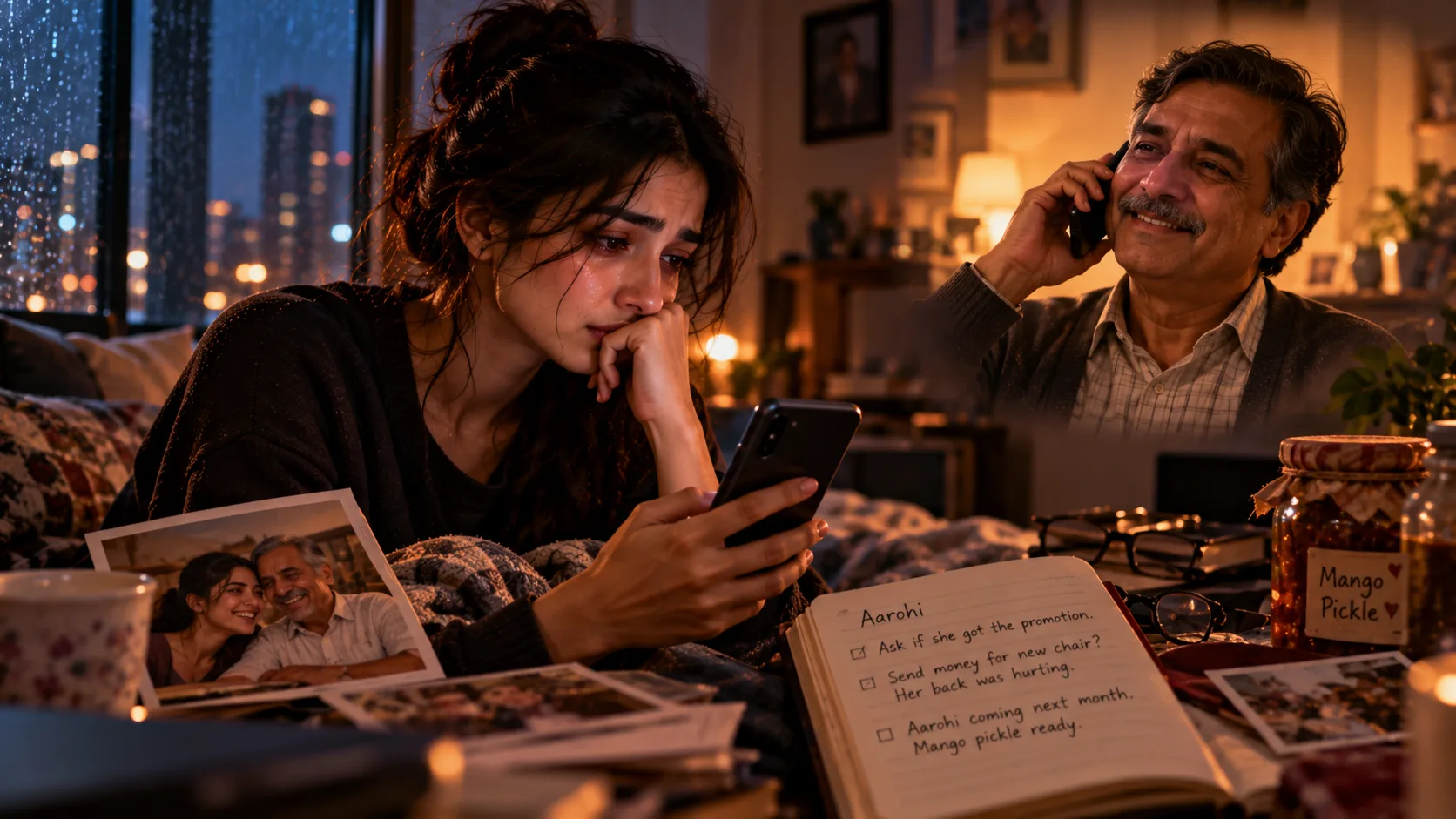
The Last Conversation You’ll Ever Have With Someone—Without Knowing It’s the Last
One day, a casual goodbye becomes the last thing you ever say to someone. No warning, no perfect final words. Just an ordinary moment that suddenly means everything.
The last thing she said to her father was, "Papa, I'm busy. I'll call you tomorrow."
He laughed softly.
"Okay, beta. Eat something before you sleep."
She rolled her eyes.
"Yes, Papa. Bye."
"Bye."
The call lasted two minutes and seventeen seconds.
Nothing remarkable happened.
No argument. No confession. No meaningful goodbye.
Just another ordinary conversation between a father who wanted to talk and a daughter who believed there would always be another day.
Three years later, she would still remember those two minutes.
Not because of what they said.
But because of everything they didn't.
The Sunday That Meant Nothing
It was 6:14 on a Sunday evening.
Aarohi was twenty-six, living in Mumbai, and trying desperately to build a life that would make her parents proud.
Her apartment was a mess.
Unwashed cups covered the kitchen counter. Her laptop was open to an unfinished presentation. A half-eaten sandwich lay beside a notebook.
Her phone rang.
Papa Calling.
She almost ignored it.
She had deadlines, emails, and a headache that refused to disappear.
But she answered.
"Hello, Papa."
"Hello, beta. What are you doing?"
"Working."
"On Sunday?"
"Yes, Papa. Some people work on Sundays."
He chuckled.
"Okay, okay. Did you eat?"
"Yes."
"What?"
"Food."
He laughed again.
She didn't.
There was a short silence.
Then he asked, "When are you coming home?"
"Papa, I told you. Maybe next month."
"Your mother is making mango pickle. She says you won't get any if you come late."
Aarohi smiled despite herself.
"Tell her to save some."
"I already told her."
Another silence.
Then, quietly, he said, "It has started raining here."
She glanced at the clock.
"Papa, I'm really busy. I'll call you tomorrow."
"Okay, beta."
And that was it.
She placed the phone facedown and returned to her presentation.
By dinner, she had forgotten the conversation entirely.
Her father hadn't.
He had looked at the phone for a moment longer, then placed it beside his chair.
What he thought afterward, nobody would ever know.
The Call That Came Instead
Monday arrived.
Aarohi woke up late, rushed to work, argued with a colleague, and spent most of the evening correcting a mistake in her presentation.
At 9:30 p.m., she remembered.
I was supposed to call Papa.
She opened his contact.
Her thumb hovered above the green button.
Then an email notification appeared.
She checked it.
I'll call tomorrow.
Tuesday was worse.
Meetings. Traffic. Exhaustion.
At 11:48 p.m., she finally collapsed into bed.
Her phone rang.
It was her younger brother.
She answered irritably.
"What happened? It's almost midnight."
He didn't reply immediately.
Then she heard him crying.
"Didi..."
Something in his voice made her sit upright.
"What's wrong?"
"Papa..."
Aarohi stood up.
"What happened to Papa?"
Her brother struggled to speak.
"He collapsed in the evening. We took him to the hospital."
"Okay. Which hospital? Is he conscious?"
Silence.
"Tell me which hospital!"
Her brother began crying harder.
And before he could finish the sentence, Aarohi understood.
Her father had died following a sudden medical emergency.
For several seconds, she couldn't move.
Her phone slipped from her hand.
Somewhere outside, Mumbai continued as though nothing had happened.
Cars passed.
Someone laughed in the next apartment.
A pressure cooker whistled.
The world had just ended.
And nobody seemed to have noticed.
The Most Expensive Two Minutes
The journey home took seventeen hours.
Aarohi remembered almost none of it.
What she remembered was her phone.
She kept opening the call history.
Sunday, 6:14 p.m.
Duration: 2 minutes, 17 seconds.
She stared at those numbers as though they contained some hidden explanation.
Two minutes.
Seventeen seconds.
That was all she had given him.
Why hadn't she listened when he mentioned the rain?
Why hadn't she asked about his day?
Why had she answered "food" when he asked what she'd eaten?
And why, when he asked when she was coming home, had she sounded so irritated?
She imagined the conversation happening differently.
"Hello, Papa!"
"Did you eat?"
"Yes. What did you eat?"
She imagined asking about the garden.
The neighbors.
His knee pain.
The silly television show he watched every evening.
She imagined saying, "I miss you."
Or perhaps something even simpler.
"I love you, Papa."
But memory doesn't allow corrections.
You can replay a conversation a thousand times.
You can change every sentence inside your imagination.
You can make yourself kinder, more patient, more loving.
And still, the original conversation remains exactly where you left it.
Two minutes.
Seventeen seconds.
Aarohi would have surrendered every presentation, promotion, and deadline in her life for two more minutes.
But there was nobody left to answer the phone.
The Things We Leave for Tomorrow
At home, everything looked unbearably normal.
His slippers were beside the bed.
His glasses rested on a folded newspaper.
A half-finished crossword lay on the dining table.
His old radio stood near the window.
And in the kitchen, there were three glass jars filled with mango pickle.
Her mother noticed her looking.
"Your father kept reminding me to make extra."
Aarohi touched one of the jars.
"He said you were saving some for me."
Her mother smiled sadly.
"He kept saying you'd come next month."
Aarohi turned away.
She had spent years imagining the future.
A bigger apartment.
A better salary.
A holiday for her parents.
One day, she would take her father to see the sea.
One day, she would buy him the watch he always admired.
One day, when work became less demanding, she would spend an entire week at home.
She had built so many beautiful tomorrows.
And somewhere along the way, she'd forgotten that the people waiting inside those tomorrows weren't guaranteed to be there.
That night, Aarohi slept in her childhood bedroom.
At 6:14 the following evening, her phone remained silent.
She had never understood how loud silence could become.
The Question That Hurt the Most
A week after the funeral, Aarohi found her father's old diary.
It wasn't particularly interesting.
Electricity bills.
Grocery lists.
Medicine reminders.
Phone numbers written twice because he kept forgetting where he'd written them the first time.
She turned the pages slowly.
Then she found a familiar name.
Aarohi.
Beside it, he'd written:
Ask if she got the promotion.
A few pages later:
Send money for new chair? Her back was hurting.
And then, on the final written page:
Aarohi coming next month. Mango pickle ready.
She sat on the edge of his bed.
And cried.
Not gracefully.
Not quietly.
She cried until her throat hurt.
Because suddenly she understood something.
While she'd been busy planning a future in which she could finally give her father everything, he had been thinking about whether her chair was comfortable.
She wanted to give him the world.
He wanted to make sure she wasn't sitting in pain.
Neither had fully understood what the other was trying to give.
What If You Had Known?
Imagine knowing, with absolute certainty, that your next conversation with someone would be your last.
Would you still complain about the traffic?
Would you argue about something insignificant?
Would you end the call because you were tired?
Probably not.
You might hold their hand a little longer.
Ask questions you've postponed for years.
Tell them what they mean to you.
Listen carefully to the sound of their voice.
But life rarely announces its final moments.
There is no warning above someone's head.
No countdown beside their name.
No mysterious feeling that reliably tells you, Remember this. You'll never hear these words again.
Most last conversations look exactly like all the others.
Someone asks whether you've eaten.
Someone complains about the weather.
Someone tells you to drive carefully.
And you answer without thinking.
Because you don't know that an ordinary goodbye is about to become a permanent memory.
The Voice She Almost Deleted
Three months passed.
Aarohi returned to Mumbai.
She went back to work.
Sometimes she laughed without feeling guilty.
Sometimes she forgot her grief for an entire afternoon.
Then a familiar song would play, or someone would mention mango pickle, and she would miss her father so suddenly that she had to sit down.
One evening, while cleaning her phone, she discovered an old voice message.
It was from him.
Sent nearly a year earlier.
She couldn't remember why she'd saved it.
Her hands trembled as she pressed play.
At first, there was only background noise.
Then his voice.
"Hello, beta. I don't know if this recording thing is working."
A pause.
"Your mother says I have to hold the button."
Another pause.
"Anyway, call when you're free."
Then, faintly, her mother's voice.
"Tell her what you actually wanted!"
Her father laughed.
"Nothing. I just wanted to hear her voice."
The recording ended.
Aarohi pressed play again.
And again.
By the fifth time, she was crying.
By the seventh, she was smiling through her tears.
For months, she'd tortured herself over their final conversation.
The impatient answers.
The unfinished promises.
The missing goodbye.
But here was something she'd forgotten.
An ordinary message from an ordinary afternoon.
A moment when her father had wanted nothing except to hear from her.
And somehow, she had managed to keep his voice.
The Conversation That Never Really Ends
Three years later, Aarohi still had the recording.
She kept copies in several places, terrified that an accidental deletion might take away the last sound of him.
She no longer remembered every detail of his face.
Some days, even his laughter felt distant.
But she remembered how he said "beta."
How he stretched the first syllable when he was happy.
How he asked whether she'd eaten, even when she'd answered the same question a thousand times.
For a long time, she believed their last conversation defined how much she'd loved him.
Eventually, she began to understand that it didn't.
Love was also the thousands of conversations that came before it.
The childhood mornings.
The arguments.
The shared meals.
The jokes nobody else understood.
One impatient goodbye could not erase a lifetime of being his daughter.
She would always wish she'd called on Monday.
She would always wish she'd stayed on the phone a little longer.
But she no longer wanted regret to become the only thing she remembered about him.
Sometimes, when it rained, she still reached for her phone.
For a second, she would forget.
Then remember.
And quietly, almost without thinking, she would whisper:
"It's raining here too, Papa."
There was no answer.
There never would be.
But she said it anyway.
Because some conversations continue inside us long after the other person is gone.
And perhaps that's what makes an ordinary goodbye so heartbreaking.
We spend our lives saying, "I'll talk to you tomorrow," without realizing that one day, tomorrow will arrive without them.