The Memory You Borrowed From Someone Else
What if the moment you remember most vividly never happened to you? One familiar scene, one stranger's confession, and a question that begins to unravel everything: who owns the stories inside our heads?
The water was green.
That was the one detail Leena could never forget.
Not the kind of green you see in photographs of beautiful lakes. This was darker, almost black, with sunlight trembling somewhere above it.
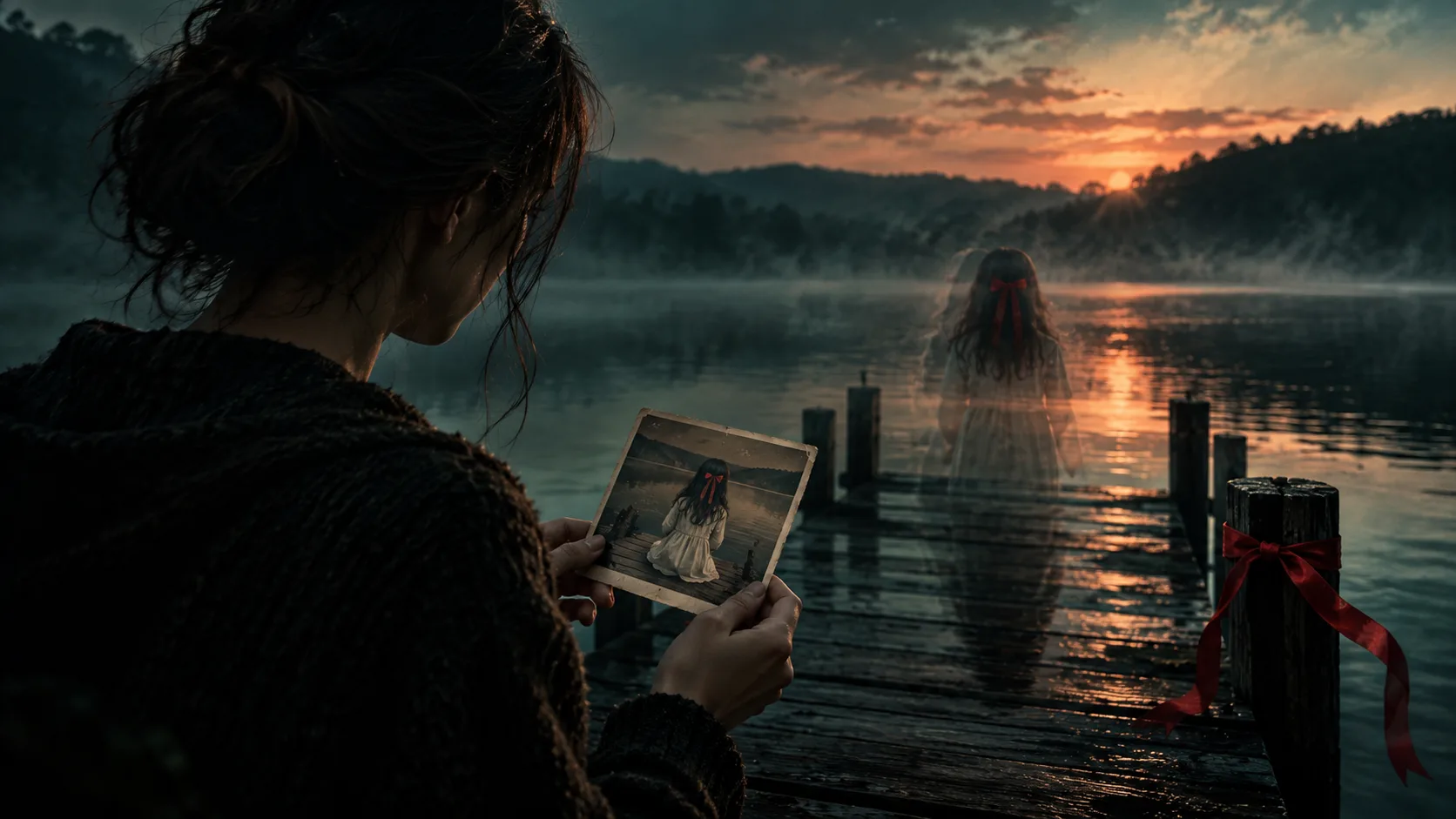
She remembered falling from the wooden pier. The sudden cold. Her little hands reaching toward the surface. A red ribbon floating past her face.
And someone screaming her name.
For twenty-three years, Leena believed she had nearly drowned when she was seven.
She told the story at family gatherings. She mentioned it whenever someone asked why she disliked deep water. Sometimes, she even dreamed about it.
Then, one Sunday afternoon, her older sister said something that made the entire memory collapse.
"Leena, that wasn't you."
The Day That Never Happened
They were cleaning their childhood home when Leena discovered an old photograph.
A little girl stood beside a lake, wrapped in a yellow towel. Her hair was wet. A red ribbon hung loosely from her wrist.
Leena smiled.
"That's the day I almost drowned."
Her sister, Tara, stopped folding clothes.
"What?"
"The lake. Remember? Dad pulled me out."
Tara stared at the photograph.
"Leena, that's me."
Leena laughed. Obviously, her sister was mistaken. They had looked remarkably similar as children.
But Tara wasn't smiling.
"You weren't even there that afternoon. You were staying with Aunt Meera."
For a moment, the room became strangely quiet.
Leena looked again.
The girl in the photograph was Tara.
She could recognize the face now.
But the memory remained.
The freezing water. The burning sensation in her chest. The red ribbon.
How could something that never happened to her feel more real than yesterday's breakfast?
And why did she remember being afraid?
Your Brain Is Not a Camera
We tend to imagine memory as a recording.
Something happens. Our brain stores it. Years later, we press play.
Unfortunately, the human mind is considerably less reliable than that.
Memory is reconstructive.
When we recall an event, the brain pieces together information from different sources: sensory impressions, emotions, beliefs, photographs, conversations, and knowledge acquired afterward.
Usually, this works remarkably well.
Sometimes, however, the pieces come from the wrong puzzle.
Psychologists call one related phenomenon a source-monitoring error.
You remember information but confuse where it originated.
Perhaps you heard a childhood story so many times that you began picturing it. Years later, you remember the picture in your imagination but forget that you created it.
The story gradually acquires the texture of experience.
That does not mean every vivid childhood memory is false. Nor does an imperfect detail invalidate an entire event.
But vividness and confidence alone cannot prove that something happened exactly as remembered.
And for Leena, that distinction was about to become painfully personal.
The Story Her Father Told
That evening, Leena called her father.
"Did I fall into the lake when I was little?"
There was a pause.
"No, sweetheart. Tara did."
"Then why do I remember it?"
Her father hesitated.
"Because you loved that story."
He explained that after Tara's accident, Leena had become fascinated by what happened. She repeatedly asked how the water looked, whether Tara could breathe, and what it felt like when their father pulled her out.
Every time, he answered.
Sometimes Tara joined in, adding details he had forgotten.
Over the years, Leena had heard the account dozens of times.
She had seen the photographs.
She had imagined the water.
Her father remembered one particularly strange detail.
"When you were small, you used to ask me to tell it as though you were the one who fell."
Leena said nothing.
She remembered asking for stories before bedtime.
But she did not remember asking that.
Somewhere between hearing the story and imagining herself inside it, the boundary had blurred.
An event that belonged to her sister had become part of her own identity.
And the most unsettling part?
Nobody had deliberately lied to her.
When Imagination Becomes Evidence
Researchers have studied how suggestion, repeated imagination, and misleading information can influence what people remember.
In some experiments, participants have come to report details of events that did not occur, particularly when plausible suggestions were combined with other information.
This does not happen to everyone, and the strength of such memories varies.
Still, the implications are disturbing.
Think about an old family photograph.
You see yourself standing beside a birthday cake, surrounded by relatives.
Your mother describes how you cried when the candles went out.
Your uncle jokes about the frosting covering your face.
You have heard this story since childhood.
Eventually, you may feel as though you remember the entire afternoon.
But what exactly are you remembering?
The event?
The photograph?
Your mother's description?
Or the scene your imagination assembled from all three?
Often, we cannot easily separate them.
Our brains do not attach perfectly reliable labels saying, "This was experienced," "This was imagined," or "Someone told you this."
And that makes memory especially vulnerable to an unexpected visitor.
Someone else's story.
The Detail That Changed Everything
A week later, Leena visited Tara again.
This time, she wanted to understand the accident rather than argue about it.
They sat beside the window, looking through old photographs.
Tara described slipping from the pier, struggling underwater, and seeing their father leap toward her.
Leena listened.
Then she asked a question.
"Did you see a red ribbon floating in the water?"
Tara frowned.
"No. Mum tied it around my wrist afterward. She was worried I'd lose it."
Leena felt something shift.
The ribbon was the clearest part of her supposed memory.
She had always seen it underwater, moving slowly past her face.
But according to Tara, it had never been underwater at all.
Leena looked down at the photograph again.
There it was.
The ribbon.
Tied around Tara's wrist.
Had her mind taken that single detail from the picture and placed it inside the drowning scene?
She couldn't know for certain how the image had formed.
But the possibility was enough.
The detail that had made her memory feel authentic might have been borrowed from a photograph taken after the event.
For the first time, Leena understood something frightening.
A memory could feel complete even when its pieces came from different places.
The Stranger Living Inside Your Past
Think about the stories that shaped you.
The childhood humiliation that supposedly made you shy.
The frightening incident that made you avoid a particular place.
The family argument you remember so clearly that you can almost hear every word.
Some of these memories may be accurate.
Others might contain details added later, without your awareness.
A familiar relative's version of events might have influenced yours. An old photograph might have supplied the setting. Years of retelling might have changed the order of what happened.
This is one reason eyewitness accounts require careful evaluation. Sincere confidence is not the same thing as independent verification.
And yet, memory's flexibility is not simply a defect.
Reconstructing the past helps us learn, connect experiences, and make sense of our lives.
The problem begins when we mistake the reconstruction for an untouched recording.
What Remains When a Memory Disappears?
Months later, Leena returned to the lake.
The wooden pier had been replaced. The trees were taller. The water looked almost black beneath the evening sky.
She stood at the edge, expecting something to feel different.
Nothing did.
Her palms still grew cold.
Her heart still quickened when she looked into the depths.
Knowing the story was borrowed had not instantly erased the fear associated with it.
Emotions, after all, can be real even when our explanation for them is mistaken.
Leena sat beside the water and watched the sunlight disappear.
She no longer told people that she had nearly drowned there.
But she sometimes wondered whether she would ever stop seeing herself beneath the surface.
Perhaps the strangest thing about memory is not that it can deceive us.
It is that we can discover the deception and still feel the past pulling at us.
Tonight, think of your earliest childhood memory.
Picture the room. The people. The sounds.
Now ask yourself one question.
Do you remember being there, or do you remember the story of being there?
Sometimes, the difference is impossible to recover.
And somewhere inside your mind, there may be a moment you have carried your entire life.
A moment that belongs to someone else.