The Illusion of Knowledge: Why Confidence Isn't Competence
Why do people sometimes feel certain about things they barely understand? Explore the psychology behind overconfidence, the illusion of explanatory depth, metacognition, and why knowing less can sometimes make it harder to recognize the limits of our own knowledge.
The Illusion of Knowledge: Why Confidence Isn't Competence
Think of something you use almost every day.
A refrigerator.
A toilet.
A bicycle.
A zipper.
A smartphone.
Now answer a simple question:
Do you understand how it works?
Probably.
At least, it feels that way.
But choose one and try explaining its operation from beginning to end.
Not vaguely.
Not:
"Electricity makes the refrigerator cold."
Explain the actual mechanism.
What happens after electricity enters the refrigerator?
What does the compressor do?
Why does compressing and expanding refrigerant change temperature?
How does heat leave the inside of the refrigerator?
Why doesn't the cold simply disappear when the compressor stops?
Suddenly, something that felt obvious becomes considerably harder to explain.
Nothing about the refrigerator changed.
What changed was your measurement of your own knowledge.
And that gap between how much we think we understand and how much we can actually explain reveals one of the strangest features of human cognition.
Feeling Like You Know
Human beings rarely walk around consciously measuring the depth of their knowledge.
Instead, the brain uses shortcuts.
If something feels familiar, we often assume we understand it.
If we recognize the terminology, understanding feels deeper.
If we have encountered something repeatedly, it becomes easier to think about.
And that ease can create confidence.
Consider a term such as inflation.
Most adults have encountered it thousands of times.
Prices rise.
Money buys less.
Central banks raise interest rates.
Easy enough.
But now try explaining precisely:
Why can higher interest rates reduce inflation?
How do those rates affect commercial banks?
How does that influence borrowing?
Why can reduced borrowing change consumer demand?
What happens to employment?
Currency values?
Investment?
Government debt?
Suddenly, knowing the definition of inflation and understanding an inflationary economy become very different achievements.
The first requires recognition.
The second requires a mental model.
We frequently confuse the two.
The Illusion of Explanatory Depth
Psychologists have a name for part of this phenomenon:
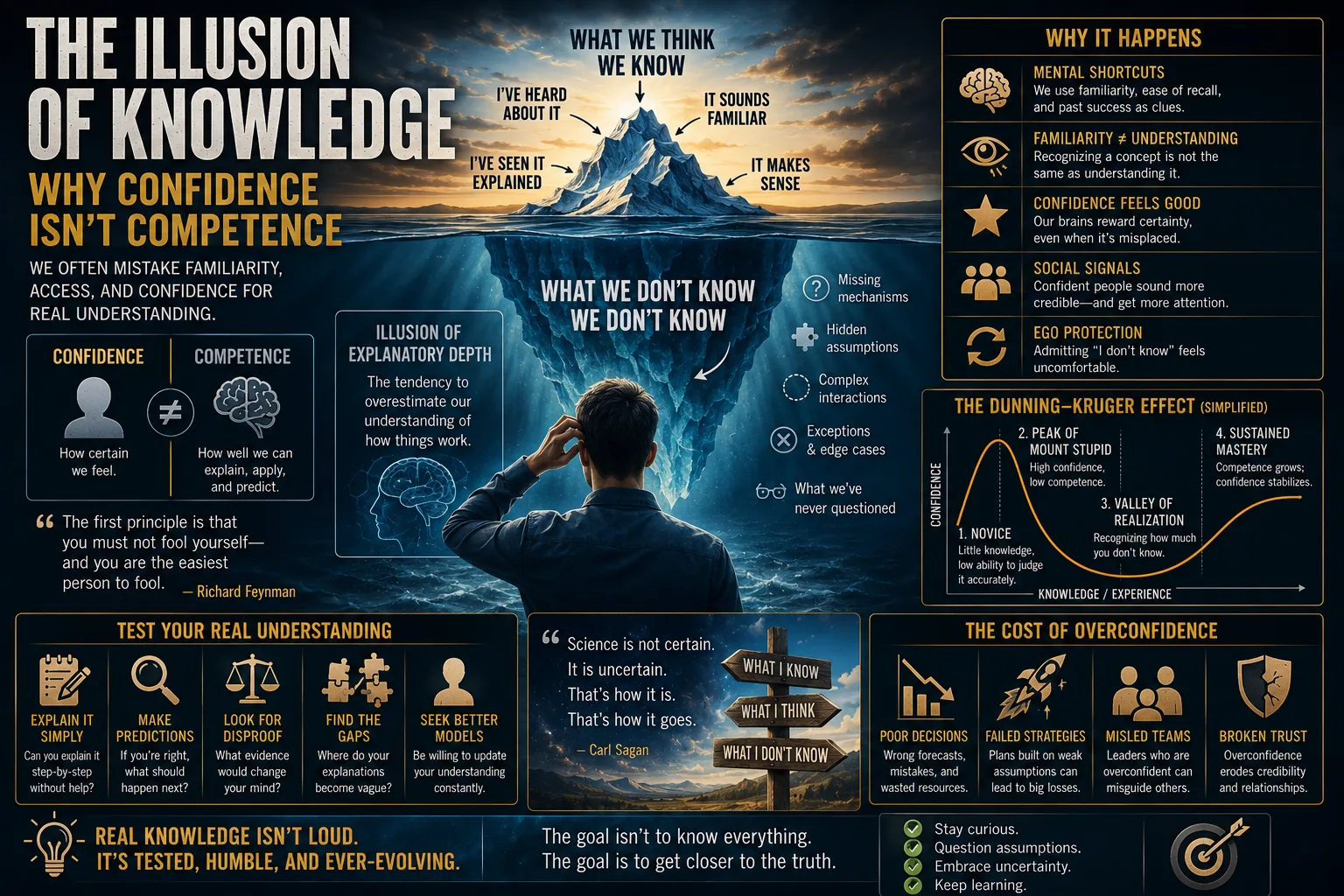
The illusion of explanatory depth.
The concept describes our tendency to believe we understand how something works in considerably greater detail than we actually do.
Classic experiments demonstrated this using ordinary objects and mechanisms.
Participants were asked to rate how well they understood things such as:
Zippers.
Toilets.
Locks.
Sewing machines.
Helicopters.
Speedometers.
Initially, people often reported relatively strong understanding.
Then researchers asked them to explain exactly how the mechanisms worked.
Their confidence dropped.
Attempting the explanation revealed missing pieces that familiarity had concealed.
🟢 Established Psychological Evidence
Research on the illusion of explanatory depth shows that people frequently overestimate how well they understand complex mechanisms. Asking them to generate detailed causal explanations can substantially reduce their self-assessed understanding.
Why Does This Happen?
Imagine your knowledge as a map.
You know several major locations.
You understand roughly how they connect.
From a distance, the map appears complete.
But zoom in.
Entire roads are missing.
Intersections disappear.
Some regions contain nothing at all.
Because everyday life rarely requires us to explain everything from first principles, those missing details remain invisible.
You don't need to understand refrigeration thermodynamics to retrieve milk.
You don't need mechanical engineering to ride a bicycle.
You don't need semiconductor physics to send a message.
The technology works regardless of whether you understand it.
So the brain rarely receives a reason to inspect the gaps.
Until somebody asks:
"How, exactly?"
Familiarity Is Not Understanding
This distinction becomes particularly important in the internet age.
Imagine watching twenty videos about quantum computing.
You learn terms such as:
Qubit.
Superposition.
Entanglement.
Quantum interference.
Eventually, conversations about quantum computers become familiar.
You can recognize the vocabulary.
You may even explain the basic concept to someone else.
That creates a powerful sensation of understanding.
But recognition of terminology can exist without deep conceptual knowledge.
Being able to say the words is not the same as understanding the underlying mathematics or physics.
The same problem appears everywhere.
Economics.
Medicine.
Artificial intelligence.
Investing.
Politics.
Nutrition.
Psychology.
The more frequently we encounter a subject, the easier it becomes to mistake familiarity with the conversation for mastery of the subject.
Confidence and Competence Are Different Variables
Confidence answers:
"How certain do I feel?"
Competence answers:
"How capable am I actually?"
They can correlate.
People who become genuinely skilled often gain justified confidence.
But the relationship is imperfect.
You can have:
High competence + high confidence.
An experienced surgeon performing a familiar procedure.
High competence + low confidence.
A knowledgeable researcher carefully acknowledging uncertainty.
Low competence + low confidence.
A beginner who recognizes how much they still need to learn.
And the dangerous combination:
Low competence + high confidence.
Someone who possesses enough knowledge to form conclusions but not enough to recognize the weaknesses in those conclusions.
Confidence is therefore information about a person's psychological state.
It is not direct evidence of accuracy.
Why Confidence Is So Persuasive
Unfortunately, humans often treat confidence as though it were evidence.
Imagine two people answering the same question.
Person A says:
"I'm almost certain this is what happened."
Person B says:
"The available evidence points in this direction, although there are important uncertainties."
Who sounds more knowledgeable?
Often Person A.
Yet Person B may actually understand the subject more deeply.
Experts frequently recognize complexities invisible to beginners.
They know where evidence is weak.
They understand exceptions.
They recognize competing explanations.
Their uncertainty may therefore reflect greater knowledge, not less.
This creates a strange communication problem.
Nuance can sound weaker than certainty.
Metacognition: Thinking About Your Thinking
To understand why confidence becomes unreliable, we need another concept:
Metacognition.
Metacognition is our ability to monitor and evaluate our own thinking.
It includes questions such as:
Do I actually know this?
How confident should I be?
Where might my reasoning be wrong?
What information am I missing?
How reliable is my memory?
Good metacognition allows confidence to track competence more accurately.
Poor metacognition creates a gap.
And that gap can be dangerous because someone may not realize there is anything to correct.
🟢 Established Psychological Evidence
Metacognitive accuracy varies between individuals and tasks. People can be competent at performing a task while being imperfect at estimating the quality of their own performance, demonstrating that skill and self-evaluation are related but distinct abilities.
The Dunning-Kruger Effect
This brings us to perhaps the internet's favorite psychological graph.
The Dunning-Kruger effect is commonly presented as a dramatic curve.
A beginner learns almost nothing.
Their confidence suddenly becomes enormous.
Then they discover how complicated the subject really is.
Confidence collapses.
Eventually expertise develops and confidence slowly returns.
It makes a wonderful meme.
Unfortunately, psychology is less cooperative.
The original research concerned people's ability to evaluate their own performance.
Individuals performing poorly on certain tasks also tended to overestimate their performance relative to how they actually scored.
One proposed explanation was that some of the skills necessary to perform well were also required to recognize poor performance.
In other words:
If you don't know what good performance looks like, recognizing your own mistakes becomes harder.
That idea is much more nuanced than:
"Stupid people think they're geniuses."
🔴 Common Myth / Misconception
The famous internet graph showing confidence rapidly rising to a "Peak of Mount Stupid," collapsing into a "Valley of Despair," and eventually reaching enlightenment is not the original Dunning-Kruger finding.
It is a popular visualization loosely inspired by the concept, not a scientific graph produced by the original research.
Beginners Have a Difficult Problem
Imagine learning chess.
At first, you barely understand the rules.
Then you learn several openings.
You discover tactical patterns.
You begin beating other beginners.
Suddenly, chess seems understandable.
But an expert sees things you don't even know exist.
Positional weaknesses.
Pawn structures.
Long-term strategic trade-offs.
Endgame transitions.
Subtle move-order consequences.
The beginner isn't necessarily irrational for becoming more confident.
Their performance genuinely improved.
The problem is that their ability to evaluate the size of the remaining territory has not improved equally.
They know more than before.
But they don't yet know enough to appreciate everything they still don't know.
Experts Have the Opposite Problem
Expertise can create its own distortion.
Once something becomes automatic, experts may forget how difficult it once was.
A programmer looks at basic code and sees an obvious solution.
A mathematician sees an equation and immediately recognizes the method.
A professional musician hears a mistake a beginner doesn't notice.
Years of practice compress complicated processes into intuition.
This can lead experts to underestimate how much specialized knowledge they possess.
Something feels easy to them.
Therefore they assume it should be easy for others.
This is sometimes described as part of the curse of knowledge.
Once you know something deeply, imagining what it feels like not to know it becomes surprisingly difficult.
The Internet Made Knowledge Feel Infinite
There is another modern complication.
Almost any fact is seconds away.
Forget something?
Search it.
Need a definition?
Search it.
Don't understand a concept?
Watch a video.
Need instructions?
Ask an AI.
Human beings now live surrounded by external knowledge systems of unprecedented scale.
This is enormously useful.
But psychologically, the boundary between:
"I know this"
and
"I know where to find this"
can become blurry.
Information availability can create a sensation of personal knowledge even when the information actually exists outside our minds.
We have access to extraordinary intelligence infrastructure.
That does not mean all of it has been downloaded into our skulls.
A regrettable bandwidth limitation in the human design.
🟡 Active Scientific Research
Researchers continue studying how search engines, smartphones, digital information systems, and AI tools affect memory, learning, metacognition, and people's judgments about their own knowledge. Evidence suggests external access to information can influence how people perceive what they personally know, although the long-term cognitive effects remain an active research area.
The Real Problem Isn't Ignorance
Ignorance itself is manageable.
If you know you don't understand something, you can learn.
You can ask.
You can investigate.
You can consult someone who knows more.
The more difficult problem is undetected ignorance.
Believing your mental model is complete when important pieces are missing.
Because then there appears to be nothing left to investigate.
That is why intellectual humility matters.
Not because intelligent people should constantly doubt everything.
But because accurate confidence requires knowing where your knowledge ends.
And unfortunately, the border of our own ignorance is one of the hardest things for the human mind to see.
The Age of Instant Expertise
The internet gave humanity access to more knowledge than any previous generation could have imagined.
It also gave everyone a microphone.
Someone can watch three videos about monetary policy in the morning and explain central banking by lunch.
Read several posts about nutrition and begin giving health advice.
Spend a weekend following financial markets and confidently predict the next recession.
Learn a few psychological terms and start diagnosing strangers in comment sections.
Access to information has expanded enormously.
But access to information and expertise remain different things.
Expertise requires more than exposure.
It usually involves experience, feedback, correction, practice, conceptual understanding, and knowing where apparently simple rules stop working.
Online environments can compress all of that into something that merely looks like expertise.
Performative Expertise
Social media creates unusual incentives.
A careful expert might say:
"The evidence currently favors this interpretation, although several uncertainties remain."
Someone else says:
"THIS is exactly what's happening, and everyone else is lying to you."
Which statement is more likely to capture attention?
Certainty is easy to communicate.
Nuance takes time.
Social platforms frequently reward:
Strong conclusions.
Simple explanations.
Emotional language.
Absolute predictions.
Easily understood narratives.
Unfortunately, complicated subjects rarely cooperate.
Economies don't have one cause.
Diseases don't always have one mechanism.
Wars don't have one explanation.
Markets don't move because of one indicator.
Scientific questions rarely collapse neatly into thirty-second videos.
But certainty sells considerably better than uncertainty.
Why Confident People Appear More Competent
Humans use confidence as a social signal.
Someone who speaks fluently, quickly, and decisively can appear knowledgeable even before we evaluate the quality of their evidence.
This makes intuitive sense.
People who know what they're doing often are more confident.
The problem is that confidence can be imitated much more easily than competence.
You can imitate:
A confident voice.
Technical terminology.
Professional clothing.
Charts.
Credentials on a screen.
A polished presentation.
You cannot imitate accurate predictions indefinitely.
Eventually reality performs the audit.
🟢 Established Psychological Evidence
Research on social judgment shows that confidence can influence perceptions of competence and credibility. However, expressed confidence and actual accuracy are imperfectly correlated, meaning confident individuals can sometimes receive greater trust than their performance warrants.
Leadership and the Confidence Trap
Leadership creates particularly dangerous conditions for overconfidence.
Organizations often reward decisiveness.
A leader is expected to have answers.
Employees want direction.
Investors want certainty.
Boards want forecasts.
Customers want reassurance.
Admitting uncertainty can therefore feel politically expensive.
This creates pressure for leaders to sound more certain than the available evidence justifies.
The consequences can compound.
A confident leader makes a prediction.
Subordinates hesitate to challenge it.
Resources are committed.
The organization becomes psychologically invested.
Contradictory evidence appears.
Now changing direction requires admitting the original decision may have been wrong.
Instead of updating, the organization doubles down.
A small forecasting error becomes a strategic failure.
Good Leaders Don't Eliminate Uncertainty
Strong decision-making does not require pretending uncertainty doesn't exist.
It requires managing it.
Compare:
"This strategy will work."
with:
"Based on current evidence, this is our highest-probability strategy. These three assumptions could invalidate it, and we'll monitor them."
The second statement sounds less dramatic.
It is also considerably more useful.
It identifies what management believes.
Why they believe it.
And what evidence would cause them to change direction.
Confidence becomes calibrated rather than theatrical.
Investing: Where Confidence Gets Expensive
Financial markets provide one of the clearest demonstrations of the difference between confidence and competence.
Imagine someone buys a stock.
It rises 40%.
They conclude:
"I'm good at investing."
But several possibilities exist.
Their analysis was excellent.
The entire market rose.
They took enormous risk and got lucky.
An unexpected event helped the company.
Their thesis was partially correct for completely different reasons.
One successful outcome cannot distinguish these explanations.
Yet humans naturally interpret success as evidence of skill.
This creates outcome bias.
We evaluate the quality of a decision based on what happened rather than whether the decision was reasonable given the information available at the time.
🟢 Established Psychological Evidence
Decision-making research distinguishes decision quality from outcome quality. Good decisions can produce bad outcomes because of uncertainty, while poor decisions can occasionally produce favorable outcomes through luck.
The Dangerous Feedback Loop
Suppose a beginner trader makes several profitable trades.
Confidence rises.
Position sizes increase.
Risk controls weaken.
The trader begins believing they can predict markets.
Then the environment changes.
The strategy stops working.
But confidence was built from outcomes rather than validated understanding.
What appeared to be competence may have been:
Skill + favorable conditions + randomness.
Separating those components requires far more evidence than humans naturally want to collect.
Markets are particularly ruthless teachers because they can reward bad reasoning temporarily.
A wrong idea that makes money can be psychologically more dangerous than a wrong idea that immediately fails.
Success Can Hide Weak Understanding
This problem extends beyond investing.
A startup launches and succeeds.
Was the strategy brilliant?
Perhaps.
Or the timing was unusually favorable.
A marketing campaign performs extremely well.
Was the creative exceptional?
Perhaps.
Or an external trend increased demand.
A manager restructures a team and productivity rises.
Did the restructuring cause it?
Maybe.
Or another variable changed simultaneously.
Humans love causal stories.
Reality contains noise.
Competence requires learning to separate the two.
AI Creates a New Illusion of Knowledge
Generative AI introduces another fascinating complication.
You can now ask an AI system about almost any subject and receive a structured explanation within seconds.
That capability is extraordinary.
It can accelerate learning dramatically.
But it creates a psychological trap.
Suppose you ask an AI to explain neural networks.
You read the answer.
Everything makes sense.
You understand each paragraph.
Twenty minutes later, someone asks:
"Derive backpropagation and explain why the chain rule allows gradients to propagate through multiple layers."
Suddenly the understanding feels considerably thinner.
The AI possessed the explanation.
You successfully followed it.
That does not necessarily mean you internalized it.
Borrowed Understanding
Humans have always relied on other minds.
Libraries store knowledge.
Teachers transmit it.
Experts specialize.
Civilization itself depends on distributed knowledge.
AI simply makes external knowledge dramatically easier to access.
The danger arises when we confuse:
"I can obtain an explanation."
with:
"I possess the understanding."
These are not the same.
AI can become an extraordinary cognitive tool.
But like search engines before it, it can also make knowledge feel closer to us than it actually resides.
🟡 Active Scientific Research
Researchers are increasingly examining how generative AI affects learning, memory, cognitive effort, problem-solving, and metacognitive judgments. Because widespread consumer use of generative AI is relatively recent, its long-term effects on human learning and perceived knowledge remain actively studied.
Can You Explain It Without Help?
One of the simplest tests of understanding is surprisingly brutal.
Close the browser.
Put away the book.
Don't use AI.
Take a blank page.
Write:
"How does this work?"
Then explain it.
Step by step.
Every time you write a vague phrase such as:
"Basically..."
"Somehow..."
"It causes..."
"The system processes it..."
Stop.
Ask:
How?
That single word exposes remarkable amounts of fake understanding.
The Feynman Technique
A popular learning approach associated with physicist Richard Feynman follows a similar principle.
Choose a concept.
Explain it in simple language as though teaching someone unfamiliar with the subject.
Identify where your explanation becomes vague.
Return to the source material.
Fill the gaps.
Then explain it again.
Whether or not every modern version deserves Feynman's name, the underlying principle is powerful:
Explanation forces hidden assumptions into the open.
If you cannot explain an idea simply, that does not automatically mean you don't understand it.
Some concepts genuinely require technical language.
But if you cannot explain the causal structure at all, your understanding may be shallower than it feels.
Prediction Is Another Powerful Test
Suppose you claim to understand a system.
Ask:
What should happen next if my explanation is correct?
Understanding should generate predictions.
If higher interest rates reduce borrowing, what else should we expect?
If a particular mechanism causes a disease, what intervention should affect it?
If your explanation of a market strategy is correct, under which conditions should it fail?
Predictions force theories to risk being wrong.
Vague explanations can survive almost anything.
Good models cannot.
Ask What Would Prove You Wrong
This may be the hardest test.
Take a belief and ask:
"What evidence would make me change my mind?"
If you can identify an answer, the belief is testable.
If the answer is:
"Nothing."
Then you no longer have a conclusion being evaluated.
You have a conclusion being protected.
Competence requires more than constructing arguments for your position.
It requires understanding how your position could fail.
Separate Knowledge Into Three Boxes
A practical method is to divide what you believe into three categories.
What I Know
Claims supported by strong evidence or knowledge you can explain and verify.
What I Think
Reasonable interpretations that contain uncertainty.
What I Don't Know
Questions where available evidence is insufficient or your own expertise is limited.
Most people spend enormous energy expanding the first box.
Good thinkers also become better at expanding the third.
Because identifying ignorance is itself progress.
Calibrate Confidence
Instead of thinking:
"I'm right."
Try:
"How confident should I be?"
Maybe:
55% confident.
75% confident.
95% confident.
Now ask what evidence would move that number.
This encourages probabilistic thinking.
It also creates psychological room for updating.
Moving from 70% to 40% confidence feels less like losing an argument than changing from:
TRUE
to
FALSE.
Reality rarely arrives in binary packages anyway.
Humans merely enjoy putting it into them because uncertainty is inconvenient.
Intellectual Humility Is Not Weakness
Intellectual humility is sometimes mistaken for indecision.
It isn't.
It means recognizing that your beliefs can be wrong while still making decisions.
You can say:
"This is the best explanation available."
while also saying:
"I will change my position if better evidence appears."
Those statements are perfectly compatible.
Science depends on exactly this principle.
Knowledge progresses because conclusions remain open to revision.
The willingness to update is not evidence that your previous reasoning was worthless.
It is evidence that your reasoning system works.
🟢 Established Psychological Evidence
Research on intellectual humility generally associates it with greater openness to opposing evidence, willingness to revise beliefs, and more accurate recognition of the limits of one's knowledge.
Frequently Asked Questions
Does confidence mean someone is competent?
No.
Confidence can correlate with competence, particularly when people receive accurate feedback and develop expertise, but confidence alone is not reliable evidence of ability.
What is the illusion of explanatory depth?
It is the tendency to believe we understand how complex systems work in greater detail than we actually do. Attempting to explain those systems step by step often reveals previously unnoticed gaps.
Is the Dunning-Kruger effect real?
Research supports systematic errors in self-assessment, including overestimation among some lower performers. However, the phenomenon is more nuanced than the popular internet interpretation that "stupid people think they're geniuses."
Can experts be overconfident?
Absolutely.
Expertise reduces some forms of error but does not eliminate overconfidence, motivated reasoning, forecasting mistakes, or incorrect assumptions.
Does using Google or AI make us less intelligent?
That conclusion is not supported simply by the existence of these tools.
External information systems can dramatically enhance human capabilities. The important distinction is between accessing knowledge and internalizing understanding.
Final Thoughts
Perhaps the strangest thing about knowledge is that ignorance does not always feel like ignorance.
Sometimes it feels exactly like understanding.
We recognize the vocabulary.
We understand the broad idea.
We've encountered the subject repeatedly.
The explanation feels familiar.
And our brain quietly fills the missing territory with confidence.
Only when we attempt to explain, predict, test, or apply that knowledge do the gaps become visible.
That is why competence requires more than accumulating information.
It requires accurate self-evaluation.
The strongest thinkers are not people who always sound certain.
They are people whose confidence changes with the quality of the evidence.
They know what they know.
They recognize what they merely suspect.
And they can identify where their understanding ends.
Perhaps genuine expertise is therefore not reaching a point where you finally possess all the answers.
It is reaching a point where you become considerably better at recognizing which questions you still cannot answer.
Confidence feels impressive.
Competence survives examination.
And between the two lies one of the most important skills a human mind can develop:
Knowing when you might be wrong.