The Science of Changing Your Mind: Why Updating Your Beliefs Is So Difficult
Why is changing your mind so difficult even when evidence changes? Explore the psychology of belief updating, cognitive dissonance, confirmation bias, identity, intellectual humility, and how humans learn to admit when they are wrong.
The Science of Changing Your Mind: Why Updating Your Beliefs Is So Difficult
Imagine discovering that something you've believed for years is wrong.
Not a trivial fact.
Something you argued about.
Defended.
Recommended to other people.
Perhaps even spent money on.
Now strong evidence appears showing that your belief may be mistaken.
What happens next?
In an idealized version of human reasoning, the process is simple:
Old belief + better evidence = updated belief.
But the human brain is not a spreadsheet.
New information has to compete with memories, emotions, identity, social relationships, previous decisions, and the uncomfortable realization that someone you argued with six months ago may now possess the unbearable privilege of saying:
"I told you so."
Changing your mind can therefore become much more than changing an opinion.
Sometimes it means changing part of the story you tell about yourself.
Your Brain Updates Beliefs Constantly
It would be wrong to imagine humans as creatures incapable of changing their minds.
We do it constantly.
You think a restaurant closes at 10 PM.
Google says 9 PM.
Belief updated.
You expect traffic on one road.
A navigation app reports an accident.
Route changed.
You believe tomorrow's meeting starts at noon.
Your colleague shows you the invitation.
Now you believe it starts at 11.
No psychological crisis required.
So the real mystery isn't:
Why can't humans change their minds?
We clearly can.
The interesting question is:
Why are some beliefs dramatically harder to update than others?
Not All Beliefs Cost the Same to Change
Consider these two beliefs:
"The pharmacy closes at 8 PM."
and
"The political movement I've supported for fifteen years is fundamentally wrong about an important issue."
Both can theoretically be corrected by evidence.
Psychologically, they are completely different.
The first belief carries little identity.
No reputation.
No community membership.
No major previous decisions.
Changing it costs almost nothing.
The second belief may be connected to:
Friends.
Family.
Values.
Identity.
Social status.
Past arguments.
Public statements.
Years of emotional investment.
Now accepting contradictory evidence carries additional consequences.
The factual question has become entangled with a social and psychological one.
Cognitive Dissonance
One important mechanism involved in belief change is cognitive dissonance.
Cognitive dissonance refers to psychological discomfort arising when important beliefs, attitudes, or behaviors conflict.
Imagine someone who strongly believes:
"I make intelligent financial decisions."
Then they invest heavily in something after doing almost no research.
The investment collapses.
Two ideas now collide:
I am a careful decision-maker.
and
I made a careless decision.
That inconsistency is uncomfortable.
There are several ways to reduce it.
One is to change the self-assessment:
"I made a bad decision."
But other possibilities exist.
"The market was manipulated."
"Nobody could have predicted this."
"The investment is still good. I just need to wait."
Notice what happened.
The evidence did not disappear.
Instead, its interpretation changed in a way that protected the existing belief.
🟢 Established Psychological Evidence
Research on cognitive dissonance shows that inconsistencies between beliefs, actions, and new information can create psychological discomfort. People may reduce that discomfort by changing their attitudes, changing their behavior, or reinterpreting the conflicting information.
Why Public Commitment Makes Updating Harder
Imagine privately predicting:
"I think Company X will succeed."
You're wrong.
Annoying, but manageable.
Now imagine posting:
"Anyone who thinks Company X will fail clearly doesn't understand this industry."
Then telling your colleagues.
Then investing heavily.
Then repeatedly defending the company for two years.
Changing your mind now requires more than updating a forecast.
You may have to admit that:
Your prediction failed.
Your critics had legitimate arguments.
Your money was poorly allocated.
Your confidence exceeded your evidence.
The belief accumulated psychological baggage.
The more identity and reputation attached to a position, the more expensive changing it can feel.
The Sunk Cost of Beliefs
We normally associate sunk costs with money.
But beliefs can accumulate sunk costs too.
Time spent researching.
Arguments won or lost.
Public statements.
Relationships built around an ideology.
Professional reputation.
Emotional investment.
None of those determines whether the belief is currently true.
Yet they can influence our willingness to abandon it.
A useful question is:
"If I encountered this idea for the first time today, knowing everything I know now, would I still believe it?"
That strips away some of the historical investment.
Not perfectly.
But enough to expose whether you're evaluating the evidence or protecting the past.
Confirmation Bias Enters the Conversation
Once we hold a belief, information supporting it often receives different treatment from information challenging it.
Suppose you strongly believe a particular economic policy works.
A study supports your position.
Your reaction:
"Interesting. More evidence."
Another study contradicts it.
Suddenly:
Who funded this?
What methodology did they use?
Was the sample representative?
Are these statistics reliable?
Those are excellent questions.
The problem arises if you never asked them about the first study.
That asymmetry is where confirmation bias becomes dangerous.
🟢 Established Psychological Evidence
Confirmation bias can influence how people search for, interpret, and remember information. Evidence consistent with existing beliefs may receive more favorable treatment than equivalent evidence challenging those beliefs.
Motivated Reasoning
Sometimes reasoning serves a goal other than discovering truth.
Imagine two lawyers examining the same evidence.
One represents the prosecution.
The other represents the defense.
Both may be intelligent.
Both may reason carefully.
But they are reasoning toward different objectives.
Something similar can happen internally.
When we strongly want a conclusion to be true, our reasoning can quietly become a defense attorney.
We search for weaknesses in opposing evidence.
Generate alternative explanations.
Remember supporting examples.
Question hostile sources.
None of these actions is inherently irrational.
The distortion comes from applying them selectively.
Identity Changes the Equation
Some beliefs answer factual questions.
Others answer:
Who am I?
Political beliefs.
Religious beliefs.
Moral beliefs.
National identity.
Professional identity.
Membership in communities.
Once an idea becomes connected to identity, changing it can threaten belonging.
Imagine that everyone important in your social group believes X.
You begin believing Y.
Now changing your mind may mean risking:
Arguments.
Rejection.
Loss of status.
Loss of community.
The brain is no longer calculating only:
"Which belief has stronger evidence?"
It may also be calculating:
"What happens to me socially if I accept it?"
Belief Perseverance
Even after the original evidence supporting a belief disappears, elements of the belief can sometimes survive.
This is associated with belief perseverance.
One reason is that people build explanations around information.
Suppose you're told:
"Alex is an excellent firefighter because he takes risks."
Later you discover that the original information about Alex was unreliable.
But you've already constructed a theory:
Risk-taking could help firefighters act decisively.
That explanation can survive even after the evidence that produced it is withdrawn.
Correcting the original fact doesn't necessarily erase the mental model built around it.
Do Facts Actually Change Minds?
Here's where popular psychology occasionally wanders into nonsense.
You've probably encountered the claim:
"Showing people evidence they're wrong only makes them believe the false thing more strongly."
This idea became associated with the so-called backfire effect.
The dramatic version is appealing.
It is also too broad.
Corrections often do reduce false beliefs.
People are not universally programmed to become more wrong whenever presented with better evidence.
Under some circumstances, defensive reactions occur.
But the scientific picture is considerably more nuanced.
🔴 Common Myth / Misconception
"Fact-checking usually makes people believe misinformation even more strongly."
This is not supported as a universal rule. Research has found that factual corrections frequently improve belief accuracy, although their effectiveness varies according to the claim, source, presentation, prior beliefs, and social context.
Facts Can Work Without Changing Everything
There is another important distinction.
Suppose someone accepts a factual correction.
That doesn't necessarily mean they will change their broader worldview.
Imagine correcting one inaccurate statistic supporting a political position.
The person may accept:
"That statistic was wrong."
while continuing to believe:
"My overall political position remains correct."
That isn't necessarily irrational.
A complex belief can depend on many pieces of evidence.
Correcting one piece should change the conclusion only as much as that evidence deserves.
Good belief updating is proportional.
Think in Probabilities
This leads to one of the most useful habits for changing your mind.
Stop treating every uncertain belief as:
TRUE
or
FALSE.
Instead, think in levels of confidence.
Suppose you believe a startup strategy will work.
You're:
80% confident.
New customer data arrives and looks weaker than expected.
Now perhaps:
65%.
A second experiment fails.
45%.
Competitors achieve better economics using another approach.
30%.
You haven't suffered some dramatic intellectual conversion.
You've updated incrementally.
This is conceptually similar to Bayesian reasoning.
Bayesian Updating Without the Mathematical Headache
Bayesian reasoning begins with a prior belief.
New evidence arrives.
You evaluate how likely that evidence would be under different explanations.
Then you update.
Suppose you hear a noise downstairs at 3 AM.
Initial possibilities:
Cat.
Wind.
Intruder.
Then you hear glass breaking.
The probability of:
"Just the wind"
drops.
The probability of other explanations rises.
You didn't need certainty.
You changed the relative plausibility of competing explanations as evidence accumulated.
Good reasoning about complicated beliefs works similarly.
Ask How Surprising the Evidence Is
A powerful question is:
"If my belief were wrong, would this evidence make more sense?"
Suppose your business hypothesis says customers desperately want Feature A.
You launch it.
Almost nobody uses it.
You can create explanations:
Marketing failed.
Users didn't notice it.
The onboarding was confusing.
Perhaps those are correct.
But eventually you must ask:
Would low usage simply be less surprising if customers don't actually care about Feature A?
Strong evidence is often evidence that one explanation predicts considerably better than its alternatives.
Confidence Should Move
Imagine someone says:
"I'm 90% confident."
Then receives substantial contradictory evidence.
Still:
"90%."
More evidence arrives.
Still:
"90%."
At some point, the issue isn't whether their original belief was reasonable.
The problem is that their confidence has become disconnected from evidence.
A healthy belief system should be capable of movement.
Not random movement.
Evidence-sensitive movement.
Changing Your Mind Is Not Intellectual Failure
People often treat changing positions as inconsistency.
Politicians are attacked for "flip-flopping."
Executives fear appearing indecisive.
Individuals don't want to admit they were wrong.
But consider the alternative.
You formed an opinion using information available in 2024.
Better evidence arrives in 2026.
You refuse to change because you want to remain consistent with yourself from two years ago.
That isn't consistency.
It's allowing an older, less-informed version of yourself to overrule the person who knows more today.
The rational goal should not be:
"Never contradict my past self."
It should be:
"Make the best judgment available with the evidence I currently possess."
Intellectual Humility: The Skill That Makes Belief Change Possible
Changing your mind requires something that sounds almost contradictory.
You need enough confidence to form conclusions.
But enough humility to abandon them.
Too little confidence and every new opinion destabilizes you.
Too much confidence and no amount of evidence moves you.
The useful position lies somewhere between:
“I know nothing.”
and
“I cannot possibly be wrong.”
This is where intellectual humility becomes important.
It does not mean constantly doubting yourself.
It means recognizing a simple fact:
Your beliefs can be reasonable, carefully considered, and still turn out to be wrong.
Intellectual Humility Is Not Weakness
Imagine two scientists.
Scientist A says:
“My explanation is correct.”
Scientist B says:
“Current evidence strongly supports this explanation, but these findings would make me reconsider it.”
Who sounds more confident?
Probably Scientist A.
Who is reasoning more scientifically?
Scientist B.
Acknowledging uncertainty does not weaken a conclusion.
It calibrates the conclusion to the available evidence.
A person can be:
95% confident
and still leave 5% probability that something important has been missed.
That tiny opening is where belief updating becomes possible.
🟢 Established Psychological Evidence
Research on intellectual humility generally links it with greater recognition of one's own fallibility, openness to opposing viewpoints, and willingness to reconsider beliefs when relevant evidence changes.
The Scientific Method Institutionalizes Being Wrong
Science provides one of humanity's best examples of structured belief revision.
A scientist develops a hypothesis.
Experiments test it.
Other researchers attempt replication.
Evidence accumulates.
The hypothesis survives, changes, or fails.
Scientific conclusions can therefore change.
That is sometimes misunderstood as weakness.
People ask:
“Why should we trust science if scientists keep changing their minds?”
But revision is precisely what makes the process valuable.
A system that never changes its conclusions after receiving new evidence isn't demonstrating strength.
It has stopped learning.
Scientific Knowledge Is Usually Provisional
Consider how scientific understanding progresses.
A model explains existing evidence.
Then researchers discover observations it cannot explain.
A better model emerges.
That does not necessarily mean the earlier model was useless.
Newtonian mechanics remains extraordinarily useful for many ordinary physical problems even though relativity provides a deeper description under conditions where Newtonian approximations break down.
Knowledge often improves through refinement rather than simply switching from:
WRONG → RIGHT.
Reality is rude enough to be more complicated than that.
What Would Change Your Mind?
Perhaps the single most useful question in this entire article is:
“What evidence would change my mind?”
Try applying it to a belief you hold strongly.
If you believe a business model will succeed:
What customer data would make you abandon it?
If you believe an investment is undervalued:
What financial result would invalidate your thesis?
If you believe someone is trustworthy:
What behavior would cause you to reconsider?
If you believe a scientific explanation:
What experimental result would weaken it?
The question forces you to define the conditions under which your belief could fail.
When the Answer Is “Nothing”
Suppose someone says:
“There is absolutely no evidence that could change my mind.”
Then evidence is no longer controlling the conclusion.
The belief has become unfalsifiable, at least in the way the person is holding it.
Any confirming evidence strengthens the belief.
Any contradictory evidence is explained away.
No possible observation counts against it.
The belief has constructed an intellectual fortress with no doors.
That makes meaningful testing impossible.
Steelman the Other Side
When humans disagree, we often attack the weakest version of the opposing argument.
Someone says:
“We should regulate this industry.”
The opponent responds:
“So you want the government controlling everything?”
That is easier to defeat.
It is also not necessarily what the person argued.
A better method is steelmanning.
Instead of constructing the weakest version of an opposing position, construct the strongest reasonable version.
Ask:
“What is the best argument someone intelligent and informed could make against my position?”
Then address that.
If your belief survives the strongest criticism, confidence becomes more justified.
Defeating nonsense proves considerably less.
Try to Explain Why the Other Person Believes It
Suppose someone disagrees with you.
There are two possible explanations.
Explanation A
They're stupid.
Explanation B
They possess different information, assumptions, experiences, incentives, or values.
Explanation A is psychologically satisfying.
Explanation B is usually more useful.
Ask:
“What would I need to believe for their conclusion to make sense?”
You may still conclude they're wrong.
But now you understand the disagreement.
And understanding the disagreement tells you which evidence actually matters.
Don't Humiliate Someone You Want to Persuade
Imagine publicly telling someone:
“You're completely wrong, and everyone can see how stupid your argument is.”
Then presenting excellent evidence.
Will they carefully reconsider?
Perhaps.
But you've created another problem.
Changing their mind now also means accepting the humiliation.
The conversation has shifted from:
“Which claim is correct?”
to:
“Who wins?”
Once disagreement becomes a status contest, belief updating becomes harder.
Give People a Way to Change Without Losing Face
Productive disagreement often requires allowing someone to revise their position without treating the revision as surrender.
Compare:
“Finally! You admit I was right.”
with:
“That new evidence changes the picture quite a bit.”
The second framing makes updating socially cheaper.
This matters in:
Relationships.
Workplaces.
Politics.
Negotiations.
Scientific debates.
Management.
People are more likely to reconsider when changing their mind does not require publicly destroying their identity.
Separate the Person From the Belief
You are not your opinions.
That sounds obvious.
Psychologically, it often isn't.
Compare:
“My startup hypothesis failed.”
with:
“I am a failed entrepreneur.”
Or:
“My prediction was wrong.”
with:
“I'm stupid.”
The first statements evaluate specific beliefs or decisions.
The second turn those outcomes into identity judgments.
When beliefs become fused with identity, defending them becomes psychologically important.
Separating the two creates room for revision.
You can abandon an idea without abandoning yourself.
Business Should Reward Updating
Consider a startup founder who believes customers want Feature A.
The company spends three months building it.
Usage data arrives.
Almost nobody cares.
There are two cultures the company could create.
Culture One
Changing direction means admitting failure.
People hide bad data.
Teams defend previous decisions.
Resources continue flowing toward weak ideas.
Culture Two
Hypotheses are expected to fail sometimes.
Teams define success criteria beforehand.
Negative evidence is valuable.
Changing direction after learning something is rewarded.
The second organization will usually learn faster.
Because people aren't punished for discovering that reality disagreed with the original plan.
Write the Kill Criteria Before You Start
One powerful method is to define kill criteria before becoming emotionally invested.
Suppose you're testing a product.
Before launch, write:
Continue if:
Retention exceeds X.
Acquisition cost remains below Y.
Conversion exceeds Z.
Reconsider if:
Retention remains below A after sufficient users.
Customers repeatedly reject the core value proposition.
Economics remain structurally unviable.
Now when results arrive, you compare them against criteria established before ego became involved.
This doesn't eliminate judgment.
It makes goalposts harder to move afterward.
Investors Need the Same Discipline
Before buying an investment, write the thesis.
Why should this asset increase in value?
What assumptions must remain true?
What risks could invalidate the thesis?
Then write:
What would make me sell?
Later, if contradictory evidence appears, compare it with the original reasoning.
Without a written thesis, memory becomes suspiciously cooperative.
After a loss, people often remember their original reasoning as more sophisticated than it actually was.
Writing creates an audit trail for your own brain.
Keep a Decision Journal
For important decisions, record:
What do I believe?
How confident am I?
Why?
What evidence supports it?
What evidence argues against it?
What would change my mind?
What do I expect to happen?
Then return later.
This helps distinguish:
Good reasoning + bad luck.
Bad reasoning + good luck.
Accurate prediction.
Convenient hindsight.
Without records, the brain enjoys quietly rewriting its previous confidence.
Apparently internal historical revisionism comes free with the hardware.
Make Predictions Before Outcomes
Suppose you think a policy, investment, strategy, or product will work.
Don't merely say:
“I think it'll work.”
Specify what you expect.
For example:
“I expect 30-day retention to exceed 25% within three months.”
Now the belief produces a measurable prediction.
If retention reaches 8%, you have information.
If you instead predict:
“The product has huge potential.”
Almost any outcome can later be interpreted as compatible with the claim.
Precise predictions make beliefs accountable.
Update in Degrees
Not every contradictory result should destroy a belief.
Suppose three studies support an idea and one weak study contradicts it.
Abandoning the entire belief may be irrational.
Instead ask:
How much evidence is this?
Strong independent evidence should move confidence more.
Weak evidence should move it less.
One anecdote should usually move it very little.
Multiple high-quality replications should move it considerably.
Belief updating should respond to the strength of evidence, not merely its existence.
Beware of Moving the Goalposts
Suppose you predict:
“If Feature A succeeds, 20% of users will adopt it.”
Adoption reaches 6%.
You respond:
“Actually, adoption isn't the right metric.”
Perhaps that's genuinely true.
But perhaps the metric became inconvenient only after seeing the result.
This is why pre-registering expectations can be powerful.
Decide what counts as evidence before seeing the evidence.
Otherwise, humans possess extraordinary creativity when reality delivers the wrong answer.
Search for Disconfirming Evidence
Instead of asking:
“Why am I right?”
occasionally ask:
“How might I be wrong?”
Search deliberately for:
Contradictory studies.
Alternative explanations.
Failed examples.
Competitors to your theory.
People who disagree intelligently.
This doesn't mean treating every opposing argument as equally credible.
It means giving your belief a genuine opportunity to fail.
A belief that has survived serious attempts to disprove it deserves more confidence than one protected from criticism.
Use a Red Team
Organizations dealing with high-stakes decisions sometimes assign people specifically to challenge a plan.
Their job is not to be annoying for recreational purposes.
Their job is to attack assumptions.
What could fail?
What did we overlook?
What would competitors do?
Which numbers are too optimistic?
Where is the weakest evidence?
This is essentially institutionalized disagreement.
And it solves an important problem:
When everyone is responsible for making a plan succeed, nobody may feel responsible for explaining why it shouldn't exist.
Changing Your Mind in Relationships
Belief updating isn't only scientific or financial.
It matters enormously in relationships.
Suppose you decide:
“My partner doesn't care about my work.”
Now every forgotten question becomes evidence.
But perhaps the real issue is:
They're overwhelmed.
They show interest differently.
You never explained how important the subject was to you.
The initial interpretation may still be correct.
But relationships deteriorate rapidly when interpretations become unquestionable facts.
A useful sentence is:
“The story I'm currently telling myself is...”
That creates separation between:
What happened.
And what you believe it means.
Changing Your Mind About People
The same applies to first impressions.
You believed someone was arrogant.
Months later, repeated evidence suggests they're simply reserved and direct.
Update.
You believed someone was trustworthy.
Repeated dishonesty appears.
Update.
Being consistent with your first impression is not a virtue.
Being responsive to observed behavior is.
People change.
Evidence changes.
Your model of them should be allowed to change too.
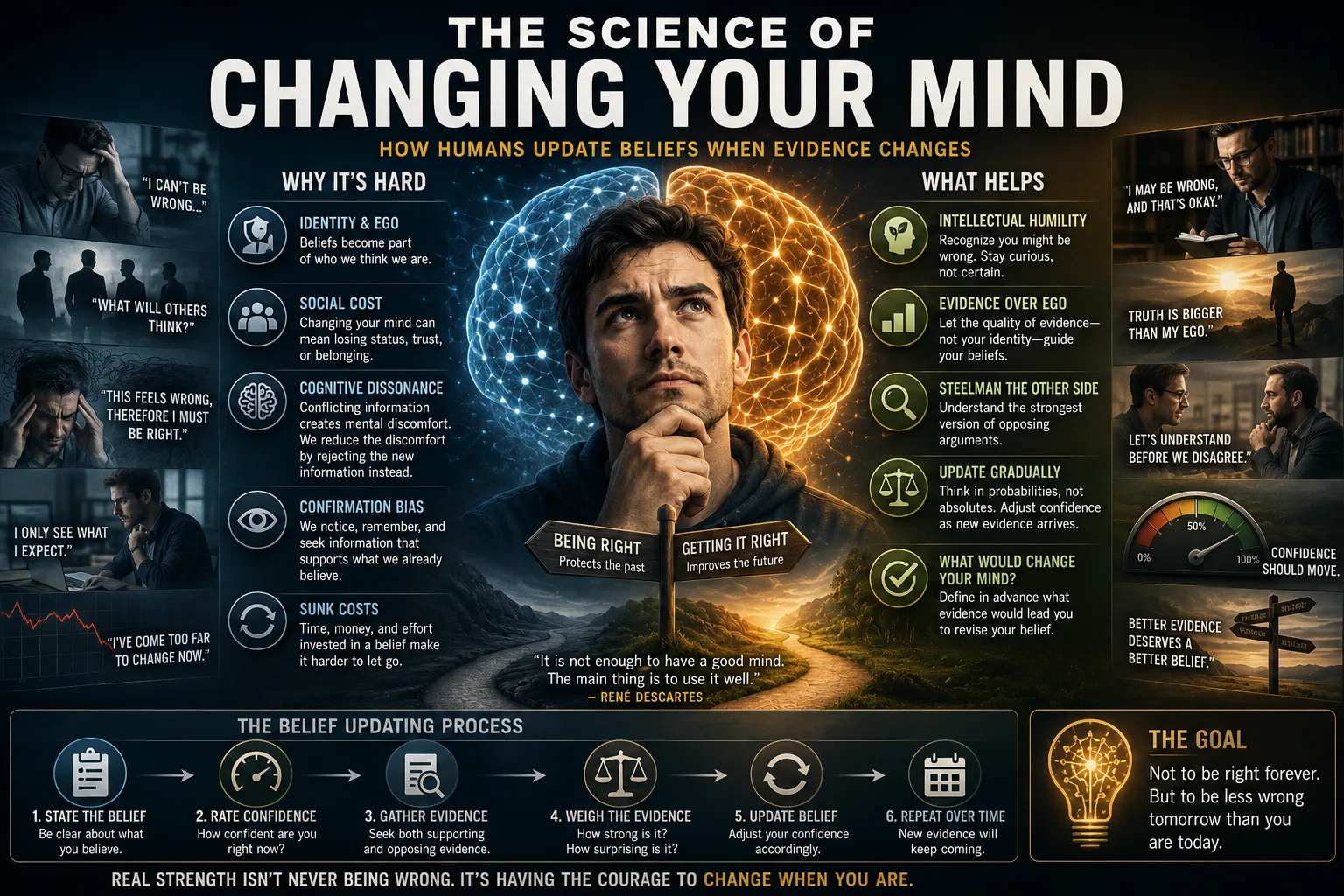
A Practical Belief-Updating Framework
For any important belief, use six questions:
1. What exactly do I believe?
State it clearly.
2. How confident am I?
Use a probability or range.
3. Why do I believe it?
Identify the actual evidence.
4. What is the strongest evidence against it?
Don't hide the inconvenient material.
5. What would change my mind?
Define the conditions beforehand.
6. Has new evidence changed the probability?
Update accordingly.
That is the entire discipline.
Simple to describe.
Annoyingly difficult to practice.
Frequently Asked Questions
Why is changing your mind so difficult?
Beliefs can become connected to identity, reputation, previous decisions, social groups, emotions, and existing mental models. Contradictory evidence may therefore create costs beyond simply changing a factual conclusion.
Does cognitive dissonance mean people refuse to admit they're wrong?
Not necessarily.
Cognitive dissonance describes discomfort arising from inconsistency. People can reduce that discomfort in multiple ways, including genuinely changing their beliefs or behavior.
Does fact-checking work?
Often, yes.
Research generally finds that factual corrections can reduce belief in misinformation, although effects vary and corrections may not completely erase false beliefs.
Is changing your mind a sign of weakness?
No.
Changing a conclusion because stronger evidence appeared is a basic feature of rational reasoning.
Changing opinions randomly without evidence would be a different matter entirely.
How can I become more open-minded without becoming gullible?
Require evidence for both accepting and rejecting claims.
Open-mindedness means allowing beliefs to change when justified, not treating every idea as equally plausible.
Final Thoughts
There is something deeply uncomfortable about saying:
“I was wrong.”
It can feel like losing.
Losing an argument.
Losing status.
Losing confidence.
Sometimes even losing part of your identity.
But there is another way to interpret those words.
“I was wrong” can also mean “I learned something.”
You formed the best model you could.
Reality supplied new information.
The model changed.
That isn't a malfunction.
That is what a functioning reasoning system is supposed to do.
The dangerous person is not someone who has been wrong many times.
Everyone qualifies for that position.
The dangerous person is someone whose beliefs remain unchanged regardless of what reality does.
So perhaps intellectual strength should not be measured by how many opinions you've successfully defended.
A better measure is whether your confidence responds to evidence.
Whether you can distinguish your identity from your ideas.
Whether you can abandon a beautiful explanation when an uglier one fits reality better.
And whether you can ask yourself, sincerely:
“What would change my mind?”
Then actually allow the answer to do it.
The goal was never to be right forever.
It was to become less wrong as you learn more.