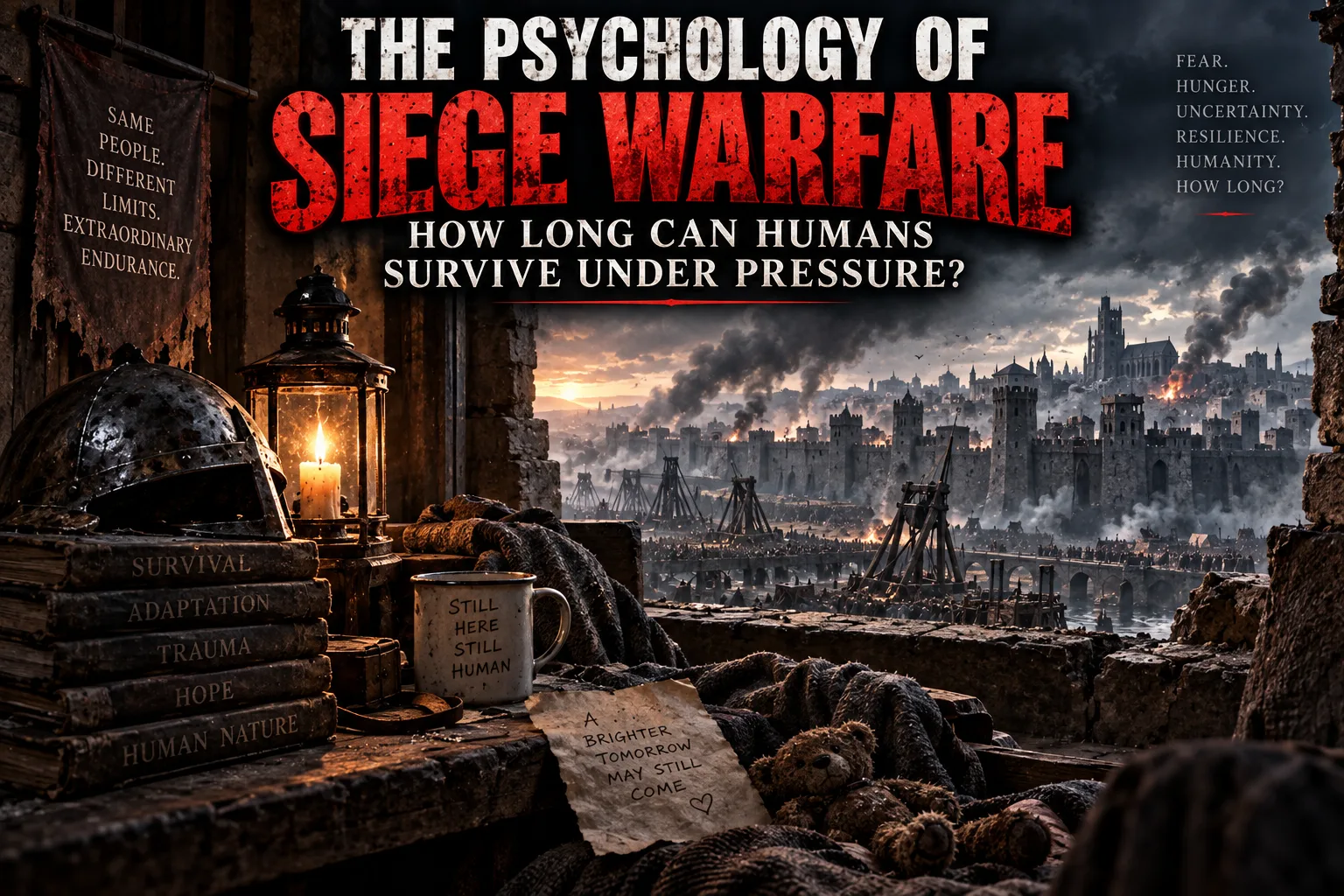
The Psychology of Siege Warfare: How Long Can Humans Survive Under Pressure?
What happens to the human mind when escape disappears? From starvation and constant danger to solidarity, fear, adaptation, and psychological collapse, siege warfare reveals how people behave under extraordinary pressure.
The Psychology of Siege Warfare: How Long Can Humans Survive Under Pressure?
Imagine waking up tomorrow and discovering that your city has been surrounded.
The roads out are blocked.
Electricity works intermittently.
Mobile networks are unreliable.
Supermarket shelves are emptying.
Hospitals are running short of medicine.
At first, everyone assumes it will be temporary.
A few days.
Maybe a week.
Then another week passes.
Explosions become part of the background.
Food portions shrink.
People begin collecting water wherever they can find it.
Every journey outside becomes a calculation of risk.
Weeks become months.
And something strange begins happening.
The impossible starts becoming normal.
That psychological transformation is one of the most remarkable aspects of siege warfare.
Humans can endure conditions that would seem unbearable from the safety of ordinary life. But survival under siege isn't simply a question of how much food or water the body needs.
It is also a battle involving:
fear, uncertainty, social trust, adaptation, hope, exhaustion, identity, and meaning.
So what actually happens to the human mind when an entire population becomes trapped?
And is there a psychological point beyond which people simply cannot continue?
The answer is considerably stranger than a simple countdown.
There Is No Fixed Psychological Survival Limit
We should clear up one misconception immediately.
There is no scientifically established number such as:
"Humans can psychologically tolerate siege conditions for 93 days."
History makes such a number impossible.
The Siege of Leningrad lasted roughly 872 days.
Sarajevo remained under siege for nearly four years.
The Siege of Candia lasted more than two decades.
Yet populations continued functioning.
That doesn't mean people were psychologically unharmed.
Far from it.
It means human psychological endurance doesn't operate like an oxygen tank gradually reaching zero.
People adapt.
Sometimes extraordinarily.
Survival Begins With the Brain's Threat System
When danger suddenly appears, the brain and body activate systems designed to keep us alive.
The sympathetic nervous system increases readiness.
Stress hormones such as adrenaline and cortisol become involved.
Heart rate may increase.
Attention narrows.
Muscles prepare for action.
Energy becomes available quickly.
In a short emergency, this system is incredibly useful.
You hear an explosion.
Your body reacts before you've finished consciously analyzing it.
That can save your life.
But siege warfare creates a problem evolution wasn't particularly elegant about solving.
The emergency doesn't end.
Acute Stress Becomes Chronic Stress
Imagine a smoke alarm that never stops ringing.
Eventually, you cannot remain at maximum alert forever.
Prolonged stress can contribute to:
Sleep disruption.
Irritability.
Difficulty concentrating.
Memory problems.
Anxiety.
Depressive symptoms.
Emotional exhaustion.
Changes in appetite.
Physical health problems.
The nervous system begins adapting to an environment where danger isn't exceptional.
Danger is Tuesday.
The Strange Normalization of Danger
Survivor accounts from wars repeatedly describe something outsiders find difficult to understand.
People adapt to explosions.
They learn differences between sounds.
They estimate distance.
They identify safer streets.
They know which buildings provide protection.
They develop routines around danger.
A newcomer might panic at every explosion.
Someone who has lived under bombardment for months may briefly look up and continue what they were doing.
This doesn't necessarily mean they have stopped being afraid.
It means their brain has learned that reacting maximally to every threat would make ordinary functioning impossible.
Habituation: When Terror Becomes Background Noise
Psychologists use the term habituation for reduced responses to repeated stimuli.
If a harmless sound happens repeatedly, your brain gradually stops treating it as important.
War complicates this because explosions aren't harmless.
But people can still become behaviorally accustomed to recurring danger.
They may learn:
Which sounds indicate incoming fire.
Which direction danger is coming from.
When shelter is necessary.
When movement is relatively safer.
The terrifying environment becomes cognitively mapped.
Unpredictable danger becomes slightly more predictable.
And predictability matters enormously.
Why Uncertainty Can Be Worse Than Known Danger
Humans generally cope better when they understand the rules of a threat.
Consider two situations.
Situation A
You know bombardment usually occurs between certain hours.
Situation B
Bombardment could occur at any moment without warning.
Even if the objective danger were similar, Situation B can produce greater psychological strain.
Why?
Because the brain cannot easily switch off vigilance.
Hypervigilance
Under prolonged threat, people may become extremely sensitive to potential danger.
A distant noise.
A vehicle.
Footsteps.
An unfamiliar person.
A sudden silence.
Any of these can trigger attention.
This state is often called hypervigilance.
In an active war zone, some degree of heightened vigilance is adaptive.
The problem comes when the danger ends but the nervous system doesn't receive the memo.
A survivor may later react strongly to:
Fireworks.
Car backfires.
Aircraft.
Sirens.
Crowds.
Sudden movements.
The environment has become safe.
The brain may continue behaving as though the siege never ended.
The Psychology of Scarcity
Sieges attack more than territory.
They attack supply.
Food becomes scarce.
Water becomes scarce.
Medicine becomes scarce.
Fuel becomes scarce.
Eventually even ordinary objects acquire extraordinary value.
A candle.
A battery.
A piece of bread.
A container of clean water.
A packet of antibiotics.
Scarcity changes how people think.
Your Attention Begins Orbiting What You Lack
Research on scarcity suggests that lacking essential resources can consume cognitive attention.
When food is uncertain, people think about food.
When money is scarce, financial problems dominate attention.
During siege conditions, this effect can become extreme.
Imagine spending much of every day calculating:
How much bread remains?
Where can we get water?
Can we trade this?
Should we eat this today?
Will supplies arrive tomorrow?
Can the children have more?
Resource management becomes a major part of cognition.
Hunger Changes Psychology
Severe caloric deprivation affects both body and mind.
One of psychology's famous studies of starvation was the Minnesota Starvation Experiment, conducted during World War II.
Healthy volunteers underwent prolonged semi-starvation.
Participants became increasingly preoccupied with food.
Some collected recipes.
Conversations centered around eating.
Mood and social behavior changed.
Irritability and emotional difficulties increased.
Energy declined.
Concentration could suffer.
And those volunteers knew researchers were supervising them.
They weren't simultaneously being bombarded.
Siege starvation adds terror and uncertainty to biological deprivation.
When Food Becomes the Center of Reality
Historical accounts from extreme famines and sieges repeatedly describe obsessive attention to food.
People remember meals from years earlier.
Discuss recipes they cannot prepare.
Dream about eating.
Calculate portions obsessively.
Search for substances that would previously have seemed inedible.
This isn't evidence of moral collapse.
It is the brain responding to biological emergency.
When the body is starving, thinking about calories is not irrational.
It is survival.
Why People Sometimes Stop Feeling Hungry
Advanced starvation can produce a strange transition.
Initial hunger may be intense.
Later, severely malnourished individuals can become:
Weak.
Apathetic.
Emotionally flattened.
Physically inactive.
The body begins conserving energy wherever possible.
This can create the misleading impression that someone is "coping."
In reality, their physiological condition may be deteriorating dramatically.
Decision-Making Under Siege
Normal life contains countless decisions.
But most aren't immediately lethal.
During siege conditions, ordinary decisions acquire consequences.
Should I leave shelter to collect water?
Should we use our remaining fuel?
Should we trade jewelry for food?
Should we attempt evacuation?
Should the family stay together?
Should we trust this rumor?
Every choice consumes mental energy.
This contributes to decision fatigue.
The Brain Starts Simplifying
Under prolonged stress, people may rely increasingly on:
Habits.
Rules of thumb.
Trusted individuals.
Group norms.
Established routines.
That isn't necessarily stupidity.
Complex analysis requires cognitive resources.
When someone is exhausted, hungry, frightened, and sleep-deprived, those resources become limited.
A routine can therefore become psychologically protective.
Routine Is One of the Most Powerful Survival Tools
This sounds almost absurd.
A city is being bombarded and we're talking about schedules.
But routines can become enormously important.
Wake up.
Prepare whatever food exists.
Collect water.
Check relatives.
Perform work.
Clean the shelter.
Teach children.
Listen for news.
Sleep.
Repeat.
Why does this matter?
Because routine restores something siege warfare constantly removes:
control.
You may not control the army outside.
But you can control when you prepare breakfast.
That tiny distinction matters.
Why People Continue Working During War
Historical siege populations often continue operating:
Hospitals.
Schools.
Factories.
Markets.
Religious institutions.
Government offices.
Theaters.
Radio stations.
Newspapers.
Why?
Some are practically necessary.
Others provide psychological structure.
Working tells the brain:
Life still exists beyond survival.
Sarajevo Provides an Extraordinary Example
During the Siege of Sarajevo, cultural activity continued despite bombardment.
Concerts were held.
Artists worked.
Theater continued.
People maintained social gatherings.
One famous example involved cellist Vedran Smailović, who performed in ruined areas of Sarajevo.
The broader phenomenon matters more than any single symbolic story.
Culture itself became resistance.
Why Would Anyone Attend a Concert During a Siege?
From a purely biological perspective, it seems ridiculous.
Calories are scarce.
Danger is everywhere.
Why spend energy playing music?
Because humans don't survive psychologically on calories alone.
People need:
Meaning.
Identity.
Connection.
Dignity.
A sense that they remain human beings rather than merely organisms avoiding death.
Music doesn't stop artillery.
But it can prevent artillery from defining the entirety of existence.
Social Connection Can Become a Survival Resource
During catastrophe, individual survival often depends heavily on groups.
Neighbors share information.
Families pool food.
People care for children.
Someone collects water.
Someone repairs equipment.
Someone knows first aid.
Someone has access to supplies.
Someone knows which road is dangerous.
Social networks become infrastructure.
Collective Resilience
Psychologists studying disasters have found that communities can develop powerful forms of solidarity.
Shared danger can strengthen group identity.
People may help strangers.
Resources may be shared.
Volunteers emerge.
Communities organize themselves.
This contradicts a popular disaster myth.
Myth: Everyone Immediately Becomes Selfish
Movies adore this idea.
Civilization collapses.
Within approximately seventeen minutes everyone becomes a leather-clad marauder fighting over canned beans.
Real disaster behavior is more complicated.
Panic and selfish behavior certainly occur.
Crime can occur.
Black markets appear.
Exploitation happens.
But research on disasters repeatedly documents substantial:
Cooperation.
Mutual aid.
Volunteerism.
Resource sharing.
Collective organization.
Humans are social animals.
Cooperation is one of our survival strategies.
Civilization is not merely a thin decorative layer hiding universal savagery.
But Siege Conditions Can Also Destroy Trust
There is another side.
Prolonged conflict can produce:
Suspicion.
Informants.
Political division.
Ethnic tension.
Competition for supplies.
Accusations of collaboration.
Black markets.
Favoritism.
Resentment.
The same pressure that strengthens one group can increase hostility toward another.
This is particularly dangerous when propaganda identifies an enemy population as responsible for suffering.
In-Group and Out-Group Psychology
Under threat, group identities can become stronger.
People think more intensely in terms of:
us
and
them.
Sometimes this increases solidarity.
But it can also encourage dehumanization.
If the enemy becomes viewed not as individual humans but as a threatening category, violence becomes psychologically easier to justify.
Siege warfare therefore isn't only fought with artillery.
Narratives matter.
Propaganda Becomes Psychological Ammunition
Both attackers and defenders may manipulate information.
Attackers might claim:
Your leaders abandoned you.
Resistance is hopeless.
Surrender and you will survive.
Defenders might claim:
Victory is near.
Relief forces are coming.
The enemy is collapsing.
Anyone advocating surrender is a traitor.
Some messages may be accurate.
Others may be deliberate psychological operations.
The objective is the same:
Control expectations.
Why Hope Matters So Much
Suppose two trapped populations have identical supplies.
Population A believes relief arrives in seven days.
Population B believes nobody is coming.
Psychologically, those aren't identical situations.
Hope changes how suffering is interpreted.
People tolerate hardship more easily when they believe:
It has a purpose.
It will end.
Their actions matter.
Help is coming.
But False Hope Can Become Dangerous
There is a balance.
Unrealistic optimism can cause disastrous decisions.
People might refuse evacuation because they expect immediate victory.
They may consume supplies too quickly.
They may underestimate danger.
Effective resilience therefore isn't:
"Everything will definitely be fine."
It is closer to:
"This is terrible, but there are still things we can do."
That distinction is psychologically powerful.
Learned Helplessness
When people repeatedly experience negative events they cannot control, they may eventually stop trying to change their circumstances.
Psychological research calls a related phenomenon learned helplessness.
Under prolonged siege conditions, helplessness can emerge when:
Attempts to improve conditions repeatedly fail.
Escape seems impossible.
Authorities appear powerless.
Loved ones die regardless of precautions.
Future plans disappear.
People may become passive.
Motivation collapses.
This can be dangerous because survival often requires continued action.
Why Tiny Choices Matter
Maintaining small areas of personal control can counter feelings of helplessness.
Choosing how to organize shelter.
Preparing food.
Maintaining hygiene.
Teaching children.
Repairing clothing.
Recording events.
Celebrating birthdays.
These acts look trivial compared with military events.
Psychologically, they aren't.
They reinforce:
I can still affect something.
Children Under Siege
Children present a particularly serious psychological concern.
They may not fully understand:
Why explosions occur.
Why school stopped.
Why adults are frightened.
Why food disappeared.
Why someone they love isn't returning.
Their responses can include:
Sleep disturbances.
Regression.
Separation anxiety.
Fear.
Aggression.
Withdrawal.
Concentration problems.
Physical complaints.
But outcomes vary enormously.
Not every child exposed to war develops lifelong psychiatric illness.
Adults Become Emotional Reference Points
Children often look toward trusted adults to interpret ambiguous situations.
If caregivers can provide:
Protection.
Routine.
Explanation.
Affection.
Predictability.
those relationships may buffer some psychological effects of adversity.
That doesn't make bombardment harmless.
It means relationships can influence how traumatic environments are processed.
Humor Appears in Terrible Places
One of the strangest features of human behavior during catastrophe is humor.
People joke during wars.
Doctors joke during exhausting emergencies.
Soldiers joke under fire.
Civilians joke about shortages.
Why?
Humor can:
Reduce tension.
Create social bonds.
Restore psychological distance.
Express defiance.
Make frightening subjects temporarily manageable.
Dark humor doesn't necessarily mean people don't understand the seriousness of their situation.
Often they understand it extremely well.
The joke is how they steal ten seconds back from it.
Why People Celebrate During Sieges
Birthdays still occur.
Weddings still happen.
Religious holidays continue.
People dress carefully when possible.
Someone saves a small amount of food for a celebration.
This can look irrational from outside.
But rituals create continuity.
They say:
There was a life before this.
There will be a life after this.
And perhaps most importantly:
We are still ourselves.
Sleep Becomes a Battlefield of Its Own
Sleep is particularly vulnerable during prolonged conflict.
Explosions interrupt rest.
People sleep in unfamiliar shelters.
Families may take turns watching for danger.
Cold and hunger make sleep difficult.
Anxiety keeps the brain alert.
Chronic sleep deprivation then worsens:
Attention.
Memory.
Emotional regulation.
Reaction time.
Judgment.
Physical health.
Now combine sleep deprivation with malnutrition and fear.
The psychological burden compounds.
Trauma Doesn't Always Look Dramatic
Popular culture often portrays trauma as constant screaming, panic attacks, or dramatic flashbacks.
Those can occur.
But trauma can also appear as:
Emotional numbness.
Avoidance.
Difficulty sleeping.
Irritability.
Detachment.
Guilt.
Concentration problems.
Feeling constantly unsafe.
Loss of interest.
Intrusive memories.
Some survivors may appear outwardly functional while struggling internally.
PTSD Is Not Inevitable
This distinction matters enormously.
Exposure to war increases risk for post-traumatic stress disorder, depression, anxiety, substance misuse, and other difficulties.
But trauma exposure does not guarantee PTSD.
People show different trajectories.
Some develop severe long-term symptoms.
Some experience temporary distress and gradually recover.
Some maintain surprisingly stable psychological functioning.
Others report forms of personal growth alongside suffering.
Human responses to trauma vary.
Post-Traumatic Growth
Some survivors report positive psychological changes after extreme adversity.
These may include:
Greater appreciation of life.
Stronger relationships.
Changed priorities.
A stronger sense of personal capability.
New spiritual or philosophical perspectives.
This phenomenon is called post-traumatic growth.
But it must be discussed carefully.
🔴 Trauma Is Not "Good for You"
Suffering doesn't need to be romanticized to acknowledge that humans can create meaning afterward.
Someone can grow after trauma while still wishing the trauma had never happened.
Both can be true.
Moral Injury
There is another psychological consequence particularly relevant to war.
Sometimes distress comes not only from what happened to someone.
It comes from what they:
Did.
Failed to do.
Witnessed.
Were forced to accept.
A parent may feel guilty because they couldn't feed a child.
A doctor may have to decide which patient receives the last medicine.
A soldier may follow an order they later regret.
A survivor may wonder why they lived when others died.
These experiences can contribute to what researchers describe as moral injury.
Survivor Guilt
After catastrophic events, survivors sometimes ask:
Why them?
Why did I survive?
Why didn't I save someone?
Could I have done more?
Logically, they may understand they had little control.
Emotionally, guilt can remain.
This is one reason psychological consequences can continue long after physical danger disappears.
The siege ends on a calendar.
Not necessarily in the nervous system.
What Happens When the Siege Finally Ends?
You might imagine immediate celebration followed by normal life.
Reality can be stranger.
During prolonged danger, survival becomes the organizing principle of existence.
Then suddenly:
No artillery.
No checkpoints.
No ration calculations.
No constant threat.
The nervous system has spent months or years learning one world.
Now it must learn another.
Safety Can Feel Unfamiliar
Some survivors report difficulty relaxing.
Silence itself may feel suspicious.
Loud sounds trigger reactions.
Crowded places feel dangerous.
People continue storing food.
They avoid wasting anything.
They maintain habits that made sense during scarcity.
These behaviors can persist for years.
Sometimes generations.
Siege Psychology Can Enter Family Culture
Parents who experienced starvation may become extremely uncomfortable with food waste.
Families who survived displacement may prioritize financial security.
Communities may preserve stories of:
Betrayal.
Heroism.
Loss.
Resistance.
The psychological legacy becomes cultural memory.
Children born decades later can grow up hearing what happened.
In that sense, some sieges continue long after the armies leave.
So How Long Can Humans Actually Survive Under Pressure?
Physically, survival depends on conditions such as:
Water.
Calories.
Temperature.
Disease.
Injury.
Shelter.
Medical care.
Psychologically, there is no universal deadline.
Humans have survived prolonged siege conditions lasting years.
But survival and wellbeing are not the same thing.
Someone can remain alive while experiencing profound:
Trauma.
Grief.
Malnutrition.
Exhaustion.
Depression.
Anxiety.
Loss.
Psychological resilience doesn't mean being unaffected.
It means continuing to function despite adversity, sometimes while paying an enormous psychological cost.
What Predicts Better Psychological Survival?
No factor guarantees resilience.
But research on extreme adversity suggests several protective elements can matter.
Social support
Strong relationships can reduce isolation and provide practical assistance.
Predictability
Knowing routines and understanding risks reduces uncertainty.
Agency
Having meaningful choices protects against helplessness.
Purpose
People endure more when suffering connects to something meaningful.
Reliable information
Accurate information reduces uncertainty and dangerous rumors.
Routine
Daily structure preserves normality.
Community identity
Shared purpose can strengthen cooperation.
Access to necessities
Psychology cannot compensate indefinitely for absent food, water, shelter, or medicine.
That last point deserves emphasis.
Resilience is not magic.
You cannot positive-think your way around dehydration.
Why Some People Break Earlier Than Others
Individual differences matter.
Prior trauma.
Physical health.
Age.
Social support.
Personality.
Loss of loved ones.
Severity of exposure.
Financial resources.
Existing mental-health difficulties.
Responsibilities toward dependents.
All can influence response.
But describing someone who develops trauma symptoms as "weak" misunderstands the biology involved.
A nervous system reacting strongly after prolonged exposure to mortal danger is not malfunctioning in some absurdly simple sense.
It learned that the world was dangerous.
Sometimes it learned the lesson too well.
Myth vs. Evidence
🔴 People panic immediately when society breaks down
Usually exaggerated.
Cooperation is common during disasters.
🟢 Chronic siege conditions can alter attention, sleep, mood, and behavior
Strongly supported by research on prolonged stress and war exposure.
🔴 Eventually everyone psychologically collapses
False.
Human responses vary enormously.
🟢 Routine can support psychological functioning
Yes.
🟢 Social relationships can improve resilience
Strong evidence supports social support as an important protective factor.
🔴 Resilient people don't experience fear
Completely wrong.
Resilience means functioning despite adversity, not becoming emotionally bulletproof.
🟢 Starvation affects cognition and emotion
Well established.
🟢 Trauma can persist after physical danger ends
Yes.
🔴 Everyone exposed to war develops PTSD
False.
Risk increases substantially, but outcomes vary.
🟡 Trauma can sometimes be followed by psychological growth
Yes, but growth doesn't erase suffering and should never be used to romanticize trauma.
Frequently Asked Questions
How long can someone psychologically survive a siege?
There is no fixed psychological limit. Historical populations have endured siege conditions for months or years, but prolonged exposure can cause serious psychological and physical consequences.
Do humans eventually become used to explosions?
People can become behaviorally habituated to recurring danger and learn to distinguish different threats. That doesn't mean the danger stops affecting them psychologically.
Why don't people constantly panic during war?
Continuous panic would be impossible to sustain. Humans adapt, establish routines, learn threat patterns, and often rely on social groups to continue functioning.
Does starvation change personality?
Severe caloric deprivation can affect mood, concentration, energy, social behavior, and preoccupation with food. Some apparent personality changes may therefore reflect physiological deprivation.
Are people more selfish during sieges?
Some selfish and exploitative behavior occurs, but disasters also produce extensive cooperation, mutual aid, and resource sharing. The idea that social order instantly becomes universal chaos is largely a cultural myth.
Can humor actually help people survive psychologically?
Humor can reduce tension, strengthen social connection, create emotional distance from fear, and provide a sense of defiance. It isn't a treatment for trauma, but it can function as a coping mechanism.
Why are routines important during war?
Routine provides predictability and a sense of control in an environment dominated by uncertainty.
Does everyone who survives a siege develop PTSD?
No. War exposure increases the risk of PTSD and other mental-health problems, but individual outcomes vary substantially.
Can siege trauma affect later generations?
The effects can persist through family behavior, cultural memory, economic consequences, displacement, parenting patterns, and community narratives. Claims of direct biological transmission require much more careful evidence and should not be casually assumed.
What is the strongest psychological protection during prolonged crisis?
There isn't one universal factor, but social support, meaningful agency, reliable information, routines, basic material security, and a sense of purpose are repeatedly important.
The Most Surprising Lesson From Siege Psychology
Perhaps the most surprising discovery isn't how easily humans break.
It's how much ordinary life they preserve.
We imagine extreme survival as a permanent state of screaming urgency.
Historical reality often looks different.
Someone is repairing shoes.
Someone is teaching mathematics.
Someone is flirting.
Someone is complaining about dinner.
Someone is writing poetry.
Someone is playing music.
Someone is making a joke that would sound completely inappropriate anywhere else.
And somewhere nearby, artillery is falling.
This doesn't mean humans are indifferent to danger.
It demonstrates something deeper.
The brain continuously tries to build normality, even where normality objectively no longer exists.
Because normality itself is psychologically protective.
Final Thoughts
Siege warfare attempts to break people by removing the foundations of ordinary existence.
Food becomes uncertain.
Water becomes dangerous to obtain.
Sleep becomes fragmented.
Information becomes unreliable.
Death becomes visible.
The future becomes impossible to plan.
And yet people continue.
Not because humans possess unlimited psychological strength.
They don't.
People develop trauma.
Some become severely depressed.
Some lose hope.
Some experience lasting anxiety, grief, guilt, or psychological injury.
Some never completely recover.
But human survival has never depended solely on individual toughness.
It depends on something far more interesting.
Adaptation.
People transform basements into homes.
Neighbors become supply networks.
Routines emerge around bombardment.
Humor appears beside fear.
Music continues among ruins.
Parents invent games for frightened children.
People divide bread.
Someone keeps records because they believe a future world should know what happened.
Someone plants something despite having no guarantee they will be alive when it grows.
That may be the deepest psychological lesson of siege warfare.
Humans don't survive extreme pressure by remaining exactly who they were before it began.
They survive by continually rebuilding a smaller version of normal life inside the catastrophe.
A meal.
A routine.
A friendship.
A joke.
A song.
A plan for tomorrow.
Military history tends to record when the walls finally fall.
Psychology asks a different question:
What kept the people behind those walls standing for so long?