Why Does a Place Feel Different After Someone Dies There?
The house hasn't changed. The clock still ticks, sunlight still crosses the floor, and the same chair sits beside the window. So why does stepping inside feel like entering someone else's life?
The first thing Kabir did when he entered the house was call her name.
"Nani? I'm home."
He wasn't thinking.
The words simply escaped, as naturally as removing his shoes at the door.
Then he remembered.
His grandmother had died seven months earlier.
In that very house.
In the bedroom at the end of the corridor, beneath the ceiling fan that still made a faint clicking sound whenever it turned.
Kabir stood motionless.
The house smelled the same. The furniture hadn't moved. Afternoon sunlight still fell across the kitchen floor in the familiar shape of a golden rectangle.
Everything was exactly where it belonged.
Except her.
And somehow, that single absence had changed everything.
The House That Forgot How to Breathe
As a child, Kabir believed his grandmother's house was the safest place in the world.
The front door always complained when opened.
The kitchen smelled of cardamom and roasted cumin.
At four every afternoon, Nani would sit beside the window, peeling oranges with a small knife she insisted was sharper than all the expensive ones.
And whenever Kabir arrived, she would shout from somewhere inside:
"Wash your hands before touching anything!"
He used to find it annoying.
Now he would have given almost anything to hear it once more.
He walked through the living room.
Her slippers were still beneath the chair.
A newspaper lay folded beside her reading glasses.
The calendar still displayed March, though it was October.
Nobody had changed it.
He approached the bedroom.
His hand stopped above the door handle.
Suddenly, he was afraid.
Not of ghosts.
Not of darkness.
But of the possibility that opening that door would make her absence feel more permanent.
He had spent seven months trying to accept that she was gone.
Yet standing in that corridor, some part of him still expected her to be waiting.
Why?
When Walls Become Memories
Our brains don't experience places as collections of walls, doors, and furniture.
Places become connected to experiences.
A childhood bedroom may bring back a feeling of safety.
A particular road may remind us of someone we loved.
A hospital corridor may awaken anxiety years after an illness has ended.
Psychologists study these relationships through concepts such as place attachment, environmental cues, and autobiographical memory.
Repeated experiences can create powerful associations between locations and emotions.
When we return to a familiar place, our minds use past experience to anticipate what might happen there.
The sound of a kitchen drawer might once have meant breakfast was coming.
Footsteps in the hallway might have meant someone was home.
A particular chair might have meant an evening conversation.
Then someone dies.
The environment remains familiar.
But the person connected to those expectations is no longer there.
The mind encounters an unsettling contradiction.
Everything suggests that life should continue as before.
Yet it cannot.
For Kabir, the house hadn't become frightening because something new had entered it.
It felt different because something familiar had disappeared.
And his mind hadn't entirely learned how to expect that disappearance.
The Sound From the Kitchen
At 4:03 p.m., Kabir heard a metallic clink.
He turned.
For half a second, he expected to see his grandmother standing near the stove.
The sound came again.
He followed it into the kitchen.
A loose window latch was tapping against its frame.
Nothing unusual.
Just metal moving in the wind.
Kabir laughed quietly at himself.
But his heartbeat remained strangely fast.
During bereavement, familiar sounds, smells, and routines can evoke an intense sense of the deceased person's presence.
Some grieving people even report briefly hearing a loved one's voice or sensing that they are nearby.
Such experiences can occur during ordinary grief and do not, by themselves, prove anything supernatural or indicate a mental disorder.
The mind has spent years learning that certain cues predict someone's presence.
Those associations don't vanish the moment that person dies.
Kabir understood none of this consciously.
He only knew that, for one beautiful and terrible second, he had expected her to walk into the kitchen.
And realizing she wouldn't hurt all over again.
The Tin Box Beneath the Cupboard
He had returned to pack the house.
His father was considering selling it, and the family needed to decide what to keep.
By evening, Kabir had filled three cardboard boxes.
Old utensils.
Winter blankets.
A stack of magazines nobody had read in years.
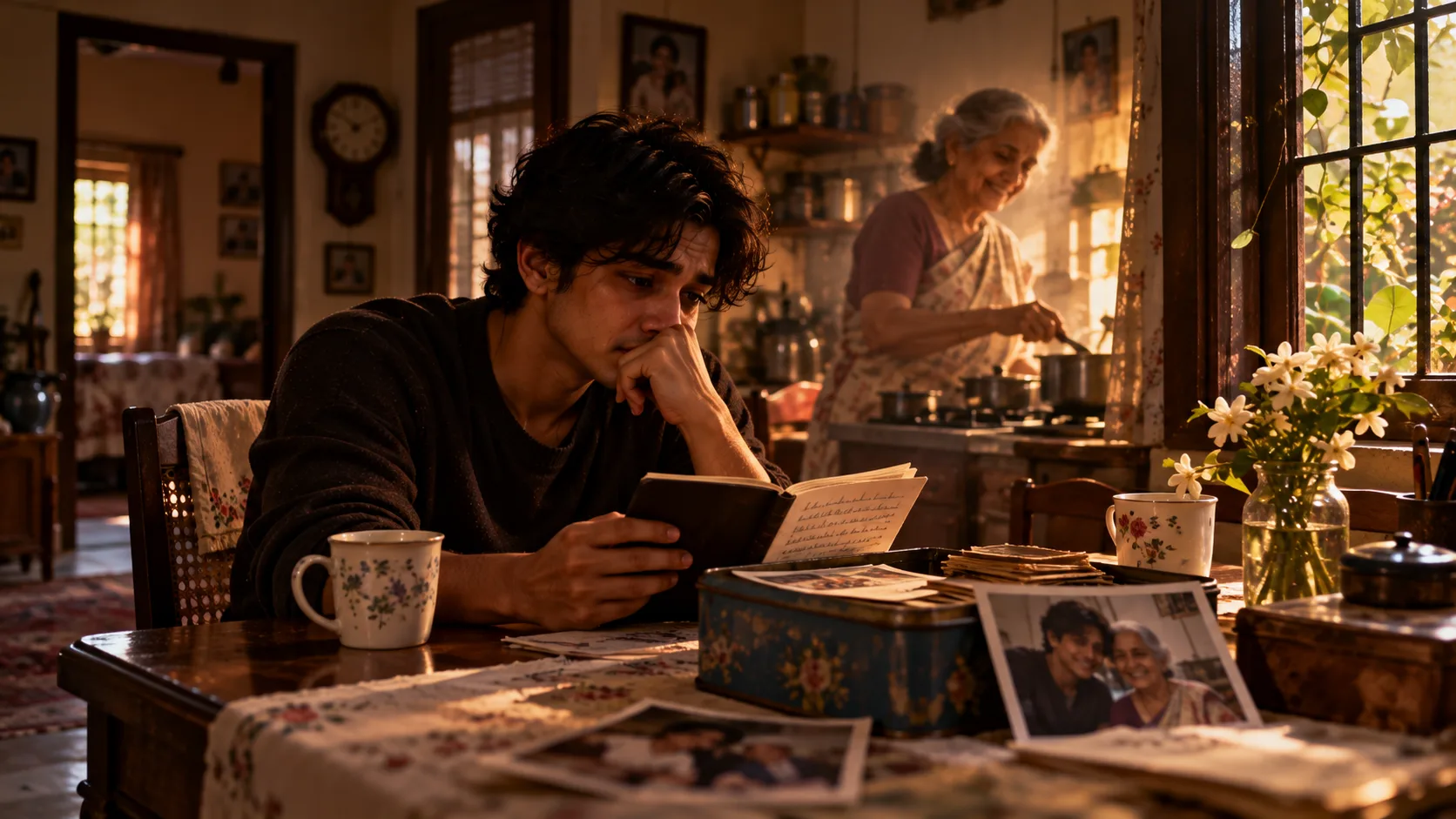
Then, while moving a cupboard, he discovered a dented blue biscuit tin.
He remembered it immediately.
As a child, he'd searched that tin for sweets.
Nani always told him it contained sewing supplies.
He had believed her.
Now, twenty years later, he opened it.
There were no sweets.
No needles.
Only a small notebook wrapped in faded cloth.
On the first page, written in his grandmother's handwriting, were six words.
Things I Don't Want to Forget.
Kabir smiled.
He expected recipes.
Perhaps telephone numbers.
Instead, the first entry made him sit down.
17 July.
The house is too quiet without him.
His grandfather had died when Kabir was very young.
He barely remembered the man.
But Nani had always spoken about him calmly, sometimes with a smile.
Kabir had assumed she'd eventually grown used to his absence.
He turned the page.
The Woman He Had Never Known
23 July.
I made tea for two again. I only noticed when I placed both cups on the table.
Another page.
8 August.
His shoes are still beside the door. I moved them today. Then I put them back.
Kabir stopped reading.
The words felt painfully familiar.
The untouched slippers.
The unnecessary cup.
The furniture nobody wanted to move.
He had thought these were strange things people did after losing someone.
Yet his grandmother had experienced the same confusion decades earlier.
She had lived inside this house long before Kabir was born.
She had loved someone here.
Lost someone here.
And learned how to live with the silence.
The notebook continued.
Months became years.
Then the entries changed.
The jasmine finally bloomed.
Made too many laddoos for Diwali. Gave some to the neighbours.
And one afternoon, several years later:
Kabir came running through the front door and shouted so loudly that the pigeons flew off the balcony.
For the first time in a long while, the house sounded full again.
Kabir placed his hand over his mouth.
He remembered those pigeons.
He remembered laughing when they scattered.
He didn't remember saving his grandmother from even one afternoon of loneliness.
He hadn't known there was loneliness to save her from.
She had made childhood feel so effortless that he'd never imagined she was learning how to feel at home again.
A House Can Hold More Than One Life
Kabir kept reading until the sunlight disappeared.
The notebook wasn't entirely sad.
There were complaints about rising vegetable prices.
A furious paragraph about a neighbour who borrowed a pressure cooker and returned it damaged.
Little celebrations.
Birthdays.
Recipes that hadn't worked.
Arguments she regretted.
And countless ordinary observations.
The house, Kabir realized, had never belonged to just one chapter of her life.
It had witnessed her as a young wife.
As a grieving widow.
As a grandmother who complained about muddy shoes.
And as a woman with private fears, ambitions, and memories that her family had never fully known.
He had spent seven months thinking of her only as someone who was gone.
But the notebook revealed someone who had continued living after experiencing exactly the kind of loss he now struggled to understand.
One entry near the end caught his attention.
Kabir has his own life now. He doesn't visit as often.
He felt a sharp ache.
Then he read the next sentence.
Good. That means he's building something of his own. I'll keep the kettle ready whenever he comes.
He closed his eyes.
Even when he'd been absent, she'd been making room for his return.
Why Some Rooms Hurt More Than Others
Grief doesn't affect every familiar place equally.
A bedroom where someone died may hold especially difficult associations.
A kitchen where they prepared meals may bring comfort one day and sadness the next.
A hallway may feel empty because you are accustomed to hearing their footsteps there.
The emotional significance comes partly from what happened in those spaces and the memories they evoke.
This is why two people can enter the same room and experience it completely differently.
One sees an ordinary wooden chair.
Another remembers forty years of conversations beside it.
One hears an old clock ticking.
Another remembers someone winding it every Sunday.
Neither perception changes the physical room.
But the room's personal meaning is entirely different.
And that meaning can change again with time.
A place that initially feels unbearable may eventually become comforting.
Not because the loss has been erased.
But because grief can evolve, and new experiences can exist alongside old memories.
The Last Evening
By sunset, Kabir had packed almost everything.
Except the blue tin.
He carried it into the kitchen and placed it beside the window.
The clock ticked.
The loose latch tapped gently in the wind.
For the first time that afternoon, he didn't turn around.
He made himself tea.
Then, without thinking, reached for a second cup.
His hand stopped.
He looked at the empty space across the table.
And laughed through his tears.
"Nani, I did it too."
He sat down with his tea.
There was no sudden peace.
No magical feeling that everything was finally okay.
He still missed her.
The house still hurt.
But the silence no longer felt quite as unfamiliar.
For decades, his grandmother had lived with memories of someone who no longer occupied these rooms.
Now he was beginning to understand what that meant.
He opened the notebook to its final blank page.
After a moment, he wrote:
27 October.
I came home today and called your name.
You didn't answer.
I think I'll keep coming anyway.
Then he closed the notebook.
Outside, evening settled over the neighbourhood.
Somewhere nearby, someone called their child home for dinner.
A pressure cooker whistled.
The old house stood quietly beneath the darkening sky.
Its walls hadn't changed.
Its windows hadn't changed.
Even the stubborn kitchen latch was exactly as it had always been.
But Kabir finally understood.
Sometimes a place feels different after someone dies there because we are still learning how to exist in a world where they no longer answer when we call.
And perhaps, with time, the same rooms that remind us of someone's absence can also remind us how fully they once lived.