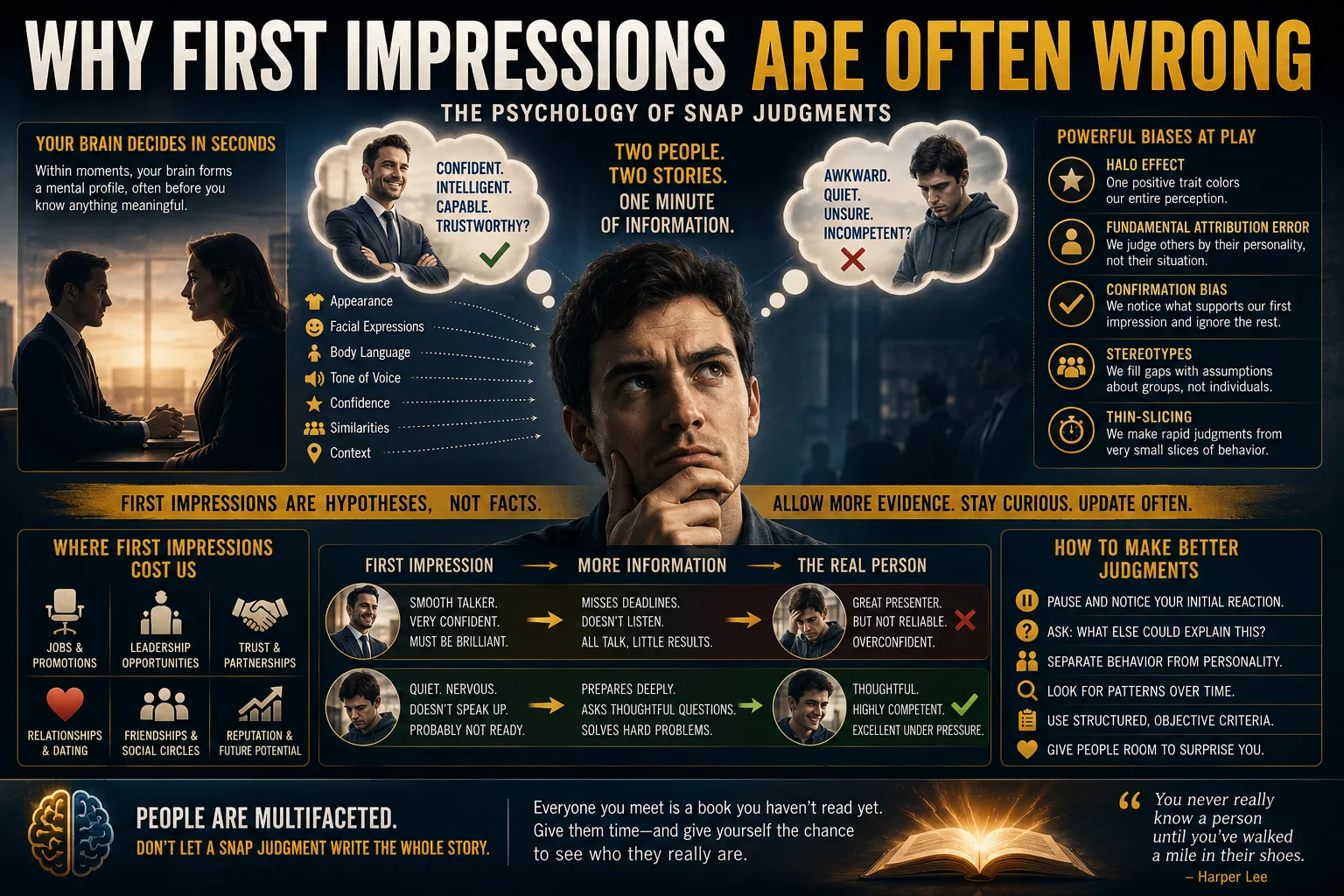
Why First Impressions Are Often Wrong: The Psychology of Snap Judgments
Your brain can form an opinion about someone within seconds, often before you know anything meaningful about them. Explore the psychology of first impressions, the halo effect, stereotypes, body language, confidence, and why early judgments can be surprisingly difficult to correct.
Why First Impressions Are Often Wrong: The Psychology of Snap Judgments
You meet someone for the first time.
They walk confidently.
Speak clearly.
Maintain eye contact.
Smile at exactly the right moments.
Within seconds, your brain begins constructing a profile.
Confident.
Intelligent.
Friendly.
Competent.
You have barely spoken to them.
Yet somehow, a complete personality is beginning to emerge.
Now imagine someone else.
They avoid eye contact.
Speak quietly.
Pause before answering.
Their posture appears uncomfortable.
Another profile forms.
Shy.
Insecure.
Unprepared.
Perhaps even:
Untrustworthy.
But what if the first person is confidently incompetent?
What if the second is an exceptional professional experiencing social anxiety?
Your brain doesn't know.
It guesses.
And one of the strangest features of human social perception is how quickly those guesses begin feeling like facts.
Your Brain Judges People Almost Immediately
Humans are intensely social animals.
Throughout our evolutionary history, understanding other people mattered enormously.
Is this stranger dangerous?
Is this person friendly?
Can they be trusted?
Are they angry?
Are they interested in cooperating?
Waiting several months to collect comprehensive personality data was not exactly a practical survival strategy.
The brain therefore developed remarkably fast systems for interpreting social information.
Within brief encounters, we extract signals from:
Facial expressions.
Tone of voice.
Posture.
Movement.
Clothing.
Eye contact.
Speech patterns.
Emotional expression.
Social context.
From those fragments, the brain begins predicting what kind of person stands before us.
Sometimes those predictions contain useful information.
The problem begins when limited evidence produces excessive certainty.
Thin-Slicing: Judging From Tiny Samples
Psychologists sometimes use the term thin-slicing to describe judgments made from very brief samples of behavior.
Imagine watching only a few seconds of someone's interaction.
Could you learn anything meaningful?
Surprisingly, sometimes you can.
Research has found that brief observations can occasionally provide useful information about certain interpersonal characteristics and outcomes.
But thin-slicing is not a supernatural ability to read someone's true personality.
Accuracy depends enormously on what is being judged and the information available.
Recognizing that someone appears angry may be relatively easy.
Determining whether they will be an excellent CEO from a photograph is an entirely different proposition.
🟡 Context-Dependent / Active Research
Studies of thin-slice judgments suggest that people can sometimes make above-chance assessments from brief behavioral observations. However, accuracy varies substantially across traits, situations, observers, and the type of information available.
First Impressions Are Predictions
A useful way to understand first impressions is to treat them as predictions.
Your brain observes:
Confident speech + eye contact + professional clothing
and predicts:
Competent person.
Or:
Quiet voice + nervous posture
and predicts:
Low confidence.
These predictions are not inherently irrational.
Certain signals can correlate with certain characteristics.
But correlation is imperfect.
A nervous person may be highly competent.
A charismatic person may be dishonest.
A confident person may be wrong.
A poorly dressed entrepreneur may build an extraordinary company.
The mistake is not forming an initial hypothesis.
The mistake is forgetting that it is a hypothesis.
The Halo Effect
Imagine meeting someone who is physically attractive, articulate, and charming.
You know almost nothing else about them.
Yet you may become more inclined to assume they possess other positive characteristics.
Perhaps they seem:
More intelligent.
More competent.
More trustworthy.
More successful.
This is the halo effect.
One positive characteristic influences judgments about unrelated characteristics.
The halo doesn't have to come from attractiveness.
It can come from:
A prestigious university.
An impressive job title.
Expensive clothing.
Confidence.
Charisma.
Wealth.
Social status.
Once a powerful positive signal appears, other judgments can begin moving in the same direction.
🟢 Established Psychological Evidence
The halo effect is a well-established phenomenon in social judgment in which an overall positive impression, or a salient positive characteristic, influences evaluations of other attributes.
Attractive Does Not Mean Competent
Physical attractiveness deserves particular attention because humans respond strongly to faces.
Research has repeatedly documented an attractiveness halo, where attractive individuals may receive more favorable judgments on characteristics unrelated to physical appearance.
This does not mean everyone automatically trusts every attractive person.
Context matters.
Culture matters.
Individual differences matter.
But attractiveness can quietly influence social evaluation.
The face supplies one piece of information.
The brain sometimes adds several characteristics that were never actually observed.
The Horn Effect
The same process can operate negatively.
Suppose someone makes one poor impression.
They arrive late.
They speak awkwardly.
Their clothing looks untidy.
They forget your name.
Now unrelated characteristics may also be judged more negatively.
One negative feature casts a psychological shadow over everything else.
This is sometimes described as the horn effect, essentially the negative counterpart of the halo effect.
Suddenly:
Late becomes irresponsible.
Quiet becomes unfriendly.
Nervous becomes incompetent.
Direct becomes arrogant.
One observation becomes a personality.
Behavior Is Not Always Personality
Imagine a colleague ignores your greeting.
What happened?
Possibility one:
They're rude.
Possibility two:
They didn't hear you.
Possibility three:
They're distracted by a family problem.
Possibility four:
They're exhausted.
Possibility five:
They're anxious.
You observe the behavior.
You do not automatically observe the situation producing it.
Yet the brain often prefers personality explanations.
"That's the kind of person they are."
This tendency connects to one of social psychology's most famous concepts.
The Fundamental Attribution Error
When explaining other people's behavior, we can place too much emphasis on personality and too little on circumstances.
Someone snaps during a meeting.
Aggressive person.
Someone struggles during a presentation.
Bad communicator.
Someone gives a short answer.
Unfriendly.
But situations matter.
Maybe the presenter slept three hours.
Maybe the aggressive colleague just received terrible news.
Maybe the unfriendly stranger doesn't speak your language fluently.
We see behavior directly.
Context is often invisible.
So personality receives too much explanatory weight.
🟢 Established Psychological Evidence
Social-psychological research has documented a tendency in many contexts to overemphasize dispositional explanations for others' behavior while underestimating situational influences. The strength of this tendency varies across situations and cultures.
We Judge Ourselves Differently
When someone else arrives late:
"They're irresponsible."
When we arrive late:
"Traffic was insane."
Notice the difference.
For our own behavior, we possess enormous amounts of contextual information.
We know:
The alarm failed.
The road was blocked.
The meeting time changed.
The car wouldn't start.
For strangers, we often possess only the behavior.
So the brain fills in the missing explanation with personality.
Apparently everyone else has a character flaw while we merely have circumstances.
Convenient arrangement.
Confidence Looks Like Competence
Now imagine two people answering a difficult question.
Person A responds immediately.
Strong voice.
No hesitation.
Absolute certainty.
Person B pauses.
Acknowledges uncertainty.
Mentions competing explanations.
Qualifies the conclusion.
Who appears more knowledgeable?
Often, Person A.
But confidence and competence are different variables.
Person A might genuinely be an expert.
Or spectacularly overconfident.
Person B might be uncertain because they lack knowledge.
Or because they understand the subject well enough to recognize its complexity.
First impressions struggle to distinguish these possibilities.
Fluency Creates Credibility
Humans tend to respond positively to information that is easy to process.
A smooth speaker can therefore appear more knowledgeable than someone delivering the same information awkwardly.
Presentation matters.
But presentation quality and factual accuracy are not identical.
A charismatic speaker can explain nonsense beautifully.
A brilliant scientist can explain correct information terribly.
The audience must somehow separate:
How good did that sound?
from:
How strong was the evidence?
Those questions feel similar.
They aren't.
Faces and Trustworthiness
Humans make extraordinarily rapid judgments from faces.
Certain facial structures or expressions may be perceived as:
Trustworthy.
Dominant.
Friendly.
Threatening.
Competent.
But perceived trustworthiness is not necessarily actual trustworthiness.
A person's facial geometry does not contain a certified moral history.
Yet impressions derived from facial appearance can influence real decisions.
This becomes particularly important when judgments involve hiring, leadership, elections, criminal justice, or financial trust.
🟡 Context-Dependent / Active Research
Research shows that people rapidly form trait impressions from facial appearance and often show agreement about those impressions. However, agreement about how a face looks does not establish that facial appearance reliably reveals the person's actual character.
Body Language Is Useful, But Not Mind Reading
Popular psychology often treats body language as a secret code.
Crossed arms?
Defensive.
Looking away?
Lying.
Touching the face?
Nervous.
Standing tall?
Dominant.
Reality is considerably messier.
People cross their arms because they're cold.
They avoid eye contact because of culture, personality, anxiety, or concentration.
They touch their face because their face itches.
Nonverbal behavior can provide useful information.
But isolated gestures rarely have one universal psychological meaning.
Context matters.
Patterns matter.
Baseline behavior matters.
🔴 Common Myth / Misconception
There is no scientifically validated universal dictionary where individual gestures reliably reveal hidden thoughts or deception. Claims such as "looking away means lying" dramatically oversimplify nonverbal communication.
Stereotypes Fill Missing Information
First impressions contain another shortcut.
When information about an individual is limited, knowledge and expectations about social categories can influence judgment.
Age.
Profession.
Accent.
Clothing.
Nationality.
Gender.
Social class.
Education.
Group membership.
The brain uses existing categories to predict missing information.
Categorization itself is a normal cognitive process.
The danger appears when assumptions about a category replace evidence about the individual.
You stop evaluating:
"What has this person actually demonstrated?"
and begin evaluating:
"What do I expect people like this to be like?"
Confirmation Bias Takes Over
Suppose your first impression is:
"This person is arrogant."
Now they interrupt someone.
Evidence confirmed.
Later they listen carefully to another colleague.
You barely notice.
Then they disagree strongly during a meeting.
More evidence.
Soon, you possess an entire collection of examples proving the original impression.
But there is a problem.
Once the first judgment formed, your attention changed.
Behavior consistent with the impression became easier to notice.
Contradictory behavior became easier to explain away.
The first impression did not merely predict later observations.
It influenced how those observations were interpreted.
The Self-Fulfilling First Impression
It can become stranger still.
Suppose you believe someone dislikes you.
You become colder around them.
They detect your coldness.
They become less friendly.
You observe their behavior and conclude:
"I knew they didn't like me."
Your original belief helped create the evidence that appeared to confirm it.
This is one way expectations can contribute to self-fulfilling prophecies.
Our judgments do not always remain passive observations.
Sometimes they change how we behave toward people.
And people respond.
Why First Impressions Are Hard to Change
Once the brain constructs a coherent model of someone, replacing it requires work.
New information is often interpreted through the existing model.
If you believe someone is generous and they refuse a request:
"They probably have a good reason."
If you believe they're selfish:
"Exactly what I expected."
Same behavior.
Different interpretation.
This is why first impressions can survive evidence that should weaken them.
The original judgment becomes the lens through which later behavior is viewed.
But First Impressions Aren't Always Wrong
This point matters.
It would be equally foolish to conclude that every first impression should be ignored.
Rapid judgments can sometimes detect useful information.
An angry expression can indicate immediate danger.
A person's conversational warmth may genuinely predict how pleasant an interaction will be.
Experienced professionals can sometimes recognize meaningful patterns quickly because years of feedback have trained their intuition.
The question is not whether intuition works.
The question is whether this particular judgment, in this particular environment, has enough reliable information behind it.
A Better Rule
Instead of:
"Trust your first impression."
Or:
"Never trust your first impression."
Use:
Treat your first impression as preliminary evidence.
Notice it.
Ask what produced it.
Then allow later behavior to update it.
Because sometimes your intuition spotted something important.
And sometimes your brain met someone for fourteen seconds and decided it had completed a full background investigation.
When First Impressions Affect Real Decisions
First impressions would be relatively harmless if they disappeared after casual conversations.
They don't.
Rapid judgments influence decisions involving:
Hiring.
Promotions.
Leadership.
Dating.
Friendships.
Networking.
Education.
Business.
And trust.
The problem is not merely that we judge people quickly.
It is that those early judgments can influence how much opportunity we give someone to prove us wrong.
A person who creates an excellent first impression may receive more patience.
More attention.
More opportunities.
Someone who creates a poor one may receive less.
The original impression can therefore begin shaping the person's future before their actual ability has been properly evaluated.
The Job Interview Problem
Job interviews seem straightforward.
Meet the candidate.
Ask questions.
Evaluate their ability.
Choose the best person.
But interviews are social interactions, which means they contain enormous amounts of information unrelated to actual job performance.
Appearance.
Charisma.
Voice.
Accent.
Eye contact.
Confidence.
Similarity to the interviewer.
Conversational chemistry.
Even seemingly trivial moments can influence the overall impression.
Suppose a candidate walks into the room confidently and immediately develops rapport with the interviewer.
Within minutes, the interviewer thinks:
"This person is excellent."
Now every later answer risks being interpreted through that initial judgment.
Confirmation Begins During the Interview
Candidate A gives an incomplete answer.
The interviewer already likes them.
"They probably understood the question differently."
Candidate B gives an incomplete answer.
The interviewer formed a negative impression.
"They clearly don't understand the subject."
The answer may be nearly identical.
The interpretation isn't.
This is one reason structured interviews can outperform completely unstructured conversations.
When candidates receive consistent questions and are evaluated using predetermined criteria, there is less room for general impressions to dominate the assessment.
🟢 Established Psychological Evidence
Personnel-selection research generally finds that structured interviews with standardized questions and systematic scoring provide better reliability and predictive validity than loosely structured interviews based heavily on informal conversation and interviewer intuition.
"Culture Fit" Can Become "Similar to Me"
Organizations often evaluate whether candidates fit company culture.
There can be legitimate reasons for doing so.
Values and working styles matter.
But vague assessments of "fit" can become vulnerable to similarity bias.
Same interests.
Similar background.
Similar personality.
Same communication style.
The conversation feels effortless.
That feeling can quietly become:
"This person belongs here."
Someone equally capable but culturally or personally different may feel less immediately comfortable.
If organizations are not careful, hiring for "culture fit" can gradually become hiring people who resemble those already inside.
Leadership and the Appearance of Competence
First impressions also influence who looks like a leader.
Certain characteristics can produce leadership impressions quickly:
Confidence.
Height.
Strong voice.
Decisiveness.
Dominant posture.
Charisma.
Polished communication.
These traits can be useful in leadership.
But none guarantees:
Good judgment.
Integrity.
Strategic thinking.
Emotional stability.
Technical competence.
Ability to listen.
A person can look like a leader before demonstrating whether they can actually lead.
Organizations that confuse the two may select excellent performers of leadership rather than excellent leaders.
Charisma Is Particularly Powerful
Charismatic people attract attention.
They communicate compelling stories.
They make ideas feel exciting.
They inspire confidence.
That can be enormously valuable.
But charisma can also create a halo.
Once someone appears visionary, observers may become less critical of:
Weak assumptions.
Poor forecasts.
Unrealistic promises.
Questionable decisions.
Charisma does not cause incompetence.
Plenty of extraordinary leaders are charismatic.
The mistake is treating charisma as evidence that the underlying strategy must therefore be sound.
A beautiful presentation cannot rescue ugly mathematics forever.
Eventually the spreadsheet develops opinions.
First Impressions in Dating
Dating may be the environment where humans most enthusiastically pretend they are making rational decisions while several million years of biology laughs quietly in the background.
First impressions can be dominated by:
Physical attractiveness.
Voice.
Humor.
Confidence.
Smell.
Clothing.
Conversation.
Similarity.
Novelty.
Emotional chemistry.
These signals matter.
Attraction itself is not irrational.
But attraction can produce a halo effect.
Someone we find highly attractive may initially appear:
Funnier.
More interesting.
More intelligent.
Kinder.
More compatible.
Those assumptions may be correct.
Or attraction may simply be doing some unauthorized editing.
Chemistry Is Information, Not Destiny
People often describe an immediate connection as:
"We just clicked."
That feeling can provide genuine information.
Conversation flowed naturally.
Interests aligned.
Both people felt comfortable.
But immediate chemistry does not automatically predict long-term compatibility.
Long-term relationships depend on characteristics that may be difficult to observe during early interactions:
Reliability.
Conflict resolution.
Honesty.
Financial behavior.
Emotional regulation.
Values.
Commitment.
Behavior under stress.
You can discover attraction in minutes.
Character usually requires considerably more data.
The Opposite Error
People can also reject potentially compatible partners because the first interaction lacked fireworks.
Someone may be nervous.
Reserved.
Having a terrible day.
Slow to become comfortable around strangers.
A mediocre first conversation is weak evidence about what a relationship with that person would actually be like.
Sometimes first impressions are accurate.
Sometimes the first meeting simply occurred on Tuesday.
Friendship Works the Same Way
Think about close friends you've known for years.
Did every one of them make an extraordinary first impression?
Probably not.
Some friendships grow slowly.
Repeated interaction reveals characteristics invisible during introductions.
Humor emerges.
Trust develops.
Shared experiences accumulate.
Initial awkwardness disappears.
This demonstrates an important limitation of first impressions:
Some valuable human qualities require time to become observable.
Loyalty cannot be demonstrated in thirty seconds.
Reliability requires repeated behavior.
Integrity becomes visible when honesty becomes costly.
Character needs opportunities to reveal itself.
Social Media Made First Impressions Even Thinner
Now consider how we judge strangers online.
A profile picture.
A username.
A biography.
One post.
Ten seconds of video.
And immediately:
I know what kind of person this is.
Except we usually don't.
Social media provides an unusually narrow and curated sample of human behavior.
People select:
Their photographs.
Their best moments.
Their opinions.
Their achievements.
Their editing.
Their captions.
Even supposedly spontaneous content can be carefully constructed.
We are forming impressions from information deliberately selected for impression formation.
An impressive efficiency loop.
The Profile Picture Effect
A photograph can influence how someone is perceived before a single sentence is read.
Professional photograph?
Competent.
Luxury setting?
Successful.
Gym photograph?
Disciplined.
Party photograph?
Extroverted.
But images contain context.
They don't necessarily contain personality.
One photograph may represent:
Five seconds.
From one day.
Selected from fifty alternatives.
Yet the brain uses it to estimate the entire person.
This is thin-slicing with aggressively insufficient data.
Why Negative First Impressions Can Be Sticky
Positive information and negative information are not always weighted equally.
Negative behavior can sometimes receive disproportionate attention, particularly when it signals threat, dishonesty, or danger.
There is an understandable reason.
Mistakenly trusting someone dangerous can be considerably more costly than mistakenly distrusting someone harmless.
Our cognitive systems therefore pay substantial attention to potential threats.
But this can make recovery from a poor first impression difficult.
One mistake becomes memorable.
Ten ordinary positive interactions barely register.
Reputation Can Become a Feedback Loop
Suppose a new employee makes an embarrassing mistake during their first week.
Colleagues form an impression:
"They're incompetent."
Now they receive fewer important assignments.
With fewer opportunities, they have fewer chances to demonstrate competence.
Their limited responsibilities become additional evidence:
"See? Nobody trusts them with anything important."
The original impression begins shaping the environment.
The environment then produces evidence that appears to validate the impression.
This is one reason premature judgments can become self-reinforcing.
When Should You Trust Your Intuition?
First impressions become more useful when three conditions are present.
1. The Environment Contains Reliable Patterns
There must actually be something predictable to learn.
2. You Have Substantial Experience
You've encountered many comparable situations.
3. You Received Good Feedback
You learned whether your previous judgments were correct.
Consider an experienced emergency physician recognizing a familiar clinical pattern.
Years of repeated exposure and feedback can produce powerful intuition.
Now compare that with someone claiming:
"I can tell whether someone is trustworthy just by looking at them."
Where was the reliable feedback?
How was trustworthiness measured?
Were incorrect predictions recorded?
Intuition without feedback can become confidence rehearsing itself.
🟢 Established Psychological Evidence
Research on expert intuition suggests that intuitive judgments can become highly effective in environments containing stable, learnable patterns when decision-makers receive sufficient practice and reliable feedback.
How to Correct a First Impression
The goal isn't to suppress every initial judgment.
That would be unrealistic.
Instead, separate observation from interpretation.
Observation:
"They spoke very little during the meeting."
Interpretation:
"They're not interested."
Other explanations exist.
Perhaps they were listening carefully.
Perhaps they were unfamiliar with the topic.
Perhaps they prefer speaking after processing information.
Keeping observation and interpretation separate prevents the first available explanation from becoming the only explanation.
Ask: What Else Could Explain This?
When someone creates a strong positive or negative impression, deliberately generate alternatives.
They avoided eye contact.
Maybe dishonest.
Maybe shy.
Maybe anxious.
Maybe culturally different.
Maybe distracted.
You don't need to believe every alternative.
The purpose is simply to prevent one interpretation from becoming certainty prematurely.
Look for Behavior Across Situations
One interaction provides limited evidence.
Repeated behavior across different situations provides much more.
Does the person remain respectful when frustrated?
Do they keep promises?
How do they treat people who cannot benefit them?
Do they admit mistakes?
Do their actions match their claims?
Personality becomes easier to evaluate when patterns repeat.
One moment is an anecdote.
Repeated behavior begins becoming evidence.
Use Objective Criteria for Important Decisions
When stakes are high, reduce dependence on general impressions.
For hiring:
Use structured questions.
Technical assessments.
Predetermined scoring criteria.
Multiple evaluators.
For investments:
Use written criteria.
Financial evidence.
Predefined risk limits.
For partnerships:
Evaluate execution history.
Incentives.
References.
Reliability.
For relationships:
Watch behavior over time.
Different domains require different evidence.
But the principle remains:
The more important the decision, the less it should depend on vibes alone.
Give Yourself Permission to Update
Perhaps the most important habit is simple.
Allow people to surprise you.
Someone you initially disliked may become a close friend.
Someone impressive may gradually reveal serious problems.
A quiet employee may become exceptional.
A charismatic leader may disappoint.
Your first impression was formed from limited evidence.
Changing it after receiving better evidence is not inconsistency.
It is rational updating.
🟢 Established Psychological Evidence
Exposure to new individuating information can modify initial impressions, although existing expectations and confirmation processes may sometimes slow that updating.
Frequently Asked Questions
How quickly do first impressions form?
People can form certain social impressions extremely rapidly, sometimes from exposures lasting fractions of a second. More complex judgments continue developing as additional information becomes available.
Are first impressions usually accurate?
There is no universal accuracy rate.
Some rapid judgments can contain useful information, while others are strongly affected by appearance, stereotypes, context, and cognitive biases.
Accuracy depends on what is being judged.
Can attractiveness affect first impressions?
Yes.
Research on the attractiveness halo shows that physical attractiveness can influence judgments about unrelated characteristics, although effects vary across contexts.
Can body language reveal whether someone is lying?
No single gesture reliably proves deception.
Nonverbal behavior must be interpreted cautiously and within context.
Why are first impressions difficult to change?
Existing impressions can influence attention and interpretation of later behavior. Information consistent with the initial impression may therefore receive greater weight than contradictory evidence.
Should I trust my gut about people?
Treat intuition as information rather than proof.
Intuition can become valuable when built through repeated experience and reliable feedback, but snap judgments about unfamiliar people can also reflect irrelevant cues and bias.
Final Thoughts
First impressions exist for a reason.
The human brain cannot spend weeks investigating every stranger it encounters.
It needs rapid estimates.
Safe or dangerous?
Friendly or hostile?
Interested or disengaged?
Those judgments help us navigate an enormously complicated social world.
But speed comes at a cost.
A face becomes a personality.
Confidence becomes competence.
Nervousness becomes weakness.
Attractiveness becomes trustworthiness.
One mistake becomes character.
And once the story forms, confirmation bias can begin protecting it.
The solution is not to ignore intuition.
It is to understand what intuition actually provides:
A first estimate based on incomplete information.
Sometimes that estimate will prove remarkably accurate.
Sometimes it will collapse the moment better evidence arrives.
The difference depends partly on whether we allow that evidence to matter.
Perhaps the healthiest approach to meeting another person is therefore surprisingly simple:
Let your brain form its first impression.
It will do that whether you give permission or not.
Just don't confuse the opening sentence with the entire story.
People are considerably more complicated than the first few seconds we spend observing them.
And occasionally, the person your brain dismissed immediately becomes the person you're most grateful you took the time to know.