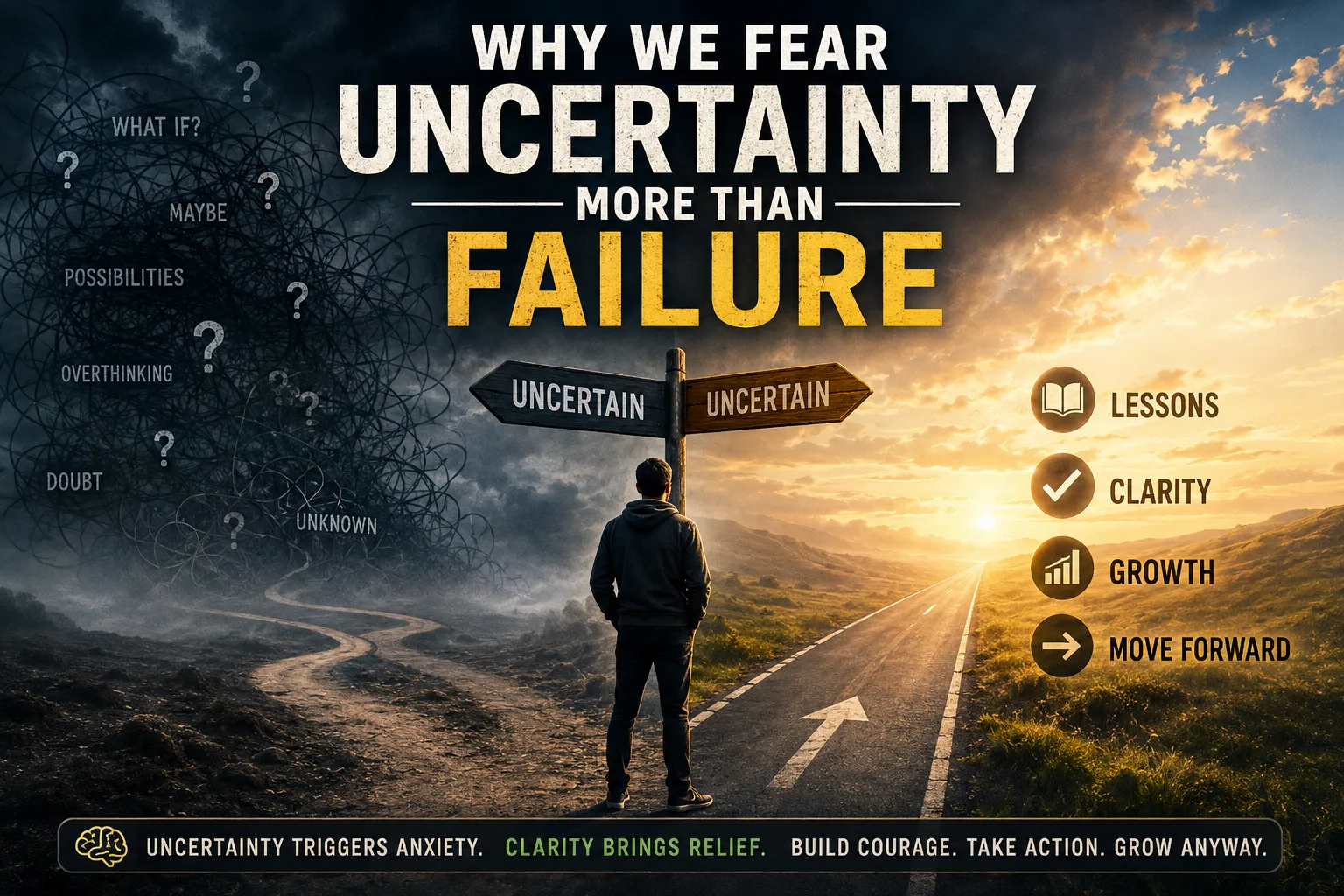
Why We Fear Uncertainty More Than Failure
Failure can hurt, but uncertainty can feel even worse. Explore why the human brain struggles with unknown outcomes and why not knowing can sometimes feel more threatening than knowing something will go wrong.
Why We Fear Uncertainty More Than Failure
Imagine two situations.
In the first, you know you failed.
The exam result is already out.
The deal collapsed.
The client said no.
The relationship ended.
It hurts.
But at least the uncertainty is over.
Now imagine something different.
The result hasn't arrived.
The investor hasn't replied.
The medical report is pending.
Your boss scheduled a meeting but didn't explain why.
Your message has been read, but there is no response.
Nothing bad has actually happened.
Yet your mind refuses to leave the situation alone.
You replay possibilities.
Construct explanations.
Predict disasters.
Check your phone again.
And somehow...
not knowing can feel worse than knowing you failed.
That seems irrational.
Failure is real.
Uncertainty is only possibility.
So why can possibility create so much stress?
Because the human brain does not merely respond to bad outcomes.
It also responds strongly to unpredictability.
And sometimes the inability to know what happens next becomes its own threat.
The Brain Wants to Predict What Comes Next
Your brain is constantly making predictions.
When you walk downstairs, you expect the next step to be where it usually is.
When someone throws a ball, your brain estimates where it will travel.
When you hear the beginning of a familiar sentence, you often anticipate the ending.
Prediction allows the brain to prepare before events fully unfold.
That is useful for survival.
If an environment is predictable, you can adjust your behavior.
If winter is coming, gather food.
If a storm is approaching, seek shelter.
If a dangerous animal follows a recognizable pattern, avoid it.
Uncertainty removes that advantage.
When the brain cannot determine what happens next, preparation becomes more difficult.
And that lack of control can feel threatening even before anything bad occurs.
🟢 Established Psychological Evidence
Psychological research consistently shows that uncertainty and unpredictability can increase stress and anxiety, particularly when outcomes are personally important or potentially threatening.
Failure Gives the Brain an Answer
Failure is painful.
But it contains information.
The interview is over.
You didn't get the job.
The startup experiment failed.
Users didn't convert.
The exam score is final.
Now the brain can begin asking:
What happened?
What can I learn?
What should I do next?
The problem has changed from prediction to response.
Uncertainty offers no such closure.
There may be nothing to fix yet.
Nothing to accept.
Nothing to act on.
So the brain keeps the problem open.
Open Loops Are Hard to Ignore
Imagine receiving this message:
"We need to talk tomorrow."
That is all.
What happens next?
Your brain begins generating possibilities.
Did I do something wrong?
Is something happening at work?
Is this relationship ending?
Is there good news?
Did somebody hear something?
A four-word message can consume hours of attention.
Why?
Because the situation is unresolved.
There is an unanswered question.
And unresolved questions tend to keep returning to consciousness.
The mind wants completion.
Uncertainty Multiplies Possible Threats
A known failure contains one bad outcome.
Uncertainty can contain twenty.
Suppose a business proposal is rejected.
Painful.
But definite.
Now suppose the client says:
"We're still considering it."
Your brain can generate multiple futures:
They might accept.
They might reject.
They may negotiate.
A competitor may win.
Your price may be too high.
Your presentation may have failed.
They may simply be delayed.
The actual future still contains only one eventual outcome.
Your imagination temporarily contains all of them.
That can make uncertainty psychologically expensive.
The Worst-Case Scenario Problem
When information is missing, humans don't always fill the gap with neutral possibilities.
Threatening possibilities can receive disproportionate attention.
That makes evolutionary sense.
If you hear movement in bushes and cannot identify the source, assuming:
"Probably nothing"
is emotionally comfortable.
Assuming:
"Possibly a predator"
may be safer.
Modern uncertainty usually doesn't involve predators.
It involves:
Emails.
Relationships.
Investments.
Careers.
Health.
But the brain still pays close attention to unresolved threat.
Why Waiting Can Feel Worse Than Bad News
Consider waiting for an important result.
You may think:
"I just want to know, even if the answer is bad."
That statement sounds strange until you understand what certainty provides.
Certainty allows emotional adaptation.
If the answer is bad, grief, planning, coping, or problem-solving can begin.
Before the answer arrives, the mind repeatedly switches between possibilities.
Hope.
Fear.
Hope again.
Another possible disaster.
Temporary optimism.
Then doubt.
This fluctuation itself can be exhausting.
🟡 Context-Dependent / Active Research
Research on anticipatory stress suggests that waiting for uncertain outcomes can sometimes produce substantial distress. However, whether uncertainty feels worse than a known negative outcome depends on the individual, the stakes, perceived control, and the type of uncertainty involved.
Ambiguity Aversion
Imagine two boxes.
Box A
You know it contains:
50 red balls.
50 black balls.
Box B
It also contains red and black balls.
But you have no idea how many of each.
Now suppose you receive money if you draw a red ball.
Which box would you choose?
Many people prefer Box A.
Why?
The probability is known.
Box B might actually contain 90 red balls.
It could be better.
But because the probability is uncertain, people often avoid it.
This tendency is known as ambiguity aversion.
We often prefer known risks over poorly understood risks.
🟢 Established Psychological Evidence
Decision-making research has repeatedly demonstrated ambiguity aversion, where people often prefer options with known probabilities over options whose probabilities are unclear.
Known Risk Feels More Controllable
Compare:
There is a 20% chance this project fails.
with:
We don't know the failure rate.
The second statement can feel more threatening even though the true risk might be lower than 20%.
The reason is partly psychological.
A known probability creates structure.
You can calculate.
Compare.
Plan.
Insure.
Diversify.
Set limits.
Unknown risk gives you less information for action.
And humans often experience lack of control as stressful.
Control Changes How Uncertainty Feels
Imagine being a passenger in a car during difficult weather.
Now imagine driving the same car yourself.
The objective danger may be similar.
Yet some people feel calmer while driving because they possess control.
The same pattern appears in uncertain situations.
You may tolerate uncertainty better when you believe:
"There is something I can do."
Apply elsewhere.
Ask for more information.
Reduce risk.
Prepare alternatives.
Leave.
Wait deliberately.
When no meaningful action exists, uncertainty can feel much harder.
Why Entrepreneurs Live Inside Uncertainty
Starting a business is essentially purchasing a very expensive subscription to uncertainty.
Will customers care?
Will the product work?
Will acquisition costs remain manageable?
Will competitors react?
Will investors fund the next round?
Will regulation change?
Will the team survive?
No spreadsheet eliminates these questions completely.
This is one reason entrepreneurship can be psychologically difficult even before anything has actually failed.
The founder is repeatedly exposed to unresolved outcomes.
And people differ substantially in how well they tolerate that state.
Failure Can Actually Be Useful Data
Suppose you launch a product.
It fails immediately.
Conversion is terrible.
Customers clearly don't understand the value.
Painful.
But useful.
Now compare that with:
Conversion is mediocre.
Some customers love it.
Most ignore it.
Retention varies wildly.
No obvious pattern emerges.
Which situation is easier to act on?
Often the clear failure.
A clean negative result can generate information.
Ambiguous results create debate.
Should we continue?
Pivot?
Wait?
Spend more?
Run another experiment?
The problem isn't merely whether the result is good or bad.
It is whether the result tells you what to do next.
Uncertainty and Anxiety
For some people, uncertainty is especially difficult to tolerate.
Psychologists often discuss this using the concept of intolerance of uncertainty.
Someone high in intolerance of uncertainty may interpret uncertain situations as especially stressful or unacceptable.
They may seek repeated reassurance.
Over-plan.
Avoid decisions.
Constantly check information.
Or mentally rehearse possible outcomes.
The behavior attempts to create certainty.
But certainty may be impossible.
🟢 Established Psychological Evidence
Intolerance of uncertainty is a well-studied psychological construct associated with anxiety and worry. Higher intolerance of uncertainty is linked to greater difficulty coping with ambiguous or unpredictable situations.
The Reassurance Trap
Suppose you're waiting for an important email.
You check your inbox.
Nothing.
Thirty seconds later:
Check again.
Nothing.
Five minutes later:
Again.
Each check briefly reduces uncertainty.
Maybe the answer arrived.
But the relief lasts only until the uncertainty returns.
This can create a loop:
Uncertainty → checking → temporary relief → uncertainty → checking
The behavior feels useful.
But you haven't gained meaningful control.
You've simply purchased thirty seconds of relief with another refresh.
Worry Pretends to Be Preparation
Worry often feels productive.
If you think through every possible disaster, maybe you'll be ready.
Sometimes planning genuinely helps.
But worry can cross into something else.
Repeating the same possibilities without generating new actions.
What if they reject me?
What if the business fails?
What if I embarrass myself?
What if something goes wrong?
The mind feels busy.
But busyness is not always problem-solving.
A useful test is:
"Did this thought produce a new action?"
If not, the brain may simply be circling uncertainty.
Why Failure Can Feel Cleaner
Consider someone deciding whether to ask for a promotion.
Two possibilities:
Ask and receive a clear no.
Or never ask.
The rejection hurts.
But it ends the question.
Avoiding the conversation preserves possibility.
Maybe they would say yes.
Maybe next month.
Maybe you're not ready.
Maybe you should wait.
Years can disappear inside that ambiguity.
A known failure can hurt once.
Uncertainty can charge interest.
Avoidance Protects Uncertainty
People sometimes avoid decisions because they fear failure.
But avoidance does something interesting.
It prevents both failure and information.
Don't apply for the job.
You cannot be rejected.
But you also never discover whether you could have been accepted.
Don't launch the product.
It cannot fail.
But you never learn whether customers wanted it.
Don't ask the person out.
No rejection.
No answer.
Avoidance turns uncertainty into a permanent condition.
Sometimes We Prefer a Bad Answer
This helps explain a curious human preference.
People will occasionally choose a known negative outcome over an uncertain one.
Not because the known outcome is objectively better.
Because certainty allows psychological preparation.
At least you know.
At least you can act.
At least the waiting ends.
That phrase:
"At least I know now."
contains the entire psychology of uncertainty in five words.
But Uncertainty Is Not Always Bad
There is an important counterpoint.
Uncertainty also creates:
Hope.
Curiosity.
Opportunity.
Discovery.
Surprise.
Adventure.
A completely predictable life would not necessarily be desirable.
Humans often enjoy uncertainty when the stakes feel manageable.
Mystery novels.
Sports.
Travel.
Games.
Entrepreneurship.
Romance.
The same mind that hates uncertainty in one context can actively seek it in another.
The difference often lies in whether uncertainty feels:
Threatening
or
interesting.
Why This Matters
The goal is not to eliminate uncertainty.
That is impossible.
The goal is to become better at distinguishing:
Risk you can reduce
from
uncertainty you must tolerate.
Some situations require more information.
Some require preparation.
Some require action.
And some require accepting that the answer simply does not exist yet.
That final category may be the hardest.
Because sometimes the most rational thing you can do is...
Wait.
And the human brain deeply resents being told that doing nothing is currently the optimal strategy.
When Uncertainty Becomes a Search for Certainty
Humans do not merely dislike uncertainty.
We often try to eliminate it psychologically, even when eliminating it factually is impossible.
Something confusing happens.
We want an explanation.
Something frightening happens.
We want a cause.
The future becomes unpredictable.
We want someone to tell us what comes next.
Usually, seeking answers is rational.
Knowledge reduces uncertainty.
Investigation solves problems.
Planning improves decisions.
But sometimes there simply isn't enough information yet.
And that creates an uncomfortable choice:
Accept uncertainty.
Or:
Adopt an explanation that makes uncertainty disappear.
The second option can feel remarkably attractive.
Even when the explanation is weak.
Certainty Can Feel Better Than Accuracy
Imagine two doctors discussing unexplained symptoms.
Doctor A says:
"Based on the current evidence, there are several possibilities. We need more tests."
Doctor B says:
"I know exactly what's causing this."
Psychologically, Doctor B may feel more reassuring.
There is an answer.
There is direction.
The uncertainty disappears.
But confidence does not guarantee accuracy.
Sometimes the scientifically responsible answer really is:
"We don't know yet."
Unfortunately, uncertainty is considerably less emotionally satisfying than certainty delivered with excellent posture.
Why Simple Explanations Become Attractive
Complicated events usually have complicated causes.
Economic crises.
Wars.
Disease outbreaks.
Corporate failures.
Political changes.
Social unrest.
These events may involve hundreds of interacting variables.
But complex explanations leave uncertainty behind.
Simple explanations provide psychological closure.
This happened because of X.
Done.
One cause.
One villain.
One explanation.
The world becomes understandable again.
The explanation may be wrong.
But psychologically, it has solved another problem:
It made uncertainty disappear.
Conspiracy Beliefs and Uncertainty
This is one reason researchers have investigated relationships between uncertainty, perceived lack of control, and conspiracy beliefs.
Conspiracy theories can provide highly structured explanations for confusing events.
Nothing is random.
Someone planned it.
Someone benefits.
Everything connects.
That narrative can transform an unpredictable world into an intentional one.
And strangely, an intentionally dangerous world can sometimes feel psychologically easier to understand than a chaotic one.
🟡 Context-Dependent / Active Research
Research has found associations between psychological factors such as uncertainty, perceived lack of control, threat, and endorsement of some conspiracy beliefs. However, conspiracy belief is influenced by many factors, and uncertainty alone does not explain why people adopt such beliefs.
Randomness Is Uncomfortable
Humans are exceptional pattern detectors.
That ability is enormously useful.
Footprints indicate an animal.
Dark clouds predict rain.
Repeated symptoms suggest disease.
Patterns help us understand causes.
But pattern detection can overshoot.
Sometimes events are coincidences.
Sometimes markets move unpredictably.
Sometimes multiple unrelated events happen close together.
Sometimes there is no satisfying hidden explanation.
The brain can nevertheless search for one.
Because:
"I understand what caused this"
often feels safer than:
"Several things happened, and we still don't fully understand why."
Uncertainty in Relationships
Few environments generate uncertainty as efficiently as human relationships.
A person replies differently than usual.
Immediately:
Are they upset?
Did I say something?
Are they losing interest?
Are they busy?
Did something happen?
The available evidence may consist entirely of:
One unusually short message.
The brain supplies the remaining screenplay.
Mind Reading
Psychologists sometimes use mind reading to describe a cognitive pattern where someone assumes they know what another person thinks or feels without sufficient evidence.
For example:
"They haven't replied because they're angry."
Maybe.
But other explanations exist.
They're working.
Sleeping.
Driving.
Distracted.
Their phone died.
They saw the message and forgot.
The problem isn't considering the negative possibility.
The problem is converting a possibility into certainty.
Ask Instead of Predicting
When information can reasonably be obtained, communication often beats speculation.
Instead of spending three hours constructing seventeen explanations:
Ask.
That sounds painfully obvious.
Humans nevertheless possess a strange willingness to perform amateur telepathy before sending one clarifying message.
Of course, asking isn't always possible.
Sometimes another person's intentions remain uncertain.
Then the challenge changes from solving uncertainty to tolerating it.
Financial Markets Are Uncertainty Machines
Markets provide another excellent example.
Investors desperately want certainty.
Will the market rise?
Will interest rates fall?
Will this company beat earnings?
Will gold rally?
Will a recession begin?
There are forecasts.
Models.
Analysts.
Indicators.
Historical patterns.
All can provide useful information.
None removes uncertainty.
Markets involve millions of participants responding to changing information.
The future cannot simply be extracted from a chart with guaranteed accuracy.
Probability Is Not Certainty
Suppose an investment strategy historically wins 70% of the time under specific conditions.
That does not mean:
"The next trade will win."
It means the next outcome remains uncertain.
Even a genuinely strong probabilistic edge can produce losses.
Humans struggle with this distinction because we naturally want predictions to become:
YES
or
NO.
But many real decisions are:
70% versus 30%.
55% versus 45%.
Unknown but estimable.
Good decision-making often requires acting without knowing which individual outcome will occur.
A Good Decision Can Still Fail
This is one of the hardest lessons about uncertainty.
Imagine taking a decision with an 80% probability of success.
It fails.
Was the decision necessarily wrong?
No.
An 80% probability still contains a 20% failure probability.
Likewise, someone can make a terrible decision and get lucky.
This means:
Outcome quality and decision quality are not identical.
If you judge every decision solely by its outcome, randomness will teach you terrible lessons.
🟢 Established Psychological Evidence
Decision science distinguishes between evaluating a decision based on the information available when it was made and evaluating it purely by the eventual outcome. Uncertain environments allow good decisions to produce bad outcomes and poor decisions to occasionally succeed.
Entrepreneurs Cannot Wait for Certainty
Suppose you're considering launching a startup.
You want to know:
Will customers pay?
How large is the market?
What will acquisition cost?
How quickly will competitors respond?
What will retention look like?
You can research.
Interview customers.
Build prototypes.
Run experiments.
Analyze competitors.
All of this reduces uncertainty.
None eliminates it.
Eventually you reach a point where obtaining additional certainty becomes more expensive than taking action.
You have to test reality.
Replace Certainty With Experiments
Instead of asking:
"Will this business succeed?"
ask:
"What is the cheapest experiment that reduces the most important uncertainty?"
Don't know whether customers will pay?
Build a landing page.
Don't know which message converts?
Run multiple versions.
Don't know whether users return?
Measure retention.
Don't know whether the product solves the problem?
Give a crude version to real users.
The goal isn't predicting the entire future.
It is reducing uncertainty one important question at a time.
Reversible and Irreversible Decisions
Another useful approach is separating decisions by reversibility.
Some decisions are easy to undo.
Try a new advertising campaign.
Test different pricing.
Change a landing page.
Run a small experiment.
These decisions often don't deserve weeks of anxiety.
Other decisions are difficult or expensive to reverse.
Signing a major long-term contract.
Making a huge capital investment.
Selling a company.
Those deserve more analysis.
Not every uncertain decision deserves the same amount of certainty.
The Cost of Waiting Matters Too
People often think:
"I'll decide when I know more."
Sometimes that's sensible.
But waiting is itself a decision.
And waiting has costs.
Lost opportunities.
Time.
Competitor movement.
Delayed learning.
Mental energy.
Imagine needing 95% confidence before launching anything.
You may avoid many failures.
You may also avoid nearly every opportunity.
There is a point where additional certainty becomes too expensive.
Planning Versus Worrying
Planning and worrying can feel remarkably similar.
Both involve thinking about the future.
But they produce different outputs.
Planning asks:
What might happen?
What can I do?
What resources do I need?
What is my backup plan?
Worrying asks:
What if?
What if?
What if?
What if?
The easiest distinction is action.
If thinking produces a useful decision, contingency, or preparation, it is probably helping.
If you have mentally replayed the same scenario fifteen times without generating new information or action, you've probably left planning behind.
Use the Control Test
When uncertainty becomes overwhelming, divide the situation into three categories.
What I Control
My actions.
My preparation.
My communication.
My risk exposure.
My response.
What I Can Influence
Other people's decisions.
Negotiations.
Team performance.
Customer behavior.
What I Cannot Control
Random events.
Other people's private thoughts.
Market movements.
The past.
Many external outcomes.
Then spend attention accordingly.
Humans routinely devote extraordinary cognitive resources to category three.
The returns are unimpressive.
Build Contingencies Instead of Predictions
Suppose you're worried that a client may reject a contract.
You cannot control the final answer.
But you can prepare:
If accepted → begin onboarding.
If they request changes → define negotiation limits.
If rejected → contact the next prospects.
Now uncertainty remains.
But helplessness decreases.
This is a powerful distinction.
You don't need to know what will happen if you're prepared for several plausible outcomes.
Set a Decision Deadline
Uncertainty can create endless analysis.
One more article.
One more opinion.
One more spreadsheet.
One more conversation.
Eventually research becomes procrastination wearing glasses.
Set a deadline.
"I will gather information until Friday at 6 PM, then decide using what I know."
This prevents the impossible pursuit of perfect certainty.
Define the Information That Would Actually Matter
Before researching further, ask:
"What information could realistically change my decision?"
If you cannot identify anything, more research may provide reassurance rather than useful evidence.
This is especially important in business.
Collecting data feels productive.
But information only has decision value if it can alter what you do.
Accept Residual Uncertainty
After all the research, planning, and risk reduction, something remains.
Uncertainty.
There is no technique that removes it completely.
At some point, you must act while accepting:
"I might be wrong."
That isn't recklessness.
It is the normal condition of decision-making in an unpredictable world.
The objective is not certainty.
It is making the best available decision while controlling the consequences if you're wrong.
Failure Becomes Less Frightening When It Is Survivable
Suppose a decision has uncertain outcomes.
Instead of obsessing over predicting which outcome will occur, ask:
"Can I survive being wrong?"
This changes everything.
Limit the downside.
Keep reserves.
Diversify.
Test small.
Avoid irreversible commitments when evidence is weak.
Create backup plans.
Now uncertainty becomes less threatening because failure no longer means catastrophe.
You don't need perfect prediction when you've designed resilience.
Frequently Asked Questions
Why does uncertainty cause anxiety?
Uncertainty makes prediction and preparation more difficult. When uncertain outcomes involve potential threats, the brain may maintain heightened attention and worry while attempting to determine what will happen.
Is uncertainty always worse than failure?
No.
The psychological response depends on the person, stakes, context, perceived control, and possible outcomes. In some situations, uncertainty can be exciting or hopeful rather than threatening.
What is intolerance of uncertainty?
It is a psychological tendency to experience uncertain situations as particularly difficult, stressful, or unacceptable. It has been strongly studied in relation to anxiety and worry.
Why do I keep checking for updates when waiting?
Checking can temporarily reduce uncertainty and provide a sense of control. Because that relief is short-lived, repeated checking can become a reinforcing cycle.
How can I become more comfortable with uncertainty?
Focus on controllable actions, distinguish productive planning from repetitive worry, use probabilities instead of demanding certainty, limit unnecessary checking, create contingency plans, and gradually practice making decisions without complete information.
Final Thoughts
Failure and uncertainty hurt in different ways.
Failure tells you:
Something went wrong.
Uncertainty tells you:
Something might go wrong, but you don't know what, when, or whether it will happen at all.
That ambiguity keeps the brain searching.
Predicting.
Checking.
Preparing.
Sometimes catastrophizing.
A definite failure closes one future.
Uncertainty keeps many futures alive simultaneously.
That is why waiting can sometimes feel worse than losing.
Why unanswered messages occupy the mind.
Why investors crave predictions.
Why entrepreneurs over-research decisions.
Why people seek simple explanations for complicated events.
And why:
"At least now I know"
can feel strangely relieving after bad news.
But uncertainty is not an error in life that eventually disappears.
It is built into the system.
Careers are uncertain.
Businesses are uncertain.
Relationships are uncertain.
Markets are uncertain.
Health is uncertain.
The future itself is uncertain.
So the useful skill is not learning how to eliminate uncertainty.
It is learning how to operate despite it.
Gather enough evidence.
Reduce the risks you can.
Prepare for plausible outcomes.
Protect yourself from catastrophic downside.
Then act.
Because eventually, seeking certainty stops reducing risk and starts preventing movement.
And sometimes the only way to discover what happens next...
is to allow the future to happen.