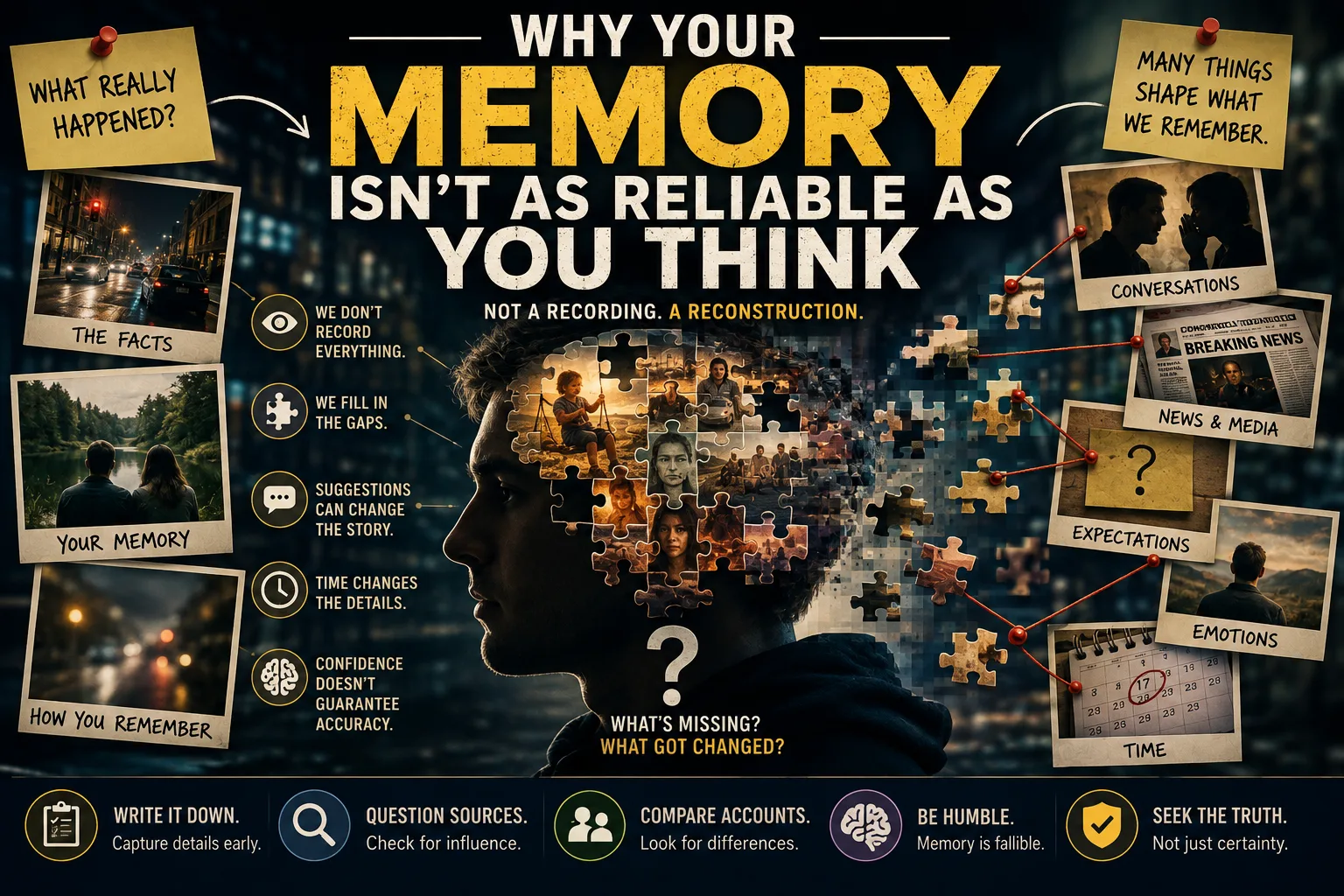
Why Your Memory Isn't as Reliable as You Think
Your memories may feel like accurate recordings of the past, but the brain reconstructs them each time you remember. Discover how details can change, disappear, and even appear without you realizing it.
Why Your Memory Isn't as Reliable as You Think
Think about one of your clearest childhood memories.
Maybe it's your first day at school.
A family vacation.
A birthday party.
An argument.
A moment when you were frightened, embarrassed, or incredibly happy.
You can probably picture pieces of it.
Where you were.
Who was there.
What happened.
Perhaps even what somebody said.
And because the memory feels vivid, you naturally assume something:
That's what happened.
But memory doesn't work like a video recording.
Your brain doesn't simply retrieve a perfectly preserved file whenever you remember something.
Instead, remembering is largely a reconstructive process.
Pieces of stored information are assembled into an experience that represents the past.
And during that reconstruction, memories can change.
Details can disappear.
Different events can become mixed together.
Later information can influence earlier memories.
Expectations can fill missing pieces.
And sometimes people can confidently remember events or details that never happened at all.
The disturbing part isn't simply that memory makes mistakes.
It's that an inaccurate memory can still feel completely real.
Memory Is Not a Camera
A camera records whatever enters its field of view.
Human memory does something fundamentally different.
Your brain must first decide what receives attention.
Then information has to be encoded.
Some of it is consolidated into longer-term memory.
Later, when you attempt to remember the event, relevant information must be retrieved.
Problems can occur at every stage.
You may never notice a detail.
You may encode it poorly.
Parts may weaken over time.
Similar memories may interfere with one another.
And reconstruction may introduce information that wasn't originally present.
So when someone says:
"I remember exactly what happened."
their confidence may be genuine.
But confidence alone cannot guarantee accuracy.
Memory Is Reconstructive
One of the most important ideas in memory science is that remembering involves reconstruction.
Suppose you attended a dinner six months ago.
You probably did not store every second.
Instead, you may retain fragments:
Where you sat.
Who attended.
A funny conversation.
The food.
Something embarrassing your friend said.
When remembering the dinner later, your brain creates a coherent representation from available information.
Usually, this works remarkably well.
But reconstruction also creates opportunities for distortion.
🟢 Established Psychological Evidence
Memory research has repeatedly demonstrated that human memory is reconstructive rather than a perfect literal recording of experience. Retrieval can be influenced by existing knowledge, expectations, later information, and the conditions under which an event is remembered.
Your Brain Stores Meaning Better Than Every Detail
Imagine someone tells you:
"Sarah drove across town because she needed groceries before the store closed."
Later, you might remember:
Sarah went to buy groceries before closing.
But perhaps you forget:
Which route she took.
Exactly what time she left.
The precise wording.
What vehicle she drove.
Memory often preserves the gist or meaning of an experience better than every individual detail.
That is usually useful.
You don't need a word-for-word transcript of every conversation you've ever had.
Your brain would become the world's least practical archive.
But preserving meaning while losing details creates another problem.
When details are missing, reconstruction may fill them in.
Schemas Help Fill the Gaps
Suppose I ask you to imagine eating dinner at a typical American restaurant.
You probably expect:
A host or server.
Menus.
Tables.
Ordering food.
Drinks.
A bill.
Perhaps tipping.
These expectations form part of your general knowledge about how restaurants work.
Psychologists often discuss organized knowledge structures like these as schemas.
Schemas help us understand situations quickly.
But they can also influence memory.
If something normally happens in a restaurant, you may later believe it happened during a particular restaurant visit even if you're not completely sure.
The Misinformation Effect
Now things become considerably stranger.
Imagine witnessing a car accident.
Later, someone asks:
"How fast were the cars going when they smashed into each other?"
Another witness is asked:
"How fast were the cars going when they contacted each other?"
The event was identical.
Only the wording changed.
Classic research by psychologists Elizabeth Loftus and John Palmer showed that wording used after an event could influence participants' estimates and later reports.
This became part of a broader body of research on the misinformation effect.
Information encountered after an event can influence how that event is subsequently remembered.
🟢 Established Psychological Evidence
The misinformation effect is a well-established phenomenon in memory research. Misleading information introduced after an event can alter later reports about what people remember.
A Question Can Change a Memory
This has enormous implications.
Imagine asking:
"Did you see the broken headlight?"
versus:
"Did you see a broken headlight?"
Tiny differences in language can imply that something existed.
Leading questions can therefore introduce information into the reconstruction process.
That doesn't mean every suggestion automatically creates a false memory.
But it means interviews need to be conducted carefully when accurate recollection matters.
Especially when the stakes involve criminal investigations.
Eyewitness Memory Can Be Wrong
Eyewitness testimony feels powerful.
Someone stands in court and says:
"I saw that person."
They appear certain.
They remember the face.
Why wouldn't we trust them?
Because identification requires several complicated memory processes.
The witness had to:
See the person clearly.
Pay attention.
Encode facial information.
Retain that information.
Later retrieve it.
Compare it with possible suspects.
Avoid contamination from subsequent information.
Each stage introduces opportunities for error.
Stress Doesn't Automatically Create Perfect Memories
Crimes and accidents can be emotionally intense.
It might seem reasonable to assume:
"The event was traumatic, so they must remember everything."
Not necessarily.
Stress can affect attention and memory in complicated ways.
During threatening situations, attention may become concentrated on particular details while other information receives less processing.
A witness might remember the threatening object extremely well but have weaker memory for peripheral details.
Emotion can make an event memorable without making every component accurate.
Weapon Focus
Research has examined a phenomenon known as the weapon focus effect.
During a threatening event involving a weapon, attention may become concentrated on the weapon.
That can reduce memory for other details, including aspects of the person holding it.
This makes intuitive sense.
If someone suddenly points a gun during a robbery, your brain may consider the gun somewhat more urgent than memorizing the robber's jawline for a future police lineup.
Attention is limited.
What receives attention affects what can later be remembered.
Confidence and Accuracy Are Not the Same Thing
One of the most dangerous assumptions about memory is:
"They sound extremely confident, so they must be correct."
Confidence can contain useful information under certain conditions.
But confidence and accuracy are not interchangeable.
People can confidently remember incorrect details.
And confidence itself can change after receiving feedback.
Imagine identifying someone from a lineup.
An investigator responds:
"Good, you identified the suspect."
That confirmation may increase confidence in the identification.
The memory didn't suddenly become more accurate.
The person's belief in their memory changed.
False Memories
A false memory is not simply lying.
A person who lies knows the statement is false.
Someone experiencing a false memory may sincerely believe they remember something that did not occur, or remember an actual event with significant inaccuracies.
That distinction matters.
The person isn't necessarily trying to deceive anyone.
Their subjective experience can feel like genuine remembering.
Can Entire Events Be Remembered Incorrectly?
Under some experimental conditions, researchers have demonstrated that suggestion and other influences can contribute to people developing false memories or partial recollections of events that did not occur.
But this topic requires careful handling.
It does not mean:
"Researchers can effortlessly implant any memory they want."
False-memory formation varies considerably.
People differ.
Events differ.
Methods differ.
And remembering an inaccurate detail is very different from constructing an elaborate false autobiographical event.
🔴 Common Myth / Misconception
Memory research does not show that every memory is unreliable or that anyone can easily be convinced they experienced any imaginary event. Memory can be highly useful and accurate while still being vulnerable to predictable forms of distortion.
Source Monitoring Errors
Imagine remembering an interesting fact.
You know you've heard it before.
But where?
A professor?
A newspaper?
A friend?
A YouTube video?
Did you perhaps merely imagine it?
Memory includes not only information but information about its source.
Sometimes the content survives while the source becomes confused.
This can produce a source monitoring error.
"I Thought I Came Up With That"
Suppose you hear a clever business idea during a meeting.
Three months later, you remember the idea.
But forget who originally suggested it.
Now it feels familiar.
Eventually, you may genuinely believe:
"I had this idea months ago."
You remembered the content.
You lost the source.
This phenomenon can contribute to accidental plagiarism and disputes over who originally said what.
Sometimes nobody is deliberately stealing anything.
Memory simply failed to preserve ownership information.
Déjà Vu Shows Familiarity Can Exist Without Context
Déjà vu creates a peculiar sensation:
"I've experienced this before."
Even when you know logically that you probably haven't.
One explanation involves a mismatch between feelings of familiarity and successful recollection.
Something about the current experience triggers familiarity.
But you cannot identify the original source.
The brain receives:
FAMILIAR
without:
HERE IS WHY.
The result can feel deeply strange.
Memories Change Over Time
Suppose you tell a story about your first job.
The first time, you describe what happened.
Years later, you've told the story twenty times.
Certain details become central.
Others disappear.
You simplify the sequence.
Perhaps one line becomes funnier.
Eventually, you may partly remember the story you've repeatedly told rather than the original experience in all its messy complexity.
Memory is not frozen.
Retrieval itself can influence what remains accessible later.
Reconsolidation
When a memory is retrieved, it can enter a state where it becomes susceptible to modification before being stored again.
This process is associated with memory reconsolidation.
The neuroscience is complex, and reconsolidation should not be reduced to:
"Every time you remember something, you completely rewrite it."
That is far too simplistic.
But retrieval is not necessarily a passive process.
Remembering can interact with later learning and updating.
Why Childhood Memories Can Become Uncertain
Childhood memories present special challenges.
Many were formed years or decades ago.
Since then, you may have:
Seen photographs.
Heard parents tell stories.
Watched family videos.
Discussed the event repeatedly.
Imagined what happened.
Eventually, distinguishing between:
what you personally remember
and
what you learned later
can become difficult.
The Family Photograph Problem
Imagine seeing the same photograph from a childhood vacation hundreds of times.
You may eventually feel as though you remember the moment the picture was taken.
Maybe you do.
But perhaps the photograph itself helped construct the mental scene.
You know:
Where everyone stood.
What they wore.
What the location looked like.
The image supplies extraordinary detail.
The feeling of remembering does not automatically tell you where each detail originated.
Flashbulb Memories
Some events create extremely vivid memories.
People may remember:
Where they were.
Who told them.
What they were doing.
How they reacted.
Major disasters, attacks, elections, deaths, and culturally significant events can produce what researchers call flashbulb memories.
Because these memories are vivid, they often feel exceptionally accurate.
But vividness and accuracy are different properties.
Remembering 9/11
Researchers studying memories surrounding the September 11 attacks in the United States found that people's recollections could change over time even while confidence remained relatively high.
Someone might strongly remember where they were or how they first learned about the attacks.
Later reports could differ from earlier reports.
The subjective feeling:
"I will never forget exactly what happened"
does not guarantee every detail remained unchanged.
Emotion Strengthens Some Things and Distorts Others
Emotional events often become highly memorable.
But emotion does not transform memory into perfect recording.
It can prioritize certain information.
Central emotional details may become strongly remembered.
Peripheral details may be weaker.
Later retelling can further shape recollection.
So:
Vivid memory ≠ complete memory.
And:
Emotional certainty ≠ perfect accuracy.
Memory Is Selective
Think about everything that happened to you yesterday.
Every sound.
Every face.
Every sentence.
Every object.
Every movement.
Every advertisement.
Every license plate.
Every notification.
Most of it is already inaccessible.
That's not necessarily failure.
Forgetting is essential.
A brain that preserved every irrelevant detail equally would face enormous problems deciding what matters.
Memory is selective because cognition needs prioritization.
Forgetting Can Be Useful
We usually treat forgetting as a defect.
But forgetting serves important functions.
Old information can become irrelevant.
Similar memories can interfere with current decisions.
Minor details may not deserve permanent storage.
Forgetting helps reduce clutter.
The goal of memory isn't to preserve your entire life at maximum resolution.
It is to retain information useful for future behavior.
Unfortunately, evolution apparently prioritized usefulness over providing everyone with legally admissible internal CCTV.
Memory and Repetition
Repeated information often becomes easier to remember.
But repetition can create another effect:
familiarity.
And familiarity can influence judgments of truth.
If you encounter a claim repeatedly, it may begin to feel more believable simply because it becomes easier to process.
This is related to the illusory truth effect.
"I've Heard That Before"
Suppose you repeatedly encounter:
"Americans only use 10% of their brains."
The claim becomes familiar.
Later, familiarity may be mistaken for credibility.
But repetition does not create evidence.
A false statement repeated 500 times remains false.
It simply becomes a false statement your brain recognizes.
🟢 Established Psychological Evidence
Research on the illusory truth effect shows that repeated statements can sometimes be judged as more truthful than unfamiliar statements, even when repetition itself provides no evidence for their accuracy.
Memory Can Influence What You Believe
Memory isn't merely a record of beliefs.
It helps construct them.
You remember examples supporting an idea.
Forget contradictory examples.
Recall emotional experiences more easily.
Confuse where information originated.
Repeated claims become familiar.
Now your current judgment is being shaped by a memory system that was never designed to function as an objective database.
This connects memory directly with cognitive bias.
The Internet Creates a New Memory Environment
Before smartphones, remembering information itself was often necessary.
Now you can retrieve enormous amounts of information almost instantly.
Need the capital of a state?
Search it.
Forgot an actor's name?
Search it.
Need directions?
GPS.
Phone number?
Contacts.
Appointment?
Calendar.
Modern technology increasingly acts as external memory.
That changes what we need to remember internally.
Remembering Where Information Is
Sometimes knowing where to find information becomes more useful than memorizing the information itself.
You may not remember the exact statistic.
But you remember:
The report.
The website.
The database.
The document.
This isn't necessarily cognitive decline.
It can be an efficient division of labor between biological and digital memory.
The danger appears when:
"I can retrieve this information"
becomes confused with:
"I understand this information."
Those are very different achievements.
Your Memory Is Usually Useful
After reading all this, you might reasonably conclude:
"So I can't trust anything I remember?"
No.
That would be another mistake.
Memory works remarkably well much of the time.
You recognize friends.
Remember skills.
Navigate familiar environments.
Recall conversations.
Use knowledge learned years earlier.
Maintain relationships.
Perform your job.
Remember where you live, which remains rather convenient.
The lesson isn't:
Memory is useless.
It is:
Memory is reconstructive and fallible, so confidence should not be treated as proof of accuracy.
Why Two People Can Remember the Same Event Differently
Imagine two people having an argument.
A week later, they discuss what happened.
Person A remembers:
"You started shouting first."
Person B is equally certain:
"No. You raised your voice before I did."
Both insist they remember clearly.
One of them must be lying.
Right?
Not necessarily.
Two people can experience the same event and later remember it differently without either deliberately changing the story.
They may have paid attention to different details.
Interpreted the interaction differently.
Encoded different information.
Reconstructed missing details differently.
Discussed the event afterward.
And remembered it repeatedly from their own perspective.
Memory doesn't begin with an objective recording.
It begins with subjective experience.
You Never Experience an Event From a Neutral Camera
Imagine four people sitting in a conference room during a tense meeting.
The CEO remembers the financial discussion.
The designer remembers criticism of the product.
The engineer remembers a technical disagreement.
The new employee remembers how uncomfortable everyone looked.
Same meeting.
Four different experiences.
Attention determines what enters memory in the first place.
If you weren't paying attention to something, your brain cannot later retrieve a detailed recording that was never properly encoded.
Attention Is Selective
Your environment contains far more information than your brain can process consciously.
Right now there may be:
Background sounds.
Objects in your peripheral vision.
Sensations from your clothing.
Changes in lighting.
Your breathing.
Notifications.
Other people moving nearby.
Most of this receives little conscious attention.
Selective attention allows you to focus on what seems important.
But what seems important differs between people.
That means two witnesses can leave the same event with genuinely different information stored.
Interpretation Begins Before Memory
Suppose your manager says:
"We need to improve this report."
Employee A interprets it as:
Constructive feedback.
Employee B interprets it as:
Harsh criticism.
The sentence was identical.
The psychological event wasn't.
Past experiences, expectations, relationships, mood, and context influence interpretation.
Later, both people remember not only what happened but what the event meant to them.
Memory and Relationships
This becomes especially important during relationship conflicts.
Imagine someone arrives 30 minutes late.
One partner remembers:
"You didn't care enough to arrive on time."
The other remembers:
"Traffic was terrible and I kept trying to get there."
Notice how factual information and interpretation begin merging.
Fact:
Someone arrived late.
Interpretation:
They didn't care.
Memory can eventually preserve both as part of the same narrative.
Years later, the interpretation may feel almost as factual as the arrival time itself.
Repeated Arguments Can Rewrite the Story
Couples sometimes argue about the same event repeatedly.
Each repetition requires retrieval.
Each person explains their version.
New information enters the discussion.
Emotions return.
Certain details receive emphasis.
Others disappear.
Eventually, the remembered event may become increasingly organized around the conflict's current meaning.
The argument isn't merely about what happened.
It becomes about whose memory represents reality.
That is a dangerous escalation because memory rarely deserves that level of absolute confidence.
Nostalgia Changes the Past
Think about high school.
Was it better than life today?
Maybe.
But memory comparisons between past and present are complicated.
You experience today's frustrations in real time.
Bills.
Deadlines.
Traffic.
Work.
Stress.
Your memories of ten years ago have already undergone years of selection.
Many ordinary boring days disappeared.
Certain positive experiences survived.
The comparison can therefore become:
Today's complete reality
versus
Yesterday's highlight reel.
Hardly a fair contest.
Rosy Retrospection
Researchers have studied tendencies for some experiences to be remembered more positively afterward than they were experienced at the time.
This is sometimes called rosy retrospection.
Consider a vacation.
During the trip:
Flight delayed.
Hotel room disappointing.
Weather terrible one afternoon.
Feet hurt.
Restaurant overpriced.
Three years later:
"That trip was incredible."
The unpleasant details may fade faster than the overall positive meaning.
🟡 Context-Dependent / Active Research
People do not universally remember the past more positively. Nostalgia and retrospective evaluation depend on the event, personality, current mood, emotional significance, and how memories have been revisited.
Nostalgia Is More Than Inaccurate Memory
Nostalgia shouldn't simply be dismissed as remembering incorrectly.
Nostalgic memories can contribute to:
Identity.
Social connection.
Meaning.
Continuity between past and present.
Emotional regulation.
The past helps construct the story of who we are.
That makes autobiographical memory useful even when it isn't a perfectly objective historical archive.
Memory Helps Build Your Identity
Ask yourself:
Who are you?
Your answer depends partly on memory.
Where you grew up.
People you loved.
Things you accomplished.
Mistakes you made.
Experiences that changed you.
Values you developed.
Without autobiographical memory, maintaining a continuous sense of identity would be extraordinarily difficult.
Memory therefore does more than preserve events.
It helps create the narrative:
"This is my life."
But Narratives Simplify Reality
Real lives are messy.
Narratives aren't.
When telling your life story, you naturally create connections.
"That failure taught me resilience."
"That teacher changed my career."
"That relationship made me understand what I wanted."
These interpretations may be meaningful and accurate.
But they are still interpretations constructed partly with hindsight.
The person experiencing the original event didn't know what would happen next.
The person remembering it does.
Hindsight Can Reshape Personal Memory
Suppose you left a job and later built a successful company.
Years afterward, you might remember leaving as:
"I knew I was destined to build something myself."
Perhaps you did.
But maybe at the time you were:
Excited.
Terrified.
Uncertain.
Considering several options.
Thinking about returning to employment.
Later success can organize earlier memories into a cleaner story.
Human lives become considerably more coherent after we already know the ending.
Memory and Emotion
Your emotional state can influence what information becomes accessible.
When you're happy, positive memories may come more easily.
When you're angry at someone, memories of their previous mistakes can suddenly become remarkably available.
This can create feedback loops.
You're angry.
Negative memories become easier to retrieve.
Those memories justify the anger.
The stronger anger makes additional negative memories accessible.
Soon your brain has assembled an impressive prosecution case.
The defense appears to have misplaced its paperwork.
Memory Changes With Age
Memory changes across the lifespan.
But saying:
"Memory simply gets worse as you age"
is too crude.
Different memory systems and cognitive abilities follow different trajectories.
Some abilities can decline.
Others remain relatively stable.
Knowledge accumulated across decades can remain extremely strong.
Vocabulary and expertise may continue providing substantial advantages.
So aging does not produce one universal decline across every type of memory.
Working Memory
Working memory allows information to be temporarily maintained and manipulated.
For example:
Remembering a number long enough to enter it.
Following several instructions.
Doing mental arithmetic.
Keeping parts of a sentence active while understanding its meaning.
Working-memory performance can change with age, particularly when tasks become demanding or require handling multiple pieces of information simultaneously.
Episodic Memory
Episodic memory involves remembering specific experiences.
What happened.
Where.
When.
For example:
What you ate at a restaurant last weekend.
Where you parked yesterday.
Who attended a particular meeting.
Some aspects of episodic memory become more vulnerable with normal aging.
But again, individual differences are enormous.
Semantic Memory
Semantic memory involves general knowledge.
Paris is the capital of France.
George Washington was the first U.S. president.
Water freezes at a particular temperature under standard conditions.
Words have meanings.
This accumulated knowledge can remain strong across much of adulthood.
An older adult may therefore retrieve certain newly learned details less easily while possessing vastly more accumulated knowledge than a younger person.
Memory isn't one single ability controlled by one imaginary percentage meter.
Forgetting a Name Isn't Automatically a Warning Sign
Almost everyone experiences:
"I know their name..."
Nothing.
Then twenty minutes later:
The name appears.
This is often called a tip-of-the-tongue experience.
Such retrieval failures can become more frequent with age.
But ordinary forgetting does not automatically indicate neurological disease.
Memory performance varies with:
Sleep.
Stress.
Attention.
Distraction.
Fatigue.
Emotion.
Medication.
Age.
And countless situational factors.
Sleep Matters for Memory
Sleep isn't simply the period when the brain turns itself off.
Sleep plays important roles in memory consolidation.
Information acquired while awake undergoes further processing during sleep.
Poor sleep can therefore affect:
Learning.
Attention.
Encoding.
Consolidation.
Retrieval.
This creates an irritatingly obvious lesson students have spent generations attempting to negotiate with:
Sometimes sleeping before an exam is more useful than studying until 4 AM while surviving on caffeine and regret.
Exercise and Memory
Physical activity is associated with numerous benefits for brain and cardiovascular health.
Research also suggests that regular exercise can support aspects of cognitive functioning across the lifespan.
But beware of exaggerated claims.
There is no single workout that permanently upgrades memory.
Exercise should be understood as part of broader health behavior rather than a magical neurological cheat code.
Can You Train Your Memory?
Yes, particular memory skills can improve with practice.
Memory competitors demonstrate extraordinary feats such as remembering long sequences of numbers or cards.
They generally don't accomplish this through supernatural biological memory.
They use strategies.
One famous method is the method of loci, sometimes called a memory palace.
The Memory Palace
Imagine your home.
Front door.
Hallway.
Kitchen.
Living room.
Bedroom.
Now suppose you need to remember:
Milk.
Coffee.
Apples.
Soap.
Batteries.
Imagine:
Milk pouring through the front door.
A giant coffee cup blocking the hallway.
Apples exploding across the kitchen.
Soap covering the couch.
Batteries bouncing on your bed.
The stranger the imagery, the easier it may be to retrieve.
You then mentally walk through the familiar location.
Each place cues an item.
Ancient humans were using versions of this technique long before somebody invented a productivity app and charged $9.99 a month for remembering things.
Retrieval Practice Beats Passive Rereading
Suppose you're studying.
Method A:
Read the chapter five times.
Method B:
Read it once, close the book, and try to recall the important ideas.
The second method forces retrieval.
Retrieval practice is one of the most consistently supported learning strategies in cognitive psychology.
Testing yourself isn't merely measuring learning.
Retrieving information can strengthen later access to that information.
🟢 Established Psychological Evidence
Research on the testing effect, or retrieval-practice effect, shows that actively retrieving learned information can improve long-term retention compared with repeated passive study under many conditions.
Spacing Beats Cramming
Imagine studying for six hours.
Option A:
Six hours tonight.
Option B:
One hour across six different days.
Distributed practice often produces better long-term retention than concentrating equivalent study into one session.
This is known as the spacing effect.
Cramming can produce short-term familiarity.
Spacing requires repeatedly reconstructing information after some forgetting has occurred.
That effort can strengthen learning.
Why Rereading Feels Better Than It Works
Rereading creates familiarity.
You look at a paragraph and think:
"I know this."
But recognizing information while it sits directly in front of you is different from retrieving it independently later.
This creates an illusion of learning.
The textbook looks familiar.
The exam question does not.
A better test is:
Close the material.
Explain the concept without looking.
Suddenly the brain's accounting department discovers several missing assets.
Write Important Things Down
If accuracy matters, don't rely entirely on memory.
Meeting decisions.
Financial agreements.
Medical instructions.
Research observations.
Business metrics.
Deadlines.
Write them down.
External records reduce dependence on later reconstruction.
This becomes particularly valuable when multiple people need to agree about what happened.
A short written summary after an important meeting can prevent months of:
"That's not what we agreed."
Record Predictions Before Outcomes
Suppose you believe the S&P 500 will rise over the next year.
Write:
What you predict.
Why.
How confident you are.
What evidence would change your mind.
Then return later.
Without a record, hindsight bias can quietly rewrite your earlier position.
After the market moves, you may remember yourself as having been far more certain, or far more cautious, than you actually were.
Decision journals turn memory into evidence.
Photographs Can Help, But They Also Shape Memory
Photos preserve visual information extraordinarily well.
But photographs don't preserve the complete experience.
A picture captures:
One angle.
One moment.
One frame.
Repeatedly viewing that frame may cause it to dominate your later recollection.
You may remember what was photographed better than things occurring outside the camera.
Technology therefore doesn't merely preserve memory.
It can influence which parts of an experience remain accessible.
Should You Photograph Everything?
Probably not.
Research on photographing experiences has produced nuanced results.
Taking photographs can sometimes impair memory for certain observed details, particularly if people mentally outsource remembering to the camera.
But photography can also direct attention, preserve cues, and later support recollection.
How photographs are taken and reviewed matters.
So:
"Phones destroy memory"
is far too simplistic.
As usual, reality declined the opportunity to fit neatly inside a viral headline.
How to Preserve Important Memories More Accurately
When accuracy genuinely matters:
Write details soon afterward.
Memory has less opportunity to change.
Separate observation from interpretation.
Write:
"She left the meeting at 2:15 PM."
rather than:
"She stormed out because she was furious."
The first describes observable behavior.
The second adds interpretation.
Avoid repeatedly exposing yourself to unreliable accounts.
Other people's versions can influence your own recollection.
Preserve original records.
Emails.
Messages.
Photographs.
Documents.
Contemporaneous notes.
Be cautious with certainty.
Prefer:
"I remember..."
over:
"I know exactly..."
when objective records are unavailable.
How Eyewitness Procedures Can Reduce Errors
Because eyewitness memory is fallible, investigative procedures matter enormously.
Better practices can include:
Avoiding leading questions.
Recording interviews.
Obtaining witness confidence at appropriate stages.
Using carefully designed identification procedures.
Preventing investigators from unintentionally signaling which person they suspect.
Separating witnesses when appropriate so they don't contaminate one another's accounts.
The goal isn't assuming witnesses are dishonest.
It is protecting genuine memories from unnecessary influence.
Independent Accounts Matter
Imagine five people witness an accident.
If they immediately discuss what happened, their memories may begin influencing one another.
Someone says:
"The SUV ran the red light."
Another person wasn't sure.
Now that suggestion exists.
Later, the second person may remember the SUV crossing on red with greater confidence.
Obtaining independent accounts early can therefore preserve useful differences between witnesses instead of accidentally creating one shared story.
Don't Treat Memory Disagreement as Automatic Dishonesty
Suppose two friends remember an event differently.
The immediate temptation is:
"Someone is lying."
Sometimes someone is.
But memory disagreement alone does not prove deception.
Both people may sincerely remember different versions.
Before escalating, separate:
What both remember.
What differs.
What objective evidence exists.
What may be interpretation.
What information was learned afterward.
That approach is less emotionally satisfying than declaring yourself the Supreme Court of Childhood Arguments, but considerably more useful.
Frequently Asked Questions
Is human memory unreliable?
Human memory is generally functional and often accurate enough for everyday life, but it is not a perfect recording system. Memory can be affected by attention, forgetting, suggestion, interference, expectations, emotion, and reconstruction.
Can people remember events that never happened?
Research demonstrates that false memories and false details can occur. Under some conditions, suggestion can contribute to memories of events that did not occur. However, susceptibility varies, and it is misleading to claim that arbitrary detailed memories can easily be implanted in everyone.
Does confidence mean a memory is accurate?
Not necessarily. Confidence and accuracy are related under some conditions, but high confidence alone does not guarantee that every remembered detail is correct.
Why do two people remember the same event differently?
They may have attended to different information, interpreted the event differently, encoded different details, forgotten different information, or encountered different information afterward.
Does taking photos damage memory?
Not universally. Photographing can alter attention and memory, but effects depend on how photographs are taken, what is photographed, and whether images are later reviewed.
What is the best way to study something I need to remember?
For long-term retention, retrieval practice and spaced learning are generally much stronger strategies than relying primarily on passive rereading.
Final Thoughts
Your memory is one of the foundations of your identity.
It tells you:
Where you've been.
What you've learned.
Who you trust.
What hurt you.
What made you happy.
Which mistakes you don't want to repeat.
And what kind of person you believe yourself to be.
That makes it incredibly powerful.
But power should not be confused with perfect accuracy.
Memory isn't a recording retrieved from storage.
It is a biological system built to help you learn from the past and navigate the future.
It selects.
Compresses.
Associates.
Forgets.
Reconstructs.
Updates.
Usually, those abilities serve you extraordinarily well.
But they also mean a vivid recollection can contain mistakes.
Two honest people can disagree about what happened.
A photograph can influence what you remember.
A leading question can alter later reports.
Repeated misinformation can become familiar.
An emotional event can feel permanently preserved while individual details quietly change.
And years of retelling can turn a complicated experience into a beautifully coherent story that reality never had the courtesy to provide.
The lesson isn't to distrust every memory.
That would make ordinary life impossible.
Instead, treat memory according to the stakes.
For casual experiences, memory is usually enough.
For important agreements, write things down.
For studying, retrieve rather than merely reread.
For major decisions, record your reasoning before knowing the outcome.
For eyewitness evidence, use procedures designed around memory's limitations.
And when another person sincerely remembers something differently, leave room for a possibility more interesting than:
"One of us must be lying."
Sometimes both people are telling the truth as they remember it.
Their memories simply aren't identical to the past.
Because remembering is not replaying history.
It is the brain's best attempt to reconstruct it.