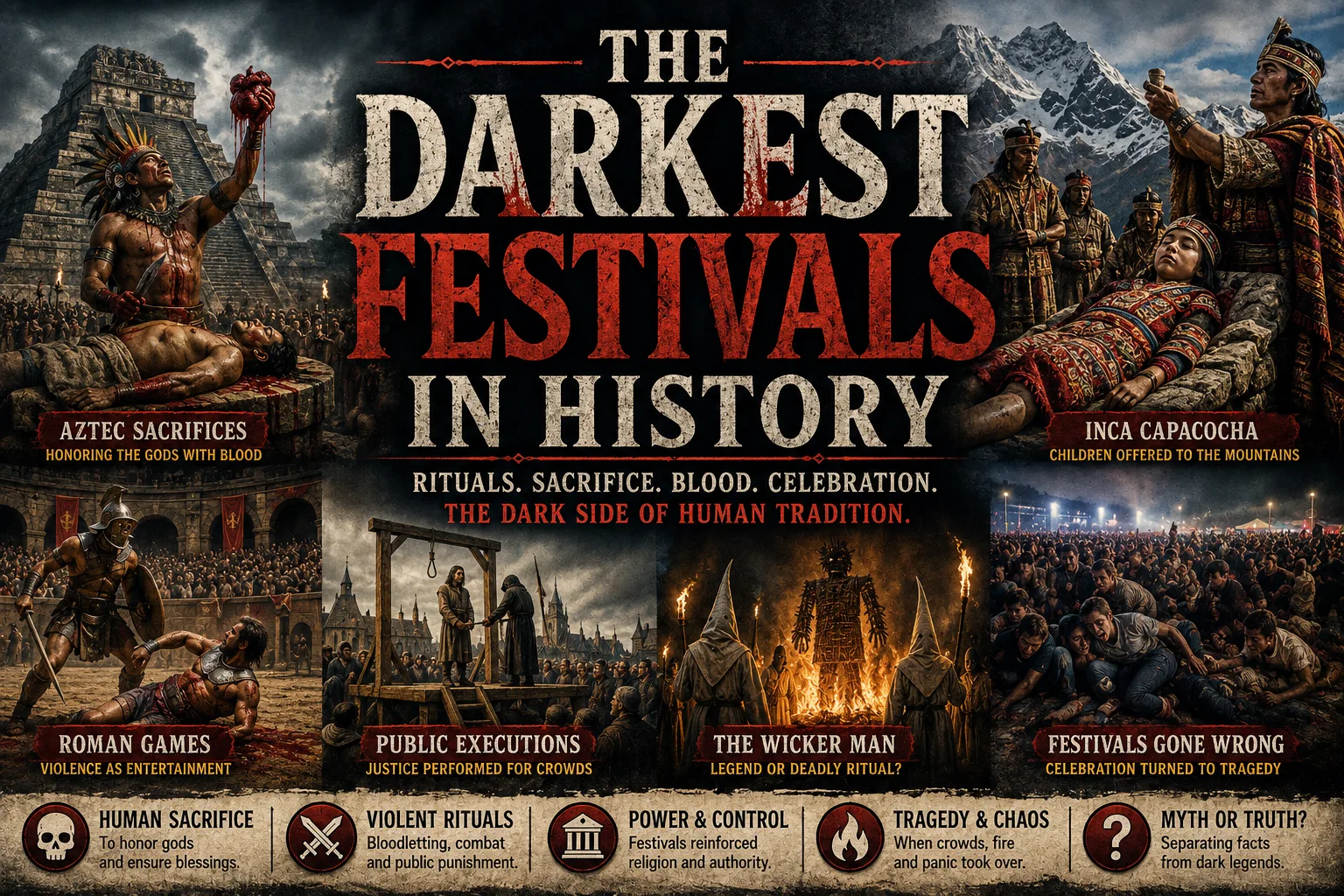
The Darkest Festivals in History: When Celebration Turned Deadly
Festivals are meant to bring communities together, but history records celebrations involving violence, sacrifice, punishment, and death. Explore some of history's darkest festivals and the truth behind their disturbing reputations.
The Darkest Festivals in History: When Celebration Turned Deadly
Today, the word festival usually means music, food, decorations, crowds, parades, and perhaps paying $14 for something that should legally qualify as a small cup of lemonade.
Historically, however, festivals could serve very different purposes.
They could honor gods.
Mark agricultural cycles.
Remember the dead.
Reinforce political authority.
Prepare communities for war.
Purify society.
Appease supernatural forces.
Or commemorate events that modern observers would find deeply disturbing.
Some ancient ceremonies involved bloodletting, animal sacrifice, public executions, ritual combat, extreme physical suffering, or human sacrifice.
But there is an important warning before entering this part of history.
Stories about supposedly "barbaric" ancient festivals have often been exaggerated by enemies, colonial writers, later chroniclers, popular entertainment, and modern internet mythology.
So the interesting question isn't:
Which civilization had the most horrifying festival?
It is:
Which disturbing practices are actually supported by historical or archaeological evidence, and which belong more to legend than history?
Because the truth is already dark enough.
We don't need to invent additional corpses.
Why Ancient Festivals Could Become Violent
Modern societies often separate religion, government, entertainment, and warfare into different institutions.
Many historical societies did not divide life so neatly.
A major religious festival could simultaneously be:
A political ceremony.
A public spectacle.
A military celebration.
A community gathering.
An agricultural ritual.
A demonstration of royal authority.
A religious obligation.
This meant that practices we would now consider horrifying could exist within events participants understood as sacred or socially necessary.
Human Sacrifice Was Real, But Not Universal
Human sacrifice is one of the most sensationalized subjects in ancient history.
It unquestionably occurred in some societies.
Archaeological evidence, historical accounts, inscriptions, and human remains provide evidence for ritual killing in several cultural contexts.
But claims about human sacrifice require caution.
Ancient writers sometimes accused rival peoples of sacrificing humans precisely because it portrayed those societies as uncivilized.
Later historians repeated those stories.
Modern entertainment amplified them.
Eventually:
"There may have been ritual killing"
becomes:
"Thousands of people were slaughtered every Tuesday."
Historical evidence rarely behaves that conveniently.
The Aztec Festivals of Tenochtitlan
Few civilizations are more closely associated with ritual sacrifice in popular culture than the Aztec Empire.
The association isn't entirely invented.
Human sacrifice occupied a genuine place within Aztec religious practice.
Aztec religion understood the cosmos as requiring continuing relationships between humans and divine forces.
Blood and sacrifice could carry profound religious significance.
Some ceremonies involved captives being sacrificed to particular deities.
But popular portrayals often flatten an enormously complicated religious system into:
Aztecs = people cutting hearts out constantly.
Reality was more complicated.
The Festival of Toxcatl
One particularly striking Aztec ceremony was associated with the deity Tezcatlipoca.
Historical sources describe the selection of a young man who served as an ixiptla, a living representation or embodiment of the deity.
For an extended period, he was treated ceremonially.
He wore elaborate clothing.
Received honors.
Participated in ritual activities.
Then, at the culmination of the ceremony, he was sacrificed.
To modern eyes, the transformation is difficult to comprehend.
For months:
Honor.
Beauty.
Sacred status.
Then:
Death.
But within the religious worldview surrounding the ceremony, the individual wasn't simply being treated as an ordinary prisoner awaiting execution.
He occupied a sacred ritual role.
Sacrifice and the Aztec Calendar
The Aztec ritual calendar contained numerous festivals associated with different deities and agricultural or cosmic processes.
Some involved:
Dancing.
Fasting.
Feasting.
Music.
Offerings.
Bloodletting.
Sacrifice.
Not every ceremony involved human death.
And different rituals carried different meanings.
Reducing the entire calendar to human sacrifice destroys most of what made the religious system historically interesting.
🟢 Strong Historical Evidence
Human sacrifice in Aztec religious practice is supported by multiple categories of evidence, including Indigenous and Spanish-era written sources, archaeology, iconography, and physical remains.
However, exact numbers reported for particular mass sacrifices remain debated.
Did the Aztecs Really Sacrifice 80,000 People at Once?
One famous claim concerns the dedication of the Templo Mayor in Tenochtitlan in 1487.
Some later accounts describe more than 80,000 captives being sacrificed over several days.
That number should not simply be repeated as established fact.
Historians have questioned whether sacrificing that many people within the reported time would have been logistically possible.
The ceremony may indeed have involved substantial sacrifice.
But the spectacular number could reflect political exaggeration, symbolic accounting, hostile reporting, or later distortion.
This distinction matters.
Evidence for sacrifice does not automatically validate every number attached to it.
The Roman Saturnalia Wasn't a Murder Festival
Now we encounter a festival that demonstrates how easily dark-history content becomes distorted.
Saturnalia was one of ancient Rome's most famous festivals.
It honored Saturn and became associated with:
Feasting.
Gift giving.
Gambling.
Public celebration.
Temporary relaxation of social conventions.
Masters sometimes served slaves during festivities.
A mock "king" could be selected to preside over revelry.
Modern retellings occasionally transform Saturnalia into something far darker.
Was the King of Saturnalia Sacrificed?
Some popular accounts claim that Romans selected a temporary "King of Saturnalia," allowed him indulgence, and then killed him.
That description should be treated very cautiously.
Mainstream evidence for ordinary Roman Saturnalia does not support portraying the festival as a routine human-sacrifice celebration.
Some arguments linking Saturnalia to ritual killing rely on later or unusual evidence and controversial interpretation.
So:
Saturnalia involved social inversion and chaotic celebration.
Yes.
Romans routinely crowned someone and murdered him at the end of every Saturnalia.
No solid basis for presenting that as standard practice.
🔴 Common Myth / Misconception
Saturnalia is frequently portrayed online as a festival ending in routine human sacrifice.
The historical evidence does not justify treating that claim as a normal feature of Roman Saturnalia.
Dark history becomes considerably less useful when every ancient party somehow ends with somebody being stabbed.
The Roman Games and Public Death
Rome did, however, possess public spectacles where people genuinely died.
Gladiatorial contests.
Executions.
Animal hunts.
Punishments staged before crowds.
These were not identical to Saturnalia, but major Roman celebrations and public events could include violent spectacles.
Condemned criminals might be executed theatrically.
Gladiators fought.
Animals were killed.
Crowds watched.
The violence had political as well as entertainment value.
Violence as Political Theater
Roman rulers understood the value of spectacle.
Large public events demonstrated:
Wealth.
Authority.
Military power.
Generosity.
Control over life and death.
Providing entertainment could strengthen relationships between rulers and citizens.
The arena therefore wasn't simply ancient entertainment.
It was also political communication.
Rome turned public spectacle into something resembling mass media.
Except occasionally the programming schedule involved lions.
The Maya and Ritual Bloodletting
Maya religious practice also incorporated blood as a powerful ritual substance.
Elite men and women performed bloodletting ceremonies.
These could involve piercing parts of the body and offering blood during religious rituals.
The purpose was not random self-harm.
Bloodletting could connect rulers with gods, ancestors, political legitimacy, and supernatural forces.
Some Maya contexts also provide evidence of human sacrifice.
The Sacred Cenote at Chichén Itzá
At Chichén Itzá in present-day Mexico, the Sacred Cenote has produced human remains alongside valuable offerings.
Historical and archaeological evidence indicates that the cenote held religious importance and that humans were deposited there in ritual contexts.
Exactly how every individual died and what each deposition represented is more difficult to establish.
Archaeology often provides physical evidence without leaving behind a convenient explanation card.
Maya Sacrifice Was More Complex Than Popular Culture Suggests
Like the Aztecs, Maya civilization is often portrayed through a narrow lens of sacrifice.
But Maya civilization lasted for centuries and included:
Cities.
Writing systems.
Astronomy.
Mathematics.
Trade networks.
Architecture.
Political rivalries.
Agriculture.
Complex religious traditions.
Ritual violence was part of that history.
It was not the entire civilization.
The Inca Capacocha Ceremony
One of the most haunting examples of documented ritual sacrifice comes from the Inca Empire.
The ceremony is generally known as capacocha, or qhapaq hucha.
Children and adolescents could be selected for major state religious ceremonies.
Some were taken enormous distances across the empire.
They might receive elaborate clothing and offerings.
Eventually, some were sacrificed at sacred locations, including high mountain summits.
Why Mountains?
The Andes were not merely geography.
Mountains could possess profound spiritual significance.
High-altitude locations connected religious practice with sacred landscapes.
Some sacrificial sites have been preserved extraordinarily well because of freezing conditions.
This has allowed archaeologists and scientists to study individuals who died centuries ago with remarkable levels of preservation.
The Children of Llullaillaco
In 1999, archaeologists discovered three remarkably preserved Inca children near the summit of Llullaillaco, a volcano on the border of modern Argentina and Chile.
They became among the best-known archaeological examples associated with capacocha.
Scientific analysis has provided information about:
Diet.
Health.
Movement.
Ritual preparation.
And substances consumed before death.
Their preservation makes the archaeological reality unusually immediate.
These were not legendary figures described centuries afterward.
They were real children.
🟢 Strong Archaeological Evidence
High-altitude Inca sacrificial sites, preserved human remains, artifacts, and historical sources provide substantial evidence that child sacrifice occurred within capacocha ceremonies.
The precise experiences and circumstances of individual victims varied and remain subjects of research.
Why Would Families Allow This?
From a modern perspective, the question is almost unavoidable.
Why would a society permit children to participate in ceremonies that could end in death?
The answer requires understanding a radically different worldview.
Sacrifice could be interpreted as:
A sacred honor.
Service to the gods.
A connection between communities and supernatural powers.
A means of protecting society.
An expression of imperial authority.
That does not make the death less disturbing.
But historical explanation requires distinguishing:
Understanding why something happened
from
morally approving of it.
Those are not the same task.
Carthage and the Tophet Controversy
Few archaeological debates surrounding ancient sacrifice have been more controversial than Carthage.
Ancient Greek and Roman writers accused Carthaginians of sacrificing children.
Archaeologists later discovered burial areas known as tophets, containing urns with cremated remains of infants and young children, sometimes alongside animals.
That seemed to support the ancient accusations.
But interpretation became heavily debated.
Were the Children Sacrificed?
Some scholars argue that archaeological and textual evidence supports child sacrifice occurring at Carthage.
Others have argued that tophets may instead have served primarily as cemeteries for infants who died naturally.
The debate involves:
Age distributions.
Cremation.
Inscriptions.
Animal remains.
Ancient testimony.
Burial practices.
Archaeological context.
There is no justification for pretending the evidence is simpler than it is.
🟡 Historically Debated
Evidence surrounding Carthaginian child sacrifice remains debated among scholars.
Ancient accounts, inscriptions, archaeological remains, and comparative evidence have been interpreted differently.
Any responsible treatment should acknowledge that disagreement rather than presenting the most horrifying interpretation as automatically proven.
Ancient Greece Had Its Own Dark Ritual Stories
Ancient Greek mythology contains numerous stories of human sacrifice.
Iphigenia.
Polyxena.
Children offered to gods.
Victims sacrificed during crises.
But mythology cannot automatically be treated as documentation of ordinary historical practice.
The existence of sacrifice in a myth does not prove that Greek communities routinely performed the same act.
The Lykaia Mystery
The ancient festival of Lykaia, associated with Zeus on Mount Lykaion, developed an especially dark reputation.
Ancient traditions described disturbing rituals involving human sacrifice and even cannibalism.
One story suggested that someone consuming human flesh during the ritual could transform into a wolf.
Hence later associations with werewolf mythology.
Archaeology has confirmed long-term ritual activity at Mount Lykaion.
But proving the most sensational ancient claims is another matter.
🟡 Historically Uncertain
Ancient sources connect Mount Lykaion with stories of human sacrifice and cannibalism, but these claims should not be treated as securely established descriptions of routine historical practice.
Myth, religious taboo, rumor, and actual ritual behavior can be extraordinarily difficult to separate.
The Celtic Wicker Man
Perhaps you've encountered the famous image:
A gigantic human-shaped structure made from wood.
Prisoners placed inside.
The entire structure burned.
This is the legendary wicker man associated with ancient Celtic religion.
The most famous written description comes from Julius Caesar.
According to Caesar, druids used large wicker figures containing human victims for sacrifice.
It is a horrifying image.
It is also historically complicated.
Caesar Wasn't a Neutral Reporter
Caesar was writing about peoples he was conquering.
That matters.
Describing opponents as barbaric could help justify Roman conquest.
Other ancient writers also described Celtic human sacrifice, so Caesar's account isn't the only evidence suggesting ritual killing existed.
But the specific giant wicker-man spectacle lacks direct archaeological confirmation.
Therefore:
Celtic human sacrifice: supported by some evidence.
Mass burning inside giant human-shaped wicker structures exactly as popularly imagined: much less certain.
Why Enemy Accounts Need Caution
This problem appears repeatedly throughout history.
Romans describing Celts.
Greeks describing Carthaginians.
Spanish chroniclers describing Indigenous American religions.
Colonial writers describing conquered populations.
Enemy accounts can contain valuable historical information.
But they also contain incentives.
If you want to conquer another society, portraying its people as:
Savage.
Immoral.
Dangerous.
Uncivilized.
can make conquest easier to defend.
Historical sources therefore need context, not blind acceptance.
Norse Blót and Human Sacrifice
Old Norse religion included sacrificial ceremonies generally associated with the term blót.
Offerings could include animals, food, drink, and possibly humans in some contexts.
Later written sources describe human sacrifices connected with religious ceremonies.
One famous account comes from Adam of Bremen, who wrote about sacrifices at the temple at Uppsala in Sweden.
He described humans and animals being sacrificed and bodies hanging in a sacred grove.
But again, caution is necessary.
The Problem With Uppsala
Adam of Bremen wrote from a Christian perspective and apparently did not personally witness the ceremonies he described.
His account remains historically important.
But historians must evaluate:
His sources.
Religious perspective.
Distance from events.
Possible exaggeration.
Archaeological evidence.
Other written traditions.
Human sacrifice may have occurred in Norse religious contexts.
But reconstructing exactly how often and under what circumstances remains difficult.
Ritual Violence Was Not Unique to One Civilization
At this point, a broader pattern should become obvious.
Ritual violence appears across societies separated by enormous distances and centuries.
Mesoamerica.
The Andes.
Europe.
The Mediterranean.
Parts of Asia.
Other regions.
That does not mean every civilization practiced human sacrifice.
Nor does it mean all ritual killing served the same purpose.
Instead, sacrifice could emerge from very different systems of belief.
Why Sacrifice Could Make Sense Inside Ancient Worldviews
Imagine believing that your community's survival depends on maintaining relationships with supernatural powers.
Rain determines whether crops grow.
Drought means starvation.
Disease can destroy families.
War can destroy cities.
There is no modern meteorology.
No germ theory.
No satellite forecasting.
No scientific understanding of many natural processes.
Religion provides explanations and mechanisms for action.
If sacrifice is believed to influence the gods, then refusing to perform it might appear dangerous.
From inside that worldview, the logic changes.
Sacrifice Could Also Be Political
Religion wasn't necessarily the only force involved.
Public ritual could demonstrate state power.
A ruler capable of organizing enormous ceremonies demonstrated control over:
People.
Resources.
Priests.
Military captives.
Sacred spaces.
Time.
Food.
Labor.
Sacrifice could therefore communicate both religious devotion and political authority.
The gods were watching.
So was everybody else.
Festivals Could Reinforce Social Order
Festivals were powerful because they gathered communities physically.
People witnessed the same ceremonies.
Heard the same stories.
Performed the same rituals.
Saw rulers and priests occupying sacred roles.
Shared meals.
Participated in collective emotion.
Festivals helped societies reproduce their worldview.
Even temporary reversals of social order could ultimately reinforce the normal hierarchy once the festival ended.
Public Punishment Became Celebration
Not every dark historical spectacle was technically a religious festival.
Public executions frequently became communal events.
Crowds gathered.
Vendors sold food.
Authorities staged ceremonies.
People traveled to watch.
Executions could become part punishment, part political theater, part public entertainment.
This occurred in multiple societies well into comparatively recent history.
You don't need to travel back to ancient civilizations to find crowds treating death as spectacle.
Executions in Early America
Colonial and early United States history included public executions that could attract substantial crowds.
Authorities viewed execution partly as deterrence.
The condemned person's final words could carry religious and moral significance.
Spectators came to witness justice being performed publicly.
Modern Americans might find the atmosphere disturbing.
But public punishment remained normal for long periods.
The United States did not conduct its last public execution until 1936, when Rainey Bethea was hanged in Kentucky before a massive crowd.
Dark spectacle is considerably closer to modern history than we sometimes like to imagine.
Why Humans Watch Dangerous Spectacles
There is another uncomfortable question.
Why were people attracted to violent public events?
There probably isn't one answer.
Curiosity.
Social participation.
Fear.
Religious belief.
Political loyalty.
Entertainment.
Moral instruction.
Community ritual.
The extraordinary nature of the event itself.
Humans possess powerful curiosity about danger and death.
Modern societies haven't eliminated that curiosity.
We mostly changed where we encounter it.
News.
Movies.
Documentaries.
True crime.
Online videos.
History articles.
Apparently civilization upgraded the delivery system.
But Don't Judge the Entire Past Through Its Darkest Moments
There is a danger in studying history this way.
If we select only:
Sacrifices.
Executions.
Wars.
Cannibalism stories.
Violent rituals.
then ancient civilizations begin looking like horror movies populated exclusively by people waiting to murder one another ceremonially.
That isn't history.
These societies also contained:
Families.
Farmers.
Artists.
Merchants.
Children.
Craftspeople.
Poets.
Builders.
Teachers.
Ordinary celebrations.
People falling in love.
People complaining about work.
People trying to survive.
The darkest practices are historically fascinating precisely because they existed inside otherwise recognizable human societies.
When Festivals Became Dangerous Without Sacrifice
Not every dark festival involved priests, altars, or intentional killing.
Sometimes people gathered to celebrate something completely ordinary.
Then thousands of bodies entered the same space.
Alcohol flowed.
Crowds compressed.
Fires burned.
Temporary structures failed.
People panicked.
And celebration turned into disaster.
This distinction matters because some of history's darkest festivals were not designed to be violent.
They became deadly because humans repeatedly underestimated what happens when enormous crowds, limited exits, poor infrastructure, and excitement occupy the same few acres.
The Field of the Cloth of Gold
In 1520, King Henry VIII of England and King Francis I of France met near Calais for an extraordinary diplomatic gathering known as the Field of the Cloth of Gold.
It was not a dark festival in the sense of ritual violence.
Instead, it demonstrated something else festivals could accomplish:
Power through spectacle.
Temporary palaces were constructed.
Elaborate clothing was displayed.
Feasts were organized.
Tournaments were held.
Entertainment filled the gathering.
The event was essentially an international political summit conducted with considerably more velvet.
Festivals Were Displays of Wealth
For kings and emperors, enormous celebrations could communicate:
Look how much food I can provide.
Look how many people I command.
Look how magnificent my court is.
Look how powerful my kingdom has become.
Festivals therefore weren't merely entertainment.
They could function as political advertising.
Long before television campaigns and social media, rulers understood that spectacle could manufacture prestige.
Medieval Tournaments Could Be Brutal
Tournaments are often romanticized.
Knights.
Armor.
Banners.
Horses.
Crowds.
But medieval tournaments could be extremely dangerous.
Early versions sometimes resembled large-scale mock battles rather than the highly controlled jousting competitions imagined today.
Participants could suffer:
Broken bones.
Crushing injuries.
Head trauma.
Fatal wounds.
Horses could also be severely injured or killed.
Eventually, rules and specialized equipment developed partly to control these risks.
Violence Was Entertainment
The important point is not that medieval Europeans uniquely enjoyed brutality.
Humans across many periods have transformed dangerous competition into entertainment.
Combat sports.
Animal contests.
Military displays.
Executions.
Dangerous races.
Spectators often enjoy activities precisely because something consequential might happen.
Modern societies usually place more safety regulation around spectacle.
Historical societies often had fewer such protections.
The excitement therefore came with substantially higher odds of somebody having a catastrophically bad afternoon.
Carnival and the Temporary Reversal of Society
European carnival traditions often occurred before Lent.
They could involve:
Feasting.
Drinking.
Masks.
Parades.
Music.
Sexual humor.
Costumes.
Mockery of authority.
Social inversion.
Ordinary rules temporarily loosened.
People could behave in ways normally discouraged by religious or social expectations.
Then Lent arrived and discipline returned.
Why Allow Disorder?
At first this seems contradictory.
Why would authorities tolerate festivals where people mocked hierarchy?
One interpretation is that temporary disorder could actually help preserve long-term order.
People received a controlled period of release.
Then normal social structures returned.
The festival created a temporary exception rather than permanent rebellion.
Whether this interpretation explains every carnival tradition is another matter, but ritualized reversal appeared repeatedly across European celebrations.
The Feast of Fools
One famous medieval tradition commonly called the Feast of Fools involved lower-ranking clergy participating in forms of parody, inversion, or unusual celebration around the Christmas season.
Later descriptions sometimes portray it as complete religious chaos:
Drunken priests.
Mock bishops.
Obscene rituals.
Animals inside churches.
Wild desecration.
Some disorder genuinely occurred.
But the popular version has often been exaggerated.
🟡 Historically Complicated
The Feast of Fools existed in various forms, but sensational descriptions sometimes combine practices from different places and periods or rely on hostile critics.
There was no single standardized medieval festival where every outrageous behavior attributed to it occurred everywhere.
Medieval Europe stubbornly refuses to organize itself for convenient internet summaries.
The Roman Carnival and Dangerous Games
In later European history, carnival celebrations could include dangerous public competitions.
Rome's carnival became famous for races and street festivities.
Other cities developed local traditions involving:
Animals.
Fire.
Crowded streets.
Physical contests.
Mock battles.
Heavy drinking.
Some activities would be almost impossible to organize legally in a modern American city without producing a meeting containing approximately seventeen insurance lawyers.
Football Before Modern Football
Medieval and early-modern communities sometimes played forms of mob football.
These games could involve huge numbers of participants.
Rules varied dramatically.
Goals might be separated by substantial distances.
Players pushed through streets and countryside.
Property damage and injuries were common enough that authorities repeatedly attempted to restrict such games.
This was not modern American football.
Nor was it modern soccer.
It was closer to an entire town arguing over possession of one ball using extremely liberal interpretations of sportsmanship.
Animal Blood Sports
Historical festivals and public celebrations sometimes incorporated activities involving animals that would now be considered severe cruelty.
Examples across Europe included:
Bear-baiting.
Bull-baiting.
Cockfighting.
Animal fights.
These events attracted spectators and could be connected with holidays, fairs, and public gatherings.
Modern attitudes toward animal welfare eventually contributed to legal restrictions on many such practices.
Bullfighting and Festival Culture
Bullfighting developed particularly strong associations with Spain and parts of the Spanish-speaking world.
Its historical development is complex and changed significantly over centuries.
Modern-style bullfighting became embedded in festivals and civic celebrations.
Supporters have viewed it as:
Tradition.
Art.
Cultural heritage.
Performance.
Critics view it primarily as animal cruelty.
The controversy demonstrates an important historical principle:
A practice can simultaneously hold deep cultural meaning and face serious ethical criticism.
Understanding tradition does not require pretending ethical disagreement doesn't exist.
Public Executions Became Social Events
One of the darkest features of European and American history was the transformation of execution into public spectacle.
When executions were conducted publicly, people gathered in large numbers.
The condemned person might deliver final statements.
Religious officials participated.
Authorities displayed control.
Vendors sometimes took advantage of the crowd.
Printed accounts could later circulate.
Death became:
Punishment.
Warning.
Ritual.
Entertainment.
News.
All at once.
London's Tyburn Executions
For centuries, Tyburn became one of London's most famous execution locations.
Condemned prisoners were transported publicly through the city.
Large crowds could gather along the route and at the execution site.
The journey itself became ritualized.
Spectators watched the condemned person's final hours.
Public hanging was intended partly to demonstrate the consequences of crime.
But the crowd did not always behave with solemn obedience.
Executions could become noisy social gatherings.
The Crowd Didn't Always Support the Authorities
Public executions created an interesting political problem.
Authorities controlled the execution.
They did not completely control the audience.
Crowds could sympathize with prisoners.
Mock officials.
Celebrate particularly popular condemned figures.
React angrily.
The spectacle intended to demonstrate state power could sometimes generate sympathy for the person being punished.
Eventually, many governments moved executions away from public view.
Revolutionary France Turned Execution Into Spectacle
The guillotine became one of the defining symbols of the French Revolution.
It was introduced partly as a standardized method of execution.
During the Reign of Terror, thousands of people were executed across France.
Crowds gathered around executions.
Names of prominent victims circulated.
Political violence became publicly visible.
But another popular myth requires correction.
🔴 Common Myth / Misconception
The guillotine was not invented simply because revolutionaries wanted an especially cruel machine.
Its adoption was connected partly with attempts to create a more uniform method of execution rather than maintaining different punishments associated with social class.
History has a talent for producing technologies whose original justification sounds considerably more civilized than their eventual reputation.
Festivals Could Become Political Weapons
Public celebrations were useful opportunities for rulers and political movements.
Why?
Because crowds were already assembled.
Symbols were visible.
Speeches could be delivered.
Rituals could create shared identity.
Political regimes therefore created or transformed festivals to reinforce particular narratives.
Revolutionary France did this extensively.
Revolutionary Festivals
French revolutionaries attempted to replace elements of the old political and religious order with new civic rituals.
Festivals celebrated concepts such as:
Liberty.
Reason.
The Republic.
National unity.
Revolutionary heroes.
Political ideals became ceremonial experiences.
This reveals something important about festivals.
They don't merely reflect culture.
They can be deliberately designed to create culture.
The Festival of the Supreme Being
In 1794, revolutionary leader Maximilien Robespierre promoted the Festival of the Supreme Being.
The enormous Paris ceremony included:
Processions.
Music.
Symbolic structures.
Public speeches.
Elaborate staging.
Robespierre occupied a prominent role.
The festival attempted to create civic and moral unity during an extraordinarily violent political period.
The contrast was striking.
Idealistic language.
Mass ceremony.
Political symbolism.
And, surrounding it historically, the machinery of the Terror.
Celebration and Violence Can Coexist
This is one of the uncomfortable lessons from historical festivals.
Societies don't necessarily stop celebrating during violent periods.
People can attend festivals while wars continue.
Watch entertainment while executions occur.
Celebrate political ideals while governments persecute opponents.
Participate in religious ceremonies while outsiders suffer.
Human beings are extraordinarily capable of separating different parts of social reality.
A society does not need to perceive itself as cruel while practicing things later generations consider horrifying.
The Dancing Plague of 1518
Few historical events sound more fictional than the Dancing Plague of 1518.
In Strasbourg, then part of the Holy Roman Empire, people reportedly began dancing uncontrollably.
The phenomenon continued for weeks.
Historical records indicate that substantial numbers of people became involved.
Authorities reportedly attempted various responses.
The exact cause remains uncertain.
Did People Really Dance Until They Died?
Popular versions claim hundreds danced uncontrollably and many died from exhaustion, heart attacks, or strokes.
The event itself has historical documentation.
But precise claims about the number of participants and especially the number of deaths are much less secure.
Explanations proposed over time have included:
Mass psychogenic illness.
Extreme social stress.
Religious beliefs.
Disease.
Ergot poisoning.
The last explanation is frequently repeated but has significant problems.
🟡 Historically Uncertain
The Strasbourg dancing phenomenon of 1518 is historically documented, but its cause and exact death toll remain uncertain.
Claims that ergot-contaminated grain definitively caused the event should not be presented as established fact.
Why the Dancing Plague Matters Here
The Dancing Plague wasn't exactly a conventional festival.
But authorities reportedly treated dancing itself as part of their attempted response.
Musicians and spaces for dancing were provided under the belief that affected people might need to continue until the condition passed.
If accurate, this may have unintentionally reinforced the behavior.
It is an extraordinary example of how cultural beliefs can shape responses to poorly understood phenomena.
Festivals and Crowd Disasters
Now we reach a category of dark festival that remains frighteningly modern:
Crowd crushes.
When enormous numbers of people enter confined spaces, small failures can become catastrophic.
A blocked exit.
A narrow passage.
Conflicting crowd movement.
Poor barriers.
Bad communication.
Panic.
Dangerously high crowd density.
At sufficient density, individual people may lose control over their movement.
Crowd Crush Is Not Simply "People Panicking"
This distinction matters.
Crowd disasters are often described as stampedes.
That language can imply irrational people suddenly running wildly.
But many fatal crowd incidents involve physical crowd pressure rather than collective hysteria.
When density becomes extreme, people can be compressed against:
Walls.
Barriers.
Other bodies.
Narrow exits.
Breathing can become impossible.
The crowd itself begins behaving like a physical system.
The 1903 Iroquois Theatre Fire
On December 30, 1903, a fire broke out during a performance at the Iroquois Theatre in Chicago.
The theater had been promoted as exceptionally safe.
It wasn't.
Hundreds died.
Problems involving exits, fire protection, crowd movement, and building design contributed to the catastrophe.
The disaster helped drive reforms in theater and building safety.
Why Disasters Change Regulations
Safety rules often look unnecessarily bureaucratic until you study the event that caused them.
Exit doors opening outward.
Occupancy limits.
Emergency lighting.
Fire-resistant materials.
Clearly marked exits.
Crowd barriers.
Evacuation plans.
These rules frequently exist because people died before someone decided:
Perhaps we should stop designing buildings this way.
Civilization has an unfortunate habit of writing safety codes in retrospect.
The 1913 Italian Hall Disaster
On Christmas Eve in 1913, hundreds of striking miners and their families attended a holiday gathering at the Italian Hall in Calumet, Michigan.
Someone reportedly shouted:
"Fire!"
There was no fire.
People rushed toward the stairs.
Dozens were killed, most of them children.
The exact circumstances surrounding the false alarm became controversial.
But the disaster became deeply embedded in local memory.
Celebration Can Turn Dangerous in Seconds
Crowd disasters reveal why the emotional character of an event provides almost no protection.
A gathering can be joyful at 8:00 PM.
Confused at 8:01.
Deadly at 8:03.
Human bodies have physical limits.
Once crowd pressure exceeds those limits, individual intelligence becomes almost irrelevant.
No amount of personal calm creates additional space inside an overcrowded exit.
The Who Concert Disaster
In 1979, eleven people died before a concert by The Who in Cincinnati, Ohio.
Thousands of fans were waiting outside.
Limited entry points and crowd pressure contributed to the tragedy.
The disaster influenced discussions about festival seating, where admission does not assign individual seats and people compete for preferred positions.
Again, design matters.
Crowd behavior is partly shaped by the environment organizers create.
Modern Festivals Are Not Automatically Safe
It would be comforting to treat deadly festivals as relics of primitive societies.
Unfortunately, history refuses.
Modern concerts, religious gatherings, sporting celebrations, nightclubs, and festivals have produced fatal crowd disasters.
We possess:
Engineering.
Computer modeling.
Emergency communications.
Building codes.
Professional security.
Medical services.
Yet basic failures in crowd management can still kill large numbers of people.
Technology helps.
Competent planning remains annoyingly mandatory.
The Station Nightclub Fire
In 2003, pyrotechnics ignited flammable material during a concert at The Station nightclub in Rhode Island.
The fire spread rapidly.
One hundred people died.
Video footage captured how quickly a seemingly ordinary entertainment event became catastrophic.
The disaster reinforced concerns about:
Indoor pyrotechnics.
Occupancy.
Exit access.
Fire-resistant materials.
Emergency response.
Why Humans Keep Underestimating Rare Disasters
Suppose a festival has operated safely for twenty years.
Organizers may gradually think:
We've always done it this way.
That creates dangerous reasoning.
Twenty successful events do not prove that safety precautions are unnecessary.
They may prove the precautions worked.
Or the event may simply have avoided the exact combination of conditions required for disaster.
Rare risks are psychologically difficult because years of safety can create confidence immediately before catastrophe.
Normalization of Deviance
Organizations sometimes gradually accept departures from safety standards when nothing bad happens.
A shortcut works once.
Then again.
Then twenty times.
Eventually, the shortcut becomes normal.
The absence of disaster becomes evidence that the behavior is safe.
Until it isn't.
This pattern is sometimes discussed as normalization of deviance.
It applies far beyond festivals.
Aviation.
Engineering.
Healthcare.
Factories.
Finance.
Spaceflight.
Any system where repeated success can hide accumulating risk.
Dark Festivals Reveal Changing Morality
Consider several practices we've encountered.
Human sacrifice.
Animal blood sports.
Public executions.
Dangerous tournaments.
Children sacrificed in religious ceremonies.
Crowds gathering to watch death.
Many participants did not necessarily understand themselves as villains.
They operated within moral and religious systems that made certain behaviors acceptable.
That should make us uncomfortable for a deeper reason.
What Do We Consider Normal Today?
Every generation looks backward and asks:
"How could they think that was acceptable?"
The harder question is:
What are we doing today that people 300 years from now may ask the same question about?
We cannot know with certainty.
That's precisely the problem.
Social norms feel normal while you're living inside them.
Historical distance makes assumptions easier to see.
The past isn't populated by a separate species called Ancient People Who Made Terrible Decisions.
It is populated by humans.
That should probably concern us more.
Why Dark History Attracts Us
Articles about sacrifice, executions, disasters, and bizarre rituals attract attention because they violate expectations.
A festival should be joyful.
A sacrifice is horrifying.
Putting them together creates psychological tension.
Dark history also lets us explore frightening behavior from a safe distance.
We can ask:
Why did people accept this?
What did they believe?
Could we behave similarly?
That last question is considerably less comfortable.
Beware of "The Most Brutal Festival Ever"
Historical content online frequently rewards exaggeration.
Titles become:
THE MOST TERRIFYING FESTIVAL IN HISTORY
ANCIENT RITUAL SO DARK HISTORIANS HID IT
THOUSANDS SACRIFICED EVERY YEAR
The evidence underneath may consist of one ambiguous ancient source written by someone's political enemy.
Good historical investigation therefore requires separating three categories:
Documented.
Debated.
Legendary.
Without those distinctions, history slowly turns into horror fiction wearing archaeological clothing.
Frequently Asked Questions
Did ancient festivals really involve human sacrifice?
Yes. Human sacrifice is supported by historical and archaeological evidence in some societies, including particular Aztec and Inca religious contexts. However, practices varied enormously and sensational numerical claims should be evaluated individually.
Did the Aztecs sacrifice thousands of people?
The Aztecs practiced human sacrifice, but exact numbers reported for individual ceremonies can be disputed. Extremely large figures from historical accounts should not automatically be treated as precise statistics.
Did Romans sacrifice someone during Saturnalia?
There is not strong evidence that ordinary Roman Saturnalia routinely ended with the sacrifice of a temporary festival king. This claim is often overstated in popular accounts.
Did Celtic druids burn people inside wicker men?
Ancient writers, especially Julius Caesar, described such practices. Evidence suggests human sacrifice may have occurred among some Celtic peoples, but direct archaeological confirmation of Caesar's giant wicker-man spectacle is lacking.
Did the Inca sacrifice children?
Yes. Archaeological discoveries, including preserved high-altitude remains, provide strong evidence that children were sacrificed in some Inca capacocha ceremonies.
Were public executions really treated like entertainment?
In many historical societies, public executions attracted large crowds and could function simultaneously as punishment, political theater, moral instruction, news, and spectacle.
Are crowd "stampedes" usually caused by panic?
Not necessarily. Many fatal crowd disasters involve dangerous density and physical compression. Calling every event a stampede can misleadingly imply irrational running when structural crowd-management failures may be central.
Final Thoughts
The darkest festivals in history are disturbing for obvious reasons.
Human beings were sacrificed.
Animals were killed for entertainment.
Prisoners died before cheering crowds.
Children became religious offerings.
Executions turned into public gatherings.
Celebrations became deadly crowd disasters.
But the most important lesson isn't simply:
"People in the past were brutal."
That's too easy.
And often wrong.
The more interesting truth is that human beings can normalize extraordinary behavior when that behavior becomes embedded in:
Religion.
Tradition.
Politics.
Entertainment.
Group identity.
Social expectations.
An Aztec participant might understand sacrifice through cosmology.
An Inca community might understand capacocha through sacred relationships with mountains and imperial religion.
A Roman spectator might understand arena violence through punishment, status, and entertainment.
A nineteenth-century crowd might attend an execution because public punishment was considered normal.
Their actions existed inside systems of meaning.
Understanding those systems does not excuse suffering.
It explains how ordinary humans can participate in practices future generations find horrifying.
And that distinction matters.
Because if history's darkest traditions were created only by uniquely evil people, they would teach us very little.
But they weren't.
They were created, maintained, watched, celebrated, questioned, and eventually changed by human beings operating inside cultures that shaped what seemed normal.
The uncomfortable lesson is therefore not simply about them.
It is about us.
Every society inherits assumptions.
Every generation normalizes behaviors.
Every culture possesses blind spots.
History gives us the advantage of seeing some of theirs.
The difficult task is recognizing our own before someone in the future has to write an article about them.