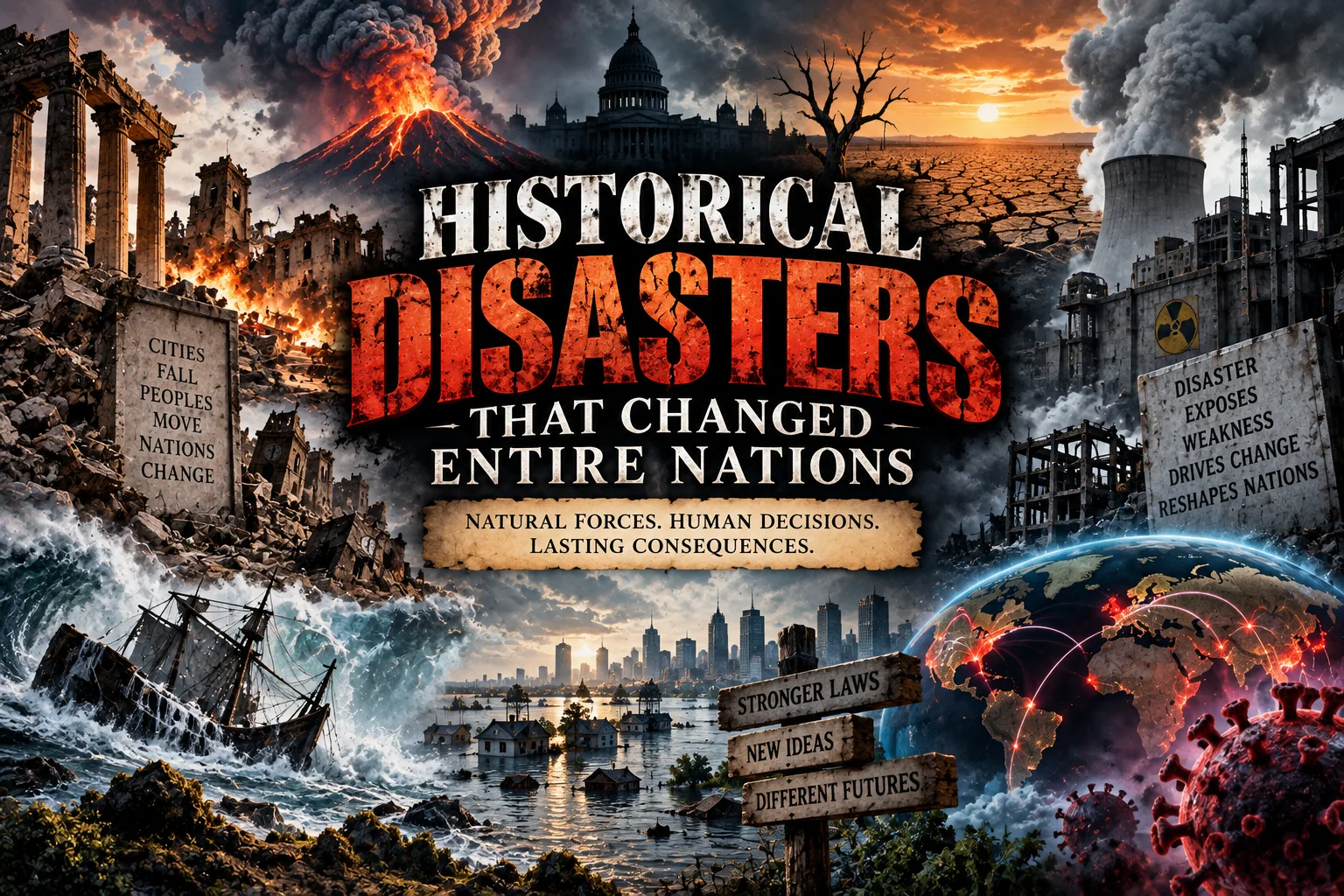
Historical Disasters That Changed Entire Nations
Some disasters did more than destroy cities or kill thousands. They transformed governments, economies, public health, migration, technology, and even the future direction of entire nations.
Historical Disasters That Changed Entire Nations
History is often told through kings, wars, elections, revolutions, and inventions.
But sometimes the future of a country is decided by something far less negotiable.
The ground moves.
Rain stops falling.
A disease arrives.
A volcano erupts.
A reactor explodes.
A storm reaches the coast.
And within hours, months, or years, assumptions that had survived for generations collapse.
Some disasters destroy buildings.
The most consequential ones destroy systems.
They expose weak governments, change laws, accelerate migration, transform public health, reshape economies, alter political movements, and occasionally contribute to the fall of regimes.
A city can be rebuilt.
A nation after catastrophe may never be quite the same.
But disaster history also attracts exaggeration. A catastrophe rarely causes a giant political transformation entirely by itself. Usually, it acts on problems already present: poverty, inequality, weak institutions, political conflict, poor infrastructure, or technological complacency.
So these are not simply stories about enormous death tolls.
They are stories about what happened afterward.
When Does a Disaster Change a Nation?
Imagine two earthquakes of identical magnitude.
One strikes a sparsely populated region with earthquake-resistant buildings.
The other strikes a dense city filled with vulnerable structures and weak emergency services.
The geological event may be similar.
The human disaster will not be.
That distinction matters because catastrophes are shaped by both natural hazards and human systems.
An earthquake doesn't write building codes.
A cyclone doesn't decide where poor communities are allowed to live.
A pathogen doesn't design a healthcare system.
And a famine is rarely explained by rainfall alone.
The consequences depend on what societies built before the crisis and what governments do afterward.
1. The Black Death: A Pandemic That Transformed Europe
Between roughly 1347 and 1353, a devastating pandemic swept through Europe, the Middle East, North Africa, and parts of Asia.
In Europe it became known as the Black Death.
Modern evidence strongly associates the pandemic with the bacterium Yersinia pestis, the organism responsible for plague.
Its demographic consequences were extraordinary.
Large portions of Europe's population died within only a few years.
Exact numbers remain uncertain, but estimates commonly suggest that roughly one-third to one-half of Europe's population may have died in the initial pandemic wave.
Entire Communities Lost Huge Portions of Their Population
Imagine a town of 10,000 people.
Within a few years:
3,000 disappear.
Then 4,000.
Perhaps 5,000.
Farmers die.
Priests die.
Merchants die.
Children die.
Craftsmen die.
Government officials die.
Landowners die.
The social consequences extend far beyond grief.
Suddenly there are fewer workers.
But the land still exists.
Labor Became More Valuable
In parts of Western Europe, severe population loss created labor shortages.
Surviving workers could sometimes demand:
Higher wages.
Better conditions.
Greater mobility.
Access to abandoned land.
Elites attempted to resist these changes.
In England, for example, authorities introduced measures intended to restrain wages and control labor after the plague.
But demographic reality was difficult to legislate away.
🟢 Established Evidence
The Black Death caused enormous population loss and significant economic and social disruption.
🟡 Historical Debate
The extent to which the plague itself caused the long-term weakening of European feudal structures remains debated.
Feudalism was already changing.
The pandemic accelerated some transformations rather than single-handedly creating them.
History stubbornly refuses to provide one-button explanations.
Public Health Began Changing Too
Repeated plague outbreaks forced governments to experiment with disease control.
Italian port cities became especially important.
Ships suspected of carrying infection could be isolated before passengers and cargo entered a city.
The famous concept of quarantine developed from these practices.
Authorities did not understand bacteria.
But they increasingly understood something crucial:
Movement could spread disease.
That insight helped produce early institutional public-health systems.
2. The Lisbon Earthquake of 1755: The Disaster That Shook an Empire and a Philosophy
On the morning of November 1, 1755, Lisbon was crowded for All Saints' Day.
Then the ground began moving.
A massive earthquake struck near Portugal.
Buildings collapsed.
Fires broke out.
Then a tsunami reached coastal areas.
Lisbon, one of Europe's important imperial capitals, was devastated.
Why the Timing Made It Worse
Churches were filled.
Candles were burning throughout the city.
When structures collapsed, fires spread.
Survivors fleeing toward open waterfront areas then faced tsunami waves.
The combination of:
Earthquake.
Fire.
Tsunami.
created a cascading catastrophe.
How Many Died?
Historical estimates vary substantially.
Tens of thousands probably died across affected areas, but precise totals cannot be established.
Lisbon itself suffered catastrophic destruction.
The Marquis of Pombal Responded
Portugal's powerful minister Sebastião José de Carvalho e Melo, later known as the Marquis of Pombal, became central to the response.
A famous statement traditionally attributed to him summarizes the approach:
Bury the dead and care for the living.
Whether every famous version of the quotation is exact matters less than what his government actually did.
Authorities attempted to:
Maintain order.
Remove bodies.
Prevent looting.
Provide supplies.
Survey damage.
Reconstruct Lisbon.
The Rebuilt City Was Different
Lisbon's reconstruction incorporated more systematic urban planning.
New streets were wider and more regular.
Buildings used construction techniques intended to improve resistance to future earthquakes.
Models were reportedly tested for earthquake resistance using troops marching around them to simulate shaking.
Not exactly a modern shake table.
But the engineering principle was moving in the right direction.
The Earthquake Also Shook European Thought
The catastrophe occurred during the Enlightenment.
Lisbon was a deeply Catholic city.
The disaster struck on a major religious holiday.
Churches collapsed.
Thousands died.
This raised uncomfortable philosophical questions.
If the universe operated according to divine justice, why would such indiscriminate suffering occur?
Thinkers including Voltaire engaged with the catastrophe.
The disaster became part of broader debates about:
Providence.
Optimism.
Nature.
Religion.
Human suffering.
🟢 Established Evidence
The 1755 earthquake transformed Lisbon and influenced Portuguese governance, urban reconstruction, disaster investigation, and European intellectual debate.
It also stimulated systematic attempts to gather information about earthquake effects, an important step toward modern seismological thinking.
3. The Eruption of Mount Tambora: The Volcano That Changed the World's Weather
In April 1815, Mount Tambora erupted on the Indonesian island of Sumbawa.
It became the largest volcanic eruption in recorded history.
The immediate destruction was catastrophic.
Communities near the volcano were obliterated.
Ash covered enormous areas.
Agriculture collapsed.
But Tambora's effects did not remain in Indonesia.
Material injected high into the atmosphere affected climate around the planet.
1816 Became the "Year Without a Summer"
Temperatures fell in parts of the Northern Hemisphere.
Weather became abnormal.
Frost occurred during growing seasons.
Harvests failed.
Food prices increased.
Europe was already recovering from years of Napoleonic warfare.
Then agriculture suffered another shock.
Hunger and Migration Followed
Poor harvests contributed to food shortages and social distress in parts of Europe and North America.
People migrated.
Markets destabilized.
Communities experienced hunger.
The eruption demonstrates something humans occasionally forget:
A mountain in Indonesia can affect dinner in Europe.
The atmosphere does not recognize national borders, despite centuries of paperwork attempting to establish otherwise.
Did Tambora Create Frankenstein?
There's a wonderful cultural connection.
During the cold, wet summer of 1816, Mary Shelley stayed near Lake Geneva with Percy Bysshe Shelley, Lord Byron, and others.
Bad weather kept the group indoors.
They challenged one another to write supernatural stories.
Mary Shelley's work eventually became Frankenstein.
So a volcanic eruption in Indonesia indirectly contributed to the environmental circumstances surrounding one of literature's most famous novels.
🟢 Established Connection
Tambora caused major global climatic effects.
Mary Shelley's famous summer near Geneva occurred during the resulting climatic anomaly.
🟡 Don't Overstate It
Tambora did not somehow "cause Frankenstein" in a simple deterministic sense.
Human creativity remains annoyingly resistant to geological equations.
4. The Great Irish Famine: When Crop Failure Became Political Catastrophe
Beginning in 1845, potato crops across Ireland were devastated by Phytophthora infestans, the organism responsible for potato late blight.
For many poor Irish families, potatoes were a dietary foundation.
Repeated crop failures therefore became catastrophic.
But describing what followed as simply a natural disaster is deeply misleading.
Ireland was then part of the United Kingdom.
Political structures, land ownership, poverty, trade, relief policies, and British governance shaped the scale of suffering.
Roughly One Million People Died
Exact estimates vary, but around one million people are commonly estimated to have died from starvation and disease.
Another enormous population escaped through emigration.
Ships carried people toward:
The United States.
Canada.
Britain.
Australia.
Other destinations.
Ireland's population collapsed.
The Demographic Damage Lasted Generations
Ireland had more than eight million inhabitants before the famine.
After death and mass migration, the population fell dramatically.
Unlike many countries experiencing temporary disaster-related population declines, Ireland's demographic trajectory remained profoundly altered.
The famine became one of the defining events of modern Irish history.
Food Still Left Ireland
One of the most politically charged aspects of the famine is that agricultural exports from Ireland did not simply cease while people starved.
Ireland's agricultural economy produced goods beyond potatoes.
The existence of exports while mass starvation occurred became a powerful symbol of the political and economic structures surrounding the disaster.
British relief efforts existed.
But they proved inadequate to prevent catastrophe.
Policies were influenced by contemporary economic ideas, attitudes toward poverty, and assumptions about government intervention.
🟢 Established Evidence
Potato blight triggered the agricultural crisis.
But political, economic, and social structures strongly shaped the resulting famine.
🔴 Oversimplification
"The potato crop failed, therefore one million people inevitably died."
No.
Crop disease explains the trigger.
It does not fully explain the mortality.
The Famine Changed Irish Politics
The catastrophe deepened resentment toward British rule.
Memories of abandonment and inadequate relief became embedded in Irish political identity.
Later nationalist movements drew heavily upon famine memory.
Meanwhile, Irish emigrants established large communities abroad, particularly in the United States.
Those communities would influence American politics and maintain strong connections to Irish nationalism.
One agricultural disaster therefore helped reshape politics on both sides of the Atlantic.
5. The Great Chicago Fire: Destruction That Helped Reinvent an American City
In October 1871, fire swept through Chicago.
The city had grown rapidly.
Large quantities of wood were used in:
Buildings.
Sidewalks.
Infrastructure.
Dry weather and strong winds helped the flames spread.
Thousands of buildings were destroyed.
Roughly 100,000 people were left homeless.
Around 300 deaths are traditionally associated with the disaster, although the precise total is uncertain.
Did Mrs. O'Leary's Cow Start It?
According to one of America's most famous urban legends, a cow belonging to Catherine O'Leary kicked over a lantern in a barn and started the fire.
It's a wonderful story.
It is not established fact.
The exact ignition source remains uncertain.
The O'Leary story became entangled with sensational journalism and anti-Irish prejudice.
🔴 Popular Myth
There is no reliable evidence proving that Mrs. O'Leary's cow started the Great Chicago Fire.
Chicago Rebuilt
The destruction created an enormous reconstruction challenge.
Over subsequent decades, Chicago became a laboratory for new architecture and urban development.
Fire-resistant construction received greater attention.
The city later became famous for early skyscraper development.
The fire didn't single-handedly invent the skyscraper.
But destruction and rebuilding helped create conditions for architectural experimentation.
Chicago lost a huge portion of itself.
Then rebuilt into something different.
6. The 1906 San Francisco Earthquake: A City Destroyed Mostly by Fire
At approximately 5:12 a.m. on April 18, 1906, a massive earthquake struck Northern California.
San Francisco experienced violent shaking.
Buildings collapsed.
Water mains broke.
Gas lines and fires created additional danger.
Then the fires began spreading.
Fire Became the Greater Destroyer
Much of the city's destruction resulted not directly from shaking but from fires that burned for days.
Firefighters faced a disastrous problem:
The earthquake had damaged the water system.
They were fighting a citywide fire with severely compromised access to water.
More than 200,000 people were displaced.
Thousands died, although official numbers at the time dramatically underestimated the eventual historical death toll.
The Disaster Changed Earthquake Science
The earthquake produced an enormous scientific investigation.
Geologist Andrew Lawson led a commission examining the event.
Researchers documented displacement along the San Andreas Fault.
The resulting report became foundational to understanding earthquake mechanics.
The disaster helped scientists move toward the idea that earthquakes involve sudden movement along faults.
San Francisco Rebuilt Quickly
Business leaders and government officials wanted to demonstrate that the city remained viable.
Reconstruction proceeded rapidly.
Building practices and emergency planning evolved.
But the recovery also involved inequality, disputes over land, and attempts to reshape parts of the city.
Disasters create opportunities.
Unfortunately, humans disagree rather intensely over who receives them.
7. The Great Kantō Earthquake of 1923: Disaster Followed by Mass Violence
On September 1, 1923, a massive earthquake struck Japan's Kantō region.
Tokyo and Yokohama were devastated.
Buildings collapsed.
Fires spread rapidly.
More than 100,000 people died or disappeared according to widely cited estimates.
But the disaster produced another tragedy.
Rumors began circulating.
Koreans Were Falsely Blamed
False claims spread that ethnic Koreans were:
Poisoning wells.
Starting fires.
Planning attacks.
These rumors triggered mass violence.
Vigilante groups and others killed Korean residents.
Chinese people and Japanese individuals mistaken for Koreans were also attacked.
The exact number killed remains debated, but the massacre itself is historically established.
🟢 Established Evidence
The earthquake produced catastrophic physical destruction.
False rumors and xenophobia contributed to organized and spontaneous violence against Koreans and others afterward.
Reconstruction Changed Tokyo
The Japanese government undertook major reconstruction.
Roads were widened.
Bridges rebuilt.
Parks and infrastructure developed.
Urban planning changed.
The catastrophe therefore became both a humanitarian disaster and a turning point in the physical development of modern Tokyo.
But the post-earthquake massacres remain an essential part of the story.
Disaster doesn't automatically create solidarity.
Sometimes fear simply gives prejudice permission.
8. The Dust Bowl: An Environmental Disaster That Reshaped America
During the 1930s, severe drought struck parts of the Great Plains of the United States.
But drought alone did not create the Dust Bowl.
Years of intensive agricultural practices had removed native grasses that helped stabilize soil.
When drought arrived, exposed topsoil became vulnerable to wind erosion.
Enormous dust storms followed.
"Black Blizzards"
Dust clouds could become so dense they darkened the sky.
Soil entered:
Homes.
Food.
Lungs.
Machinery.
Livestock areas.
Agricultural productivity collapsed in badly affected regions.
Families lost farms and livelihoods.
Migration Toward California
Hundreds of thousands of people left affected regions.
Many traveled west.
California became a major destination.
Migrants from Oklahoma and neighboring areas were often collectively labeled "Okies," sometimes derogatorily.
Their experiences became embedded in American cultural memory.
John Steinbeck's The Grapes of Wrath famously depicted this world.
Government Policy Changed
The Dust Bowl helped encourage major federal soil-conservation efforts during the New Deal.
Authorities promoted:
Contour plowing.
Shelterbelts.
Crop rotation.
Soil conservation.
Improved land-management practices.
The catastrophe demonstrated that environmental disaster can be partly manufactured by economic behavior.
🟢 Established Evidence
Drought was crucial.
But unsustainable farming practices greatly intensified soil erosion.
The Dust Bowl therefore wasn't simply "bad weather."
It was an interaction between climate and human land use.
9. The Bengal Famine of 1943: A Disaster Where Food and War Collided
During World War II, Bengal, then part of British India, experienced a devastating famine.
Millions died.
The Bengal famine remains intensely studied and politically debated because no single cause adequately explains it.
Factors included:
Wartime disruption.
Inflation.
Rice-market instability.
Loss of Burmese rice imports.
Crop damage.
Distribution failures.
Government policy.
Panic and speculation.
Unequal access to food.
Food Availability Was Only Part of the Problem
Economist Amartya Sen famously emphasized that famine can occur when people lose the ability to obtain food, even when food still exists somewhere within the broader economy.
A laborer's wages may no longer buy rice.
A fisher may lose access to markets.
Prices may rise faster than income.
Food exists.
But economically, it might as well be on another planet.
Churchill and the Bengal Famine
Modern discussions frequently reduce the entire famine to one person:
Winston Churchill.
British wartime policy and imperial priorities unquestionably deserve scrutiny.
Churchill and members of his government made decisions and statements that remain heavily criticized.
But historians continue debating the relative importance of different causes, policy decisions, shipping constraints, provincial governance, wartime economics, and food availability.
🟢 Established Evidence
British colonial governance and wartime policy were important elements of the catastrophe.
🟡 Historical Debate
Assigning the entire famine to one policy, one crop failure, or one individual oversimplifies a complex disaster.
What isn't controversial is the outcome:
Millions of people died under British colonial rule.
The Political Consequences Were Enormous
The famine severely damaged the legitimacy of British colonial government.
India was already moving through a period of intense nationalist struggle.
The visible failure to protect millions of civilians strengthened arguments that colonial rule was neither benevolent nor competent.
Only four years later, British rule in India ended.
The famine did not single-handedly cause Indian independence.
But it became part of the political and moral collapse of the imperial system.
10. Hiroshima and Nagasaki: Nuclear Destruction Changes the World
On August 6, 1945, the United States dropped an atomic bomb on Hiroshima.
Three days later, another atomic bomb was dropped on Nagasaki.
The explosions killed tens of thousands immediately.
Many more died later from:
Burns.
Injuries.
Radiation exposure.
Cancer and other consequences.
Japan announced its surrender shortly afterward.
World War II ended.
And humanity entered the nuclear age.
A New Kind of Disaster
Cities had been devastated by bombing before.
Tokyo, Dresden, Warsaw, and many others had suffered catastrophic destruction.
But nuclear weapons introduced something qualitatively terrifying:
A single bomb could destroy much of a city.
And radiation could continue harming people after the explosion.
The Hibakusha
Survivors of the atomic bombings became known as hibakusha.
Many experienced long-term health effects.
Some also faced discrimination because of fears and misunderstandings about radiation.
Their testimony became central to global anti-nuclear activism.
Japan's Postwar Identity Changed
Postwar Japan adopted a constitution whose Article 9 renounced war as a sovereign right of the nation, although Japan later developed Self-Defense Forces and debates over defense policy continue.
The atomic bombings became deeply embedded in Japanese memory and political culture.
Hiroshima developed into an international symbol of nuclear destruction.
🟢 Established Evidence
The bombings contributed to Japan's surrender and transformed global military strategy.
🟡 Major Historical Debate
Historians continue debating exactly how the atomic bombings, Soviet entry into the war against Japan, internal Japanese politics, and other military factors interacted in producing surrender.
Reducing the end of the Pacific War to a single cause ignores that debate.
11. The Great Chinese Famine: When Policy Amplified Catastrophe
Between approximately 1959 and 1961, China experienced one of the deadliest famines in recorded history.
It occurred during Mao Zedong's Great Leap Forward.
The campaign attempted rapid industrialization and agricultural transformation.
Communal farming expanded.
Production targets became politically charged.
Local officials sometimes exaggerated harvest figures.
The state then procured grain based partly on unrealistic information.
The Feedback System Failed
Imagine a local official knows the harvest is poor.
But admitting failure could be politically dangerous.
So the official reports success.
Higher authorities believe food production is abundant.
Grain is collected accordingly.
Villagers are left without enough food.
Then criticism becomes dangerous.
The system cannot easily admit its own mistake.
That is how political incentives can become biological consequences.
How Many Died?
Estimates vary enormously.
Scholarly calculations commonly run into the tens of millions of excess deaths.
The exact number remains debated because demographic data and definitions differ.
But there is no serious dispute that mortality was catastrophic.
🟢 Established Evidence
Great Leap Forward policies, procurement systems, institutional failures, coercion, and suppression of accurate information played major roles in the famine.
Weather and other factors contributed but cannot adequately explain the catastrophe alone.
12. The 1970 Bhola Cyclone: The Disaster That Helped Change the Map of South Asia
On November 12, 1970, an enormous tropical cyclone struck the low-lying coastal regions of what was then East Pakistan, today Bangladesh.
The storm surge overwhelmed communities.
Hundreds of thousands of people died.
It remains among the deadliest tropical cyclones in recorded history.
But the political aftermath made the disaster even more consequential.
East and West Pakistan Were Already Divided
Pakistan consisted of two geographically separated regions:
West Pakistan.
East Pakistan.
India lay between them.
The eastern population had long experienced political and economic grievances.
Then the cyclone struck.
The central government's relief response was widely perceived in East Pakistan as slow and inadequate.
Anger intensified.
An Election Followed
Pakistan held national elections in December 1970.
The Awami League, led by Sheikh Mujibur Rahman, won an overwhelming victory in East Pakistan and secured a parliamentary majority nationally.
A political crisis followed when power was not transferred smoothly.
In 1971:
Repression began.
War followed.
India intervened.
East Pakistan became the independent nation of Bangladesh.
🟢 Established Evidence
The cyclone and dissatisfaction with the government's response intensified existing political grievances in East Pakistan.
🔴 Oversimplification
"The cyclone created Bangladesh."
No.
Bengali nationalism, linguistic conflict, economic inequality, electoral politics, military repression, and war were already central.
But the cyclone became an important accelerant.
Few disasters have such a direct connection to the political circumstances preceding the creation of a new country.
13. Bhopal: The Industrial Disaster That Changed India's Environmental Debate
Shortly after midnight on December 3, 1984, toxic gas escaped from a pesticide plant in Bhopal, India, operated by Union Carbide India Limited.
A cloud containing methyl isocyanate and other reaction products spread over surrounding neighborhoods.
Many residents were asleep.
People woke coughing.
Eyes burned.
Breathing became difficult.
Panic spread through the streets.
Thousands Died
Several thousand people died in the immediate aftermath.
Long-term death estimates are substantially higher.
Hundreds of thousands were exposed.
Survivors reported chronic health problems involving:
Respiratory systems.
Eyes.
Neurological symptoms.
Reproductive health.
Other conditions.
The exact long-term burden remains contested and studied.
The Legal Battle Became Part of the Disaster
The catastrophe produced decades of disputes over:
Compensation.
Corporate responsibility.
Criminal liability.
Environmental contamination.
Medical care.
Cleanup.
The relationship between multinational corporations and developing countries.
In 1989, India's Supreme Court approved a $470 million settlement with Union Carbide.
The settlement itself became highly controversial.
India Changed Its Environmental Laws
Bhopal helped drive significant legal and regulatory changes.
India enacted the Environment (Protection) Act, 1986, giving the central government broader powers regarding environmental protection.
Industrial safety and hazardous chemical regulation received greater attention.
🟢 Established Evidence
Bhopal became one of the world's worst industrial disasters and profoundly influenced Indian environmental regulation and debates about corporate accountability.
Its effects continue to shape public memory decades later.
14. Chernobyl: A Nuclear Disaster That Damaged Trust in the Soviet State
On April 26, 1986, reactor number four at the Chernobyl Nuclear Power Plant in Soviet Ukraine exploded during a safety test.
The accident involved serious reactor design vulnerabilities combined with operational decisions.
A reactor explosion and fire released radioactive material into the atmosphere.
Authorities Initially Controlled Information
The nearby city of Pripyat was not evacuated immediately.
Residents continued ordinary life for hours after the explosion.
Radiation spread beyond Soviet territory.
Swedish monitoring stations detected unusual radiation levels.
Eventually the scale of the accident could no longer remain an internal Soviet matter.
Hundreds of Thousands Participated in Cleanup
Firefighters responded without fully understanding the radiation hazard.
Plant workers attempted to control the disaster.
Later, enormous numbers of military personnel, engineers, miners, construction workers, and other liquidators participated in cleanup and containment.
Some received substantial radiation exposure.
Did Chernobyl Cause the Soviet Union to Collapse?
This claim is tempting.
Even Mikhail Gorbachev later suggested Chernobyl may have been a significant factor in the Soviet collapse.
But the USSR already faced:
Economic stagnation.
Political problems.
Nationalist movements.
The Afghanistan war.
Institutional dysfunction.
Chernobyl didn't create those problems.
It exposed them.
🟢 Established Evidence
Chernobyl damaged public confidence in Soviet institutions and highlighted problems involving secrecy, bureaucracy, safety culture, and information control.
🔴 Oversimplification
"Chernobyl destroyed the Soviet Union."
No single reactor managed that impressive geopolitical workload.
But it became a powerful symbol of systemic failure.
15. The 2004 Indian Ocean Tsunami: A Disaster That Changed Global Warning Systems
On December 26, 2004, an enormous undersea earthquake occurred off northern Sumatra.
It generated a tsunami that spread across the Indian Ocean.
Waves devastated coastlines in:
Indonesia.
Sri Lanka.
India.
Thailand.
The Maldives.
Other countries.
More than 200,000 people died across the region.
There Was No Comprehensive Indian Ocean Tsunami Warning System
The Pacific had long developed tsunami-warning capabilities.
The Indian Ocean did not have an equivalent regional system capable of rapidly warning all threatened populations.
In some places, hours passed between the earthquake and arrival of destructive waves.
Yet many communities had no idea what was coming.
A Natural Warning Was Missed
Before a tsunami reaches shore, the sea can sometimes withdraw dramatically.
People unfamiliar with the phenomenon may approach the exposed seabed out of curiosity.
That happened in some locations.
Today, public education emphasizes a simple rule:
If coastal water suddenly retreats unusually far after strong shaking:
Move inland and to higher ground immediately.
Do not investigate why the ocean has apparently resigned.
Warning Infrastructure Changed
After the catastrophe, governments and international organizations developed and expanded Indian Ocean tsunami-warning systems.
Seismic networks improved.
Ocean monitoring expanded.
Emergency communication received greater attention.
The disaster produced one of the clearest examples of tragedy directly accelerating international disaster-preparedness infrastructure.
16. Hurricane Katrina: When a Natural Disaster Became a Governance Crisis
In August 2005, Hurricane Katrina struck the U.S. Gulf Coast.
New Orleans became the center of the catastrophe.
The storm was powerful.
But much of New Orleans' devastation resulted from failures in the city's flood-protection system.
Levees and floodwalls failed.
Large areas flooded.
People Were Trapped
Residents climbed onto roofs.
Hospitals lost critical infrastructure.
Thousands sought shelter at the Superdome and Convention Center.
Emergency response became chaotic.
Television broadcast images of suffering across the United States and the world.
More than a thousand people died.
Hundreds of thousands were displaced across the broader region.
Katrina Exposed Inequality
The disaster disproportionately affected communities with fewer resources.
Not everyone could simply evacuate.
Some people lacked:
Cars.
Money.
Accessible transportation.
Safe destinations.
Medical mobility.
Social support.
The phrase "just evacuate" becomes considerably less useful when evacuation assumes resources people do not possess.
Political Consequences
Federal, state, and local authorities faced intense criticism.
The Federal Emergency Management Agency (FEMA) became particularly associated with failures in response.
Investigations examined preparedness, communication, levee design, emergency management, and coordination.
Katrina permanently changed American discussions about:
Disaster preparedness.
Infrastructure.
Race.
Poverty.
Climate vulnerability.
Emergency governance.
17. The 2011 Tōhoku Earthquake, Tsunami, and Fukushima Disaster
On March 11, 2011, a magnitude 9.0 earthquake struck off northeastern Japan.
The earthquake itself was enormous.
Then the tsunami arrived.
Entire communities were overwhelmed.
Nearly 20,000 people were killed or remained missing, overwhelmingly because of the tsunami.
But another crisis developed at the Fukushima Daiichi Nuclear Power Plant.
The Tsunami Disabled Critical Systems
The plant automatically shut down its operating reactors after the earthquake.
But reactors still require cooling after shutdown.
The tsunami flooded critical backup power systems.
Cooling failed.
Fuel overheated.
Hydrogen explosions occurred.
Radioactive material was released.
Large areas were evacuated.
Japan's Energy Policy Changed
Before Fukushima, nuclear energy was an important part of Japan's electricity system.
After the disaster, Japan shut down its nuclear reactors for safety reviews.
Public opposition increased dramatically.
Energy imports increased.
Japan later restarted some reactors under stricter regulations, and its energy debate continues.
🟢 Established Evidence
Fukushima produced major changes to Japanese nuclear regulation, emergency planning, and energy policy.
🟢 Important Distinction
The overwhelming majority of immediate deaths from the 2011 disaster resulted from the earthquake and tsunami, not acute radiation exposure.
Confusing those numbers produces a badly distorted understanding of the event.
18. COVID-19: When the Entire Planet Became a Disaster Zone
In late 2019, cases of a new respiratory illness appeared in Wuhan, China.
The disease would become known as COVID-19, caused by SARS-CoV-2.
Within months, the virus had spread around the world.
Borders closed.
Schools shut.
Flights disappeared.
Hospitals filled.
Businesses closed.
Billions of people experienced restrictions unlike anything in modern peacetime history.
The Death Toll Was Enormous
Officially reported global deaths reached millions.
Estimates based on excess mortality suggest the pandemic's true mortality burden was substantially higher than confirmed COVID death counts alone.
Different countries experienced dramatically different outcomes depending on:
Population age.
Healthcare capacity.
Timing.
Public-health policy.
Vaccination.
Prior immunity.
Social behavior.
Data quality.
Other factors.
Governments Expanded Their Powers
Countries introduced extraordinary policies.
Lockdowns.
Travel restrictions.
Mask mandates.
Testing requirements.
Vaccine mandates in some settings.
Emergency economic support.
Massive government spending.
Remote education.
Remote work.
The appropriate balance between disease control and individual liberty became politically explosive.
Vaccines Arrived at Extraordinary Speed
Multiple COVID-19 vaccines were developed and deployed within roughly a year of the virus being identified.
The pandemic accelerated technologies including mRNA vaccination, which had been researched for decades but had never before been deployed at such global scale.
The crisis also exposed weaknesses in:
Medical supply chains.
Hospital capacity.
Public communication.
International cooperation.
Misinformation management.
Pandemic preparedness.
COVID Changed Work
Perhaps one of its most durable social consequences was remote work.
Millions of office workers suddenly discovered that work previously described as absolutely requiring physical presence could apparently be conducted from a bedroom while someone's dog participated in the meeting.
Companies adopted:
Remote work.
Hybrid work.
Cloud collaboration.
Video conferencing.
Digital workflows.
Some workers later returned to offices.
Others never did.
The long-term structure of white-collar employment changed.
What These Disasters Have in Common
At first glance, these events have little in common.
A bacterium.
An earthquake.
A volcano.
A crop disease.
A fire.
A famine.
A cyclone.
A chemical leak.
A nuclear accident.
A hurricane.
A pandemic.
But the most consequential disasters share several patterns.
1. Disasters Expose Weaknesses That Already Exist
The Bhola cyclone did not invent political inequality between East and West Pakistan.
Katrina did not create racial and economic inequality in New Orleans.
Chernobyl did not create Soviet secrecy.
The Irish famine did not create Ireland's political relationship with Britain.
The Bengal famine did not create colonial inequality.
The Great Chinese Famine did not create authoritarian information problems.
Disasters expose systems under extreme stress.
Think of them as societal stress tests nobody volunteered to take.
2. Poor People Usually Have Fewer Ways to Escape
Wealth changes disaster risk.
A wealthy household may have:
A vehicle.
Insurance.
Savings.
A strong home.
Access to healthcare.
Multiple places to evacuate.
A poorer household may have none of those.
Two people can experience the same hurricane and inhabit completely different disasters.
3. Information Can Save Lives
The Great Kantō earthquake demonstrated how false information can produce violence.
Chernobyl demonstrated the dangers of secrecy.
COVID demonstrated both the importance and difficulty of communicating uncertain science.
The 2004 tsunami demonstrated what happens when warning information doesn't exist or doesn't reach people.
In disasters, information becomes infrastructure.
4. Governments Are Judged Differently During Catastrophe
Citizens tolerate bureaucratic inconvenience during normal life.
During disaster, expectations change.
People need:
Food.
Water.
Rescue.
Healthcare.
Shelter.
Reliable information.
Immediately.
Failure becomes visible.
A government may survive decades of abstract criticism but lose legitimacy after several days of visibly incompetent disaster response.
5. Catastrophes Accelerate Technology
Disasters repeatedly force innovation.
Lisbon encouraged earthquake-resistant construction and systematic seismic investigation.
The Dust Bowl accelerated soil conservation.
San Francisco contributed to earthquake science.
Bhopal strengthened industrial safety debates.
Chernobyl transformed nuclear safety thinking.
The 2004 tsunami accelerated warning systems.
Fukushima changed reactor safety requirements.
COVID accelerated vaccine platforms and digital work.
Disasters compress years of institutional debate into months.
Apparently civilization occasionally requires something to catch fire before approving the budget.
Can Disasters Cause Revolutions?
Sometimes they contribute.
But rarely alone.
Disaster can:
Increase food prices.
Destroy livelihoods.
Expose government incompetence.
Increase inequality.
Trigger migration.
Intensify existing political grievances.
Those pressures can destabilize societies.
But saying:
"Earthquake → revolution"
or
"famine → independence"
usually removes most of the actual history.
The more accurate model is:
Existing instability + disaster shock + political response = potentially transformative consequences.
Which Disaster Changed a Nation the Most?
There is no objective answer.
It depends on what we measure.
Population?
The Great Irish Famine permanently transformed Ireland's demographics.
Political geography?
The Bhola cyclone became part of the chain of events preceding Bangladesh's independence.
Government legitimacy?
Chernobyl became a major symbol of Soviet institutional failure.
Urban design?
Lisbon and Tokyo were physically reconstructed.
Environmental regulation?
Bhopal transformed India's regulatory landscape.
Energy policy?
Fukushima radically altered Japan's nuclear debate.
Public health?
The Black Death and COVID reshaped institutions separated by nearly seven centuries.
Different catastrophes transform different layers of society.
Frequently Asked Questions
What was the deadliest disaster in recorded history?
The answer depends heavily on definitions. Some famines and pandemics produced death tolls far exceeding individual earthquakes, storms, or volcanic eruptions. The Black Death and twentieth-century Chinese famine rank among history's largest mortality catastrophes.
Did the Black Death kill half of Europe?
Possibly in some estimates and regions, but exact mortality remains uncertain. Modern scholarship generally accepts an extraordinarily high death rate, often estimated around one-third to one-half of Europe's population during the initial pandemic.
Did the Lisbon earthquake influence modern earthquake science?
Yes. The Portuguese government's systematic collection of information about the earthquake's effects is frequently recognized as an important early development in scientific earthquake investigation.
Did the Irish famine happen because there weren't enough potatoes?
Potato blight triggered the crisis, but political economy, poverty, land systems, relief policies, and food distribution strongly influenced the enormous mortality.
Did Mrs. O'Leary's cow cause the Chicago fire?
There is no reliable evidence proving that story.
Was the Bengal famine purely a natural disaster?
No. Wartime disruption, economic conditions, colonial policy, market failures, food access, and other factors were central.
Did the 1970 cyclone create Bangladesh?
No. But anger over the response intensified existing political tensions shortly before the crisis that resulted in Bangladesh's independence.
Did Chernobyl cause the Soviet Union to collapse?
It contributed to declining trust and exposed systemic problems, but the Soviet collapse resulted from many economic, political, nationalist, and geopolitical factors.
Did radiation kill thousands immediately at Fukushima?
No. The enormous immediate mortality from the 2011 disaster resulted overwhelmingly from the earthquake and tsunami. The nuclear accident created serious evacuation, contamination, economic, and long-term public-health concerns, but it should not be conflated with the tsunami death toll.
Are natural disasters actually "natural"?
The hazard may be natural.
The scale of human suffering often isn't.
Building quality, poverty, infrastructure, preparedness, governance, geography, and inequality determine how destructive a hazard becomes.
Myth vs. Evidence
🟢 The Black Death transformed European society
Strongly supported, although the exact scale and mechanisms of long-term change remain debated.
🟢 The Lisbon earthquake influenced European philosophy
Yes.
🟢 Tambora altered global climate
Yes.
🔴 Mrs. O'Leary's cow definitely started the Chicago fire
Legend.
🟢 Human decisions worsened the Dust Bowl
Yes.
🟢 The Bhola cyclone intensified Pakistan's political crisis
Yes.
🔴 The cyclone alone created Bangladesh
No.
🟢 Bhopal influenced Indian environmental regulation
Yes.
🟢 Chernobyl damaged trust in Soviet institutions
Yes.
🔴 Chernobyl single-handedly destroyed the USSR
No.
🟢 The 2004 tsunami accelerated Indian Ocean warning systems
Yes.
🟢 Fukushima changed Japanese energy policy
Yes.
🟢 COVID permanently accelerated digital work and vaccine technology
Yes, although the long-term scale of those changes continues evolving.
The Difference Between a Hazard and a Catastrophe
Perhaps the most important lesson from disaster history is surprisingly simple.
Nature creates hazards.
Societies determine much of the vulnerability.
An earthquake beneath an empty desert may become a geological event.
The same earthquake beneath a poorly constructed city becomes a humanitarian catastrophe.
Heavy rainfall can become manageable water.
Or catastrophic flooding.
A pathogen can produce an outbreak.
Or overwhelm an entire healthcare system.
A cyclone can strike a coastline where shelters and warning systems save thousands.
Or one where almost nobody knows it's coming.
The physical event matters enormously.
But so does everything humans did before it arrived.
Final Thoughts
The disasters that changed entire nations were rarely important only because of how many people died.
Their real historical power came from what they revealed.
The Black Death exposed how radically population determines economic power.
Lisbon forced Europeans to confront both physical and philosophical assumptions about catastrophe.
Tambora demonstrated that the climate connects societies separated by oceans.
The Irish and Bengal famines showed that starvation is shaped by politics and economics as much as agriculture.
The Dust Bowl demonstrated how environmental hazards and human land use can amplify one another.
The Great Kantō earthquake showed how quickly misinformation and prejudice can transform catastrophe into violence.
Hiroshima and Nagasaki introduced humanity to a weapon capable of destroying cities almost instantly.
The Great Chinese Famine demonstrated what happens when political incentives corrupt information about basic survival.
The Bhola cyclone intensified a political crisis that soon helped redraw the map of South Asia.
Bhopal exposed the consequences of industrial failure and weak accountability.
Chernobyl revealed the danger of combining complex technology with secrecy and institutional dysfunction.
The Indian Ocean tsunami demonstrated the enormous value of early-warning systems.
Katrina exposed how infrastructure and inequality determine who can escape.
Fukushima forced one of the world's most technologically advanced nations to reconsider nuclear risk.
COVID showed that even a civilization equipped with satellites, genomic sequencing, supercomputers, and modern medicine could still be profoundly disrupted by microscopic biology.
That is what makes disaster history worth studying.
Not because catastrophe is fascinating from a safe distance.
But because every disaster leaves instructions.
Build differently.
Prepare earlier.
Communicate faster.
Protect vulnerable people.
Allow institutions to report bad news.
Don't confuse technological confidence with invulnerability.
And remember that the systems holding modern society together are considerably more fragile than they look.
A nation can spend centuries building institutions.
Then the ground moves for sixty seconds.
What happens next reveals what was actually built.