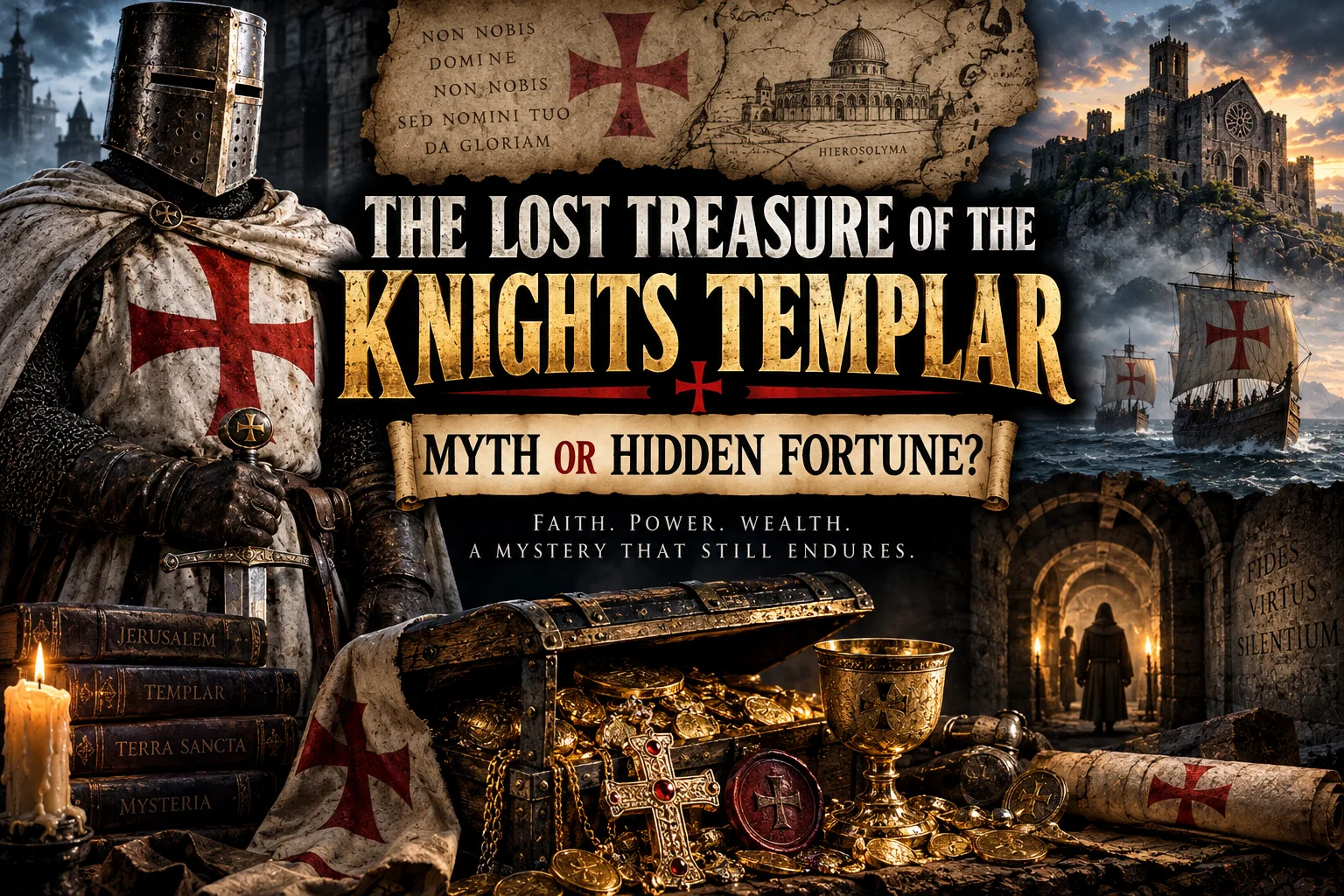
The Lost Treasure of the Knights Templar: Myth or Hidden Fortune?
The Knights Templar became one of medieval Europe's richest and most mysterious orders. After their sudden downfall, legends claimed their treasure vanished. But was there ever a hidden fortune to find?
The Lost Treasure of the Knights Templar: Myth or Hidden Fortune?
On the morning of Friday, October 13, 1307, officers across France began carrying out an extraordinary series of arrests.
Their targets were not ordinary criminals.
They were members of one of the most powerful religious military organizations in medieval Europe:
The Knights Templar.
Templars were arrested.
Their properties were seized.
Their leaders were interrogated.
Accusations of heresy, blasphemy, corruption, and secret rituals followed.
Within a few years, an organization that had existed for nearly two centuries was gone.
But something was supposedly missing.
Its treasure.
According to one of history's most persistent legends, King Philip IV of France expected to seize enormous quantities of Templar gold and silver.
Instead, the great fortune had vanished.
Later stories claimed Templar ships secretly departed France carrying treasure shortly before the arrests.
Other versions placed the fortune beneath castles, inside Scottish vaults, under churches, or across the Atlantic.
And eventually, the supposed treasure grew beyond ordinary wealth.
It came to include objects such as:
The Holy Grail.
The Ark of the Covenant.
Ancient manuscripts.
Secret religious documents.
Relics from Jerusalem.
Evidence allegedly capable of transforming Christianity itself.
Seven centuries later, treasure hunters are still looking.
But there is a rather important question hidden beneath all of this:
Was there ever a missing Templar treasure in the first place?
Who Were the Knights Templar?
To understand the treasure legend, we first need to understand what the Templars actually were.
The order emerged in the early twelfth century following the First Crusade.
European Christian forces had captured Jerusalem in 1099.
Pilgrims subsequently traveled to the Holy Land, but journeys through the region could be dangerous.
Around 1119 or 1120, a small group of knights led by Hugh of Payns formed an organization traditionally associated with protecting Christian pilgrims.
They became known as the Poor Fellow-Soldiers of Christ and of the Temple of Solomon.
Much less conveniently:
The Knights Templar.
Why "Templar"?
The early knights were given quarters on Jerusalem's Temple Mount.
Medieval Christians associated the location with the biblical Temple of Solomon.
That connection eventually became enormously important to later legends.
If the Templars lived around the Temple Mount, people reasoned, perhaps they discovered something underneath it.
Treasure.
Relics.
Ancient knowledge.
Secret documents.
Unfortunately for anyone planning an Indiana Jones expedition, historical evidence becomes considerably thinner once we reach that part.
🟢 Established Evidence
The Templars genuinely established themselves in Jerusalem and were associated with buildings on the Temple Mount.
Their name derived from that connection.
🔴 Popular Myth / Unsupported Claim
There is no reliable historical evidence demonstrating that the early Templars discovered the Ark of the Covenant, Holy Grail, or a secret collection of documents beneath the Temple Mount.
The location is real.
The treasure story is speculation.
History apparently needed only a basement before constructing seven centuries of conspiracy theories.
From Poor Knights to an International Organization
The word "Poor" in the Templars' formal identity became increasingly misleading.
The order gained official Church recognition and attracted donations from European elites.
Supporters gave them:
Land.
Farms.
Buildings.
Money.
Rights to income.
Mills.
Vineyards.
Livestock.
Other property.
Templar estates eventually stretched across large parts of Europe and the eastern Mediterranean.
The Templars Became Extremely Wealthy
This is where the treasure legend gains a genuine historical foundation.
The organization really did control substantial resources.
But institutional wealth is not the same thing as having a giant underground room filled with gold coins.
A medieval order's wealth could exist as:
Land.
Agricultural production.
Rental income.
Rights and privileges.
Fortifications.
Equipment.
Horses.
Loans.
Commercial relationships.
Donations.
Financial claims.
The Templars were wealthy partly because they controlled an enormous network of productive assets.
Were the Templars Medieval Bankers?
Sort of.
But the popular statement that:
"The Knights Templar invented modern banking"
is too simplistic.
The Templars did provide sophisticated financial services.
Pilgrims and nobles could deposit funds or valuables with parts of the Templar network and obtain documentation allowing access to resources elsewhere.
The order also handled money for rulers and participated in lending and financial administration.
Its international presence made this extraordinarily useful.
Why This Mattered
Imagine traveling from France toward Jerusalem during the Middle Ages carrying a large quantity of silver.
Congratulations.
You have converted yourself into a walking treasure chest.
A network capable of reducing the need to physically transport wealth could provide enormous advantages.
The Templars' religious status, geographic reach, administrative organization, and fortified properties made them useful financial intermediaries.
But they were not the only medieval people developing sophisticated finance.
Italian merchants and banking families would become particularly important in European financial history.
🟢 Established Evidence
The Templars performed important financial functions, including holding deposits, transferring funds, lending money, and managing royal finances.
🔴 Oversimplification
Calling them the singular "inventors of banking" exaggerates their role and ignores other medieval financial institutions.
Why Did the Templars Become So Powerful?
Their structure was unusual.
They combined:
Religion.
Military organization.
International property.
Financial administration.
Papal privileges.
Political connections.
They were not simply subordinate to whichever local noble happened to control the territory around a Templar estate.
The order enjoyed important protections from the papacy.
That gave it unusual independence.
And independence plus money tends to make rulers extremely attentive.
Especially rulers who owe you money.
Enter King Philip IV of France.
Philip IV Had a Money Problem
Philip IV ruled France from 1285 to 1314.
His monarchy faced substantial financial pressures.
Wars were expensive.
Royal administration was expensive.
Medieval kings discovered the same unpleasant truth modern governments know perfectly well:
Everything costs money.
Philip had already taken aggressive measures involving financial groups within his kingdom.
He had clashed with the papacy.
He had expelled Jews from France in 1306 while confiscating property.
And he had financial dealings with the Templars.
Then Came October 13, 1307
Philip ordered the arrest of Templars throughout France.
The operation was prepared secretly.
On Friday, October 13, royal officials moved against the order.
Templars were accused of extraordinary crimes.
These included allegations that initiates:
Denied Christ.
Spat on the cross.
Participated in obscene rituals.
Engaged in prohibited sexual behavior.
Worshipped mysterious idols.
The accusations were explosive.
Were the Charges True?
This remains one of the central historical questions surrounding the Templar downfall.
Many confessions were obtained under coercion and torture.
Some Templars admitted to accusations.
Others denied them.
Some confessed and later withdrew their confessions.
The evidence is deeply compromised by the methods used to obtain testimony.
Most modern historians treat many of the sensational charges with substantial skepticism.
🟡 Historically Contested
Individual irregular practices cannot necessarily be ruled out across a large organization.
But there is no strong basis for accepting the dramatic package of heresy accusations exactly as Philip's prosecution presented it.
The political and financial interests surrounding the suppression matter enormously.
Did Philip Attack the Templars Because He Owed Them Money?
This is commonly presented as the entire explanation.
Philip owed the Templars money.
Therefore:
Arrest Templars → erase debt → steal treasure.
Reality was probably more complicated.
Financial motives certainly mattered.
But Philip was also consolidating royal authority.
The Templars represented an independent international institution with significant resources and papal connections.
The military purpose that had justified the order was also under pressure after Christian forces lost their remaining major footholds in the Holy Land.
Multiple political, institutional, religious, and financial factors converged.
Where Was the Treasure?
Here we finally reach the mystery.
If the Templars were enormously wealthy, Philip should have seized an enormous fortune.
Right?
Not necessarily.
The assumption contains a hidden mistake.
Wealth is not the same thing as liquid treasure.
Suppose a modern organization owns:
$2 billion in real estate.
$500 million in agricultural property.
$300 million in infrastructure.
$200 million in financial claims.
That organization is enormously wealthy.
But police raiding its headquarters would not necessarily discover:
$3 billion stacked in the basement.
The same principle applies to medieval wealth.
Templar Wealth Was Spread Across Europe
The order controlled property across many jurisdictions.
France contained substantial Templar assets, but the organization wasn't a French company with one central vault.
Its wealth existed across:
England.
The Iberian Peninsula.
Italy.
The Holy Roman Empire.
The eastern Mediterranean.
Other territories.
Furthermore, individual Templars were supposed to live according to religious vows rather than accumulate enormous personal fortunes.
The order was wealthy.
The knights were not supposed to be medieval billionaires wandering around with bags of diamonds.
But Was Money Missing From the Paris Temple?
This is where things become interesting.
The Templars maintained an important complex in Paris known as the Temple.
It served financial and administrative functions.
The French monarchy itself had used Templar financial services.
Later treasure legends claim that Philip's agents expected enormous movable wealth there but found surprisingly little.
From this grew the idea that somebody had been warned.
The treasure had been moved.
The Secret Templar Fleet
One of the most famous versions of the legend says Templars loaded their treasure onto ships at La Rochelle.
Shortly before the arrests, the fleet supposedly sailed away.
Destination unknown.
Scotland?
Portugal?
The Mediterranean?
Across the Atlantic?
This sounds wonderfully cinematic.
Torches burning on the docks.
Crates of gold being loaded.
Knights receiving coded orders.
Ships disappearing into darkness hours before royal soldiers arrive.
There's one annoying issue.
🔴 No Strong Evidence for the Famous Treasure Fleet
Historical evidence does not securely establish that a secret Templar fleet carrying the order's treasure escaped from La Rochelle immediately before the arrests.
The Templars certainly possessed maritime capabilities and used ships.
That part is unsurprising for an organization operating between Europe and the eastern Mediterranean.
The leap from:
"Templars had ships"
to:
"A hidden fleet escaped with the Holy Grail and several tons of gold"
requires evidence we do not have.
Ships, much like basements, have suffered terribly from conspiracy inflation.
Did Some Templars Escape?
Almost certainly not every Templar was arrested simultaneously across Europe.
Philip controlled France.
He did not control the entire continent.
News spread.
Responses varied by kingdom.
Some rulers were skeptical of Philip's accusations.
Arrests and investigations occurred differently across Europe.
So individual Templars could certainly have escaped detention or relocated.
That does not establish the existence of an organized treasure evacuation.
Pope Clement V Enters the Crisis
Philip's attack created an enormous problem for Pope Clement V.
The Templars were a religious military order.
A secular king could not simply redefine the entire organization as heretical without involving the Church.
The papacy therefore became entangled in investigations, political pressure, and legal proceedings.
Eventually, the order's position became untenable.
The Order Was Suppressed
At the Council of Vienne, Pope Clement V formally suppressed the Knights Templar in 1312.
This distinction matters.
The order was suppressed administratively rather than straightforwardly declared universally guilty of every accusation brought against it.
Much of its property was intended to pass to another military religious order:
The Knights Hospitaller.
That fact creates another problem for the lost-treasure story.
If Philip Wanted Everything, Why Didn't He Simply Keep Everything?
Philip and other rulers certainly extracted money and benefited from parts of the process.
Administration, imprisonment, property management, and claims against Templar assets became complicated.
But Templar estates did not simply disappear into one royal treasure chest.
Many properties eventually passed to the Hospitallers or other institutions depending on local circumstances.
The fate of assets differed across Europe.
That looks much more like messy medieval institutional liquidation than a single missing fortune.
Messy paperwork has once again attacked a perfectly good treasure story.
Jacques de Molay: The Last Grand Master
The most famous individual associated with the Templars' final years was Jacques de Molay, the order's last grand master.
He was arrested in 1307.
Years of imprisonment and proceedings followed.
In 1314, de Molay and another senior Templar, Geoffroi de Charney, were condemned as relapsed heretics after retracting earlier confessions.
They were burned to death in Paris.
The Curse of Jacques de Molay
Legend says that while dying, de Molay cursed:
King Philip IV.
Pope Clement V.
He supposedly summoned them to face divine judgment within a year.
Then something extraordinary happened.
Clement died in April 1314.
Philip died in November 1314.
Both were dead within months of de Molay.
Cue seven centuries of ominous music.
Did De Molay Actually Curse Them?
Stories about his final words developed over time.
The famous detailed curse is difficult to establish from contemporary evidence.
The deaths of Clement and Philip are real.
The perfectly theatrical prophecy is much less secure.
🟡 Legend Built Around Real Events
Jacques de Molay was executed in 1314.
Clement V and Philip IV both died later that year.
But the famous curse predicting their deaths appears to have been embellished in later tradition.
History occasionally produces coincidences so good that storytellers barely need to help.
They help anyway.
What Happened to Templars Outside France?
The answer varied enormously.
And this is where the idea that the entire Templar organization vanished on one Friday becomes misleading.
In England, arrests occurred but torture was initially less readily accepted than in France.
On the Iberian Peninsula, rulers had practical reasons to preserve experienced military institutions involved in frontier warfare.
In Portugal, something especially interesting happened.
Portugal and the Order of Christ
King Denis of Portugal did not simply throw away the organizational usefulness of the Templars.
A new institution, the Order of Christ, was established in 1319 with papal approval.
Former Templar properties and personnel became associated with the new order.
Centuries later, the Order of Christ would become connected with Portuguese maritime expansion.
Prince Henry the Navigator became its governor.
Did the Templars Secretly Become Portuguese Explorers?
Not exactly.
There is institutional continuity worth discussing.
But conspiracy narratives often stretch that continuity into:
Templars escaped → secretly preserved ancient knowledge → financed exploration → discovered America before Columbus.
That chain contains increasingly speculative links.
The historical relationship between Templar property and the Order of Christ is real.
The grand hidden-civilization narrative isn't established.
The Templars in Scotland
Scotland occupies an enormous place in modern Templar mythology.
One popular theory claims fugitive Templars escaped to Scotland because King Robert the Bruce had been excommunicated and might therefore ignore papal action against them.
From there, some legends claim Templars participated in the Battle of Bannockburn in 1314.
The battle resulted in a major Scottish victory over English forces.
Did mysterious Templar knights suddenly appear and help win it?
🔴 No Reliable Evidence
There is no strong contemporary evidence showing an organized Templar force fighting at Bannockburn.
Individual former Templars could theoretically have ended up in Scotland.
But that's very different from claiming a secret Templar army decided the battle.
The story appears much more strongly in later legend than contemporary documentation.
Rosslyn Chapel and the Templar Mystery
Few buildings attract Templar theories like Rosslyn Chapel in Scotland.
The chapel was founded in the fifteenth century by William Sinclair.
Its elaborate carvings have inspired theories involving:
Templars.
Freemasons.
The Holy Grail.
Secret knowledge.
Pre-Columbian voyages to America.
Hidden chambers.
The chapel became internationally famous through modern books and fiction.
There's a Timeline Problem
The Templars were suppressed in 1312.
Construction of Rosslyn Chapel began more than a century later.
That doesn't make every possible cultural connection impossible.
But it means Rosslyn was not a functioning Templar chapel constructed by the medieval order during its existence.
Any direct Templar connection requires additional evidence.
The Mysterious "American Plants"
Some claims suggest carvings at Rosslyn depict:
Maize.
Aloe or agave-like plants.
Other New World vegetation.
If true, that might suggest knowledge of America before Columbus' 1492 voyage.
But interpreting stylized medieval stone carvings as precise botanical illustrations is extremely uncertain.
Researchers disagree about what particular carvings represent.
Seeing a shape resembling corn is not the same thing as demonstrating that medieval Scots had returned from North America carrying agricultural knowledge.
🟡 Interesting Interpretation, Weak Evidence
Rosslyn Chapel contains extraordinary carvings.
Claims that they prove pre-Columbian Templar voyages to America are not supported by strong historical evidence.
Oak Island: Did the Templars Bury Treasure in Canada?
Now the treasure legend crosses the Atlantic.
Oak Island, Nova Scotia, has attracted treasure hunters for more than two centuries.
Stories developed around a supposed Money Pit, underground structures, mysterious artifacts, flooding tunnels, and buried treasure.
Over time, practically every sufficiently famous missing object has been nominated as the treasure.
Pirate gold.
Spanish treasure.
Shakespeare manuscripts.
The Ark of the Covenant.
The Holy Grail.
And naturally:
The Knights Templar treasure.
At some point the island's underground storage capacity should become a serious logistical concern.
Is There Evidence Connecting Oak Island to the Templars?
No convincing historical evidence establishes that medieval Templars crossed the Atlantic and buried their treasure on Oak Island.
Various artifacts and underground features have generated debate.
But the specific Templar theory requires multiple extraordinary assumptions.
Templars possessed transatlantic navigation knowledge.
They crossed the Atlantic before Columbus.
They reached Nova Scotia.
They transported treasure there.
They constructed a sophisticated hiding place.
They left essentially no clear documentary trail.
Possible in the abstract is not the same as historically demonstrated.
🔴 Popular Treasure Theory
There is currently no reliable evidence proving that the Knights Templar buried treasure on Oak Island.
What About the Holy Grail?
The Holy Grail became increasingly connected with the Templars in modern popular culture.
But medieval Grail literature is complicated.
The Grail appears in medieval romances in different forms.
Its meaning evolves.
Some traditions connect Grail guardians with knightly orders or mysterious guardians.
Later writers increasingly blended these traditions with the Templars.
But there is no historical inventory saying:
Templar Headquarters:
Horses: 214
Silver: 800 marks
Holy Grail: 1
The Grail belongs primarily to literary and religious legend, not established Templar financial records.
And the Ark of the Covenant?
The biblical Ark of the Covenant disappeared from the historical narrative long before the Templars existed.
Theories about its fate include locations ranging from Jerusalem to Ethiopia and beyond.
Because the Templars occupied the Temple Mount, speculation arose that they might have discovered it.
Again:
No reliable evidence demonstrates this.
The argument essentially becomes:
The Ark may have been associated with the ancient Temple.
The Templars lived near the Temple.
Therefore the Templars found the Ark.
That is not evidence.
That's geographic matchmaking.
Did the Templars Discover Secret Documents About Christianity?
This theory became especially popular in modern conspiracy literature.
The basic idea says the Templars excavated beneath the Temple Mount and discovered documents revealing forbidden truths about:
Jesus.
Mary Magdalene.
Early Christianity.
The Church.
The bloodline of Christ.
The documents supposedly gave the Templars leverage over the papacy.
This allegedly explains their rapid rise and unusual privileges.
It's a fantastic thriller plot.
🔴 Unsupported Conspiracy Theory
There is no credible historical evidence demonstrating that the Templars possessed secret documents capable of blackmailing the medieval Church.
Their rise can be explained through much more ordinary factors:
Crusading ideology.
Elite patronage.
Papal support.
Military usefulness.
Donations.
Institutional growth.
Ordinary history is occasionally rude enough to explain things without secret bloodlines.
Were the Templars Connected to Freemasonry?
This is one of the longest-running Templar mysteries.
Modern Freemasonry emerged clearly into historical documentation many centuries after the medieval Templars.
Some Masonic traditions later incorporated Templar imagery, legends, and degrees.
That does not demonstrate direct organizational continuity from Jacques de Molay's order.
Why the Connection Became Attractive
The Templars offered perfect symbolic material.
Secret initiation.
Brotherhood.
Religious imagery.
Knights.
Persecution.
Hidden knowledge.
A dramatic destruction by powerful authorities.
Freemasonry developed its own symbolic and ritual traditions in an environment fascinated by antiquity and secret societies.
Templar mythology fit beautifully.
🟡 Cultural Connection, Not Proven Institutional Continuity
Later Masonic traditions incorporated Templar themes.
There is no strong documentary chain demonstrating that medieval Knights Templar secretly survived for centuries and directly became modern Freemasonry.
So Where Did the Real Templar Wealth Go?
This question has a much less cinematic answer.
Much of it probably never "went" anywhere mysterious.
Land remained land.
Buildings remained buildings.
Agricultural estates continued operating.
Debts and claims had to be resolved.
Properties were confiscated, transferred, contested, or absorbed by other institutions.
Some movable wealth may certainly have disappeared.
Individual members may have hidden money or valuables.
Officials may have stolen assets.
Records may be incomplete.
That happens during major institutional collapses.
But none of this requires one enormous secret treasure.
Could Some Templar Treasure Still Exist?
Absolutely.
But we need to define treasure carefully.
Could archaeologists someday discover:
Coins hidden by Templars?
Weapons?
Documents?
Religious objects?
Buried valuables?
Previously unknown caches?
Certainly.
Medieval hoards are discovered.
People hide valuables during political crises.
Sometimes they never return.
A Templar-connected cache would be an extraordinary archaeological discovery.
But that's very different from claiming that the entire wealth of the order remains hidden somewhere waiting for one heroic metal detector.
The Real Treasure May Be the Missing Records
For historians, the most valuable discovery might not be gold.
It could be documents.
Imagine discovering an intact archive containing:
Financial ledgers.
Correspondence.
Property records.
Orders from leadership.
Trial documents.
Personal letters.
Shipping records.
Internal regulations.
Such material could answer questions historians have debated for centuries.
Gold tells us that someone was wealthy.
Documents tell us how their world worked.
Archaeologists are terribly inconvenient treasure hunters that way.
Give them a chest of medieval administrative paperwork and they may become more excited than if you hand them jewelry.
Why Treasure Legends Survive
The Templar story contains nearly every ingredient required for an immortal conspiracy theory.
A secretive military order.
Enormous wealth.
Jerusalem.
Ancient sacred locations.
Royal betrayal.
Mass arrests.
Torture.
Confessions.
A dramatic execution.
A supposed curse.
Missing assets.
Possible escapees.
Ships.
Scotland.
Religious relics.
And incomplete records.
You could hardly design a better mythology intentionally.
Friday the 13th: Did the Templar Arrests Create the Superstition?
This claim appears constantly.
The Templars were arrested on:
Friday, October 13, 1307.
Friday the 13th is unlucky today.
Therefore:
The superstition began because of the Templar arrests.
Neat.
Memorable.
Probably wrong.
🔴 Popular Myth
There is no strong evidence that modern Friday-the-13th superstition originated directly from the arrest of the Templars.
Negative traditions surrounding Fridays and the number 13 developed through separate cultural histories.
The specific combination became especially prominent much later.
The coincidence is wonderful.
The causal connection isn't established.
The Chinon Parchment Changed the Modern Story
One fascinating document deserves special attention.
The Chinon Parchment, discovered in the Vatican archives and brought renewed scholarly attention in the early twenty-first century, records proceedings involving senior Templars in 1308.
It showed that papal representatives had granted absolution to Jacques de Molay and other Templar leaders from certain accusations after they sought reconciliation with the Church.
This does not mean:
"The Vatican proved the Templars innocent of everything."
But it complicates the simplistic story that the Church straightforwardly regarded the Templar leadership as irredeemable heretics from beginning to end.
History Is Usually More Complicated Than the Conspiracy
Ironically, the genuine Templar story doesn't need fictional treasure to be fascinating.
A military religious order emerged from the Crusades.
It built an international network.
Accumulated property.
Developed sophisticated financial functions.
Received unusual papal privileges.
Lost its original strategic environment after Christian defeats in the Holy Land.
Then collided with one of Europe's most ambitious monarchies.
Its members were arrested.
Confessions were extracted.
International investigations followed.
Its property became politically contested.
The order was suppressed.
Its last grand master was burned.
That is already an extraordinary historical story.
Adding aliens would actually lower the quality.
Frequently Asked Questions
Did the Knights Templar really have enormous wealth?
Yes. The order controlled substantial land, property, income, and financial resources across Europe and the Mediterranean. But much of that wealth existed as assets rather than piles of gold.
Did the Templar treasure disappear in 1307?
There is no conclusive evidence that one centralized treasure disappeared immediately before the arrests. The order's assets were distributed across many regions and took numerous forms.
Did Templar ships escape from La Rochelle with treasure?
The Templars possessed maritime capabilities, but the famous story of a secret treasure fleet escaping immediately before the arrests lacks strong historical evidence.
Did the Knights Templar possess the Holy Grail?
There is no reliable evidence that they possessed the Holy Grail.
Did they find the Ark of the Covenant?
No credible historical evidence demonstrates this.
Did Templars escape to Scotland?
Individual Templars may have moved or escaped persecution, but there is no strong evidence supporting the popular story of an organized Templar force escaping to Scotland with the treasure.
Did Templars fight at Bannockburn?
There is no reliable contemporary evidence demonstrating that a secret Templar force fought at the Battle of Bannockburn.
Is Rosslyn Chapel a Templar building?
Rosslyn Chapel was constructed more than a century after the Templar order was suppressed. Claims of direct Templar connections remain speculative.
Is the Templar treasure on Oak Island?
There is no convincing historical or archaeological evidence linking Oak Island to the medieval Knights Templar.
Did the Templars become Freemasons?
Later Freemasonry adopted Templar symbolism and traditions, but direct organizational continuity from the medieval Templars has not been established.
The Three Layers of the Templar Treasure Story
After stripping away centuries of storytelling, we can divide the mystery into three layers.
🟢 What We Know
The Knights Templar were wealthy.
They owned extensive property.
They performed financial services.
Philip IV ordered mass arrests in France in 1307.
The order was suppressed in 1312.
Its assets were redistributed through complicated political and institutional processes.
Jacques de Molay was executed in 1314.
🟡 What Is Possible but Unproven
Some movable assets may have been hidden.
Some Templars may have escaped with valuables.
Individual caches may remain undiscovered.
Records may have disappeared.
Some local assets may never have been properly accounted for.
🔴 What Lacks Strong Evidence
A giant secret Templar treasure fleet.
The Holy Grail in Templar possession.
The Ark of the Covenant.
Secret documents proving an alternative history of Christianity.
A hidden Templar army at Bannockburn.
Templar treasure beneath Rosslyn Chapel.
Templar treasure on Oak Island.
Direct secret survival into modern Freemasonry.
The distinction matters.
Mystery is not evidence.
Final Thoughts
The lost treasure of the Knights Templar may be one of history's greatest mysteries partly because people have been searching for the wrong thing.
The Templars really were wealthy.
That part is not legend.
They controlled estates, financial networks, buildings, military resources, and property across a huge geographic area.
Then their organization collapsed with astonishing speed.
That naturally created questions about what happened to everything they owned.
But medieval wealth did not necessarily sit inside treasure chests.
It existed in fields.
Mills.
Vineyards.
Rent.
Horses.
Buildings.
Loans.
Land rights.
Financial obligations.
And institutional networks.
When the order disappeared, much of that wealth was transferred, confiscated, contested, absorbed, sold, or simply continued under new ownership.
Could some Templars have hidden gold or valuables?
Certainly.
Could an undiscovered Templar cache still exist somewhere?
Absolutely.
But the evidence does not currently support the much larger story of one colossal treasure disappearing from Paris aboard a secret fleet before being transported to Scotland, Rosslyn Chapel, Oak Island, or another suitably mysterious destination.
And the legendary sacred objects are even harder to establish.
No verified Grail.
No verified Ark.
No secret archive rewriting Christianity.
No confirmed treasure fleet.
What survives instead is something almost perfectly engineered for mythology:
A wealthy secretive order.
A king desperate for control.
Mass arrests on Friday the 13th.
Confessions obtained under torture.
Missing assets.
An executed grand master.
A supposed deathbed curse.
And enough gaps in the surviving evidence for seven centuries of imagination to move in.
Perhaps somewhere beneath an old European estate, archaeologists really will uncover a forgotten chest bearing unmistakable Templar connections.
That would be extraordinary.
But until evidence appears, the most famous Templar treasure remains exactly where it has been for centuries:
Somewhere between history and legend.