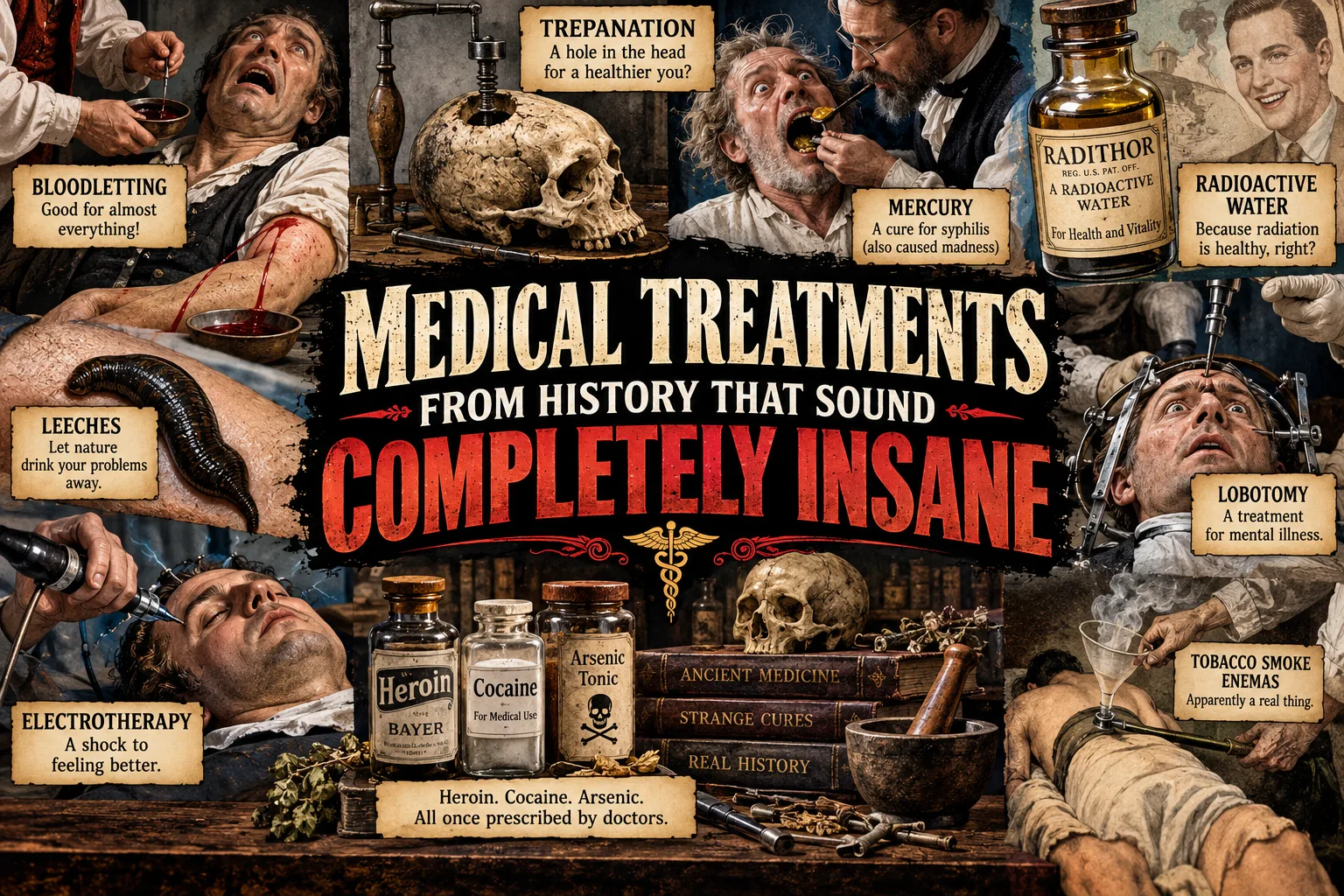
Medical Treatments From History That Sound Completely Insane
From bloodletting and mercury cures to drilling holes in skulls, medical history is filled with treatments that sound unbelievable today. But many were once considered serious medicine.
Medical Treatments From History That Sound Completely Insane
Imagine walking into a doctor's office with a fever.
Instead of receiving medicine, your physician opens a vein and removes a substantial amount of your blood.
You have syphilis?
Mercury.
Severe mental illness?
Perhaps a hole should be drilled into your skull.
Persistent cough?
There was a time when a doctor might prescribe something containing heroin.
Feeling tired or "weak"?
Maybe an electrical current will restore your mysterious lost vitality.
And if you're unfortunate enough to live in a period when physicians believe illness comes from an imbalance of invisible bodily humors, the treatment might make you considerably weaker before anyone decides it isn't working.
From a modern perspective, some historical medicine sounds less like healthcare and more like an elaborate attempt to determine how much additional suffering a sick person can tolerate.
But simply laughing at old medicine misses the interesting part.
Many of these treatments were not considered ridiculous at the time.
They were based on the best medical theories available to particular societies. Some even produced occasional benefits, although often for completely different reasons than physicians believed.
Others were dangerous from beginning to end.
And a few practices that sound horrifying actually contained ideas that modern medicine still uses in radically improved forms.
So instead of asking:
"How could people possibly believe this?"
A better question is:
"What evidence and theories made these treatments seem reasonable at the time?"
Because future physicians may eventually ask exactly the same thing about parts of medicine practiced today.
1. Bloodletting: When Losing Blood Was Supposed to Make You Healthier
For centuries, one of the most common medical treatments involved deliberately removing blood from the patient.
This was bloodletting.
Physicians used:
Lancets.
Knives.
Special bleeding instruments.
Leeches.
Patients could be bled for an enormous range of complaints.
Fever.
Headache.
Inflammation.
Infections.
High blood pressure-like symptoms.
Mental disturbances.
Even preventive healthcare.
If something was wrong with you, apparently having slightly less blood was worth investigating.
Why Did Doctors Believe in Bloodletting?
To understand it, we need to enter an entirely different model of the human body.
Ancient Greek medicine developed ideas involving four bodily humors:
Blood
Phlegm
Yellow bile
Black bile
Health was associated with balance among them.
Disease could result from imbalance.
If physicians believed a patient possessed too much blood, removing some seemed perfectly logical within that framework.
The reasoning wasn't necessarily stupid.
The underlying biological model was wrong.
That's an important distinction.
Galen Helped Make the System Extremely Influential
The Greek-Roman physician Galen, who lived during the second century CE, became one of the most influential medical thinkers in history.
His writings shaped European and Islamic medicine for centuries.
Galen developed complex ideas about physiology and humoral balance.
Later physicians inherited those traditions.
Bloodletting became deeply embedded in medical practice.
And once a treatment becomes standard practice across generations, challenging it becomes surprisingly difficult.
Human institutions remain remarkably consistent on that point.
George Washington's Final Illness
One of the most famous examples involves George Washington.
In December 1799, Washington developed a severe throat illness.
His physicians treated him using several approaches, including extensive bloodletting.
A substantial quantity of blood was removed during his final illness.
Washington died on December 14, 1799.
🟢 Established Evidence
Washington was repeatedly bled during his final illness.
🟡 Historical Medical Debate
Exactly how much the bloodletting contributed to his death cannot be determined with certainty.
His underlying illness itself was serious.
However, removing large quantities of blood from an already critically ill patient could obviously worsen physiological stress.
So it would be too simplistic to say:
"Bloodletting killed George Washington."
But it certainly did not provide the kind of treatment modern medicine would consider appropriate.
Was Bloodletting Always Useless?
Here's where history becomes inconvenient.
Removing blood can actually have legitimate medical applications in specific conditions.
Modern therapeutic phlebotomy may be used for disorders such as:
Hemochromatosis.
Polycythemia vera.
Certain other carefully selected conditions.
The difference is enormous.
Modern medicine doesn't conclude:
"Your humors seem argumentative today. Fetch the bucket."
It uses defined diagnoses, controlled quantities, physiological monitoring, and evidence.
2. Leeches: Medieval Horror That Modern Medicine Still Uses
Leeches are practically designed to make humans uncomfortable.
They attach to skin.
Cut into tissue.
Consume blood.
And release substances that interfere with clotting.
Naturally, physicians looked at this creature and thought:
Medical equipment.
For centuries, medicinal leeches were used as part of bloodletting.
During the eighteenth and nineteenth centuries, demand became enormous in parts of Europe.
Then Modern Surgery Brought Them Back
Here comes the twist.
Leeches still have legitimate medical applications.
In reconstructive and microsurgery, surgeons can sometimes successfully restore arterial blood flow to reattached tissue while venous drainage remains inadequate.
Blood accumulates.
The tissue becomes congested.
A medicinal leech can remove blood while its saliva helps maintain local bleeding.
That can temporarily relieve venous congestion while new circulation develops.
🟢 Modern Evidence-Based Use
Medicinal leeches remain useful in carefully selected reconstructive surgical situations.
So:
Leeches everywhere for mysterious humor imbalance?
Bad medicine.
Sterile medicinal leeches under specialist supervision for venous congestion?
Legitimate medicine.
History occasionally hands modern medicine back its weirdest equipment with improved instructions.
3. Trepanation: Drilling a Hole Into the Skull
Few historical medical practices sound more alarming than trepanation.
A hole was intentionally cut, scraped, or drilled into the skull.
And humans have been doing versions of this for thousands of years.
Archaeologists have discovered trepanned skulls from prehistoric societies across multiple regions of the world.
Some examples show signs of bone healing.
Which means the patient survived.
Why Were People Doing This?
We don't have one universal explanation.
Trepanation occurred across different cultures and periods.
Possible motivations may have included:
Treatment of head injuries.
Relief of pressure.
Neurological symptoms.
Headaches.
Seizures.
Ritual or spiritual beliefs.
Different societies may have performed it for entirely different reasons.
Therefore the popular claim:
"Ancient people drilled skulls to release evil spirits"
is too broad.
That explanation may fit some cultural interpretations, but it cannot automatically explain every archaeological example.
🟢 Established Evidence
Trepanation is archaeologically documented across thousands of years, and some individuals survived the procedure.
🟡 Interpretation Varies
The reasons for prehistoric trepanation cannot always be reconstructed confidently.
Does Modern Medicine Drill Into Skulls?
Absolutely.
Neurosurgeons perform procedures involving openings in the skull for very specific medical reasons.
A craniotomy may provide access to the brain.
Burr holes may be used in certain circumstances to relieve intracranial pressure or drain collections such as some subdural hematomas.
The similarity is superficial but fascinating.
Opening the skull isn't inherently insane.
Doing it without modern imaging, anesthesia, sterile technique, antibiotics, or an evidence-based indication is where the experience becomes substantially less appealing.
4. Mercury: The Medicine That Could Poison the Patient
Mercury occupies a strange place in medical history.
It fascinated societies because of its unusual physical properties.
It was incorporated into treatments in different medical traditions.
One of its most notorious historical uses involved syphilis.
Before effective antimicrobial treatment existed, mercury preparations became associated with attempts to treat the disease.
Patients might receive mercury through:
Ointments.
Ingestion.
Fumigation.
Other preparations.
The Treatment Could Be Horrific
Mercury exposure can produce serious toxicity.
Depending on the form, dose, and exposure, effects can involve:
Neurological damage.
Kidney injury.
Tremors.
Behavioral changes.
Gastrointestinal symptoms.
Other systemic effects.
Some historical treatments deliberately produced heavy salivation because physicians interpreted it as part of the therapeutic process.
Imagine being poisoned by your treatment while your physician interprets the poisoning symptoms as evidence that the medicine is working.
Medical history can be an aggressively humbling subject.
"A Night With Venus, a Lifetime With Mercury"
A famous phrase became associated with syphilis treatment:
"A night with Venus, a lifetime with Mercury."
The expression reflected the long, unpleasant treatment patients could face.
Mercury remained part of anti-syphilitic medicine for centuries before more effective therapies emerged.
Eventually, antibiotics transformed treatment.
🟢 Established Evidence
Mercury compounds were historically used against syphilis and could cause serious toxicity.
🔴 Modern Safety Reality
Mercury is not an acceptable DIY or alternative treatment for infection.
Historical use demonstrates the desperation created by diseases for which medicine had few effective options.
5. Arsenic: Poison, Medicine, and an Unexpected Modern Legacy
Arsenic is famous as a poison.
Which makes its medical history sound immediately suspicious.
Yet arsenic compounds were historically incorporated into medicines.
One famous preparation was Fowler's solution, developed in the eighteenth century.
It contained potassium arsenite.
It was used for various conditions over time.
Then Came Salvarsan
In the early twentieth century, Paul Ehrlich and his collaborators searched systematically for compounds capable of targeting infectious organisms.
Their work eventually produced arsphenamine, better known as Salvarsan.
It became an important treatment for syphilis before penicillin.
Salvarsan wasn't harmless.
Administration was difficult and adverse effects occurred.
But it represented an important step toward targeted antimicrobial chemotherapy.
And Arsenic Still Has a Medical Use
This sounds like the historical insanity should end here.
It doesn't.
Arsenic trioxide is used today in modern medicine for specific forms of acute promyelocytic leukemia.
Under carefully controlled medical conditions, a substance notorious as a poison can become an effective drug.
Because toxicology has a habit of ruining the comforting division between:
"Poison" and "medicine."
Dose, formulation, target, exposure, and context matter enormously.
6. Tobacco Smoke Enemas
Now we arrive at a treatment whose name already sounds like satire.
During the eighteenth century, particularly in Europe, tobacco smoke was sometimes introduced into the rectum as a resuscitation treatment.
Yes.
That sentence unfortunately contains no typo.
Devices were developed to blow tobacco smoke into a patient's intestines.
The method became particularly associated with attempts to revive drowning victims.
Why Would Anyone Think This Worked?
Tobacco had acquired a reputation for medicinal properties after its introduction into European practice.
Nicotine produces noticeable physiological effects.
Warm smoke was also thought to stimulate the body.
The intestines provided a route through which substances could be absorbed.
Within the medical theories of the period, the treatment wasn't necessarily viewed as comedy.
It was an attempted resuscitation technology.
A profoundly unpleasant one, but still.
Did It Work?
There is no good evidence that tobacco smoke enemas were an effective resuscitation treatment.
As understanding of respiration and tobacco's toxic effects improved, the practice disappeared.
🟢 Historical Practice
Tobacco smoke enemas genuinely appeared in historical resuscitation practices.
🔴 Not Evidence-Based Modern Treatment
They have no role in modern resuscitation.
Modern CPR has, mercifully, redesigned the user experience.
7. Corpse Medicine: When Human Remains Became Pharmacy Ingredients
This may be one of the most uncomfortable chapters in European medical history.
From the medieval period into the early modern era, substances derived from human bodies were sometimes used medicinally.
These could include:
Human blood.
Fat.
Bone.
Skull.
And preparations known as mumia.
Mumia and the Mummy Confusion
The history of mumia is complicated.
The term became associated with substances derived from embalmed bodies and eventually with actual Egyptian mummies.
European demand contributed to mummy material being sold for medicinal use.
People consumed preparations believing they possessed therapeutic properties.
Yes.
Europeans really did turn ancient human remains into medicine.
The Victorians later became associated with mummy-unwrapping entertainment too, because apparently disturbing archaeological remains required several separate industries.
Why Would Human Remains Be Considered Medicine?
Historical medicine sometimes relied on ideas of sympathetic healing.
A substance's perceived qualities could supposedly transfer therapeutic properties.
Blood represented vitality.
Skull might be connected symbolically with conditions involving the head.
The body itself could become pharmacological material.
These ideas existed within broader medical and magical frameworks that differed dramatically from modern biomedical science.
🟢 Established Historical Practice
Human-derived materials were genuinely incorporated into some European medicines.
🔴 No Scientific Basis for Most Such Claims
Consuming powdered human remains does not provide the mystical therapeutic effects historically attributed to them.
And perhaps archaeology appreciates us finally establishing that boundary.
8. Heroin as Medicine
Today, heroin is associated primarily with addiction, overdose, and illicit drug markets.
But heroin began its commercial life very differently.
Diacetylmorphine was synthesized in the nineteenth century.
The pharmaceutical company Bayer later marketed heroin around the end of that century.
It was promoted for medical purposes, including cough suppression.
Why Did It Seem Reasonable?
Heroin is an opioid.
Opioids can suppress coughing.
They can also reduce pain.
The problem is that heroin carries major risks including:
Dependence.
Respiratory depression.
Overdose.
Addiction.
As these dangers became clearer, medical attitudes and regulation changed.
The Broader Lesson
Heroin's medical history demonstrates something important.
A drug can produce a genuine therapeutic effect while still having an unacceptable risk profile for a particular use.
The fact that something "works" in one sense doesn't automatically make it good medicine.
Modern drug evaluation asks questions such as:
How effective is it?
At what dose?
For which patients?
Compared with what alternative?
What are the adverse effects?
What is the dependence potential?
What happens during long-term use?
Medicine becomes safer when those questions become harder to avoid.
9. Cocaine Was Once a Medical Breakthrough
Cocaine also has a legitimate medical history.
During the nineteenth century, researchers discovered its powerful local anesthetic properties.
That was enormously important.
Before effective local anesthesia, many procedures were significantly more painful and difficult.
Cocaine could numb tissue.
Ophthalmology became one important early field of use.
Freud and Cocaine
A young Sigmund Freud became interested in cocaine and wrote about its possible medical applications.
At the time, its addiction risks were not fully appreciated.
Cocaine entered various commercial and medicinal products during the late nineteenth century.
Eventually, evidence of dependence and toxicity changed perceptions.
Is Cocaine Still Used Medically?
In limited contexts, pharmaceutical cocaine still has medical applications, particularly in certain procedures involving nasal tissues, because it combines local anesthetic effects with vasoconstriction.
That doesn't make recreational cocaine safe.
It means pharmacology refuses to respect simplistic categories.
🟢 Important Distinction
Historical cocaine enthusiasm underestimated serious risks.
But its anesthetic properties were real and contributed to the development of modern local anesthesia.
10. Radium Water and the Radioactive Health Craze
After radioactivity was discovered around the turn of the twentieth century, the phenomenon seemed revolutionary.
Radium glowed.
Radiation was mysterious.
Science was transforming civilization.
Naturally, commercial entrepreneurs concluded it should be added to health products.
Radioactive materials appeared in products marketed with health claims.
One infamous example was Radithor, a preparation containing radioactive substances dissolved in water.
Eben Byers and Radithor
American industrialist and athlete Eben Byers became one of the most famous victims of radioactive patent medicine.
He consumed large quantities of Radithor after being encouraged to use it for health complaints.
Eventually he developed catastrophic health problems associated with radiation exposure.
His jaw and bones were severely damaged.
He died in 1932.
🟢 Well-Documented Case
Byers' illness and death helped draw public attention to the dangers of radioactive consumer remedies.
Radiation would become enormously valuable in medicine.
But:
Radiation therapy targeted against cancer under controlled conditions
is very different from:
"Drink radioactive water because energy sounds healthy."
The twentieth century needed some time to work through that distinction.
11. Lobotomy: Surgery Intended to Treat the Mind
Few medical treatments experienced such a dramatic rise and fall in reputation as the lobotomy.
During the twentieth century, physicians experimented with psychosurgery for severe psychiatric disorders.
Portuguese neurologist António Egas Moniz developed the prefrontal leucotomy during the 1930s.
He later received the 1949 Nobel Prize in Physiology or Medicine partly for this work.
Then Walter Freeman Popularized Lobotomy in America
American physician Walter Freeman became closely associated with lobotomy.
He promoted a technique involving access through the eye socket, commonly called the transorbital lobotomy.
An instrument was inserted behind the eyelid and driven through the thin bone toward the frontal brain.
Even describing the procedure makes modern informed-consent paperwork spontaneously generate itself.
Thousands of lobotomies were performed.
Why Did Doctors Do This?
This question requires historical context.
Psychiatric hospitals contained many people with severe conditions for which medicine had extremely limited effective treatments.
Antipsychotic medications did not yet exist.
Some patients were profoundly distressed, violent, suicidal, psychotic, or unable to function independently.
Families and institutions were desperate for treatments.
Early reports suggested some patients became easier to manage.
But "easier to manage" and "neurologically healthy" are very different outcomes.
The Consequences Could Be Devastating
Patients could experience:
Personality changes.
Emotional flattening.
Cognitive impairment.
Seizures.
Disability.
Infection.
Death.
As psychiatric medications emerged and understanding of the procedure's harms grew, lobotomy fell out of mainstream practice.
🟢 Historically Established
Lobotomy was genuinely used as psychiatric treatment and received substantial professional legitimacy for a period.
🔴 Important Distinction
Modern neurosurgery and highly specialized psychosurgical techniques should not be equated with historical lobotomy.
Today's procedures involve radically different technologies, targeting, ethics, evidence requirements, and patient selection.
12. Insulin Coma Therapy
Before modern psychiatric drugs became available, physicians experimented with several physical treatments for severe mental illness.
One was insulin coma therapy.
Large doses of insulin were administered deliberately to produce profound hypoglycemia.
Patients could enter coma.
The treatment was repeated over multiple sessions.
It became particularly associated with schizophrenia.
Why?
The technique emerged during the 1930s and gained considerable popularity.
Some physicians believed patients improved.
But later controlled evaluation failed to support the dramatic therapeutic claims that had driven its adoption.
Meanwhile, deliberately inducing severe hypoglycemia carried obvious risks.
The method eventually disappeared.
This Reveals a Recurring Pattern
A treatment appears.
Doctors observe improvement in some patients.
The treatment spreads.
Professional enthusiasm grows.
Then better-controlled studies arrive.
And suddenly:
Natural recovery.
Selection effects.
Biased observation.
Placebo effects.
Differences in supportive care.
Poor outcome measurement.
Other confounding factors.
begin to look considerably more important.
This is one reason randomized controlled trials became such a critical part of modern medicine.
Human observation is powerful.
It is also remarkably talented at lying to itself.
13. Malaria Therapy: Deliberately Infecting Patients to Treat Syphilis
This treatment sounds completely insane.
It also earned a Nobel Prize.
Before effective antibiotics, neurosyphilis could cause devastating neurological and psychiatric disease.
Austrian physician Julius Wagner-Jauregg developed a treatment involving deliberately infecting patients with malaria.
Why?
Because malaria causes high fevers.
The hope was that fever would damage the organism responsible for syphilis.
Afterward, the malaria itself could be treated with drugs such as quinine.
Did It Actually Work?
Unlike many treatments on this list, malaria therapy could produce real benefit in some patients with neurosyphilis.
Wagner-Jauregg received the 1927 Nobel Prize in Physiology or Medicine for this work.
The treatment was dangerous.
Some patients died.
But before antibiotics, physicians were dealing with a severe progressive disease with few effective options.
Once penicillin became available, deliberately giving someone malaria became understandably less attractive.
🟢 Historically Effective but Dangerous
Malaria therapy was not simply pseudoscience.
It had therapeutic effects against neurosyphilis in the pre-antibiotic era.
It became obsolete because medicine developed something much safer and better.
This is a crucial distinction.
Some old treatments were irrational.
Others were rational responses to terrible circumstances using the limited tools available.
14. Electroconvulsive Therapy: The Treatment People Think Disappeared
Mention electroconvulsive therapy, or ECT, and many people imagine historical psychiatric institutions.
Patients restrained.
Violent electrical shocks.
No anesthesia.
Hollywood has done considerable work here.
Early forms of ECT could indeed be much harsher than modern practice.
But here's the important part:
ECT still exists.
And unlike many abandoned historical psychiatric treatments, modern ECT has substantial evidence supporting it for specific severe conditions.
Modern ECT Is Not the Movie Version
Today, ECT is performed medically under controlled conditions.
Patients receive anesthesia.
Muscle relaxants are used.
Electrical parameters are carefully controlled.
The treatment may be considered for conditions such as severe depression, particularly when rapid treatment is required or other treatments have failed.
Memory-related adverse effects can occur and must be considered seriously.
🟢 Evidence-Based Modern Treatment
Modern ECT is a legitimate psychiatric treatment.
It should not be grouped casually with abandoned procedures such as lobotomy simply because both appear frightening.
This is precisely why evaluating medicine by "that sounds horrifying" is unreliable.
Some horrifying-sounding treatments work.
Some harmless-sounding treatments kill people.
Evidence has terrible respect for aesthetics.
15. Electrotherapy and the Age of Electrical Miracle Cures
When electricity became scientifically and technologically exciting, people quickly began imagining it as a universal medical force.
Devices promised electrical treatment for:
Weakness.
Nervous disorders.
Sexual problems.
Fatigue.
Pain.
Paralysis.
Hair loss.
Almost whatever ailment happened to be commercially convenient.
Electric belts and other devices entered the marketplace.
Electricity Does Affect the Body
That is what made the claims plausible.
Nerves communicate through electrical activity.
Muscles respond to electrical stimulation.
Electrical interventions genuinely have medical uses.
Modern healthcare uses electricity in:
Pacemakers.
Defibrillation.
Nerve stimulation.
Deep brain stimulation.
Physical rehabilitation.
Electrosurgery.
ECT.
But:
"Electricity can affect biology"
does not imply:
"This electrified belt cures everything advertised in the newspaper."
16. Animal Dung and Other Uncomfortable Ingredients
Historical pharmacopoeias sometimes contain ingredients modern readers find extraordinary.
Animal feces.
Urine.
Fat.
Organs.
Blood.
Insects.
Minerals.
Plants containing potent toxins.
Some preparations came from symbolic medical theories.
Others may have produced actual pharmacological effects.
And some were simply harmful.
Ancient Medicine Was Not One Thing
This deserves emphasis.
It is misleading to describe all ancient medicine as superstition.
Ancient physicians and healers accumulated practical knowledge about:
Wounds.
Fractures.
Plants.
Childbirth.
Diet.
Surgery.
Disease patterns.
Some treatments were effective.
Some ineffective.
Some dangerous.
And the distinction was extremely difficult to determine without modern experimental methods.
Ancient people were not biologically less intelligent than us.
They lacked:
Microbiology.
Modern chemistry.
Controlled clinical trials.
Medical imaging.
Molecular biology.
Antibiotics.
Advanced pathology.
Reliable statistical methods.
Give a brilliant physician the wrong model of disease and they can produce brilliantly logical wrong answers.
The Theory That Dominated Medicine for Centuries
The history of medicine repeatedly demonstrates the power of a framework.
Humoral medicine is the clearest example.
If disease means imbalance among bodily humors, then treatments aimed at restoring balance make sense.
Bleeding.
Purging.
Vomiting.
Dietary manipulation.
Enemas.
Once the framework is accepted, every observation gets interpreted through it.
Patient improves after bleeding?
The treatment worked.
Patient gets worse?
The imbalance was more severe than expected.
Patient dies?
Treatment came too late.
A theory capable of explaining every possible outcome becomes extremely difficult to disprove.
Modern science tries to solve this by demanding something much more uncomfortable:
Predictions that can fail.
How Did Medicine Escape This?
Not through one discovery.
Modern medicine emerged gradually through multiple revolutions.
Anatomical investigation challenged inherited assumptions.
William Harvey's work transformed understanding of blood circulation.
Microscopy revealed previously invisible structures.
Germ theory fundamentally changed ideas about infectious disease.
Anesthesia transformed surgery.
Antisepsis and sterile technique reduced surgical infection.
Statistics allowed treatments to be compared systematically.
Randomized controlled trials reduced bias.
Medical imaging allowed physicians to look inside living bodies.
Molecular biology transformed disease mechanisms.
None made medicine perfect.
But together they changed how medical claims could be tested.
The Most Important Revolution Wasn't a Drug
It was a question:
"How do we know this treatment works?"
That question sounds obvious now.
Historically, it was revolutionary.
Personal experience is not enough.
Expert authority is not enough.
Tradition is not enough.
A famous doctor's opinion is not enough.
A patient improving afterward is not enough.
Modern evidence-based medicine tries to compare outcomes systematically.
Because without comparison, humans routinely mistake coincidence for causation.
Why Patients Often Improved After Useless Treatments
This is one of the reasons bad medicine can survive.
Suppose 100 people develop an illness that usually resolves naturally.
A healer gives all 100 an ineffective potion.
Seventy recover.
What do they remember?
The potion cured seventy people.
But perhaps seventy would have recovered anyway.
Without an untreated or appropriately controlled comparison group, we don't know.
Other factors complicate things further:
Placebo effects.
Regression toward the mean.
Misdiagnosis.
Changes in diet.
Rest.
Supportive care.
Selective memory.
Publication bias.
The natural course of disease.
This is why anecdotes can be emotionally powerful while scientifically weak.
Why "Natural" Didn't Mean Safe Either
Historical medicine relied heavily on natural substances.
That sometimes gets romanticized.
But nature produces:
Arsenic.
Mercury.
Belladonna.
Hemlock.
Opium.
Toxic mushrooms.
Venoms.
Disease-causing organisms.
Nature is not a pharmaceutical company with an ethical review board.
Natural substances can be enormously useful.
Many modern drugs originated from or were inspired by natural compounds.
But safety depends on chemistry, dose, route, interactions, and biology.
Not whether something grew politely beside a tree.
What Will Future Doctors Think About Us?
This is perhaps the most uncomfortable question.
It's easy to look backward and laugh.
Bloodletting.
Mercury.
Radium water.
Tobacco smoke enemas.
Lobotomies.
But the physicians using these treatments usually did not wake up intending to harm patients.
Many genuinely believed they were practicing good medicine.
Some treatments were supported by respected institutions.
Some were taught professionally.
Some had enthusiastic patients.
Some received prestigious awards.
That should make us cautious about assuming modern medicine has reached the final version of truth.
It hasn't.
Medical recommendations continue changing as evidence improves.
Some current treatments will almost certainly be modified or abandoned.
Others will look primitive compared with technologies available centuries from now.
Progress does not mean:
"We finally know everything."
It means:
"We have better methods for discovering when we're wrong."
Frequently Asked Questions
Did doctors really bleed sick patients?
Yes. Bloodletting was used across multiple medical traditions and remained common in Western medicine for centuries.
Did George Washington receive bloodletting before he died?
Yes. Washington underwent repeated bloodletting during his final illness in December 1799. The exact degree to which it contributed to his death remains debated.
Are leeches still used by doctors?
Yes. Medicinal leeches can be used in specialized reconstructive surgery to help relieve venous congestion.
Did ancient people really drill holes into skulls?
Yes. Archaeological evidence of trepanation exists across multiple ancient and prehistoric populations. Some skulls show healing, demonstrating survival.
Was mercury really used to treat syphilis?
Yes. Mercury preparations were historically used against syphilis before safer and more effective treatments became available.
Was heroin originally sold as medicine?
Yes. Diacetylmorphine was commercially marketed for medicinal purposes around the turn of the twentieth century, including as a cough treatment.
Did people actually drink radioactive medicine?
Yes. Products containing radioactive substances were commercially promoted during the early twentieth century. Radithor became one notorious example.
Were lobotomies considered legitimate medicine?
Yes. Psychosurgery received significant professional acceptance during part of the twentieth century, although lobotomy could cause devastating complications and was eventually largely abandoned.
Did doctors deliberately give patients malaria?
Yes. Malaria therapy was used to treat neurosyphilis before antibiotics and could produce genuine therapeutic benefit despite substantial risks.
Is electroconvulsive therapy still used?
Yes. Modern ECT is an evidence-based treatment used under anesthesia for selected severe psychiatric conditions. It differs substantially from many early portrayals and historical practices.
Myth vs. Reality
🟢 Bloodletting existed for centuries
True.
🔴 Every ancient doctor believed every disease required bleeding
False. Medical practice varied substantially across cultures, periods, and practitioners.
🟢 Human remains were used medicinally
True in certain historical European contexts.
🟢 Tobacco smoke enemas existed
Unfortunately, also true.
🔴 Trepanation always meant releasing demons
Unsupported oversimplification.
🟢 Mercury was used against syphilis
True.
🟢 Heroin and cocaine had legitimate medical histories
True.
🔴 Everything old was useless
Definitely false.
Some historical therapies worked.
Others contained principles later refined into modern medicine.
🔴 Everything modern is therefore automatically safe
Also false.
Modern treatments require continuous evidence, monitoring, and revision.
Final Thoughts
Historical medicine looks insane when viewed from a world of antibiotics, MRI scanners, sterile operating rooms, molecular diagnostics, and controlled clinical trials.
But that perspective can make us arrogant.
Bloodletting made sense within humoral theory.
Mercury was used because physicians desperately needed something against diseases such as syphilis.
Trepanation may sometimes have addressed genuine head trauma.
Malaria therapy deliberately created one dangerous disease to fight another, and astonishingly, it could actually help.
Leeches went from ancient bloodletting tools to legitimate assistants in reconstructive surgery.
Arsenic went from poison to historical medicine and eventually became part of modern treatment for a specific leukemia.
Electricity produced ridiculous miracle devices, yet carefully controlled electrical interventions now save lives.
The real dividing line between ancient absurdity and modern medicine isn't simply whether a treatment sounds frightening.
It's whether we can demonstrate:
Who benefits.
How much they benefit.
What the risks are.
Why the treatment works.
Whether it performs better than alternatives.
And most importantly:
Whether the evidence survives attempts to prove it wrong.
The disturbing lesson from medical history isn't that people in the past were stupid.
They weren't.
It's that intelligent people can build extremely sophisticated systems around incorrect assumptions.
And once those assumptions become accepted wisdom, patients can be bled, poisoned, shocked, cut, irradiated, or subjected to treatments for decades before enough evidence accumulates to overturn them.
That is why medical science remains unfinished.
Every generation inherits treatments from the previous one.
Some survive testing.
Some are improved.
Some disappear.
And a few eventually end up in articles with titles like:
"Medical Treatments From History That Sound Completely Insane."
Future historians are almost certainly preparing our section.