10 Historical Punishments That Sound Too Cruel to Be Real
From public humiliation to horrifying methods of execution, history contains punishments so brutal they sound invented. Discover 10 documented examples while separating genuine practices from myths and later exaggerations.
10 Historical Punishments That Sound Too Cruel to Be Real
Human societies have always needed ways to deal with crime.
Modern justice systems generally rely on things such as:
Fines.
Probation.
Imprisonment.
Community service.
And, in some jurisdictions, capital punishment.
Travel far enough back through history, however, and punishment could serve a very different purpose.
It wasn't always enough to stop the offender.
Authorities might also want to:
Humiliate them.
Terrify everyone watching.
Destroy their social status.
Demonstrate state power.
Make the punishment symbolically fit the crime.
Or turn someone's suffering into a public warning.
The result was a collection of punishments so brutal that some sound like inventions from horror fiction.
Unfortunately, several were real.
Others, however, have been exaggerated or even largely invented by later writers.
So rather than assembling another internet list where every medieval torture device is accepted because somebody put it underneath a picture of a castle, we're going to separate:
Documented punishment.
Historically plausible but disputed claims.
Later legend.
And the distinction produces some surprises.
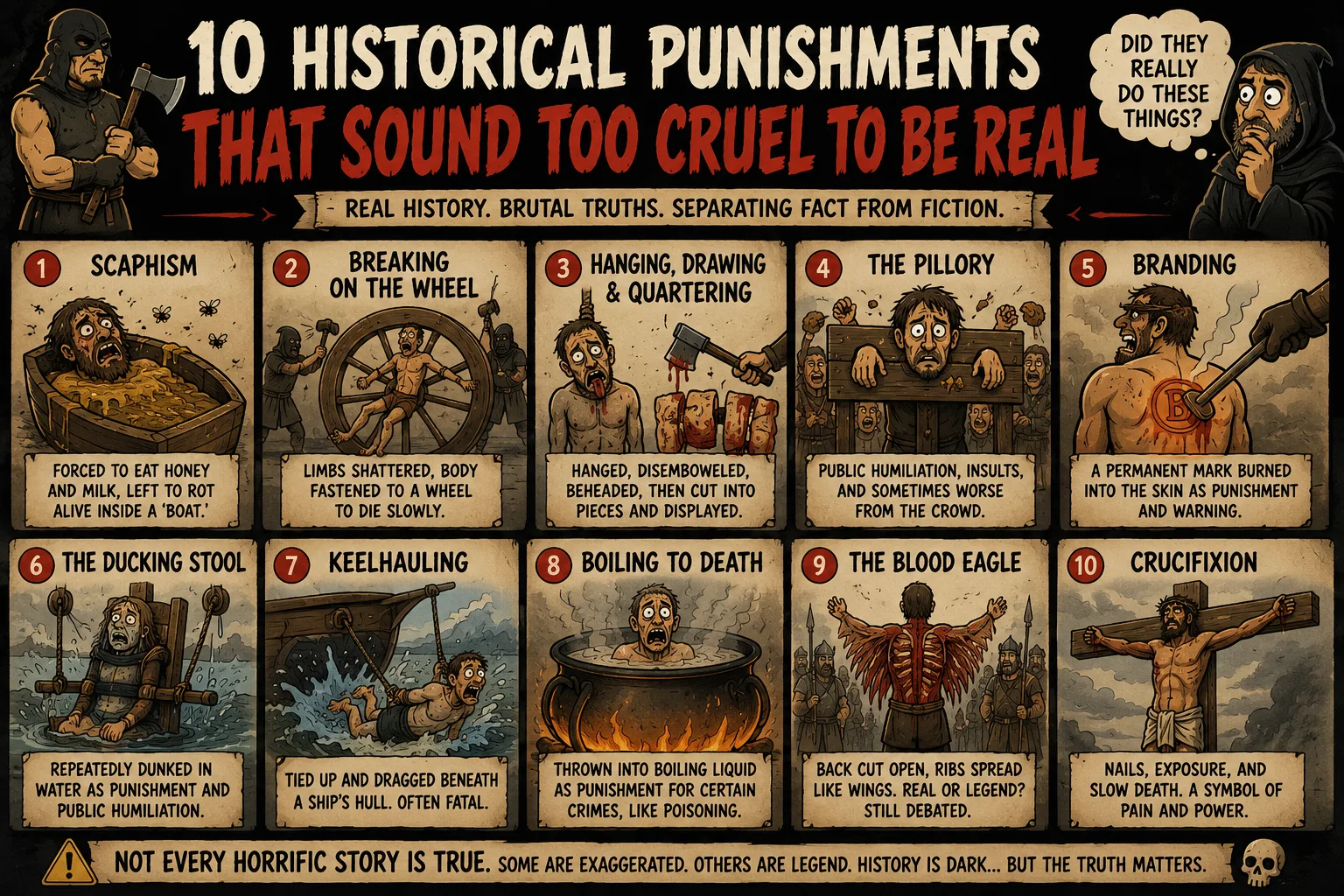
1. Scaphism: The Persian "Boats"
Let's begin with one of history's most infamous alleged execution methods.
Ancient Greek writer Plutarch described a Persian punishment sometimes called scaphism.
According to his account, a condemned person was enclosed between two boats or hollowed structures with the head, hands, and feet exposed.
The victim was reportedly force-fed milk and honey.
More honey was placed on the body.
The person was then left exposed.
Insects supposedly gathered around the victim while excrement accumulated inside the enclosure.
Death came slowly through a combination of exposure, infection, and other complications.
It is difficult to imagine a punishment more deliberately designed around prolonged suffering.
There's just one problem.
How Certain Are We That Scaphism Really Happened?
Our famous description comes from Plutarch, who lived centuries after the Persian king associated with the story.
That makes verification difficult.
Greek writers also had political and cultural reasons to portray Persia as cruel or decadent.
We therefore shouldn't describe every detail as independently established fact.
🟡 Historically Uncertain
Scaphism appears in ancient literary sources, most famously Plutarch, but strong independent evidence confirming the punishment as a regularly practiced Persian execution method is lacking.
It may reflect a real practice, an embellished account, or hostile storytelling.
So scaphism belongs on this list.
But with a very large historical asterisk attached.
2. Breaking on the Wheel
Unlike scaphism, breaking on the wheel is very well documented.
The punishment appeared in parts of Europe and remained in use into the early modern period.
A condemned person's limbs could be deliberately broken, often with a heavy object.
The body might then be attached to or displayed on a large wheel.
Procedures varied according to place and period.
Sometimes death came relatively quickly.
In other cases, the process was deliberately prolonged.
Why Use a Wheel?
The wheel made the punishment highly visible.
That mattered.
Execution wasn't merely about killing someone.
It was public communication.
Authorities wanted spectators to understand:
This is what happens to people who commit certain crimes.
The destroyed body became part of the warning.
Punishment therefore operated simultaneously on two audiences:
The condemned person.
And everyone watching.
🟢 Strong Historical Evidence
Breaking on the wheel is extensively documented in European legal and historical records and appears in contemporary imagery and accounts.
Unlike many famous "medieval torture devices," its historical use is not seriously in doubt.
3. Hanging, Drawing and Quartering
In medieval and early-modern England, men convicted of high treason could face one of the most notorious execution sentences in European history:
Hanged, drawn and quartered.
The precise procedures changed across time.
But the punishment could involve dragging the condemned person to the execution site, hanging them, disembowelment or mutilation, decapitation, and division of the body.
The remains could then be displayed publicly.
The objective went far beyond death.
Treason Was Treated Differently
Treason attacked the political order itself.
A person convicted of ordinary murder had killed an individual.
A traitor, in the logic of monarchy, had attacked the sovereign and therefore the state.
The punishment reflected that perceived magnitude.
The body could literally be divided and displayed in different places.
The message was impossible to miss.
Challenge royal authority and the consequences would follow you even after death.
William Wallace
One famous victim was William Wallace, executed in London in 1305 after being convicted of treason against King Edward I.
Wallace was subjected to the brutal execution associated with the sentence.
His head was displayed on London Bridge, while parts of his body were sent elsewhere.
Centuries later, Wallace became a major Scottish national figure.
His execution demonstrates another recurring feature of public punishment:
Authorities control the execution.
They do not necessarily control how history remembers the victim.
🟢 Strong Historical Evidence
Hanging, drawing and quartering is extensively documented in English legal history.
However, popular descriptions sometimes combine procedures from different periods as though every execution followed exactly the same sequence.
4. The Pillory
Compared with dismemberment, the pillory might initially sound almost harmless.
A person was restrained in a wooden framework, typically with the head and hands exposed.
Then they stood publicly while people watched.
But the punishment wasn't merely uncomfortable.
It weaponized the crowd.
Spectators could insult the prisoner.
Throw garbage.
Rotten food.
Mud.
And sometimes far more dangerous objects.
The victim had limited ability to protect themselves.
Public Humiliation Was the Punishment
Modern people sometimes underestimate how devastating public shame could be in societies where reputation strongly affected:
Employment.
Business.
Marriage.
Community standing.
Social relationships.
The pillory attacked both the body and social identity.
And because the crowd could participate, the boundary between judicial punishment and mob violence could become dangerously thin.
People Could Die in the Pillory
Being placed in a pillory did not automatically mean death.
But serious injuries and deaths could occur when crowds became violent.
That makes the pillory an interesting example of punishment whose severity depended partly on the spectators.
The government supplied the stage.
The public could supply the cruelty.
Humanity discovered interactive entertainment rather early.
🟢 Strong Historical Evidence
Pillories were genuinely used in Europe and colonial America.
They should not be confused with every similar restraint device, however, because stocks and pillories served somewhat different purposes and restrained the body differently.
5. Branding
Imagine committing an offense and receiving a punishment designed to remain visible long after you leave the authorities.
That was part of the purpose of judicial branding.
A heated metal instrument could be pressed against the body, leaving a permanent scar.
The mark might indicate the offense or legal status of the person.
Branding therefore combined:
Pain.
Punishment.
Identification.
Stigma.
A Criminal Record Written on the Body
Today, criminal records are stored in databases and documents.
Historically, a physical mark could serve a similar social function.
Anyone seeing it might know that the person had previously been punished.
The sentence therefore continued long after the wound healed.
It could affect:
Employment.
Social acceptance.
Future legal treatment.
Reputation.
The body became the record.
Branding in Colonial America
Judicial branding was also used in parts of colonial North America.
Punishments varied among colonies and across time.
Certain offenses could lead to letters or other marks being burned into the body.
This is worth remembering whenever brutal punishment is treated as something practiced only by distant ancient civilizations.
American history contains plenty of its own examples.
No need to outsource all historical cruelty to Europe.
🟢 Strong Historical Evidence
Judicial branding is well documented across multiple historical societies, including European jurisdictions and parts of colonial America.
The precise location and symbol used varied according to the legal system and offense.
6. The Ducking Stool
Some punishments were specifically designed around humiliation.
The ducking stool involved securing someone to a chair and repeatedly lowering them into water.
It was used in Britain and elsewhere in various contexts.
Women accused of being:
"Scolds."
Disorderly.
Quarrelsome.
Or otherwise socially disruptive
could be targeted.
The punishment reveals something beyond physical cruelty.
It shows how law could enforce expectations about acceptable social behavior.
Punishing People for Being "Difficult"
The historical offense of being a common scold sounds bizarre today.
But it reflected social norms concerning behavior, gender, neighborhood conflict, and public order.
Punishment wasn't always directed toward acts modern criminal law would recognize as serious crimes.
Sometimes authorities punished people for violating expected social roles.
That makes old legal systems useful windows into what societies valued and feared.
Ducking Stool vs. Cucking Stool
Historical terminology becomes messy here.
Cucking stools and ducking stools are often treated as identical.
They weren't necessarily the same thing historically.
A cucking stool could be used for public humiliation without immersion.
Ducking mechanisms involving water developed in related traditions.
Popular accounts frequently merge them.
Because apparently even torture-adjacent furniture requires careful taxonomy.
🟢 Documented With Important Nuance
Ducking stools are historically documented, but online descriptions often oversimplify their development and relationship to cucking stools.
They also should not automatically be described as standard methods for testing alleged witches.
7. Keelhauling
Imagine being on a sailing ship.
You're tied with ropes.
Then you're thrown overboard and dragged beneath the vessel.
That is the basic concept associated with keelhauling.
The punishment is particularly associated with some European maritime traditions, including the Dutch navy.
A victim could suffer:
Drowning.
Impact injuries.
Severe abrasions.
Cuts.
Trauma from marine growth attached to the hull.
Whether the person survived depended on the procedure and circumstances.
Why Was It So Dangerous?
Wooden ship hulls could accumulate hard marine organisms.
Being dragged against the underside of such a vessel could cause severe injuries.
But drowning itself was also an obvious danger.
Keelhauling therefore combined punishment with an environment where even small mistakes could become fatal.
🟢 Historical Evidence Exists
Keelhauling is not simply a pirate legend.
Evidence supports its use in some historical naval contexts, particularly in the Dutch maritime world.
However, pirate fiction has helped create the misleading impression that it was universally practiced across sailing ships.
It wasn't.
8. Boiling to Death
This one unfortunately requires very little imagination.
Execution by boiling existed in some historical contexts.
A condemned person could be placed into heated liquid and killed.
One particularly notorious episode occurred in England during the reign of Henry VIII.
The 1531 Act for Poisoning
After a poisoning case involving Richard Roose, Parliament passed legislation making boiling to death the punishment for certain forms of poisoning.
Roose himself was executed by boiling in 1531.
The punishment was unusual even by the standards of English execution practices.
It did not become Britain's ordinary method of execution.
Why Such an Extreme Punishment?
Historical punishment frequently contained symbolism.
Poisoning could be viewed as especially treacherous because the victim might unknowingly consume the substance.
An unusually horrific execution demonstrated society's condemnation of the crime.
Henry VIII's England was not exactly famous for responding to political and criminal problems with excessive restraint.
🟢 Strong Historical Evidence
Execution by boiling was legally prescribed for certain poisoning offenses during Henry VIII's reign and was actually carried out.
However, it was relatively uncommon and should not be portrayed as a routine medieval English execution.
9. The Blood Eagle
Now we enter dangerous historical territory.
The blood eagle is one of the most famous alleged Viking execution methods.
Popular descriptions claim that a victim's back was opened, ribs separated from the spine, and lungs pulled outward to resemble wings.
It appears in later Norse literary traditions.
It also appears constantly in modern entertainment because subtlety apparently lost the marketing meeting.
But did Vikings really perform it?
The answer is:
We don't know.
The Evidence Is Highly Debated
References associated with the blood eagle come primarily from medieval Norse literary material written after the events they supposedly describe.
Scholars have debated whether these passages represent:
A real ritual execution.
Poetic imagery.
Later literary invention.
Misinterpretation.
Or some combination.
Modern anatomical analysis can ask whether such a procedure was physically possible.
Physical possibility, however, does not prove historical occurrence.
🟡 Historically Debated
The blood eagle should not be presented as a securely documented standard Viking execution.
Literary sources exist, but historians continue debating whether they describe an actual ritual practice.
This is precisely the kind of punishment that becomes "historical fact" after enough television episodes repeat it.
10. Crucifixion
Few ancient execution methods are as culturally recognizable as crucifixion.
Unlike several legendary punishments, crucifixion is unquestionably historical.
It existed in various forms in the ancient world and became particularly associated with Roman punishment.
Victims could be attached to wooden structures through ropes, nails, or combinations of methods.
Death could result from complex physiological effects involving trauma, exposure, exhaustion, and impaired bodily function.
Crucifixion Was Designed to Be Public
Roman crucifixion wasn't merely about killing.
It was degrading.
Slow.
Visible.
Victims could be displayed along roads or other prominent locations.
The punishment was particularly associated with people of low status, enslaved people, rebels, and others viewed as threats to Roman authority.
Roman citizens generally possessed protections against this form of execution, although political circumstances could complicate such distinctions.
Spartacus and the Appian Way
After the defeat of the slave revolt associated with Spartacus in 71 BCE, ancient sources report that thousands of captured rebels were crucified along the Appian Way between Capua and Rome.
The display transformed execution into political messaging.
Travelers moving along the road encountered the consequences of rebellion.
Rome wasn't merely punishing defeated rebels.
It was advertising what happened to people who challenged Roman power.
🟢 Strong Historical Evidence
Crucifixion is extensively supported by ancient literary evidence and archaeological discoveries.
However, there was no single universal crucifixion procedure. Methods varied across periods and circumstances.
Wait, Where Is the Iron Maiden?
A list about historical punishment practically demands the Iron Maiden.
You know the object.
A human-sized metal cabinet.
Victim placed inside.
Doors close.
Spikes penetrate the body.
Classic medieval torture.
There's one small problem.
The famous Iron Maiden is probably not an authentic medieval torture device in the form popularly imagined.
The Medieval Iron Maiden Is Largely a Myth
Devices displayed as Iron Maidens became famous centuries after the Middle Ages.
The notorious Iron Maiden of Nuremberg is generally associated with much later construction and storytelling.
There is weak evidence that medieval courts routinely used such spike-filled cabinets.
The device became a perfect symbol of supposedly barbaric medieval punishment.
It was dramatic.
Memorable.
Terrifying.
And apparently too marketable for historical accuracy to interfere.
🔴 Likely Historical Myth
The classic spiked Iron Maiden should not be presented as a standard medieval torture device.
Its popular reputation largely developed in later centuries.
What About the Brazen Bull?
Another famous device supposedly came from ancient Greece.
The Brazen Bull was allegedly a hollow bronze bull created for Phalaris, tyrant of Acragas in Sicily.
A victim was supposedly locked inside.
A fire was lit underneath.
The person's screams passed through tubes engineered to resemble the sound of a bull.
According to the legend, the inventor himself eventually became a victim of his creation.
It is an extraordinary story.
Perhaps suspiciously extraordinary.
History or Legend?
Ancient authors wrote about Phalaris' cruelty and the Brazen Bull.
But separating historical reality from literary tradition is difficult.
The device became part of the tyrant's legendary reputation.
Without stronger archaeological evidence, the elaborate details should not be treated with the same confidence as documented punishments such as crucifixion or breaking on the wheel.
🟡 Historically Uncertain
Ancient literary traditions describe the Brazen Bull, but whether the famous device existed and operated exactly as later accounts claim remains uncertain.
Why Were Historical Punishments So Public?
A modern prison hides punishment behind walls.
Many historical legal systems did the opposite.
Punishment needed witnesses.
Public execution communicated:
Authority.
Deterrence.
Moral judgment.
Religious meaning.
Political power.
The condemned person's body became a message.
The larger the audience, the further that message traveled.
Deterrence Was Only Part of It
It is tempting to assume:
"They made punishments horrible because horrible punishment prevents crime."
Deterrence certainly mattered.
But historical punishment could serve several purposes simultaneously.
Retribution.
Revenge.
Religious purification.
Public humiliation.
Political theater.
Removal of dangerous individuals.
Reinforcement of hierarchy.
Community participation.
There wasn't one universal philosophy of punishment.
Punishment Often Reflected Social Class
Historical justice was rarely equal.
The method of punishment could depend on:
Status.
Gender.
Citizenship.
Occupation.
Political position.
Type of crime.
A noble might receive one execution method.
A commoner another.
An enslaved person something worse.
Punishment didn't merely enforce law.
It reinforced social hierarchy.
Why Torture Museums Can Mislead You
Visit certain museums or tourist attractions and you'll encounter spectacular devices labeled:
MEDIEVAL TORTURE DEVICE
The problem is that some famous devices have uncertain histories.
Others were reconstructed from descriptions.
Some were modified.
Some may have been created largely for exhibition.
And occasionally unrelated historical objects acquired wonderfully horrifying explanations because horrifying explanations sell tickets.
Physical existence today does not automatically prove medieval use.
Historians Need More Than a Terrifying Object
To establish historical use, researchers look for combinations of evidence:
Legal documents.
Court records.
Contemporary descriptions.
Illustrations.
Archaeological context.
Administrative records.
Independent accounts.
Physical remains.
Provenance of surviving artifacts.
One nineteenth-century object labeled "medieval torture device" isn't enough.
Context is everything.
Why Cruel Punishment Declined
There was no single moment when societies collectively decided:
"Perhaps dismembering people in public is excessive."
Changes occurred gradually.
Legal philosophy evolved.
States changed.
Ideas about human rights developed.
Prisons expanded.
Public executions faced criticism.
Criminal justice became increasingly institutionalized.
Concepts of rehabilitation gained influence.
Different countries followed different paths.
And brutality certainly did not disappear.
It changed form.
The Eighth Amendment and the United States
The U.S. Constitution's Eighth Amendment prohibits:
"cruel and unusual punishments."
Those four words have generated centuries of legal debate.
What qualifies as cruel?
What qualifies as unusual?
Should constitutional meaning reflect standards from the eighteenth century?
Or evolving social standards?
American courts continue confronting these questions.
The fact that societies abandoned breaking wheels does not mean humanity finished debating what punishment should morally be allowed to accomplish.
Frequently Asked Questions
What was the cruelest punishment in history?
There is no objective way to rank suffering across completely different methods, victims, and historical contexts. Claims identifying one punishment as definitively "the cruelest ever" are mostly sensational.
Was scaphism real?
Ancient sources describe it, particularly Plutarch, but independent evidence is limited. It should be treated as historically uncertain rather than unquestioned fact.
Was the Iron Maiden really used in medieval Europe?
The classic spiked Iron Maiden is largely a later historical myth. There is little credible evidence for its routine use as a medieval torture device.
Was the blood eagle real?
Possibly, but the evidence is disputed. Norse literary sources describe something interpreted as the blood eagle, but scholars disagree about whether it represents an actual historical execution ritual.
Was breaking on the wheel real?
Yes. It is well documented in European history.
Was keelhauling real?
Yes, it was used in some historical maritime contexts. However, it was not the universal pirate punishment portrayed in fiction.
Did England really execute people by boiling them?
Yes. Boiling was legally prescribed for certain poisoning offenses during Henry VIII's reign and was used in a small number of executions.
Did public executions happen in the United States?
Yes. Public executions occurred throughout American history. The last public execution in the United States took place in Kentucky in 1936.
Final Thoughts
The disturbing thing about historical punishment isn't simply how painful it could become.
It's how deliberately suffering was designed to communicate.
The wheel displayed a destroyed body.
Branding transformed skin into a permanent criminal record.
The pillory invited society to participate in humiliation.
Quartering turned the body of a traitor into political propaganda.
Crucifixion transformed execution into a warning visible from the road.
These punishments were not merely methods of hurting people.
They were systems of communication.
They told communities:
Who possessed power.
Which behaviors were forbidden.
Whose lives had less protection.
What crimes society feared most.
And what authorities were willing to do to maintain order.
But studying them also reveals another lesson.
Not every horrific story about the past is true.
Scaphism is uncertain.
The blood eagle is debated.
The Brazen Bull is difficult to verify.
The classic Iron Maiden is largely a later myth.
Meanwhile, punishments that sound equally unbelievable, such as breaking on the wheel, branding, keelhauling, boiling, quartering, and crucifixion, have genuine historical evidence behind them.
Reality and legend became mixed together because cruelty makes excellent storytelling.
That is precisely why dark history needs more skepticism, not less.
The past was brutal enough.
We don't need to make it worse to make it interesting.