The Strangest Deaths of Famous Historical Figures
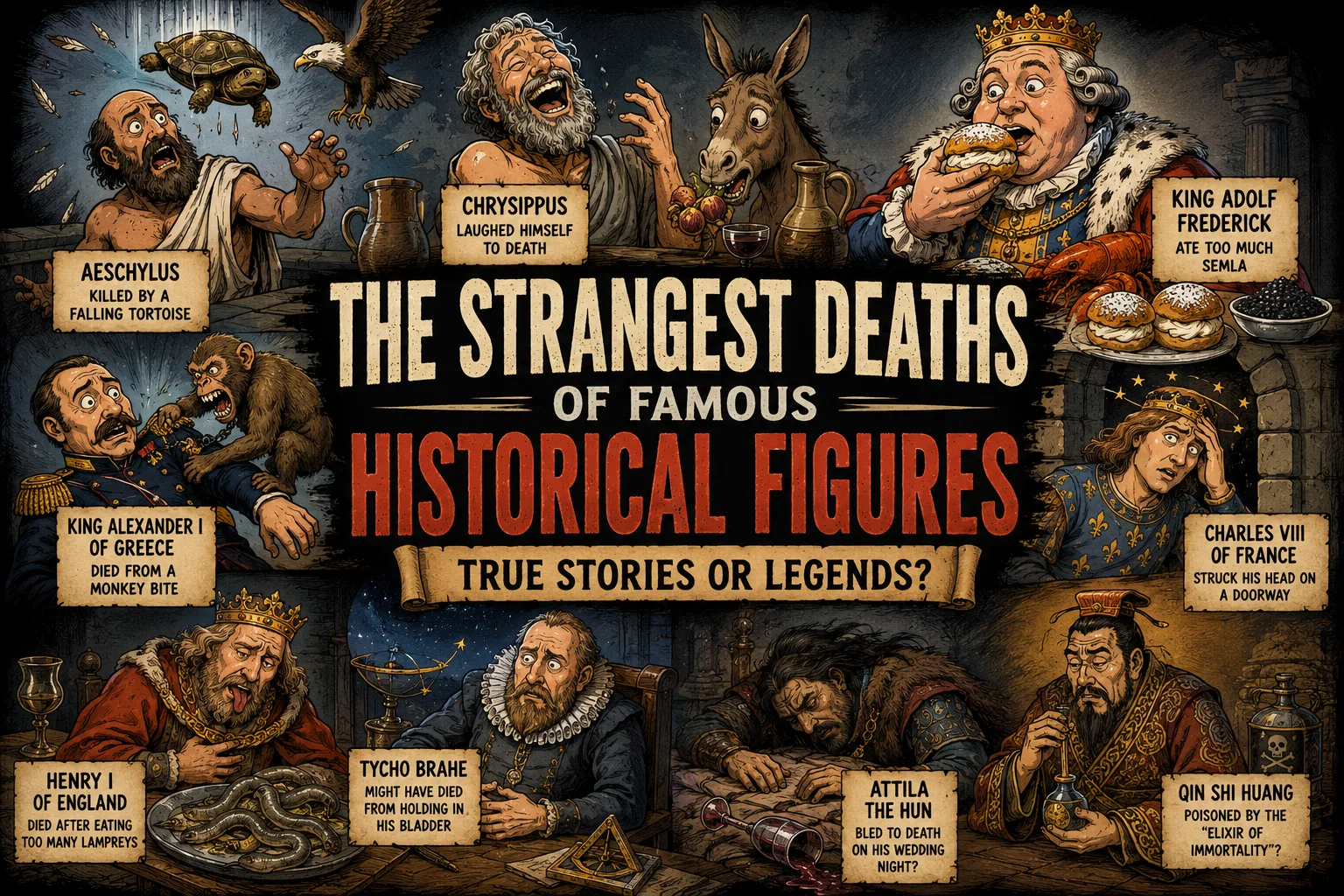
From kings killed by unexpected accidents to philosophers whose deaths became legendary, history is filled with bizarre endings. But which strange deaths really happened, and which were embellished centuries later?
The Strangest Deaths of Famous Historical Figures
History usually remembers famous people for what they did while alive.
Kings conquered kingdoms.
Philosophers changed how people understood the world.
Generals won wars.
Scientists transformed knowledge.
Writers produced works that survived centuries.
Then there are historical figures whose final moments became almost as famous as everything they accomplished.
A king supposedly died after eating too many lampreys.
A philosopher was said to have laughed himself to death.
A ruler may have been killed by a tortoise falling from the sky.
Another king died after striking his head on a doorway.
One of the world's greatest conquerors attended a banquet, became desperately ill, and never recovered.
Some of these stories are remarkably well documented.
Others were recorded decades or centuries after the person died.
And a few have been repeated so often that legend has quietly been promoted to biography.
So this isn't merely a collection of bizarre deaths.
It's an investigation into something considerably trickier:
How much do we actually know about the deaths of famous historical figures?
Strange Deaths Make Excellent Legends
There's a reason unusual death stories survive.
They are memorable.
Compare:
"The ruler became ill and died several days later."
with:
"The ruler was killed when an eagle dropped a tortoise onto his bald head."
One of those will survive two thousand years of storytelling considerably more efficiently.
Ancient historians understood this too.
They weren't always writing biographies according to modern standards. Stories could carry:
Moral lessons.
Political messages.
Religious meaning.
Irony.
Character judgments.
Entertainment.
A bizarre death could become the perfect ending to someone's life story.
That means our first rule is simple:
A historical source describing something does not automatically prove it happened exactly that way.
With that inconvenience established, we can begin.
1. Aeschylus and the Falling Tortoise
Aeschylus was one of ancient Greece's greatest tragedians.
Born around 525 BCE, he helped shape Greek tragedy and wrote works including The Persians and the Oresteia trilogy.
His own alleged death sounds like something rejected from a comedy for being too ridiculous.
According to a later tradition, Aeschylus was outdoors when a bird carrying a tortoise dropped it.
The tortoise struck his head.
He died.
Why would a bird weaponize a reptile?
There is actually a plausible behavioral explanation.
Birds Really Do Drop Tortoises
Some large birds have been observed carrying tortoises into the air and dropping them onto rocks to crack their shells.
According to the traditional story, Aeschylus' bald head may have been mistaken for a stone.
Which would make his death an extraordinarily unfortunate case of avian target identification.
But there is a historical problem.
The story comes from sources written long after Aeschylus lived.
We do not possess contemporary evidence proving that this is how he died.
🟡 Famous Tradition, Weak Verification
The tortoise story is ancient rather than a modern internet invention, but it is not securely established by contemporary evidence.
It may preserve a genuine event.
It may also be a humorous or legendary explanation attached to the death of a famous playwright.
The tortoise, regrettably, left no statement.
The Prophecy Makes the Story Even Stranger
Some versions add another detail.
Aeschylus had supposedly received a prophecy that he would be killed by something falling on him.
He therefore stayed outdoors to avoid buildings.
Then the tortoise arrived.
This is almost suspiciously perfect storytelling.
The attempt to escape prophecy causes the prophecy to be fulfilled.
Ancient literature loved that structure.
Whenever a historical death comes packaged with a perfectly ironic prophecy, skepticism is healthy.
2. Chrysippus: Did a Philosopher Laugh Himself to Death?
The Greek Stoic philosopher Chrysippus lived during the third century BCE.
He became one of the most important intellectual figures in the development of Stoicism.
Hundreds of works were attributed to him, although almost none survive intact.
Yet one of the things modern audiences remember most is his alleged death.
According to one ancient account, Chrysippus saw a donkey eating figs.
He found the situation amusing.
Then he supposedly told someone to give the donkey wine to wash down the figs.
He laughed so intensely that he died.
Can Someone Actually Die From Laughing?
In rare circumstances, intense laughter could theoretically contribute to a medical emergency.
Laughter affects breathing and cardiovascular activity.
Someone with an underlying medical condition might experience complications.
But saying:
"Chrysippus literally laughed himself to death"
goes beyond what we can establish.
There is also another ancient account in which he became ill after drinking wine at a feast and died several days later.
🟡 Conflicting Ancient Accounts
The famous laughing-death story comes from ancient biographical tradition, but alternative accounts of Chrysippus' death also existed.
We therefore cannot confidently diagnose the cause of death more than two thousand years later.
Still, dying after watching a drunk donkey eat figs would be an aggressively memorable ending for a Stoic philosopher.
3. Draco: Suffocated by Appreciation?
The ancient Athenian lawgiver Draco gave us the word draconian.
His legal code became famous for extraordinarily severe punishments.
Later tradition claimed that even relatively minor offenses could receive death sentences.
His own alleged death, however, involved something much softer.
Clothing.
Lots of clothing.
According to a later story, Draco visited a theater where supporters honored him by throwing:
Hats.
Cloaks.
Other garments.
So many supposedly landed on him that he suffocated beneath them.
Death by Fan Appreciation
If true, Draco may have suffered one of history's strangest celebrity-related deaths.
Not assassination.
Not poisoning.
Not execution.
Too much enthusiastic merchandise.
But once again, the evidence is weak.
The story survives through later historical tradition rather than strong contemporary documentation.
🟡 Probably Legendary or Unverifiable
Draco's supposed death beneath a mountain of clothing is famous, but historians cannot establish it confidently.
The story belongs more safely in the category of ancient biographical tradition than documented forensic fact.
4. King Adolf Frederick and the Legendary Semla Meal
Now we move considerably closer to modern history.
Adolf Frederick, king of Sweden, died on February 12, 1771.
His death became associated with an enormous final meal.
According to the famous story, the king consumed:
Lobster.
Caviar.
Sauerkraut.
Smoked herring.
Champagne.
And multiple servings of semla, a rich Swedish bun traditionally eaten around Lent.
He later became ill and died.
This eventually produced the wonderful historical label:
"The king who ate himself to death."
Did Semla Actually Kill Him?
Probably not in the simplistic sense.
Historical accounts associate his death with digestive illness or a stroke-like medical event rather than establishing that a specific pastry directly killed him.
The elaborate meal may have preceded his death.
But:
Meal before death ≠ meal medically caused death.
That distinction has not prevented the semla from receiving two and a half centuries of terrible publicity.
🟢 Death Is Documented, Famous Explanation Is Simplified
Adolf Frederick genuinely died after what sources describe as a substantial meal.
But saying he was straightforwardly killed by eating too many semlor turns a complicated medical event into a cleaner legend.
Historical storytelling loves a convenient final course.
5. King Alexander of Greece and the Monkey Bite
This one sounds absurd.
It is also substantially better documented.
Alexander I of Greece became king in 1917 during an extremely turbulent period in Greek politics.
In 1920, while walking on the royal estate at Tatoi, an incident involving monkeys occurred.
Accounts differ slightly in detail, but Alexander was bitten.
The wounds became infected.
His condition deteriorated.
Weeks later, the 27-year-old king died.
A Small Bite Became a National Event
Today, a serious animal bite can be treated with:
Wound cleaning.
Antibiotics where appropriate.
Tetanus prevention.
Other medical care depending on the animal and circumstances.
Alexander lived before modern antibiotics.
Once severe bacterial infection developed, physicians had far fewer options.
He reportedly developed septic illness and died on October 25, 1920.
🟢 Strong Historical Evidence
Alexander I's death following an infected monkey bite is well documented.
Unlike the falling-tortoise or death-by-laughter stories, this isn't merely a colorful ancient legend.
And the consequences extended far beyond one unfortunate royal walk.
How Could a Monkey Change European History?
Alexander's death created a political crisis.
His father, Constantine I, eventually returned to the Greek throne.
Greek political and military circumstances changed during the continuing Greco-Turkish conflict.
Winston Churchill later famously commented on the enormous consequences associated with the monkey bite.
It would be excessive to claim:
"One monkey single-handedly rewrote European history."
Historical events have many causes.
But Alexander's unexpected death unquestionably altered Greek politics at a crucial moment.
Sometimes history turns on elections.
Sometimes wars.
Sometimes economics.
And occasionally a monkey enters the paperwork.
6. King Charles VIII and the Doorway
On April 7, 1498, Charles VIII of France was at the Château d'Amboise.
The king was reportedly going to watch a game of tennis.
While passing through a doorway or gallery, he struck his head against a low stone feature.
At first, the injury apparently did not seem immediately fatal.
Later, Charles collapsed.
He died that same day.
He was only 27.
A King Defeated by Architecture
Charles had invaded Italy.
He commanded armies.
He participated in dynastic politics involving some of Europe's most powerful states.
Yet the event that ended his life appears to have been an accidental blow to the head.
Without modern imaging, neurosurgery, and emergency medicine, internal head injuries could be extraordinarily dangerous even when the victim initially remained conscious.
🟢 Historically Well Attested
Charles VIII's fatal head injury at Amboise is supported by contemporary or near-contemporary historical accounts.
The exact medical mechanism cannot be established with modern diagnostic precision, but the accident itself is not merely legend.
7. Henry I and the Lampreys
English king Henry I died in Normandy in 1135.
A famous historical tradition says he died after eating "a surfeit of lampreys."
Lampreys are jawless aquatic animals that resemble eels and were eaten as delicacies.
According to chronicler Henry of Huntingdon, the king's physicians had advised him against eating them.
Henry ignored the advice.
Because apparently being king historically included the constitutional right to disregard medical recommendations.
He became ill and died.
Did Lampreys Kill Henry I?
We cannot know.
"Surfeit" could suggest overindulgence, but medieval descriptions of illness don't allow modern physicians to reconstruct the exact cause reliably.
Possibilities discussed by later commentators have included:
Food poisoning.
Gastrointestinal illness.
Other unrelated disease.
The lamprey story survives because it provides a wonderfully specific explanation.
🟡 Historically Reported, Medical Cause Uncertain
A near-contemporary chronicler connected Henry I's final illness with excessive consumption of lampreys.
That makes the story historically significant.
It does not allow us to prove that lampreys were medically responsible for his death.
The fish have been convicted largely on circumstantial evidence for nearly nine centuries.
8. Tycho Brahe: Did Holding His Bladder Kill Him?
Danish astronomer Tycho Brahe was one of the most important observational astronomers before the invention of the telescope.
His extraordinarily precise measurements helped provide data later used by Johannes Kepler.
Brahe died in Prague in 1601.
For centuries, a bizarre story surrounded his death.
At a formal banquet, etiquette supposedly prevented him from leaving the table to urinate.
He held his bladder for too long.
He became seriously ill.
And died days later.
The Bladder Story Became Famous
Historical descriptions do suggest Brahe developed severe urinary problems during his final illness.
That led generations of writers to describe his death as resulting from a ruptured bladder.
But modern scientific investigation complicated the story.
Researchers examined samples from Brahe's remains to investigate possible causes of death.
Was Tycho Brahe Poisoned With Mercury?
Another theory claimed Brahe might have died from mercury poisoning.
This became especially dramatic because speculation emerged that he might have been deliberately poisoned.
Some even dragged Johannes Kepler into the theory.
Later analyses did not support the idea that Brahe died from acute lethal mercury poisoning.
The precise cause remains uncertain, although severe urinary or other illness remains plausible.
🟡 Cause of Death Still Uncertain
Tycho Brahe genuinely suffered a serious illness involving urinary difficulties before his death.
But the classic story that etiquette forced him to hold his bladder until it burst should not be treated as a proven medical diagnosis.
Nor is murder by mercury supported by the strongest modern evidence.
9. Alexander the Great: The Conqueror Who Couldn't Conquer a Fever
By age 32, Alexander the Great had created one of the largest empires the ancient world had seen.
His armies had moved from Macedonia through the Persian Empire and toward India.
Then, in Babylon in 323 BCE, Alexander became ill.
Ancient sources describe a worsening fever or illness lasting days.
Eventually, he could no longer speak.
Then he died.
The most powerful military commander of his generation was gone at 32.
What Killed Alexander?
Humans have spent more than two thousand years proposing answers.
Malaria.
Typhoid fever.
Other infections.
Pancreatitis.
Neurological disease.
Poisoning.
Alcohol-related complications.
Various syndromes.
The difficulty is enormous.
We have no body available for modern examination.
Ancient medical descriptions are incomplete.
Sources differ.
Symptoms were recorded without modern diagnostic concepts.
Was Alexander Murdered?
Poisoning theories appeared in ancient traditions.
But many historians and medical researchers regard deliberate poisoning as difficult to establish.
His illness reportedly developed over a period that doesn't neatly fit some famous poisoning scenarios.
That doesn't prove murder impossible.
It means evidence isn't sufficient to announce a murderer 2,300 years late.
🟡 Major Historical Mystery
Alexander's death in Babylon is well established.
Its exact medical cause is not.
Claims that historians have finally "solved" his death should therefore be treated cautiously unless extraordinary new evidence emerges.
His Death Created Another Problem
Alexander had built an enormous empire around his personal military authority.
He did not leave behind a stable adult successor capable of simply taking control.
After his death, his generals and successors fought over the empire.
The resulting conflicts eventually divided much of Alexander's territory among competing Hellenistic kingdoms.
His death therefore demonstrates a recurring weakness in highly personalized political systems:
The ruler may be extraordinarily powerful.
Succession can still be catastrophically fragile.
10. Attila the Hun: Did He Die From a Nosebleed on His Wedding Night?
Few rulers frightened the late Roman world like Attila the Hun.
He led a powerful Hunnic empire during the fifth century.
Roman writers portrayed him as an extraordinary military threat.
Then, in 453, Attila died.
Not in battle.
According to the historian Priscus, whose account survives through later writers, Attila died during the night after celebrating his marriage to a woman named Ildico.
He reportedly suffered severe bleeding.
The Famous Wedding-Night Death
Later descriptions say Attila was found dead after blood flowed from his nose or mouth while he slept.
One interpretation is that heavy drinking may have contributed to a fatal hemorrhage or aspiration.
Other theories propose:
Internal bleeding.
A ruptured blood vessel.
Alcohol-related complications.
Assassination.
But the exact medical explanation is unknown.
🟡 Historical Account, Uncertain Diagnosis
Ancient evidence supports the tradition that Attila died suddenly during the night following wedding celebrations.
The precise medical cause cannot be established.
Claims that he simply "drowned in his own nosebleed" compress uncertain ancient evidence into a modern headline.
Was Attila Murdered by His New Wife?
Later stories accused Ildico of killing him.
That makes an excellent assassination narrative.
It is also poorly established.
Political murder was certainly possible in Attila's world.
But possibility is not evidence.
Priscus' tradition reportedly emphasized that there was no wound.
Without stronger evidence, Ildico should not be transformed into a murderer because later storytelling wanted a dramatic bride-with-a-dagger ending.
11. Qin Shi Huang and the Search for Immortality
China's first emperor, Qin Shi Huang, accomplished something extraordinary.
He unified competing states and became the first emperor of a unified imperial China in 221 BCE.
He also became deeply interested in avoiding death.
Historical sources describe his pursuit of immortality and association with alchemical preparations.
Some ancient Chinese elixirs contained mercury.
Which creates one of history's greatest possible ironies.
The search for immortality may have helped kill him.
Mercury Was Once Considered Extraordinary
Mercury is chemically fascinating.
It is a metal that remains liquid at ordinary room temperatures.
To ancient observers, substances with unusual properties could appear to possess profound alchemical significance.
Mercury became connected with ideas about transformation and longevity in some traditions.
Unfortunately:
Mercury is toxic.
Repeated exposure can damage the nervous system, kidneys, and other organs.
Did Mercury Definitely Kill Qin Shi Huang?
Not definitely.
Historical sources connect the emperor with immortality preparations, and archaeological evidence from his enormous mausoleum complex has also fueled fascination with mercury.
But we don't possess the kind of forensic evidence needed to declare mercury poisoning the proven cause of death.
🟡 Plausible Historical Theory
Qin Shi Huang's pursuit of immortality and use of mercury-containing preparations are supported by historical tradition.
Mercury poisoning is therefore a plausible contributor to his death, but it should not be presented as definitively established.
The irony remains almost offensively perfect:
A substance consumed in pursuit of eternal life may have shortened it.
12. Francis Bacon and the Frozen Chicken Experiment
English philosopher and statesman Francis Bacon became enormously influential in the history of scientific thought.
A famous story says his death followed an experiment involving food preservation.
In 1626, Bacon reportedly became interested in whether cold could preserve meat.
He obtained a chicken.
Had it stuffed with snow.
Then became ill after exposure to cold conditions.
He died shortly afterward.
Did Science Kill Francis Bacon?
Not exactly.
Bacon likely died from illness such as pneumonia or another respiratory condition.
The snow experiment may have occurred shortly before he became seriously sick.
But claiming:
"Francis Bacon died because he invented frozen chicken"
would be historical malpractice with excellent comedic timing.
Still, the connection between his final illness and an experiment with cold preservation appears in an early account.
🟡 Famous Account With Uncertain Causation
Bacon's snow-and-chicken experiment is associated with accounts of his final illness, but whether exposure during the experiment directly caused his death cannot be established.
What These Deaths Actually Tell Us
At first, these stories seem like historical trivia.
A monkey.
A doorway.
Lampreys.
A tortoise.
A banquet.
Mercury.
But underneath the absurdity lies something more revealing.
Power offered surprisingly little protection against ordinary biological vulnerability.
A king could command thousands of soldiers.
He couldn't command bacteria to stop reproducing.
An emperor could conquer nations.
He couldn't negotiate with mercury toxicity.
A philosopher could understand logic better than almost anyone alive.
His cardiovascular system remained unimpressed.
Medicine Changed the Meaning of "Minor" Injuries
Alexander of Greece's monkey bite demonstrates this particularly well.
Today, an animal bite is usually not treated as an automatic death sentence.
But before antibiotics, bacterial infections could become lethal.
Likewise:
Small wounds.
Dental infections.
Childbirth.
Food contamination.
Respiratory infections.
Minor surgical complications.
Conditions modern medicine often manages routinely could once become fatal.
Historical mortality makes much more sense when we stop unconsciously giving ancient people twenty-first-century hospitals.
Historical Diagnosis Is Extremely Difficult
There is a recurring temptation to read an old description such as:
"He developed fever, abdominal pain, weakness and died."
Then announce:
"Clearly typhoid fever."
But many diseases produce overlapping symptoms.
Historical descriptions may be incomplete.
Translations matter.
Writers may exaggerate.
Medical terminology changes.
Important symptoms may never have been recorded.
Without biological samples, diagnosis can remain speculative.
Why Poisoning Gets Blamed So Often
Famous rulers attract poisoning theories.
Alexander the Great.
Tycho Brahe.
Napoleon.
Various Roman emperors.
Medieval kings.
Political figures who died unexpectedly.
Why?
Because assassination provides an intentional explanation.
Someone benefited.
Someone had motive.
Someone had access.
The death becomes a mystery with a villain.
Disease is narratively disappointing.
"A microorganism won" doesn't provide anyone to interrogate.
Modern Science Can Sometimes Reopen Old Cases
Historical mysteries aren't necessarily frozen forever.
Researchers can sometimes examine:
Hair.
Bones.
Teeth.
Preserved tissue.
Chemical residues.
Ancient DNA.
Pathogens.
Isotopic signatures.
These methods can test old theories.
But they also have limitations.
Contamination occurs.
Samples degrade.
Burial environments alter chemistry.
Identifying exposure does not automatically prove cause of death.
Finding mercury in someone's remains, for example, does not by itself prove mercury killed them.
Forensic archaeology requires the same annoying discipline as ordinary history:
Evidence first. Story second.
Frequently Asked Questions
Did Aeschylus really die when a tortoise fell on his head?
Ancient tradition says so, but the story comes from later sources and cannot be independently confirmed. It should be treated as a famous historical legend rather than certain fact.
Did Chrysippus really laugh himself to death?
One ancient account says he died after laughing at a donkey eating figs, while another gives a different explanation. The exact cause is unknown.
Which strange historical death is strongly documented?
King Alexander I of Greece dying after infection following a monkey bite is well documented. Charles VIII's fatal head injury is also historically well attested.
Did Henry I die from eating lampreys?
A near-contemporary chronicler connected his final illness with eating too many lampreys, but we cannot establish the actual medical cause with certainty.
Did Tycho Brahe die because he refused to use the bathroom?
He suffered severe urinary problems before his death, but the popular story that etiquette caused his bladder to burst is not securely proven.
Was Alexander the Great poisoned?
Poisoning has been proposed for centuries, but there is no conclusive evidence establishing it as the cause of his death.
Did Attila the Hun die on his wedding night?
Historical tradition places his sudden death during the night following wedding celebrations in 453. The exact medical cause remains uncertain.
Did Qin Shi Huang poison himself while searching for immortality?
He was associated with mercury-containing immortality preparations, making mercury exposure plausible. However, mercury poisoning cannot be established as his definitive cause of death.
The Problem With Perfectly Ironic Deaths
Notice something about several stories.
A tragedian escapes a prophecy and gets killed by a falling tortoise.
A Stoic philosopher dies laughing.
A severe lawgiver is suffocated by people honoring him.
An emperor seeking immortality may poison himself with an immortality drug.
A great conqueror survives battle after battle and dies from illness.
These endings feel satisfying because they contain irony.
And that is exactly why historians should become suspicious.
Real life occasionally produces astonishing irony.
But storytellers also create irony.
Over centuries, messy deaths can become cleaner narratives.
Uncertainty disappears.
Symbolism grows.
The final story becomes better than the evidence.
Final Thoughts
The strangest deaths in history sit somewhere between medicine, biography, and mythology.
Some genuinely happened.
Alexander I of Greece was bitten by a monkey, developed a severe infection, and died.
Charles VIII really suffered a fatal accidental head injury.
Historical evidence strongly supports those basic events.
Other stories occupy uncomfortable territory between history and legend.
Henry I's lampreys may have preceded his fatal illness, but the fish cannot be confidently convicted.
Tycho Brahe suffered urinary problems, but the famous exploding-bladder version oversimplifies the evidence.
Attila died suddenly after his wedding celebration, but the exact mechanism remains uncertain.
Qin Shi Huang pursued immortality through substances associated with mercury, yet proving mercury caused his death is another matter.
And then we have Aeschylus' airborne tortoise, Chrysippus' fatal laughter, and Draco's mountain of clothing.
Ancient sources preserve those stories.
History cannot guarantee them.
Perhaps that's what makes these deaths genuinely fascinating.
They remind us that history is not simply a collection of facts waiting to be memorized.
It is a reconstruction.
We inherit fragments.
Chronicles.
Archaeological evidence.
Medical descriptions.
Political propaganda.
Later retellings.
Legends.
Then historians attempt to determine what probably happened.
Sometimes the evidence gives us a strong answer.
Sometimes it gives us several possibilities.
And occasionally, after two thousand years of investigation, the most responsible conclusion remains:
We have absolutely no idea whether a tortoise killed that man.
Which, irritatingly, is much more interesting than pretending we do.