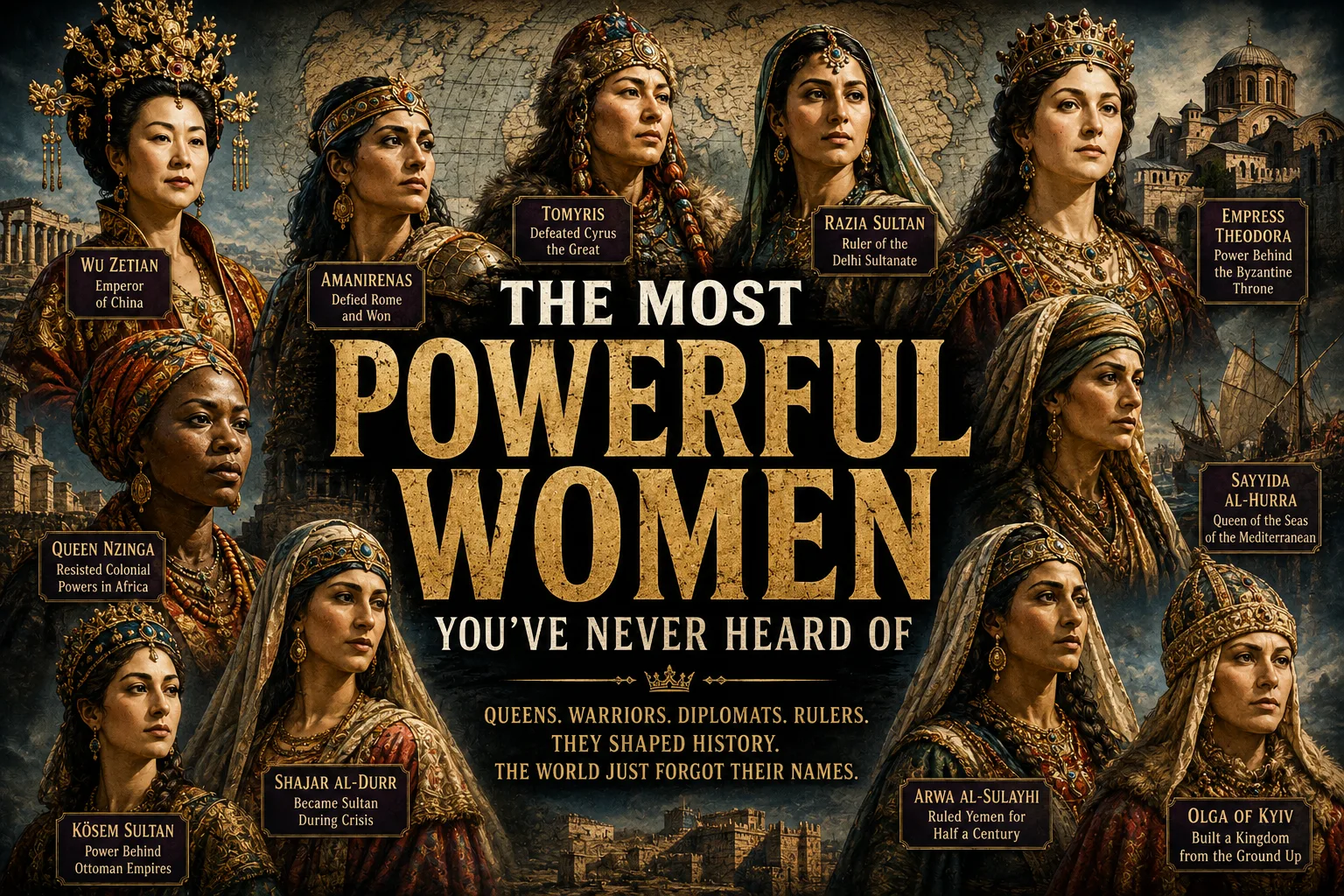
The Most Powerful Women You've Never Heard Of
History remembers famous queens and empresses, but many women who commanded armies, ruled kingdoms, shaped empires, and influenced world-changing events remain surprisingly unknown.
The Most Powerful Women You've Never Heard Of
History likes familiar names.
Cleopatra.
Joan of Arc.
Queen Elizabeth I.
Marie Curie.
Rosa Parks.
And those women absolutely deserve to be remembered.
But history is much larger than the small group of figures who survive in school textbooks.
Across centuries, women ruled kingdoms, commanded armies, negotiated with emperors, financed wars, controlled trade routes, led rebellions, influenced succession crises, and shaped entire regions.
Some governed directly.
Some exercised power behind thrones.
Some inherited kingdoms during periods of chaos and somehow kept them intact.
Others built states so effectively that later generations forgot just how much depended on them.
The strange part is not that powerful women existed.
It is that so many disappeared from popular memory.
So this is not another list of famous queens everyone already knows.
These are women whose influence was enormous, whose stories were real, and whose names should probably be considerably more familiar than they are.
1. Wu Zetian: The Only Woman to Rule China as Emperor in Her Own Name
Let's begin with someone who should not be obscure at all.
Wu Zetian rose from the imperial court of the Tang dynasty and eventually became the only woman in Chinese history to formally rule as emperor in her own name.
Not empress consort.
Not regent.
Emperor.
She ruled during the late seventh century and established her own Zhou dynasty.
That alone makes her one of the most extraordinary political figures in world history.
From Concubine to Supreme Ruler
Wu entered the imperial palace relatively young.
Over time, she navigated one of the most dangerous political environments imaginable.
Imperial courts were full of:
Dynastic competition.
Factional politics.
Succession struggles.
Court officials.
Military interests.
Family rivalries.
She survived them.
Then surpassed them.
She Expanded the State
Wu's reign was not merely symbolic.
Her government expanded the imperial examination system, promoted officials based on ability, and strengthened administrative structures.
Military campaigns extended Chinese influence.
Agricultural production and state organization remained important priorities.
She also supported Buddhism heavily and used religious symbolism to strengthen her legitimacy.
🟢 Strong Historical Evidence
Wu Zetian's rule is extensively documented in Chinese historical records.
Later Confucian historians often portrayed her harshly, partly because her rule violated traditional expectations about gender and political hierarchy.
That makes her a useful example of another historical problem:
The people recording history were not neutral observers.
Was Wu Zetian Ruthless?
Yes.
But "ruthless" describes an enormous number of male rulers who somehow still receive statues.
Wu used purges, intelligence networks, punishments, and political violence.
Her reign could be severe.
But reducing her entire career to cruelty ignores the fact that she successfully governed one of the world's largest states in an age when elite political culture was heavily hostile to female sovereignty.
History often expects female rulers to be unusually gentle before granting them legitimacy.
Male emperors were apparently allowed a somewhat broader emotional range.
2. Queen Nzinga: The Diplomat Who Fought Portuguese Expansion
In seventeenth-century Central Africa, Queen Nzinga became one of the most formidable political leaders resisting Portuguese expansion.
She ruled the kingdoms of Ndongo and Matamba, in the region of modern Angola.
Her political environment was brutal.
Portuguese colonial power was expanding.
The Atlantic slave trade was transforming the region.
Neighboring states competed.
European alliances shifted constantly.
Nzinga survived through diplomacy, warfare, negotiation, and strategic adaptation.
The Famous Chair Story
One of the most repeated stories about Nzinga concerns a meeting with Portuguese officials.
According to tradition, when the Portuguese governor provided himself a chair but expected Nzinga to sit on a mat, one of her attendants knelt so that Nzinga could sit on her back.
The image became symbolic:
She would not accept a lower diplomatic status.
Whether every detail occurred exactly as later remembered is another question.
But the story captures something historically real:
Nzinga understood political symbolism extremely well.
She Used Diplomacy and War
Nzinga negotiated treaties.
Converted to Christianity at one stage and took the name Ana de Sousa.
Later shifted alliances.
Worked with the Dutch against Portugal.
Built military resistance.
Integrated refugees and displaced people into her political system.
She ruled for decades in an environment where weaker states could disappear very quickly.
🟢 Strong Historical Evidence
Nzinga's diplomatic and military career is documented in Portuguese and African historical traditions.
However, some sensational stories about her personal behavior originated in hostile European accounts and should be treated cautiously.
Powerful women have historically attracted suspiciously creative biographies.
3. Tomyris: The Queen Who Defeated Cyrus the Great
One of the most powerful rulers of the ancient world was Cyrus the Great, founder of the Achaemenid Persian Empire.
He conquered enormous territories.
Built one of antiquity's greatest empires.
Then, according to ancient historian Herodotus, he encountered Queen Tomyris of the Massagetae.
And lost.
Who Were the Massagetae?
The Massagetae were a nomadic or semi-nomadic people living somewhere in Central Asia.
Our information about them comes largely through outsiders, especially Greek writers.
Tomyris appears as their ruler.
According to Herodotus, Cyrus attempted to bring her people under Persian control.
She resisted.
Conflict followed.
The Battle
Herodotus' story says Persian forces used deception involving a camp stocked with food and wine.
Massagetae forces consumed the unfamiliar wine, became vulnerable, and were attacked.
Tomyris' son was captured and later died.
She then led her forces against Cyrus.
The Persians were defeated.
Cyrus himself was killed.
The Famous Blood Story
Herodotus adds a dramatic ending.
Tomyris supposedly placed Cyrus' severed head into a container filled with blood, saying that he had thirsted for blood and would now have his fill.
It's spectacular.
Which means historians should immediately become annoying.
We cannot independently verify that scene.
🟡 Historically Important, Details Uncertain
Cyrus appears to have died during a campaign in Central Asia around 530 BCE.
Herodotus attributes his death to a battle against Tomyris and the Massagetae.
Other ancient traditions differ.
Therefore Tomyris is historically significant, but the exact circumstances of Cyrus' death remain uncertain.
Still, even the possibility that one of history's greatest conquerors died fighting a queen most people have never heard of should probably earn her more than a footnote.
4. Amanirenas: The Queen Who Fought Rome and Kept Her Kingdom Independent
During the first century BCE, Rome was expanding aggressively.
Egypt had fallen under Roman control.
Most states facing Roman armies did not have excellent long-term prospects.
Then Rome moved south toward the Kingdom of Kush, centered in Nubia.
There it encountered a ruler known as Amanirenas.
She was a kandake, a title associated with powerful royal women of Kush.
And she fought Rome.
Kush Was Not a Minor Civilization
This matters.
Modern popular history often treats ancient Africa outside Egypt as an empty background.
Kush was a major civilization with:
Cities.
Royal dynasties.
Monumental architecture.
Trade networks.
Military power.
Religious traditions.
Meroë became one of its important centers.
Amanirenas ruled within that political world.
War With Augustus' Rome
Kushite forces attacked Roman-controlled territory in Egypt.
Roman forces retaliated.
The conflict became serious.
The Romans invaded Kushite territory and captured settlements.
But Kush did not simply disappear under Roman control.
Negotiations eventually produced a peace settlement.
The frontier stabilized.
Kush retained its independence.
A Roman Head Buried Under a Temple
One of the most famous archaeological details comes from Meroë.
A bronze head of the Roman emperor Augustus was found buried beneath the entrance to a building associated with Kushite religious use.
The symbolic meaning seems fairly direct.
People walking over the image of Rome's emperor every day does not exactly communicate admiration.
🟢 Strong Historical and Archaeological Evidence
The Roman-Kushite conflict is documented by ancient sources and archaeology.
Amanirenas emerges as a major figure in that resistance.
The settlement that followed allowed Kush to retain substantial autonomy rather than becoming simply another conquered Roman province.
That is an impressive result against Rome at the height of its power.
5. Razia Sultan: The Woman Who Ruled the Delhi Sultanate
In thirteenth-century India, Razia Sultan became one of the very few women to rule a major Islamic state in medieval South Asia.
She ruled the Delhi Sultanate from 1236 to 1240.
Her father, Sultan Iltutmish, reportedly recognized her political ability.
But succession politics did not politely accept competence as sufficient.
She faced resistance partly because she was a woman attempting to exercise sovereign authority in a male-dominated elite system.
Razia Ruled as Sovereign
Razia did not simply act as someone's ceremonial queen.
She governed.
Appeared publicly.
Led military activity.
Made administrative appointments.
Attempted to reduce the influence of powerful nobles.
That last part was especially dangerous.
Because medieval rulers could usually survive being unpopular with ordinary subjects considerably more easily than being unpopular with the military aristocracy standing nearby with armed retainers.
Gender Became Political Ammunition
Opposition to Razia cannot be reduced entirely to gender.
There were factional rivalries, elite interests, and struggles over appointments.
But gender clearly shaped how her authority was perceived.
A male ruler might be criticized for political decisions.
A female sovereign also had to justify why she was ruling at all.
Her Reign Was Short
Powerful nobles rebelled.
Razia was eventually removed.
She attempted to regain power but was defeated and killed in 1240.
Her reign lasted only a few years.
Yet its significance is enormous.
She demonstrated that a woman could occupy the highest office of the Delhi Sultanate itself.
🟢 Strong Historical Evidence
Razia's reign is well documented in Persian chronicles.
Her short rule should not be interpreted as evidence that she lacked political ability.
Medieval succession politics eliminated plenty of male rulers with impressive efficiency too.
6. Empress Theodora: From Performer to Co-Ruler of Byzantium
The Byzantine emperor Justinian I is one of the most famous rulers of late antiquity.
His legal reforms, wars, and construction projects shaped the Eastern Roman Empire.
Standing beside him was Empress Theodora.
Calling her simply Justinian's wife dramatically understates her political importance.
Contemporary sources portray her as a major participant in imperial government.
An Extraordinary Rise
Theodora came from a relatively humble background.
Accounts connect her early life with the entertainment world of Constantinople.
Later, she became Justinian's partner and eventually empress.
Her rise crossed enormous social boundaries.
That alone made her a target for hostile elite writers.
The Nika Revolt
In 532, Constantinople exploded into the Nika riots.
Political anger and factional violence threatened Justinian's government.
Large areas of the city burned.
The emperor reportedly considered fleeing.
According to historian Procopius, Theodora delivered a forceful speech arguing that abandoning imperial authority was worse than death.
Whether the speech survives word-for-word is doubtful.
Ancient historians loved polished speeches.
But the broader tradition portrays Theodora as strongly supporting resistance.
The government stayed.
The revolt was brutally suppressed.
Justinian remained emperor.
She Influenced Law and Policy
Theodora is associated with legislation affecting women, including issues related to exploitation, marriage, and prostitution.
Exactly how much responsibility belonged personally to Theodora versus Justinian and their broader government is difficult to separate.
But her influence at court appears substantial.
🟢 Strong Historical Evidence With Hostile Sources
Theodora's political influence is well supported.
However, some of the most sensational allegations about her come from Procopius' Secret History, an extraordinarily hostile work.
That means historians must distinguish useful testimony from what occasionally resembles a two-thousand-word grudge.
7. Shajar al-Durr: The Woman at the Center of a Dynastic Revolution
In thirteenth-century Egypt, Shajar al-Durr became one of the pivotal figures during the transition from Ayyubid to Mamluk rule.
Her political career unfolded during the Seventh Crusade, led by King Louis IX of France.
Egypt faced invasion.
Then Sultan al-Salih Ayyub died.
This was the worst possible moment for a succession crisis.
So his death was initially concealed.
She Helped Keep the State Functioning
Shajar al-Durr participated in maintaining political continuity while the war continued.
Documents were reportedly issued under the dead sultan's authority.
Military leadership continued resistance.
The crusading army was eventually defeated.
Louis IX himself was captured.
Imagine successfully managing a state crisis while a French king is invading and your own ruler has just died.
Apparently administrative inconvenience was operating at maximum settings.
She Became Ruler
After further political turmoil, Shajar al-Durr was proclaimed ruler in 1250.
Coins were minted and official prayers recognized her authority.
But recognition from the wider Islamic political world became problematic.
Her formal reign was brief.
She later married the Mamluk leader Aybak.
Political conflict followed.
Eventually, both became caught in lethal palace politics.
🟢 Strong Historical Evidence
Shajar al-Durr's role in Egypt's political transition and resistance during the Seventh Crusade is well documented.
Her reign was short, but her influence on the establishment of Mamluk power was substantial.
8. Tamar of Georgia: The Queen Called "King"
During the late twelfth and early thirteenth centuries, Tamar of Georgia presided over what is often described as a golden age of medieval Georgian power.
In Georgian royal tradition, she could be referred to using a title equivalent to king, reflecting sovereign authority rather than merely female consort status.
Under Tamar, Georgia expanded politically and militarily.
Culture flourished.
Religious and architectural development continued.
She Had to Fight for Authority Before Fighting Enemies
Tamar inherited power in a political system dominated by male nobles.
Her position was challenged.
Elite factions attempted to influence her.
Her first marriage became disastrous.
She eventually removed her husband and chose another partner, David Soslan, who became an important military commander.
But sovereignty remained Tamar's.
Georgia Became a Regional Power
Georgian forces won major victories, including against larger Muslim coalitions.
The kingdom expanded influence across parts of the Caucasus.
Trade and cultural life developed.
Literature flourished.
The period produced the celebrated Georgian epic The Knight in the Panther's Skin, associated with poet Shota Rustaveli.
🟢 Strong Historical Evidence
Tamar is one of medieval Georgia's most important rulers.
Her relative obscurity in many English-language history courses reflects geographic emphasis more than lack of historical importance.
Apparently world history occasionally means "Western Europe plus whichever empire was fighting Western Europe."
9. Arwa al-Sulayhi: The Queen Who Ruled Yemen for Decades
Arwa al-Sulayhi ruled in Yemen during the eleventh and twelfth centuries.
She became one of the most powerful women in medieval Islamic history.
Her political career lasted for decades.
Arwa exercised genuine sovereign authority and played a major role in religious and political networks connected with Isma'ili Islam.
She Outlasted Rivals
Arwa's world involved:
Dynastic politics.
Regional warfare.
Religious authority.
Tribal alliances.
Competing centers of power.
She survived and governed for an exceptionally long period.
Her political longevity alone should make her much better known.
Religious Authority Increased Her Influence
Arwa held an unusually elevated religious position within the Tayyibi Isma'ili tradition.
That gave her influence extending beyond ordinary territorial government.
Her capital at Jibla became closely associated with her rule.
Buildings and religious institutions connected to her legacy survive.
🟢 Strong Historical Evidence
Arwa al-Sulayhi's long reign and political-religious importance are historically well established.
Her story demonstrates that women exercising major political authority in medieval Islamic societies were rare but certainly not nonexistent.
10. Sayyida al-Hurra: The Mediterranean Queen and Naval Power
During the sixteenth century, Sayyida al-Hurra ruled Tétouan in northern Morocco.
Her life unfolded in the aftermath of Muslim displacement from Iberia following the Reconquista.
She became a major regional political figure and developed alliances within Mediterranean power struggles.
European sources associated her with maritime raiding.
Which means she is frequently described today as a:
Pirate queen.
That phrase is excellent marketing.
It is also slightly simplistic.
Piracy Depends on Who Is Writing the Report
Mediterranean maritime warfare blurred distinctions between:
Piracy.
Privateering.
State-sponsored raiding.
Naval warfare.
Commercial competition.
Sayyida al-Hurra worked within political networks where raiding Christian shipping could function as both warfare and economic strategy.
European merchants called it piracy.
Her own political context looked rather different.
History becomes fascinating once you realize "pirate" sometimes means:
Naval actor whose paperwork your government does not recognize.
She Ruled Tétouan
Sayyida al-Hurra wasn't merely associated with ships.
She governed an important northern Moroccan city and participated in regional diplomacy.
She later married Sultan Ahmed al-Wattasi.
Significantly, the marriage reportedly occurred in Tétouan rather than forcing her to abandon her political base.
That symbolism reinforced her independent authority.
🟢 Strong Historical Core
Sayyida al-Hurra's political rule is well established.
Modern descriptions of her as a "pirate queen" capture part of her maritime role but can oversimplify the political and military context of Mediterranean raiding.
11. Kösem Sultan: The Woman Behind Multiple Ottoman Sultans
The Ottoman Empire formally placed sultans at the center of political authority.
But imperial power also flowed through the palace, dynastic family, officials, military institutions, and court networks.
During the period often called the Sultanate of Women, imperial women could exercise extraordinary influence.
Few became more powerful than Kösem Sultan.
She Became Valide Sultan
Kösem was the consort of Sultan Ahmed I and later mother of sultans.
As valide sultan, or mother of the reigning ruler, she occupied one of the most influential positions in the empire.
When young or politically weak sultans occupied the throne, Kösem's authority became especially important.
She served as regent.
Managed court politics.
Influenced appointments.
Built alliances.
She Survived Multiple Reigns
Ottoman dynastic politics were lethal.
Brothers could be executed.
Sultans could be deposed.
Court factions competed.
Military groups intervened.
Surviving one reign was difficult.
Kösem remained politically relevant across several.
Eventually, however, palace rivalry caught up with her.
She was killed in 1651 during a struggle involving another powerful imperial woman, Turhan Sultan.
🟢 Strong Historical Evidence
Kösem Sultan's role as regent and political power broker is extensively documented.
Her career demonstrates how formal titles do not always reveal where political power actually resides.
A throne may belong to one person while half the government is negotiating with his mother.
12. Olga of Kyiv: Regent, Ruler, and Builder of State Power
Olga of Kyiv ruled as regent in the tenth century after the death of her husband, Igor.
She became famous partly because medieval chronicles tell spectacular stories of revenge against the people responsible for Igor's death.
Those stories involve:
Buried envoys.
Burned buildings.
A city allegedly destroyed using birds carrying burning material.
They are memorable.
They may also contain literary embellishment.
Beyond the Revenge Stories
The problem with Olga's legend is that the violent anecdotes can overshadow her actual political importance.
She governed the polity known as Kievan Rus'.
She reformed tribute collection.
Strengthened administrative structures.
Travelled diplomatically.
Converted to Christianity before the wider Christianization associated with her grandson Vladimir.
Those achievements mattered far more historically than whether birds truly burned down a city.
🟡 Political Career Strongly Documented, Revenge Tales Less Certain
Olga's historical role as regent and ruler is well established.
The highly dramatic revenge stories come from later chronicle traditions and may combine historical memory with literary storytelling.
Apparently medieval chroniclers also understood that tax reform gets fewer readers than flaming pigeons.
Why Have So Many Powerful Women Been Forgotten?
At this point, a question becomes unavoidable.
How can people who ruled kingdoms, defeated empires, captured crusader kings, shaped dynasties, and governed for decades remain relatively obscure?
There is no single explanation.
But several patterns matter.
Historical Sources Were Often Written by Men
For most recorded history, literacy, official bureaucracy, religious scholarship, and historical writing were disproportionately controlled by men.
That does not mean male historians simply erased every woman.
But it influenced which activities were considered historically important.
War.
Kingship.
Formal office.
Dynastic succession.
Male elite institutions.
Women's influence could operate through:
Court networks.
Marriage diplomacy.
Religious authority.
Economic patronage.
Regency.
Informal political relationships.
Those forms of power were sometimes harder for traditional histories to categorize.
Powerful Women Were Often Described Differently
A politically aggressive man might become:
Ambitious.
Strong.
Strategic.
A politically aggressive woman could become:
Manipulative.
Scheming.
Unnatural.
Sexually dangerous.
This pattern appears repeatedly.
That doesn't mean every negative account of a female ruler is misogynistic.
Some rulers genuinely did terrible things.
The point is that historians need to ask whether male and female power were being judged by equivalent standards.
Often, they weren't.
Sexual Rumors Were Political Weapons
Powerful women attracted sexual allegations with impressive consistency.
Promiscuity.
Seduction.
Affairs.
Manipulation through sexuality.
Immorality.
Sometimes evidence exists.
Sometimes hostile writers appear to have discovered that accusations involving sex were an extremely efficient way to damage a woman's legitimacy.
Theodora is one obvious example.
Wu Zetian faced similar hostile traditions.
Marie Antoinette centuries later would experience comparable propaganda.
Different countries.
Same playbook.
Human political innovation occasionally disappoints.
Geography Shapes What Counts as "World History"
There's another simpler reason many of these women are unfamiliar.
History education varies by country.
American and European classrooms often emphasize:
Ancient Greece.
Rome.
Western Europe.
The United States.
Major twentieth-century wars.
That leaves less space for:
Kush.
Medieval Georgia.
Yemen.
Central African kingdoms.
The Delhi Sultanate.
Moroccan maritime politics.
Chinese dynastic history.
A person can therefore be extraordinarily important regionally while remaining almost invisible elsewhere.
Obscurity isn't the same thing as insignificance.
Women Also Exercised Power Without Thrones
Our list focused heavily on rulers because political authority is easier to demonstrate.
But women have influenced history through many other forms of power.
Bankers.
Landowners.
Religious leaders.
Spies.
Industrialists.
Diplomats.
Revolutionaries.
Scientists.
Writers.
Patrons.
Political organizers.
A person does not need a crown to affect millions of lives.
Sometimes the most influential person in a government doesn't appear on the official organizational chart.
Every office worker on Earth has already encountered this phenomenon.
Historical Power Is More Than Commanding Armies
Power can mean:
Ability to make laws.
Control resources.
Influence succession.
Shape religious institutions.
Move armies.
Control trade.
Determine appointments.
Finance governments.
Create diplomatic alliances.
Mobilize populations.
Change what people believe.
Using this broader definition reveals many historical actors traditional military narratives overlook.
Frequently Asked Questions
Who was the most powerful female ruler in history?
There is no objective answer because power differs across eras and political systems. Figures such as Wu Zetian, Catherine the Great, Queen Victoria, Empress Dowager Cixi, and others controlled enormous states or exercised substantial influence.
Was Wu Zetian really China's only female emperor?
Yes. Other women exercised enormous political influence in Chinese history, but Wu Zetian was the only woman to formally assume the imperial title and rule in her own name as emperor.
Did Tomyris really kill Cyrus the Great?
Herodotus says Cyrus died fighting Tomyris and the Massagetae, but alternative ancient accounts exist. The exact circumstances of Cyrus' death remain uncertain.
Did Queen Nzinga really resist Portugal?
Yes. Nzinga engaged in decades of diplomacy and warfare involving Portuguese expansion and regional politics in Central Africa.
Was Razia Sultan actually the ruler of Delhi?
Yes. Razia ruled the Delhi Sultanate from 1236 to 1240 and exercised sovereign authority rather than functioning merely as a consort.
Did Amanirenas defeat Rome?
Kushite forces fought Rome, and the eventual peace settlement preserved Kushite independence under favorable enough conditions that describing her resistance as highly successful is reasonable. Saying she simply "destroyed Rome" would obviously be nonsense.
Was Sayyida al-Hurra really a pirate queen?
She was a ruler of Tétouan associated with maritime raiding and alliances in Mediterranean conflicts. "Pirate queen" is a catchy modern label but simplifies the political context.
The Difference Between Being Forgotten and Being Erased
It is tempting to claim:
"History deliberately erased these women."
Sometimes individuals were deliberately marginalized.
Records were destroyed.
Later regimes rewrote reputations.
Hostile chroniclers shaped narratives.
But broad historical forgetting is often less coordinated.
Curriculums have limited space.
Empires collapse.
Languages change.
Archives disappear.
Political priorities shift.
Some stories receive translations.
Others don't.
Certain figures become culturally useful symbols.
Others remain specialists' territory.
No secret committee needs to meet and vote:
"Remove Amanirenas from textbooks."
Historical memory naturally becomes selective.
The important task is recognizing what selection leaves behind.
Final Thoughts
History does not suffer from a shortage of powerful women.
It suffers from a shortage of people who know their names.
Wu Zetian became emperor of China.
Nzinga fought one of Europe's expanding colonial powers for decades.
Amanirenas confronted Rome and kept Kush independent.
Razia Sultan ruled Delhi.
Theodora helped shape Byzantine imperial politics.
Shajar al-Durr helped hold Egypt together during a crusading invasion and became ruler herself.
Tamar presided over one of medieval Georgia's greatest periods.
Arwa al-Sulayhi exercised political and religious authority across decades.
Sayyida al-Hurra controlled a Mediterranean city and maritime networks.
Kösem Sultan influenced multiple Ottoman reigns.
Olga of Kyiv governed and strengthened an emerging state.
Tomyris may have defeated one of antiquity's greatest conquerors.
These women were not historical exceptions because women somehow suddenly acquired political ability.
They were exceptions because social systems rarely allowed women straightforward access to formal power.
Those who reached it therefore often had to navigate:
Gender expectations.
Dynastic politics.
Military threats.
Religious restrictions.
Elite hostility.
Foreign invasion.
Court conspiracies.
And ordinary competition for power.
Some ruled well.
Some ruled brutally.
Some made catastrophic decisions.
Some became exceptional stateswomen.
In other words:
They behaved exactly like powerful historical men.
And perhaps that is the most useful correction.
The goal isn't to replace one simplistic historical mythology with another where every forgotten female ruler becomes a flawless heroine.
History doesn't need saints.
It needs accurate humans.
These women deserve to be remembered not because they were women who somehow escaped history's normal rules.
They deserve to be remembered because they made history.
And in several cases, entire empires had to negotiate with them accordingly.