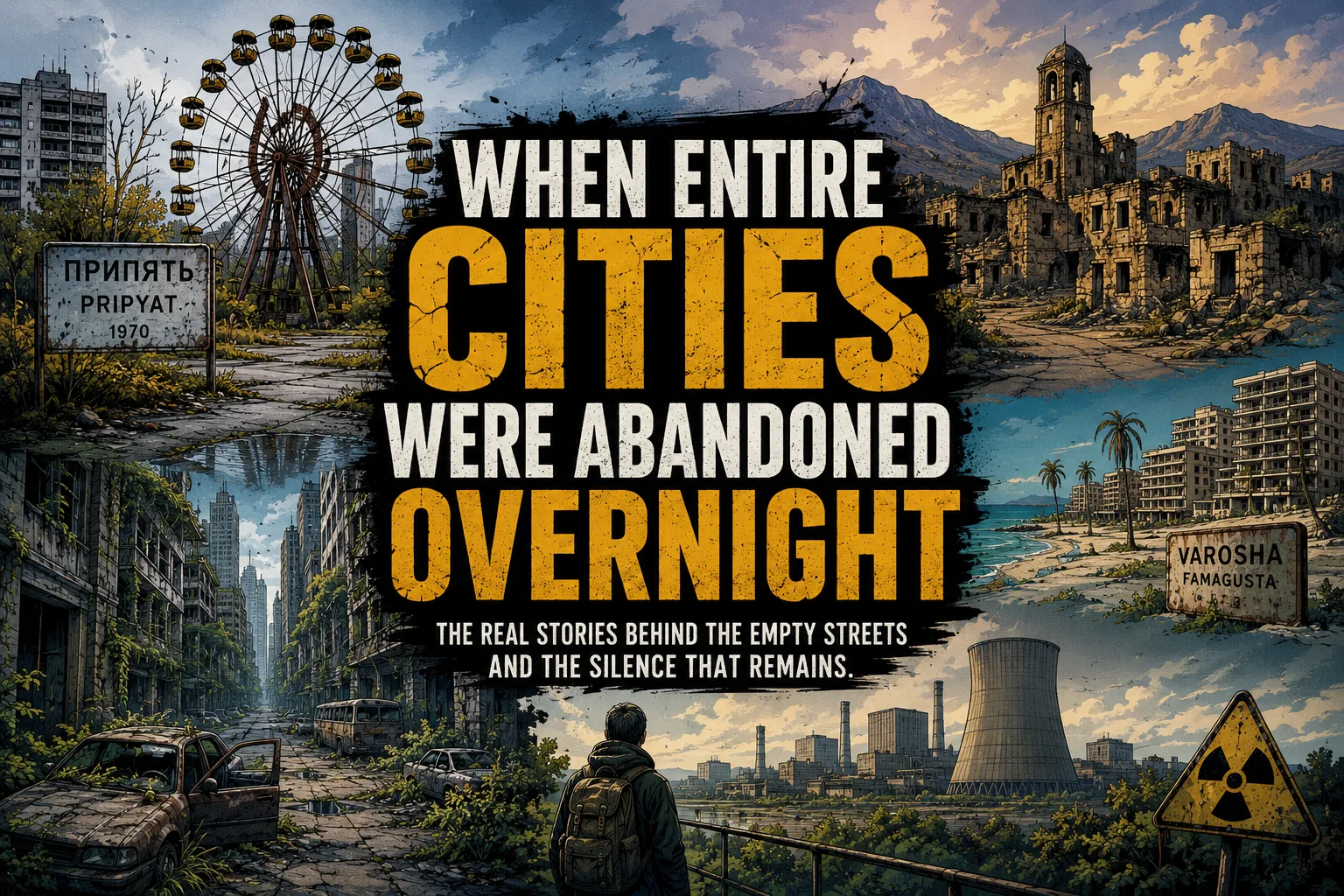
When Entire Cities Were Abandoned Overnight: What Really Happened?
Some cities were emptied by disaster, war, radiation, or sudden evacuation, while others only appear to have vanished overnight. Explore the real stories behind settlements humanity abruptly left behind.
When Entire Cities Were Abandoned Overnight: What Really Happened?
A city is supposed to feel permanent.
People build homes.
Businesses open.
Children go to school.
Roads fill with traffic.
Families spend generations in the same neighborhoods.
Buildings rise because everyone assumes there will be a tomorrow in which somebody needs them.
And then, occasionally, history interrupts.
A volcano erupts.
Radiation escapes from a reactor.
An army approaches.
A dam fails.
The ground becomes unstable.
A government orders everyone out.
Within hours or days, streets that once held thousands of people become almost silent.
Furniture remains inside apartments.
Cars sit where they were left.
Schools contain abandoned desks.
Stores still have signs hanging above their doors.
Nature begins reclaiming places built under the assumption that humans would remain indefinitely.
These places are often described online as cities that were "abandoned overnight."
But that phrase creates a problem.
Some genuinely experienced extraordinarily rapid evacuations.
Others declined over decades or centuries and were later transformed into dramatic stories of populations mysteriously disappearing.
So what happens when we separate the real sudden evacuations from the legends?
The answer is considerably more interesting.
What Does "Abandoned Overnight" Actually Mean?
Very few major cities literally went from normal life to completely empty between sunset and sunrise.
Historical abandonment usually falls into several categories:
Sudden catastrophe
A natural or technological disaster forces people out immediately.
Emergency evacuation
Authorities order residents to leave within hours or days.
War and invasion
Populations flee approaching armies or active fighting.
Environmental collapse
Water shortages, changing rivers, erosion, or agricultural problems gradually make settlement difficult.
Economic decline
Industries disappear and residents slowly leave.
Political relocation
Governments deliberately move populations.
These processes can produce similar ruins.
But they tell completely different stories.
1. Pripyat: The City Told to Leave for Three Days
Few abandoned cities capture the imagination like Pripyat.
Built in the Soviet Union near the Chernobyl Nuclear Power Plant, Pripyat was a relatively young city.
It housed plant employees and their families.
Schools operated.
Apartment blocks filled the skyline.
Stores served residents.
Children played in parks.
The city had tens of thousands of inhabitants.
Then, on April 26, 1986, Reactor No. 4 at the nearby Chernobyl plant exploded.
Radioactive material entered the environment.
Pripyat's ordinary life had effectively received an expiration date.
Its residents simply didn't know it yet.
The Evacuation Didn't Begin Immediately
One of the most disturbing aspects of Pripyat's story is that residents were not evacuated immediately after the explosion.
People continued moving through the city while radiation levels were dangerously elevated.
Authorities eventually ordered evacuation on April 27, roughly 36 hours after the disaster began.
Buses arrived in enormous numbers.
Residents were told to take identification, essential belongings, and some food.
The evacuation was presented as temporary.
"You'll Be Back Soon"
Residents were reportedly told they would likely return after only a few days.
That meant many left behind:
Clothing.
Photographs.
Furniture.
Personal possessions.
Children's belongings.
Household objects.
Pets.
Most residents never returned permanently.
The temporary evacuation became permanent displacement.
That detail explains much of Pripyat's eerie appearance.
People did not pack their homes as if they were moving.
They left expecting to come back.
🟢 Documented Rapid Evacuation
Approximately 49,000 people were evacuated from Pripyat on April 27, 1986.
The city is therefore one of the strongest modern examples behind the idea of a populated urban area becoming effectively abandoned in an extraordinarily short period.
The Famous Pripyat Ferris Wheel
One of the most recognizable images of Chernobyl is Pripyat's abandoned Ferris wheel.
It has become almost symbolic of the disaster.
The amusement park was scheduled to open officially around the May Day celebrations shortly after the reactor explosion.
It never entered normal public operation as planned.
Today the rusting Ferris wheel appears in countless photographs, documentaries, games, and films.
It creates an almost perfectly unsettling image:
A machine designed for laughter standing inside a city people can no longer normally inhabit.
Pripyat Wasn't Frozen Perfectly in 1986
There's another misconception.
Photographs can make Pripyat look as though everyone walked out and nobody touched anything afterward.
Reality is messier.
Over the decades, buildings have been affected by:
Weather.
Decay.
Looting.
Tourism.
Vandalism.
Vegetation.
Structural deterioration.
Objects have been moved.
So an abandoned classroom photographed decades later should not automatically be interpreted as an untouched snapshot of the exact moment evacuation occurred.
Ruins acquire histories of their own.
2. Pompeii: A City Buried by a Volcano
If Pripyat represents technological catastrophe, Pompeii represents one of history's most famous natural disasters.
The Roman city stood near Mount Vesuvius in southern Italy.
In AD 79, Vesuvius erupted catastrophically.
The eruption buried Pompeii beneath volcanic material.
Buildings disappeared.
People died.
And large parts of the city remained preserved beneath the deposits for centuries.
Did Everyone in Pompeii Die?
No.
This is an important misconception.
The eruption developed over time.
Many inhabitants appear to have escaped before the most lethal phases reached the city.
We don't know exactly how many people were living in Pompeii at the time or precisely how many successfully fled.
But the discovery of victims should not create the impression that the entire population simply stood in place waiting for the volcano.
Humans, despite our impressive record of poor decisions, generally attempt to escape erupting mountains.
Why Pompeii Became Extraordinary
Cities normally change continuously.
Buildings are renovated.
Objects are removed.
Old structures are demolished.
People carry possessions away.
Pompeii experienced something different.
Volcanic material buried substantial portions of the city.
That preserved:
Buildings.
Street layouts.
Wall paintings.
Graffiti.
Shops.
Household spaces.
Objects.
Human remains.
Archaeologists gained an extraordinary window into Roman urban life.
The Bodies of Pompeii
Visitors often encounter haunting human forms associated with Pompeii.
But many are not simply intact bodies preserved exactly as they died.
As buried bodies decomposed, they sometimes left cavities inside hardened volcanic material.
In the nineteenth century, archaeologist Giuseppe Fiorelli developed a technique of pouring plaster into some of these voids.
When surrounding material was removed, casts revealed the shapes of victims at death.
That is why expressions, clothing impressions, and body positions can sometimes appear remarkably detailed.
🟢 Strong Archaeological Evidence
Pompeii was catastrophically buried during the AD 79 eruption of Vesuvius, but describing it simply as a city whose entire population vanished "overnight" is misleading.
Many inhabitants escaped, while others died during different phases of the eruption.
3. Herculaneum: Pompeii's Less Famous Neighbor
Pompeii receives most of the attention.
But nearby Herculaneum suffered an equally extraordinary fate.
The Roman town was also destroyed during the eruption of Vesuvius.
Different volcanic processes affected Herculaneum, creating preservation conditions that sometimes protected materials rarely surviving elsewhere.
Wooden objects.
Building structures.
Food.
Furniture.
Other organic material.
This makes Herculaneum exceptionally valuable archaeologically.
The People Waiting Near the Shore
For years, relatively few human remains had been discovered at Herculaneum.
That contributed to theories that many inhabitants escaped.
Later excavations near ancient shoreline structures uncovered numerous victims.
Some apparently sought shelter near the waterfront, perhaps hoping for rescue or evacuation.
Instead, lethal volcanic surges reached the area.
The discovery transformed archaeologists' understanding of the town's final hours.
4. Centralia: The Town Burning Beneath the Ground
Not every abandoned place disappeared suddenly.
Centralia, Pennsylvania demonstrates why the "overnight" label can be misleading.
In 1962, a fire began in or entered underground coal workings near the town.
The underground fire continued.
Concerns grew about:
Toxic gases.
Ground instability.
Sinkholes.
Long-term safety.
Eventually, governments began relocating residents.
Centralia Did Not Empty Overnight
This is crucial.
Centralia's abandonment occurred gradually.
Residents debated the danger.
Some resisted relocation.
Properties were acquired.
Buildings were demolished.
The population declined over many years.
A small number of residents remained under legal arrangements.
So Centralia absolutely belongs in discussions of abandoned American towns.
But:
"An entire town suddenly evacuated because the ground caught fire"
is a much cleaner story than the historical reality.
And therefore, naturally, the internet prefers it.
🟡 Gradual Abandonment
Centralia is genuinely associated with a long-burning underground mine fire, but its population decline occurred over decades rather than overnight.
The Highway Covered in Graffiti
One famous Centralia attraction was an abandoned portion of Pennsylvania Route 61.
Visitors covered the roadway with graffiti.
Images spread online and helped transform Centralia into a dark-tourism destination.
The abandoned highway was later covered with dirt to discourage trespassing.
Once again, the abandoned landscape people recognize from photographs changed after abandonment.
Ghost towns don't remain aesthetically frozen for Instagram.
5. Hashima Island: From Industrial Powerhouse to Ghost Island
Off the coast of Nagasaki, Japan, sits a remarkable island commonly known as Hashima or Gunkanjima, meaning Battleship Island.
Coal mining drove its development.
Apartment buildings rose tightly across the small island.
At its peak, thousands of people lived within an extraordinarily dense industrial settlement.
Then Japan's energy economy changed.
Coal declined in importance relative to petroleum.
The mine closed in 1974.
Residents departed.
An Entire Industrial Community Disappears
Hashima contained more than industrial infrastructure.
It had:
Homes.
Schools.
Shops.
Community facilities.
Public spaces.
The mine provided the economic reason for the settlement's existence.
Once the mine closed, that foundation vanished.
Residents left rapidly over the following months.
The concrete buildings remained.
Why Hashima Looks Post-Apocalyptic
Unlike many abandoned settlements where wooden structures eventually disappear, Hashima contains substantial reinforced-concrete architecture.
Empty apartment blocks dominate the island.
Windows are gone.
Walls deteriorate.
Vegetation emerges through cracks.
From a distance, the island resembles a fortress.
Up close, it looks like someone removed the population from a functioning industrial city and left the architecture behind.
Which, economically speaking, is essentially what happened.
But Hashima Has a Darker History
The island's history cannot be discussed only as a fascinating ghost town.
During Japan's wartime mobilization, Korean and Chinese laborers were brought to industrial sites, including Hashima, under coercive conditions.
The broader history of forced labor remains politically sensitive, particularly between Japan and South Korea.
This is a reminder that picturesque ruins can conceal histories considerably darker than their abandoned architecture suggests.
6. Craco: The Italian Town That Slowly Lost Its People
Perched dramatically on a hill in southern Italy is Craco.
Photographs make it look like a medieval settlement whose residents suddenly disappeared.
The reality was gradual.
Craco faced serious geological instability.
Landslides damaged the settlement.
Flooding and earthquakes contributed additional problems.
Residents were progressively relocated.
By the late twentieth century, the historic center was largely abandoned.
Why Craco Looks Like Everyone Just Left
Buildings remain clustered together.
A church tower rises over empty streets.
Stone structures still trace the shape of a community.
Because much of the architecture survives, the town creates the illusion of sudden disappearance.
But architectural preservation does not reveal the speed of abandonment.
Sometimes ruins look sudden even when history wasn't.
Craco Became a Film Location
Its dramatic abandoned landscape has attracted filmmakers.
Productions have used Craco as a setting precisely because it looks ancient, isolated, and strangely preserved.
That creates an interesting second life for abandoned settlements.
A place loses its original population.
Then tourism, photography, filmmaking, and cultural fascination give the ruins a completely different economic identity.
The town dies.
The image of the town becomes valuable.
Humanity found a way to monetize ghosts.
7. Varosha: A Resort Frozen by War
On the island of Cyprus lies one of the strangest abandoned urban districts in modern history.
Varosha was once a thriving resort area of Famagusta.
Hotels lined the coast.
Tourists arrived.
Businesses operated.
The district became associated with Mediterranean tourism.
Then came 1974.
Political crisis and military conflict transformed Cyprus.
As Turkish forces advanced, Varosha's Greek Cypriot population fled.
The area was subsequently fenced off and remained largely inaccessible for decades.
Hotels Without Guests
Varosha became visually extraordinary because substantial tourism infrastructure remained.
Hotels.
Apartment buildings.
Commercial streets.
Beachfront properties.
For decades, these structures stood inside a restricted military-controlled area.
The result looked almost like an urban experiment:
What happens when a modern resort city loses normal human activity?
Weather takes over.
Plants spread.
Concrete deteriorates.
Metal corrodes.
Windows break.
The city begins slowly returning to the environment.
🟢 Rapid Wartime Abandonment
Varosha's population fled rapidly during the conflict of 1974.
However, its continuing status is inseparable from the unresolved political division of Cyprus, and parts of the area have been reopened under controversial circumstances since 2020.
It is therefore not accurate today to describe every part of Varosha as completely sealed and untouched.
8. Agdam: A City Destroyed by Conflict
Agdam, in the South Caucasus, presents another example of war producing urban abandonment.
During the First Nagorno-Karabakh War, intense fighting transformed the region.
Agdam's Azerbaijani population fled as Armenian forces captured the city in 1993.
Much of the urban area was subsequently destroyed or dismantled.
For years, photographs showed extensive ruins where a functioning city had once stood.
Abandoned Does Not Mean Forgotten
Calling somewhere a "ghost city" can make the place sound historically finished.
For displaced populations, it isn't.
Homes remain part of personal memory.
Families remember neighborhoods.
Property claims continue.
Political disputes continue.
Governments plan reconstruction.
Former residents may hope to return.
An abandoned city can therefore be physically empty while remaining psychologically crowded.
Agdam Is Changing Again
Following later changes in territorial control, Azerbaijan regained control of Agdam in 2020.
Large-scale reconstruction and resettlement plans followed.
That means Agdam illustrates another important point:
Abandonment isn't always permanent.
Cities can experience:
Settlement.
Destruction.
Abandonment.
Reconstruction.
Resettlement.
Urban history isn't necessarily a one-way journey toward ruins.
9. Plymouth, Montserrat: A Capital Buried by Volcanoes
Imagine losing not merely a town but your country's capital.
That happened on the Caribbean island of Montserrat.
In 1995, the Soufrière Hills volcano began erupting after centuries of dormancy.
The eruptions transformed the island.
The capital, Plymouth, eventually became uninhabitable.
Pyroclastic flows and volcanic deposits buried large parts of it.
A Modern Pompeii
Plymouth is sometimes described as a modern Pompeii.
The comparison is obvious.
Buildings protrude from volcanic deposits.
Streets disappeared.
Roofs and upper floors remain visible above buried lower structures.
But Plymouth's destruction occurred through an evolving volcanic crisis rather than one simple instantaneous event.
Evacuations occurred as the danger developed.
More Than a City Was Lost
The volcanic crisis displaced a large share of Montserrat's population.
Many residents moved abroad.
The island experienced enormous demographic and economic disruption.
This reveals something photographs of abandoned buildings cannot fully communicate.
When a city disappears, infrastructure isn't the only loss.
Communities fragment.
Jobs disappear.
Schools relocate.
Families migrate.
Social networks break apart.
The physical ruin is only the visible part.
10. Bodie: America's Famous Ghost Town
California's Bodie became one of America's most recognizable ghost towns.
Gold discoveries transformed the settlement during the nineteenth century.
At its height, thousands lived there.
Then the mining economy declined.
Residents gradually left.
Businesses closed.
Fires damaged parts of town.
Eventually, Bodie became largely abandoned.
Bodie Wasn't Abandoned Overnight Either
This is another case where photographs create the wrong impression.
Bodie did not suddenly wake up empty.
Its decline unfolded over decades.
Today, preserved buildings create an extraordinary representation of an American mining town.
California maintains Bodie as a State Historic Park in a condition often described as "arrested decay."
The objective isn't to reconstruct everything into pristine condition.
It is to prevent the remaining structures from disappearing.
Gold Creates Cities Quickly and Destroys Them Just as Quickly
Mining towns reveal the vulnerability of settlements dependent on one economic resource.
Gold discovered:
Workers arrive.
Businesses appear.
Housing expands.
Population explodes.
Gold production declines:
Workers leave.
Customers disappear.
Businesses close.
Property values collapse.
Town declines.
The pattern resembles modern communities built around:
Factories.
Oil fields.
Military bases.
Tourism.
Large technology employers.
Cities may look permanent.
Their economic foundations sometimes aren't.
The Most Mysterious Abandoned Cities Are Much Older
So far, most examples have relatively clear explanations.
Volcano.
Radiation.
War.
Mining.
Economic decline.
But ancient abandoned cities create a different challenge.
Sometimes written records are limited.
Populations disappeared centuries before modern archaeology.
Ruins remain.
And humans absolutely hate unanswered questions.
So mythology rushes into the empty space.
What Happened to the Maya Cities?
Popular documentaries once loved asking:
"Why did the Maya mysteriously disappear?"
There's a major problem with that sentence.
The Maya did not disappear.
Millions of Maya people live today.
What happened historically was far more complicated.
During the Terminal Classic period, many major cities in parts of the southern Maya lowlands experienced political and demographic decline.
Some urban centers were abandoned or dramatically reduced.
There Was Probably No Single Cause
Researchers have investigated combinations of:
Drought.
Warfare.
Political instability.
Environmental pressure.
Agricultural problems.
Changing trade networks.
Social disruption.
Different regions experienced different trajectories.
Some cities declined.
Others continued.
Populations moved.
Maya societies persisted.
So the idea that an entire civilization simply vanished is misleading.
🔴 Common Myth / Misconception
The ancient Maya did not mysteriously disappear as a people.
Certain political systems and urban centers declined, particularly in parts of the southern lowlands, while Maya communities continued elsewhere and remain alive today.
Angkor Wasn't Simply "Lost"
The enormous urban complex associated with Angkor in Cambodia presents another famous abandonment story.
Angkor served as a center of the Khmer Empire.
Its temples include the world-famous Angkor Wat.
Eventually, political and demographic changes reduced the importance of the urban center.
Researchers have investigated factors including:
Political shifts.
Warfare.
Changing trade.
Water-management challenges.
Extreme climate variability.
The Jungle Didn't Discover Angkor
Western popular culture sometimes tells stories of European explorers "discovering" Angkor hidden in the jungle.
That framing is deeply misleading.
Local Khmer people knew the temples existed.
Angkor Wat continued to have religious significance.
European visitors documented the site centuries before nineteenth-century explorers made it famous internationally.
A place can become unfamiliar to outsiders without being lost to the people living nearby.
Abandoned City Myths Follow a Pattern
Someone encounters ruins.
Then asks:
Where did everyone go?
If the answer isn't obvious, increasingly dramatic explanations appear.
Unknown civilization.
Curse.
Catastrophe.
Secret invasion.
Advanced technology.
Aliens.
Because apparently gradual migration caused by drought has terrible thumbnail performance.
But archaeology usually reveals something more human.
People respond to changing conditions.
They move.
Governments collapse.
Trade routes change.
Water becomes scarce.
Wars occur.
Economic opportunities shift.
Cities lose the systems that made large populations possible.
Cities Are Systems, Not Just Buildings
This may be the most important idea in understanding abandoned cities.
A city isn't merely:
Roads + houses + buildings.
A functioning city requires continuous systems.
Water.
Food.
Energy.
Employment.
Transportation.
Government.
Security.
Waste removal.
Healthcare.
Trade.
Communication.
Remove enough of those systems and the buildings can remain while the city itself stops functioning.
Pripyat's apartment blocks survived.
But radiation removed the population.
Hashima's concrete towers survived.
But the coal economy disappeared.
Varosha's hotels survived.
But war removed their inhabitants.
Buildings can outlive the reason people built them.
Nature Moves Back In
Once humans leave, something fascinating happens.
Plants enter cracks.
Trees grow through floors.
Animals occupy buildings.
Road surfaces fracture.
Water infiltrates roofs.
Metal corrodes.
Concrete deteriorates.
Drainage systems stop working.
Without maintenance, even enormous infrastructure begins degrading surprisingly quickly.
Cities are not naturally permanent structures.
They survive because humans constantly repair them.
Stop maintaining civilization and gravity immediately begins submitting invoices.
Cities Abandoned Because the Ground Became Dangerous
Sometimes a city doesn't lose its population because its economy collapses or an army arrives.
Sometimes the physical landscape itself becomes hostile.
Earthquakes.
Landslides.
Floods.
Subsidence.
Volcanic activity.
Contamination.
A settlement can survive centuries of political change and then encounter a geological event that makes the question of staying remarkably simple:
Leave, or accept a level of risk most people reasonably won't.
Wittenoom: Australia's Contaminated Ghost Town
In Western Australia, the former mining town of Wittenoom became associated with one of the country's worst industrial health disasters.
The town developed around the mining of blue asbestos, or crocidolite.
For years, workers extracted and processed the mineral.
Asbestos fibers contaminated mining and residential environments.
Eventually, the enormous health risks became impossible to ignore.
Mining ended in the 1960s.
The town's population gradually declined.
The Danger Didn't Disappear When the Mine Closed
Asbestos exposure is associated with serious diseases, including:
Mesothelioma.
Lung cancer.
Asbestosis.
Other respiratory disease.
The problem at Wittenoom therefore wasn't merely an abandoned industrial site.
Contaminated material existed across the surrounding area.
Authorities progressively removed services and infrastructure while discouraging people from entering the region.
Wittenoom Was Effectively Erased
Over time, Wittenoom was removed from official maps and road signs.
Government efforts continued to close the former town and acquire remaining properties.
The last permanent resident reportedly left in 2022.
That means Wittenoom took roughly half a century to move from mining settlement to effectively abandoned site.
🟡 Gradual Abandonment
Wittenoom is sometimes grouped with suddenly abandoned towns, but it did not empty overnight.
Its decline occurred over decades as the consequences of asbestos contamination became increasingly recognized.
Times Beach: The American Town Bought by the Government
In Missouri, a town called Times Beach experienced a very different contamination disaster.
During the 1970s, waste oil was sprayed on roads to control dust.
Unfortunately, some of that oil contained dioxin contamination.
The danger became apparent only later.
Then, in December 1982, the Meramec River flooded.
Contaminated material and floodwater created an extraordinary environmental crisis.
Residents were evacuated.
The Town Never Really Came Back
Testing revealed serious contamination concerns.
In 1983, the federal government announced a buyout of the community.
Hundreds of properties were eventually acquired.
The town was disincorporated.
Contaminated materials were later dealt with through a major cleanup operation.
A functioning American town effectively ceased to exist.
Route 66 Ran Through It
Times Beach sat along historic Route 66.
That gives the story an especially strange contrast.
The road symbolizes:
American travel.
Cars.
Roadside businesses.
Postwar mobility.
Freedom.
And sitting beside that mythology was a town rendered uninhabitable by environmental contamination.
Today, the former community is associated with Route 66 State Park.
A disaster site became recreational land after remediation.
Cities occasionally have extremely strange second careers.
🟢 Documented Environmental Abandonment
Times Beach is a genuine example of an American community permanently evacuated and bought out because of contamination concerns.
However, the process unfolded over months and years rather than literally one night.
Gilman, Colorado: A Mining Town Behind Warning Signs
High in Colorado sits Gilman, an abandoned mining town.
Mining supported the community for decades.
Workers extracted valuable metals including:
Lead.
Zinc.
Silver.
Copper.
Gold.
Eventually, mining ceased.
Environmental contamination became a major concern.
The site became associated with the Eagle Mine Superfund cleanup.
Today, access to the abandoned town is restricted.
Why Mining Towns Become Ghost Towns So Easily
Mining settlements can have an unusually fragile economic structure.
Imagine almost everyone in town depending directly or indirectly on one mine.
The mine employs workers.
Workers buy food.
Stores survive.
Families need schools.
Businesses need customers.
Local government collects revenue.
Then:
Mine closes.
The economic chain begins collapsing.
A diversified city can lose one industry and survive.
A company town built around one resource may have no replacement.
Picher, Oklahoma: A Town Undermined by Mining
Another remarkable American example is Picher, Oklahoma.
Picher grew as a major lead and zinc mining center.
Mining produced enormous piles of waste known locally as chat piles.
Environmental contamination became severe.
Lead exposure presented serious health concerns.
Meanwhile, underground mine workings created risks of ground collapse.
The town's long-term future was already bleak.
Then nature delivered another blow.
The 2008 Tornado
In May 2008, a powerful tornado struck Picher.
Homes and businesses were destroyed.
People died.
But rebuilding a heavily contaminated community already undergoing federal buyouts made little sense.
The disaster accelerated the town's disappearance.
Picher was eventually dissolved as a municipality.
Sometimes Cities Die From Multiple Causes
Picher demonstrates why abandoned-city stories rarely fit one neat explanation.
Was Picher abandoned because of:
Mining collapse?
Lead contamination?
Ground instability?
Government relocation?
The tornado?
The answer is:
All of them contributed.
Historical events often have multiple interacting causes.
Single-cause explanations are easier to remember.
Reality remains inconsiderately complicated.
San Juan Parangaricutiro: A Town Buried by a New Volcano
In 1943, something extraordinary happened in a farmer's field in Mexico.
The ground opened.
Volcanic activity began.
A new volcano emerged.
It became known as Parícutin.
Over the following years, lava and volcanic material transformed the surrounding landscape.
Nearby communities had to evacuate.
One of the most famous was San Juan Parangaricutiro.
The Church That Survived the Lava
Much of the settlement was overwhelmed.
But part of the town's church remained visible above the hardened lava.
Today, the church ruins rising from a black volcanic landscape create one of the most extraordinary images associated with abandoned settlements.
A building constructed by humans sits surrounded by rock that did not exist in that form when the building was erected.
Geology essentially redesigned the neighborhood without consulting planning permission.
Parícutin Gave Scientists a Rare Opportunity
Most volcanoes studied by geologists existed long before modern scientific observation.
Parícutin was different.
Scientists were able to observe much of the volcano's development from its early stages.
Its emergence provided extraordinary information about volcanic processes.
For residents, however, this scientific opportunity came at enormous cost.
Homes and agricultural land were lost.
Communities relocated.
The Myth of Cities Found With Food Still on Tables
Abandoned-city stories often contain a wonderfully cinematic detail:
Explorers enter homes.
Plates remain on tables.
Meals sit untouched.
Beds look recently slept in.
The entire population apparently disappeared in the middle of dinner.
Sometimes rapidly evacuated places genuinely contain abandoned possessions.
But these stories require skepticism.
Why?
Because abandoned sites change after residents leave.
Objects Move
Looters enter.
Weather destroys rooms.
Visitors rearrange things.
Photographers stage scenes.
Tour operators modify locations.
Animals disturb objects.
Buildings collapse.
Souvenir hunters remove items.
Decades later, somebody photographs a dusty shoe beside an overturned chair.
The internet announces:
"Everything remains exactly as residents left it."
Usually, nobody has enough evidence to establish that.
Abandoned places are not sealed archaeological time capsules unless unusual circumstances preserve them.
Kolmanskop: The Desert Reclaims a German Colonial Mining Town
In present-day Namibia sits one of the world's most visually spectacular ghost towns.
Kolmanskop developed after diamonds were discovered in the region during the early twentieth century.
German colonial architecture appeared in the desert.
The settlement contained amenities remarkable for its remote location.
But richer diamond deposits were eventually found elsewhere.
Mining activity declined.
Residents left.
By the mid-twentieth century, Kolmanskop was abandoned.
Sand Entered the Houses
Without residents maintaining buildings, desert sand began moving inside.
Today, some rooms contain enormous dunes.
Doors open into sand.
Floors disappear beneath it.
Windows frame the desert.
The result looks surreal.
But there is nothing mysterious about it.
Wind plus decades plus unmaintained architecture will happily redesign your living room.
Kolmanskop Also Has a Colonial History
The ghost-town imagery can distract from the historical context.
Diamond extraction in German South West Africa existed within a colonial system marked by racial inequality and exploitation.
So Kolmanskop shouldn't be understood only as:
"Beautiful abandoned desert town."
Its wealth and architecture existed within a much larger colonial history.
Ruins can be aesthetically fascinating while representing deeply unequal societies.
Both things can be true.
Oradour-sur-Glane: A Town Deliberately Left in Ruins
Not every abandoned settlement is preserved because people cannot return.
Sometimes ruins are intentionally maintained as memorials.
Oradour-sur-Glane in France is one of the most powerful examples.
On June 10, 1944, soldiers from a Waffen-SS unit entered the village.
Hundreds of civilians were killed.
Buildings were burned.
After World War II, the destroyed village was not simply rebuilt on the same site.
A new settlement was constructed nearby.
The ruins of the original village were preserved.
A Ghost Town as Evidence
Walking through the ruins means encountering:
Destroyed buildings.
Burned vehicles.
Empty streets.
Fragments of ordinary civilian life.
But Oradour-sur-Glane isn't a mysterious abandoned town.
Its emptiness has a deliberate purpose.
The ruins function as:
Memorial.
Historical evidence.
Public warning.
Place of mourning.
The absence of residents is itself part of the site's meaning.
Abandoned Places Can Preserve Trauma
Ghost towns attract photographers because empty buildings look mysterious.
But people once lived there.
That sounds obvious.
Yet it changes how these places should be understood.
An abandoned house may represent:
A family displaced by war.
A worker who lost employment.
A community poisoned by industry.
Someone forced from ancestral land.
A child evacuated after disaster.
A neighborhood destroyed by political decisions.
The aesthetic of abandonment can conceal the human cost of becoming abandoned.
Belchite: A Spanish Town Preserved After War
During the Spanish Civil War, the town of Belchite became the site of intense fighting in 1937.
The battle caused extensive destruction.
After the war, rather than fully rebuilding the old town, a new settlement was constructed nearby.
The ruins remained.
Today, old Belchite stands as another example of an urban landscape preserved partly because destruction itself became historically meaningful.
War Produces Different Kinds of Ghost Cities
A city abandoned because of war may experience:
Sudden flight.
Forced displacement.
Population transfer.
Physical destruction.
Looting.
Land mines.
Political exclusion.
Later reconstruction.
Unlike a mine closure, war can also make return politically impossible even when buildings remain structurally usable.
The barrier isn't always physical.
Sometimes the border changed.
Famagusta and Varosha Show This Clearly
Recall Varosha from Part 1.
Its buildings remained.
Its beaches remained.
Its Mediterranean climate remained.
Its tourism potential remained.
Yet political conflict prevented the original community from simply returning.
That illustrates something fundamental:
Cities exist within political systems as much as physical landscapes.
A perfectly habitable building can become unusable because sovereignty, security, or property rights changed.
Ani: The City of a Thousand and One Churches
Near the modern Turkey-Armenia border lie the ruins of Ani.
During the medieval period, Ani became an important Armenian city and political center.
Its location connected trade routes.
Churches, defensive walls, and other structures demonstrated substantial wealth and importance.
But Ani experienced repeated political and military disruption.
Control changed.
Invasions occurred.
Trade patterns shifted.
Earthquakes caused damage.
Population declined.
Eventually, the city was largely abandoned.
Ani Did Not Vanish Overnight
Like many famous lost cities, Ani's decline unfolded across a long period.
That is historically important.
Civilizations rarely behave like computer programs:
CITY.EXE HAS STOPPED WORKING.
More often:
Population declines.
Political importance moves elsewhere.
Trade weakens.
Infrastructure deteriorates.
Disasters accelerate existing problems.
Eventually, a settlement crosses the line from struggling city to ruins.
There may never be one identifiable "last day."
Fatehpur Sikri: The Capital That Didn't Last
In India, Mughal emperor Akbar developed Fatehpur Sikri as an imperial capital during the sixteenth century.
The complex included magnificent:
Palaces.
Mosques.
Courtyards.
Administrative buildings.
Monumental architecture.
Yet its period as the principal imperial capital was relatively brief.
The Mughal court shifted away.
Was Fatehpur Sikri Abandoned Because It Ran Out of Water?
A popular explanation says the city was abandoned simply because of water shortages.
Water availability may indeed have been important.
But historians have considered broader strategic, political, and logistical explanations for the Mughal court's relocation.
The simplistic version:
Huge capital built → water disappears → everyone leaves
is probably too neat.
Imperial capitals are political systems.
Their fortunes can change when rulers and military priorities move.
🟡 Historical Explanation Is Multifactorial
Fatehpur Sikri's relatively short period as Akbar's main capital is sometimes attributed entirely to water shortages.
Water constraints likely mattered, but political and strategic considerations also need to be considered.
Cahokia: America's Forgotten Pre-Columbian City
Near modern St. Louis, Missouri, an enormous Indigenous urban center once flourished.
Today we call it Cahokia.
Around its height, roughly a thousand years ago, Cahokia contained monumental earthworks, large public spaces, residential areas, and complex political and social organization.
Its largest surviving structure, Monks Mound, remains enormous.
For many Americans, Cahokia produces an unexpected realization:
Large, complex urban societies existed in North America long before European colonization.
Why Was Cahokia Abandoned?
There is no single universally accepted explanation.
Researchers have investigated factors including:
Environmental change.
Flooding.
Political instability.
Resource pressures.
Social transformation.
Population movement.
Changing economic networks.
The city declined over generations.
Eventually, the major urban center was abandoned.
Cahokia Was Not an Empty Wilderness Before Europeans
This matters because older narratives often portrayed pre-Columbian North America as sparsely populated wilderness.
Archaeology demonstrates a much more complicated history.
Indigenous societies built:
Large settlements.
Trade networks.
Monumental architecture.
Agricultural systems.
Political institutions.
Cahokia's ruins challenge simplistic ideas about North American history.
Mesa Verde: Why Did People Leave?
In the American Southwest, Ancestral Pueblo peoples built extraordinary settlements, including cliff dwellings associated today with Mesa Verde.
By the late thirteenth century, communities had moved away from many settlements in the region.
Older popular narratives sometimes called this a mysterious disappearance.
Again:
They did not simply vanish.
Populations migrated.
Their descendants are connected with Pueblo communities living today.
Drought Was Important, But Not Everything
The late thirteenth century included severe drought conditions.
Environmental stress likely contributed to migration.
But researchers also examine:
Social changes.
Conflict.
Resource pressure.
Religious transformation.
Political organization.
Regional relationships.
Migration itself.
The better question isn't:
"Where did everyone mysteriously disappear?"
It is:
"Why did communities decide that living somewhere else offered a better future?"
That framing treats historical people like rational humans rather than missing characters from a supernatural documentary.
Why People Leave Cities
Across all these examples, several recurring forces appear.
Environmental disaster
Volcanoes.
Earthquakes.
Floods.
Landslides.
Drought.
Technological disaster
Radiation.
Industrial contamination.
Mine fires.
War
Invasion.
Civil conflict.
Ethnic displacement.
Military occupation.
Economic collapse
Mine closure.
Trade-route changes.
Industry decline.
Political change
Capital relocation.
Border changes.
Government resettlement.
Infrastructure failure
Water shortages.
Transportation disruption.
Unsafe buildings.
Usually, more than one factor interacts.
Could a Modern Megacity Ever Be Abandoned?
Imagine:
New York City.
Los Angeles.
Tokyo.
London.
Mumbai.
Population measured in millions.
Could one eventually become a ghost city?
In principle, yes.
But abandoning a modern megacity would require extraordinary circumstances.
Large cities possess enormous economic inertia.
People have:
Jobs.
Property.
Infrastructure.
Family networks.
Businesses.
Government institutions.
Universities.
Hospitals.
Transportation systems.
These make complete abandonment difficult.
Climate Change Creates a Different Problem
The more realistic scenario isn't necessarily:
Everyone leaves tomorrow.
Instead:
Insurance becomes expensive.
Flooding becomes frequent.
Infrastructure requires increasingly costly protection.
Heat becomes dangerous.
Water becomes less reliable.
Some neighborhoods lose value.
Wealthier residents relocate.
Governments invest in defenses.
Population patterns gradually shift.
A city can become less viable long before it becomes empty.
Jakarta Shows How Cities Can Adapt
Indonesia has been developing Nusantara as a new national capital, while Jakarta faces major problems including land subsidence, flooding, congestion, and environmental stress.
But relocating national capital functions does not mean Jakarta simply becomes abandoned.
Jakarta remains an enormous metropolitan and economic center.
This distinction is important.
Moving a capital is not the same thing as evacuating a city.
Cities can lose one political function while retaining millions of residents and substantial economic activity.
What Would Happen If Humans Suddenly Left a City?
Suppose every person disappeared from a modern city tomorrow.
Not realistically.
Just as a thought experiment.
Within days:
Power systems would begin failing.
Some pumps would stop.
Transportation systems would shut down.
Animals would move differently through urban areas.
Within months:
Vegetation would spread.
Water damage would begin affecting buildings.
Road maintenance would stop.
Drainage systems would clog.
Within years:
Roofs would fail.
Freeze-thaw cycles would damage structures in colder climates.
Tree roots would break pavement.
Corrosion would weaken metal.
Flooding would accelerate decay.
Skyscrapers Need Humans More Than They Look Like They Do
A skyscraper looks enormously permanent.
Steel.
Concrete.
Glass.
Massive foundations.
But modern buildings depend on constant maintenance.
Water intrusion is particularly destructive.
Once seals fail and roofs leak:
Water enters.
Metal corrodes.
Concrete deteriorates.
Mold spreads.
Freeze-thaw cycles widen cracks.
Mechanical systems fail.
Eventually, sections become structurally dangerous.
Nature doesn't need to knock the building down.
It only needs humans to stop repairing it.
Roads Would Become Rivers and Forests
Urban drainage constantly controls water.
Remove maintenance and:
Storm drains clog.
Road surfaces crack.
Water collects.
Plants establish roots.
Roots widen cracks.
Soil accumulates.
Larger vegetation follows.
Over decades, some roads could become difficult to recognize.
We think of cities as replacing nature.
They actually suppress it continuously.
Stop suppressing it and biology returns with impressive enthusiasm.
Chernobyl Shows Part of This Process
The exclusion zone surrounding Chernobyl provides a real-world, though imperfect, example of reduced human activity.
Vegetation has expanded through formerly developed areas.
Wildlife populations use landscapes where human activity was dramatically reduced.
But the simplistic headline:
"Nature completely healed Chernobyl"
is misleading.
Radiological contamination remains.
Different species respond differently.
Humans still work within parts of the exclusion zone.
The region is not an untouched wilderness.
Nature returning does not mean contamination vanished.
Why Ghost Cities Fascinate Us
An abandoned city creates a psychological contradiction.
Cities exist because humans gather together.
A city without people feels wrong.
A house without residents is ordinary.
An entire neighborhood without residents feels unsettling.
An entire city without residents feels almost impossible.
Our brains immediately ask:
Where did everybody go?
And that question creates mystery even when the answer is written clearly in historical records.
Abandoned Cities Let Us Imagine a World Without Us
There's another reason these places are compelling.
Walk through an abandoned building and you encounter something uncomfortable:
Civilization is temporary.
Every skyscraper will eventually disappear.
Every highway will eventually fail.
Every city requires maintenance.
The structures around us feel permanent because their deterioration occurs slowly compared with daily human experience.
Ghost cities accelerate the timeline.
They show us what happens when maintenance stops.
They Also Reveal What People Valued
Archaeologists can learn extraordinary things from abandoned settlements.
Where people cooked.
What they ate.
How homes were organized.
Where elites lived.
How water moved through cities.
What people worshipped.
How goods were traded.
How streets were designed.
What ordinary people owned.
Sometimes abandonment preserves information that continuous occupation would have destroyed.
A functioning city constantly erases its own history.
Old buildings disappear.
New roads replace old ones.
Foundations are rebuilt.
Abandonment can accidentally freeze portions of that process.
Are There Truly "Lost Cities"?
Yes, but the phrase needs care.
Some settlements were genuinely forgotten outside local traditions and later identified archaeologically.
Others were never actually lost.
Local populations knew about them.
Religious communities continued visiting them.
Historical documents described them.
Then a Western explorer arrived centuries later and received credit for "discovering" the place.
Historical discovery stories often tell us as much about who was writing history as about the ruins themselves.
Machu Picchu Wasn't Simply "Discovered" in 1911
American historian and explorer Hiram Bingham brought international attention to Machu Picchu in 1911.
He did not enter an unknown city untouched since the Inca period.
Local people knew the ruins existed.
Families lived and farmed nearby.
Bingham's importance lies in bringing the site to wider scholarly and international attention, not literally becoming the first human to encounter it since antiquity.
🔴 Common Myth / Misconception
Machu Picchu was not a completely forgotten city suddenly discovered by an outsider in 1911.
Local residents already knew of the site.
The language of "discovery" can erase local knowledge.
Frequently Asked Questions
Have entire cities really been abandoned overnight?
Very few large cities literally became completely empty overnight. However, places such as Pripyat experienced extremely rapid evacuations, while war also emptied districts and settlements within short periods.
Why was Pripyat abandoned?
Pripyat was evacuated following the 1986 Chernobyl nuclear disaster because of dangerous radioactive contamination. Roughly 49,000 residents were evacuated on April 27.
Is Pompeii still radioactive or dangerous?
No. Pompeii was buried by volcanic material after the AD 79 eruption of Mount Vesuvius. Its risks are unrelated to radiation.
Is Centralia still burning?
The underground mine fire associated with Centralia has persisted for decades. The former town's abandonment, however, occurred gradually rather than through one sudden evacuation.
Did everyone in Pompeii die?
No. Many inhabitants appear to have escaped during the eruption. Archaeologists have discovered victims who remained or were unable to escape.
Why was Hashima Island abandoned?
Its coal mine closed in 1974 as Japan's energy economy shifted away from coal. Residents subsequently left the island.
Are abandoned cities left exactly as residents left them?
Usually not. Weather, structural decay, looting, animals, tourism, vandalism, cleanup efforts, and later human activity alter abandoned places.
Did the Maya civilization disappear?
No. Some major Classic Maya political centers declined or were abandoned, but Maya peoples survived and millions of Maya people live today.
Can abandoned cities be repopulated?
Yes. Abandonment isn't necessarily permanent. Reconstruction, environmental remediation, political change, or economic redevelopment can allow populations to return.
Final Thoughts
The phrase "abandoned overnight" is irresistible.
It creates an image of breakfast still sitting on tables while thousands of people mysteriously vanish.
But history is usually less supernatural and more revealing.
Pripyat emptied rapidly because radiation made ordinary life dangerous.
Pompeii was buried because a volcano overwhelmed a Roman city.
Varosha emptied because war transformed political geography.
Plymouth was lost to volcanic activity.
Hashima lost the industry that justified an intensely populated island settlement.
Centralia declined because a fire beneath the ground made long-term habitation increasingly impractical.
Times Beach disappeared because contamination turned an ordinary American town into an environmental emergency.
Picher suffered industrial pollution, ground instability, economic decline, and natural disaster.
Ancient cities such as Cahokia, Ani, and parts of the Maya world declined through far more complicated combinations of environmental, political, economic, and social change.
There usually wasn't one mysterious night.
There was a tipping point.
And that distinction tells us something important about cities.
Buildings do not create permanence.
Systems do.
A city survives only while people can maintain:
Water.
Food.
Energy.
Safety.
Employment.
Infrastructure.
Political stability.
Social networks.
Remove enough of those systems and even enormous cities can begin to fail.
The skyscrapers may remain.
The roads may remain.
The schools may remain.
The houses may remain.
But without people continuously maintaining and using them, they become something fundamentally different.
Ruins.
And perhaps that is why abandoned cities feel so unsettling.
They show us familiar human spaces after the humans have gone.
A kitchen without a family.
A school without students.
A hotel without guests.
A road with nowhere anyone needs to go.
They remind us that cities aren't permanent monuments dominating nature.
They're ongoing human projects.
Every day, millions of people quietly keep them alive.
And when those people leave, nature doesn't need permission to take the land back.