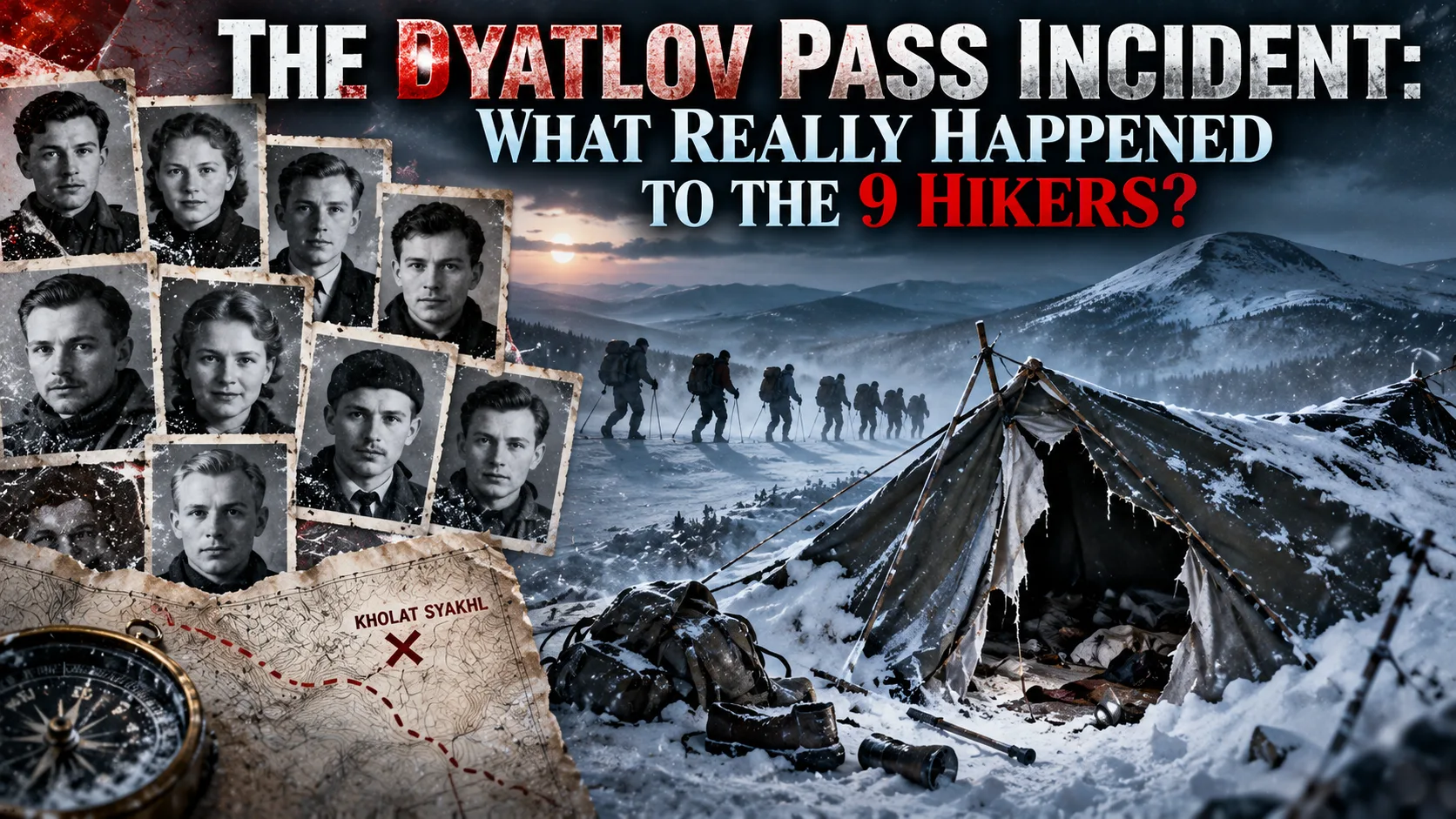
The Dyatlov Pass Incident: What Really Happened to the 9 Hikers?
In 1959, nine experienced hikers died in the remote Ural Mountains under circumstances that shocked investigators and baffled the public for decades. Their tent was found cut open from the inside, and some hikers had abandoned it in freezing conditions. Were they caught in an unusual avalanche, driven into the wilderness by extreme weather, or confronted by something else? Explore the evidence, competing theories, and what modern investigations can actually explain.
The Dyatlov Pass Incident: What Really Happened to the 9 Hikers?
In February 1959, nine experienced hikers died in the frozen Ural Mountains. Their tent was found cut open from the inside, several had fled into the wilderness without proper clothing, and some bodies showed devastating injuries. More than six decades later, the leading explanation is a natural disaster, but important questions remain.
Introduction: The Tent on the Mountain
Imagine waking in the middle of a freezing night.
You are high in the Ural Mountains, far from the nearest settlement. The wind is tearing across the snow, the temperature is dropping, and the people sharing your tent are suddenly alarmed by something you cannot afford to ignore.
You have warm clothing, food, equipment, and shelter. Outside, the landscape is covered in darkness and snow. Whatever is happening, leaving the tent means risking exposure to the cold.
Yet you leave.
You cut through the tent fabric from the inside, abandon much of your equipment, and descend toward a distant forest. Some of your companions are wearing little more than the clothes they slept in. Others have no proper footwear.
Why would experienced hikers make such a decision?
This is the question that has haunted the Dyatlov Pass incident, one of the most discussed unexplained deaths in modern history.
In January 1959, ten Soviet hikers set out on a demanding winter expedition in the northern Ural Mountains. Only one returned before the disaster. The remaining nine never came home.
Searchers eventually found their abandoned tent on a snowy mountainside. Some of the hikers had died near a forest, while others were discovered months later in a ravine. Several had suffered severe internal injuries. Rumours about strange lights, military experiments, mysterious substances, and secret government operations soon surrounded the tragedy.
The circumstances were disturbing enough to generate decades of speculation.
But the real story is more complicated than the familiar image of nine hikers fleeing an invisible enemy.
There is no verified evidence that a monster attacked them. No confirmed proof establishes that a secret military experiment killed them. And the popular claim that their injuries were impossible to explain medically goes far beyond what the evidence supports.
At the same time, the case cannot honestly be reduced to a completely solved mystery. The precise chain of events that drove the group out of its tent remains uncertain.
To understand what most likely happened, we must separate the established facts from the explanations proposed to make sense of them.
The central question is not whether the incident was mysterious. It clearly was. The question is how much of that mystery can be explained by the unforgiving physics of a winter mountain.
1. Who Were the Nine Hikers?
The expedition leader was Igor Dyatlov, a 23-year-old engineering student at the Ural Polytechnic Institute in the Soviet Union.
He was an experienced outdoor enthusiast who had participated in previous hiking and skiing expeditions. His companions were also familiar with demanding conditions and organised winter travel.
The group was young, educated, and accustomed to the practical difficulties of travelling through remote terrain.
The nine hikers who died were:
Igor Dyatlov, 23
Zinaida Kolmogorova, 22
Rustem Slobodin, 23
Yuri Doroshenko, 21
Yuri Krivonischenko, 23
Lyudmila Dubinina, 20
Semyon Zolotaryov, 37
Alexander Kolevatov, 24
Nikolai Thibeaux-Brignolle, 23
The group included seven men and two women. Most were university students or young graduates, while Zolotaryov was considerably older and had military experience.
Their expedition was intended to reach the mountain area around Mount Otorten, travelling through difficult winter terrain. The journey required navigation, skiing, careful management of supplies, and an ability to cope with severe weather far from inhabited settlements.
These were not nine inexperienced tourists who had wandered into the mountains without preparation.
That detail matters because many explanations rely on the assumption that the group simply panicked over an ordinary inconvenience.
Experienced hikers can make mistakes, certainly. Experience does not make someone immune to bad decisions, equipment failures, or sudden emergencies. But it does influence which explanations are plausible.
The hikers understood that winter conditions could be dangerous. They knew the importance of shelter and warm clothing. Abandoning both would have represented a serious decision, not an ordinary response to a minor disturbance.
Something must have made staying in the tent appear more dangerous than leaving it.
Exactly what that was remains the heart of the mystery.
The tenth member who survived
One person originally belonging to the expedition did survive.
His name was Yuri Yudin.
Yudin became ill during the early part of the journey and was forced to leave the group before the fatal stage of the expedition. He returned home while the others continued.
His departure was an ordinary consequence of illness, but it had an extraordinary outcome: he became the only member of the original expedition party to survive.
For the families of the nine who died, the fact that one member had left shortly before the tragedy was especially painful. Yudin later became an important source of information about the group's plans, personalities, and earlier movements.
He did not witness the final night.
Consequently, his testimony could help explain who the hikers were and how the expedition progressed, but it could not directly reveal what happened after they entered the mountains alone.
🟢 Established Evidence: The expedition consisted of ten people initially. Yuri Yudin left because of illness, leaving nine hikers to continue toward the area where they eventually died.
2. The Journey Into the Ural Mountains
The expedition began in late January 1959.
The group travelled through settlements and remote wilderness before continuing on skis into increasingly isolated terrain. They maintained written records and took photographs along the way, leaving investigators valuable evidence of their movements.
The plan was demanding but not inherently extraordinary for experienced Soviet hiking groups of the period. Winter expeditions were organised activities, and participants often sought to complete difficult routes under challenging conditions.
The group was expected to return around the middle of February.
When the agreed return date passed without news, concern increased. Friends and relatives knew the expedition was taking place under dangerous conditions, and the absence of communication became increasingly troubling.
A search effort was organised.
At first, rescuers had little indication of what had happened. The hikers might have been delayed by weather, exhausted, injured, or forced to alter their route. In a remote winter landscape, any of those possibilities could become serious.
Searchers eventually expanded their efforts, involving additional hiking groups and official personnel. Aircraft were also used during the search.
On February 26, 1959, the abandoned tent was discovered on the slope of a mountain known as Kholat Syakhl.
The tent was not simply sitting intact with everyone mysteriously absent.
The discovery presented several disturbing details.
The group had left equipment, clothing, food, and personal possessions behind. Tracks descended toward a forest approximately a kilometre away. The circumstances suggested that the hikers had departed suddenly rather than dismantling their camp and continuing the expedition in an orderly fashion.
The tent's fabric had been cut from the inside.
That detail became one of the most famous features of the case.
To later observers, it seemed to indicate overwhelming terror. Why else would experienced people damage their own shelter and flee into life-threatening cold?
But the observation alone cannot identify the thing they feared.
A tent cut from within establishes something about the circumstances of departure. It does not establish whether the group faced an avalanche, feared an approaching threat, responded to a structural failure, or experienced some other emergency.
The distinction between what was observed and what was inferred would become increasingly important as the investigation continued.
3. The Tent Cut From the Inside
The phrase cut from the inside has become almost inseparable from the Dyatlov Pass story.
It is frequently presented as proof that the hikers were escaping a person or creature trying to enter their tent.
That conclusion does not automatically follow.
In an emergency, the fastest way out of an enclosed shelter may be more important than preserving the shelter itself.
A conventional entrance can become difficult to use if snow is pressing against it, if equipment obstructs the exit, or if people are trying to leave in darkness under extreme stress. Cutting through fabric can create an additional exit wherever one is needed.
A sudden external hazard could make that decision rational, even if the danger itself remained outside the tent.
Consider a scenario in which the hikers hear a deep rumble, feel the shelter shift, or believe snow is collapsing over their heads.
They might reasonably decide that escaping immediately is safer than spending time locating the entrance and opening it.
This is one reason the tent cuts are compatible with a sudden environmental emergency.
But compatibility is not proof.
The cuts do not reveal what the hikers heard or felt. They do not establish precisely when each person left, whether everyone departed simultaneously, or whether all nine interpreted the situation in the same way.
The surviving physical evidence offers a limited picture of the final hours.
Why not return for their clothing?
The hikers apparently left many of their belongings behind, including substantial clothing and equipment.
This has often been interpreted as evidence that they were so terrified that they could no longer think rationally.
There is another possibility.
If the tent appeared unsafe, retrieving clothing might have seemed like an unacceptable delay. Even experienced mountaineers can decide that a known immediate danger outweighs the slower but equally serious threat of freezing.
Once outside, the situation could become even more difficult.
Darkness, severe cold, wind, poor visibility, and unfamiliar terrain can turn a short journey to safety into a desperate struggle. A decision that seems irrational when reconstructed later may have appeared necessary during the emergency.
The hikers also may have expected to return after the immediate threat passed.
That possibility is particularly important. Leaving a tent temporarily is not the same as consciously choosing to abandon shelter for the remainder of the night.
Perhaps they thought the danger would disappear within minutes. Perhaps they intended to reach safer terrain and reassess the situation.
If their original plan depended on returning to the tent, the subsequent deaths could have resulted from circumstances deteriorating faster than they anticipated.
The evidence strongly suggests an urgent departure. It does not tell us what the hikers believed would happen next.
🟢 Established Evidence: The tent was found abandoned with equipment and personal belongings left behind, and it had cuts made from the inside.
🟡 Active Debate / Hypothesis: A sudden external threat may have prompted the group to leave, but the exact trigger and the group's intentions remain uncertain.
4. The First Bodies Near the Forest
The search did not uncover all nine bodies at once.
Two hikers, Yuri Doroshenko and Yuri Krivonischenko, were found near a large cedar tree in the forest below the tent. The remains of a small fire were nearby.
Both had died from hypothermia.
Their location suggested that the forest had become an important destination after the group left the mountainside.
But why stop there?
A forest could offer protection from the wind. Tree cover might make the immediate environment less exposed, and branches could provide fuel for a fire.
In an emergency, reaching the trees could have seemed like the best available option.
The fire also suggested that the hikers had attempted to manage the situation rather than simply running without direction.
However, a fire provides only limited protection when the temperature is extremely low, clothing is inadequate, and a person is exhausted or injured.
Building a fire in difficult winter conditions takes time. Gathering usable wood can be physically demanding, and maintaining a fire requires a continuous supply of fuel.
The condition of the hikers and the circumstances under which the fire was made would have mattered enormously.
A small fire might keep someone alive for a period without being sufficient to protect them throughout the night.
The forest could also have introduced other hazards. Trees and fallen branches might provide material for shelter, but moving around in the darkness could result in injuries. If people were poorly clothed, every additional minute in the cold would increase the danger.
Three hikers appeared to be heading back
Three more bodies were found along the general route between the forest and the tent.
They were Igor Dyatlov, Zinaida Kolmogorova, and Rustem Slobodin.
Their positions have often been interpreted as evidence that they were attempting to climb back toward the tent.
That interpretation is plausible because their locations broadly fit the route between the forest and the abandoned camp.
It is not a perfect record of their intentions.
A person's body position at discovery cannot always establish the precise direction in which they were moving when they collapsed. Snow, wind, later weather, and the circumstances of death complicate reconstruction.
Nevertheless, the distribution of these bodies supports a reasonable possibility: some group members attempted to return uphill, perhaps to retrieve supplies, recover shelter, or reunite with companions.
This would be consistent with a situation in which the initial emergency had passed or seemed less urgent, while the dangers of remaining outside became increasingly obvious.
The difficulty is that the return journey may have proved impossible.
Climbing a snowy slope in freezing conditions, without proper equipment and while suffering from exposure, is a very different task from approaching a tent in daylight.
The hikers may have been exhausted, disoriented, injured, or weakened by the cold.
If they had no reliable light source or clear visibility, even knowing where the tent was located might not have been enough to reach it.
The forest and the tent were not impossibly far apart. But distance becomes a misleading measure when a person is struggling to survive.
5. The Ravine: The Most Disturbing Discovery
The final four hikers were not discovered until May, after the snow conditions had changed.
They were found in a ravine under a substantial amount of snow.
The group consisted of Lyudmila Dubinina, Semyon Zolotaryov, Alexander Kolevatov, and Nikolai Thibeaux-Brignolle.
Several had suffered severe injuries, including serious damage to the chest or skull.
These findings became central to the mystery.
How could experienced hikers die in the same incident, with some apparently dying of exposure while others sustained injuries severe enough to cause major internal damage?
The popular imagination often treats the different injuries as evidence that multiple unrelated forces were involved.
But a single environmental emergency can produce different injuries depending on where people are standing or lying, what they are doing, what surfaces they strike, and whether they are trapped or struck by moving material.
Consider the consequences of a person falling into a concealed depression under snow.
They could suffer severe trauma without visible damage to every part of the body. Another person nearby might avoid impact but later die from hypothermia. A third could survive the initial event and subsequently become lost or trapped.
The same incident does not produce identical injuries in every victim.
The severity of the injuries
The injuries were not all the same.
Some hikers died primarily from hypothermia. Others had major traumatic injuries, including chest injuries and skull damage.
This distinction matters because it complicates simplistic reconstructions in which all nine people supposedly experienced exactly the same event in precisely the same way.
At the same time, the presence of severe trauma does not automatically establish that another person attacked the hikers.
The human body can experience substantial internal injury during impacts, compressive forces, or falls. Depending on the circumstances, serious trauma may occur without the obvious external wounds people expect to see.
The question is not whether the injuries were severe. They were.
The question is whether a plausible natural mechanism could produce them within the sequence of events suggested by the other evidence.
A later scientific avalanche model attempted to answer precisely that question.
It demonstrated that a relatively small slab avalanche could, under specific conditions, generate enough force to cause serious injuries to people trapped between moving snow and a firm surface.
That does not prove such an avalanche occurred in 1959. The model depends on assumptions about the snow, the terrain, and the circumstances at the tent.
But it shows why the injuries should not be treated as proof of an otherwise unexplained weapon or supernatural attack.
What about the missing tongue and eyes?
One of the most repeated details concerns Lyudmila Dubinina, whose body was found with severe injuries and missing soft tissue, including the tongue.
These details often appear in retellings as evidence of deliberate mutilation.
That interpretation is not established by the finding itself.
Soft tissues can deteriorate after death, particularly in wet environments. Scavenging animals and the effects of decomposition can also alter a body.
Dubinina was found in a ravine associated with a stream and substantial snow. The condition of the remains must be considered in that environment.
This does not prove exactly how every missing or damaged tissue was lost. It means that such findings are not, by themselves, reliable evidence of an attack.
A shocking postmortem condition can have several explanations, and investigators must distinguish what was observed from the process that produced it.
The same principle applies to the unusual injuries across the group.
A disturbing detail is not a complete explanation.
🟢 Established Evidence: The victims suffered different combinations of hypothermia and traumatic injuries. Some bodies were found near a forest, while four were discovered later in a ravine.
🟡 Active Debate / Hypothesis: Snow movement, falls, impacts, and the ravine environment may explain parts of the injury pattern, but the precise sequence of events has not been established conclusively.
6. The Strange Radiation on Some Clothing
Another detail that helped fuel conspiracy theories was the detection of elevated radioactive contamination on some clothing belonging to members of the group.
In the popular imagination, radiation immediately suggested nuclear testing, secret weapons, or an encounter with an experimental device.
But radiation measurements require context.
A finding that a sample has elevated contamination does not automatically identify its origin. Investigators need to know which materials were tested, how the measurements compare with background levels, what substances were present, and whether the contamination can be linked to a particular event.
The hikers had previous lives, workplaces, and activities. Their clothing could have had a history unrelated to the fatal night.
The existence of elevated readings on certain items is not the same as proof that a nuclear accident occurred at the campsite.
Nor does it establish that all nine hikers were exposed to a lethal radioactive event.
If radiation had been the direct cause of their deaths, that explanation would need to account for the pattern of illness, the timing, the different injuries, and the circumstances in which the bodies were found.
The available evidence does not establish a radioactive event as the cause of the tragedy.
The distinction is straightforward but important: a measurement can be genuine while the dramatic explanation attached to it remains unproven.
Why radiation became such an important clue
The incident took place in the Soviet Union during the Cold War.
Nuclear technology, military secrecy, and restricted information were part of the broader political environment. For people trying to explain an unsettling death, a radioactive reading appeared to connect the case with the most secretive and frightening aspects of that era.
The theory also offered a seemingly convenient explanation for the hikers' sudden departure: perhaps they encountered a secret test or dangerous military equipment.
However, the theory has a major weakness.
It needs evidence that connects the alleged military event to the hikers' actions and deaths.
A radioactive reading on a piece of clothing does not establish the existence of a secret operation at the campsite. It does not show that the group saw a weapon or encountered military personnel. It does not explain why the evidence otherwise fits a desperate movement toward the forest and, possibly, an attempted return.
The radiation detail is worth investigating on its own merits. It should not be allowed to carry an entire conspiracy theory.
🔴 Popular Myth / Unsupported Claim: The radioactive contamination reported on some clothing does not establish that the hikers were killed by a nuclear experiment, secret weapon, or military operation.
7. The Leading Natural Explanation: A Snow Slab Avalanche
For decades, one of the central objections to the avalanche explanation was that rescuers found no obvious evidence of a large avalanche at the tent.
The slope did not resemble the dramatic avalanche terrain people imagine from films. The campsite was not found buried beneath an enormous field of wreckage, and the surrounding scene did not provide an unmistakable record of a huge avalanche.
The idea that a massive wall of snow had swept away the hikers seemed difficult to reconcile with the observations.
But the avalanche hypothesis does not require a gigantic avalanche.
In 2021, researchers Johan Gaume and Alexander Puzrin published a scientific model examining how a relatively small slab avalanche could have occurred at the campsite.
Their work proposed a specific mechanism involving the slope, the way the hikers had cut into the snow to establish their tent, and wind-driven accumulation of snow above the campsite.
The proposed avalanche would have been small enough to leave a different kind of scene from the large avalanches people typically imagine.
It also offered a possible explanation for the severe injuries.
The model was important because it attempted to connect several troubling observations through a physical process rather than simply declaring that an avalanche must have happened.
What is a slab avalanche?
Snow does not always move downhill as a loose cloud of individual flakes.
Under suitable conditions, a relatively coherent layer of snow can slide over a weaker layer beneath it. This is called a slab avalanche.
The upper layer behaves somewhat like a sheet or slab, moving as a mass rather than dispersing immediately.
If a slab moves onto people or traps them against a firm surface, it can produce substantial force.
The result depends on the thickness, density, speed, and geometry of the moving snow, as well as where the people are located.
A comparatively small avalanche can be dangerous without producing the enormous debris field associated with a major mountain avalanche.
In the Dyatlov Pass model, the researchers proposed that the tent's placement could have contributed to the conditions needed for a slab failure.
Cutting into the slope to create a relatively level campsite may have altered the local structure of the snow. Wind then could have deposited additional snow above the tent. Under the right conditions, the accumulated slab might have released after a delay.
This sequence offers a possible explanation for why the hikers could have been asleep or resting before an unexpected event occurred.
The danger need not have been obvious when they first settled down.
Why the tent location matters
The campsite was established on a slope.
To create a suitable place to rest, the hikers had cut into the snow. That action was practical and understandable, but it may also have affected the local snowpack.
A slope can appear stable while layers of snow are accumulating above a weak interface. Wind can transport snow and deposit it unevenly, creating local differences that are not apparent from the surface.
According to the researchers' model, these conditions could allow a slab to become unstable after the camp had been established.
The scenario is therefore more specific than the claim that a huge avalanche randomly swept over the tent.
It proposes a small, delayed release associated with local topography, the excavated campsite, and drifting snow.
The idea is plausible in physical terms, though the model cannot recover the exact conditions of the night as if investigators had been present.
No one recorded the moment the snow released. There is no complete eyewitness account of the event, and the original snow structure cannot now be inspected directly.
The model reconstructs a possible mechanism using available evidence and reasonable assumptions.
That makes it an important explanation to consider, not an indisputable record of what happened.
How could a small slab cause serious injuries?
The researchers used numerical simulations to study how a moving slab might affect a person lying inside a tent.
Their model suggested that a slab moving at relatively modest speed could produce significant chest compression if a person were trapped between the snow and the compacted surface beneath them.
This is important because the tent floor was not a soft, unrestricted space.
The ground beneath the snow could offer resistance, and the structure of the campsite might help transfer the force of the impact to the people inside.
In a suitable configuration, the snow could cause serious trauma without leaving the kind of external injuries people might expect from a violent attack.
The model attempted to show how some of the reported chest injuries could occur under these conditions.
However, the model did not establish that every injury in every victim was caused by a slab avalanche. Nor did it demonstrate that the hikers definitely experienced the particular impact sequence it simulated.
It showed that the proposed mechanism could be physically possible.
That distinction is essential when evaluating scientific explanations of historical disasters.
🟢 Established Evidence: A small slab avalanche can be dangerous, and scientific modelling has shown a plausible way such an event could generate the kind of compressive injuries reported in the Dyatlov case.
🟡 Active Debate / Hypothesis: The proposed slab avalanche remains a leading explanation, but the simulation is a reconstruction of a possible event, not direct observation of the event itself.
8. If an Avalanche Happened, Why Were There Few Obvious Traces?
This is one of the strongest questions raised against the avalanche theory.
If snow moved onto the tent, why did the searchers not discover unmistakable evidence of an avalanche?
The answer offered by later research is that a small avalanche and the weather following it could leave a less obvious record than a major avalanche.
Snow moves. Wind redistributes it. Fresh snowfall can cover earlier disturbances. Over several weeks, the original scene can change substantially.
In a remote mountain environment, the landscape found by searchers may not resemble the landscape that existed during the initial emergency.
The researchers who developed the slab avalanche model later undertook field investigations in the area. Their follow-up work argued that the local terrain could support avalanche activity and that wind could erase visible traces of relatively small snow releases.
This research challenged the assumption that the absence of a dramatic avalanche scar automatically ruled out a small slab release.
Still, there are limits to the argument.
The fact that an event could have left few traces does not prove that it did occur. A theory cannot be considered correct merely because its predicted evidence might have disappeared.
The explanation has to fit the rest of the record as well.
In this case, the slab avalanche theory has several strengths. It offers a physical mechanism for sudden danger, the decision to leave the tent, and at least some of the severe injuries. It also addresses objections about terrain and a lack of obvious avalanche debris.
Its weaknesses are equally important. The precise event was never directly observed, the model involves assumptions, and the subsequent movements of the hikers remain incompletely reconstructed.
The theory should therefore be taken seriously without being elevated into certainty.
The best explanations in historical investigations are often those that account for the largest number of observations while requiring the fewest unsupported assumptions.
The avalanche hypothesis has become influential because it attempts to do exactly that.
9. What Happened After the Hikers Left the Tent?
Even if a snow slab triggered the evacuation, another part of the story remains difficult to reconstruct.
Why did the hikers move toward the forest? Why did some apparently try to return? Why did the group become separated, and how did the final four end up in the ravine?
A plausible reconstruction can be assembled from the locations of the bodies, the fire, the abandoned equipment, and the environmental conditions.
But it must remain a reconstruction.
The descent into the forest
If the group believed their tent was in immediate danger, moving downhill toward the forest could have seemed sensible.
The slope above the campsite would be the area of concern if the hikers thought snow was moving or likely to move again. Descending toward the trees might place them farther from the perceived danger and offer protection from the wind.
Once they reached the forest, they could assess the situation, build a fire, and decide what to do next.
The fire near the cedar tree suggests that at least some people attempted to establish warmth.
A fire might also have served as a temporary gathering point where the hikers could regroup.
But the forest was not necessarily safe. Temperatures were extremely low, and the people had abandoned much of their protective clothing and footwear.
They needed to remain warm while determining how to survive until daylight or reach safer shelter.
The possibility of a divided group
The locations of the bodies suggest that not every hiker ended up in the same place.
Some died near the forest. Others were found on a route toward the tent, while the final four were discovered in the ravine.
This distribution is compatible with the possibility that the group split its efforts between finding immediate shelter and returning to recover equipment.
For example, one or more people could have remained near the fire while others attempted to return to the tent.
Another possibility is that some of the hikers tried to construct a more sheltered location in the ravine, where the terrain might offer protection from wind.
The ravine group may have become separated from the others during these efforts.
However, we cannot confidently assign each person a complete sequence of actions. The arrangement of the bodies offers clues, not a recording of the night.
We do not know the exact conversations, the order in which decisions were made, or whether one plan was agreed upon by everyone.
Why would anyone return toward the tent?
Returning to the tent would make sense if the immediate threat appeared to have passed.
The tent contained clothing, food, and equipment. If the hikers believed they could retrieve those supplies safely, returning would offer a chance to survive the night.
It might also have been necessary to recover gear for continuing the expedition or travelling toward a rescue point.
The difficulty was that the return route required climbing a snow-covered slope under dangerous conditions.
If the hikers were already cold, dehydrated, exhausted, or injured, the climb could become overwhelming.
Exposure weakens physical performance and decision-making. A person who is cold may struggle to complete tasks that would be manageable in normal conditions.
The journey could also have become more difficult if visibility deteriorated or the original landmarks were hard to recognise.
This offers a possible explanation for why some hikers may have died while attempting to return rather than reaching the tent.
But again, a plausible scenario should not be mistaken for a proven itinerary.
The ravine and the final four
The final four hikers may have sought shelter in the ravine or become involved in an attempt to establish a more protected location.
If they were caught in a fall, struck by moving snow, or trapped in the terrain, they could have suffered injuries that later proved fatal.
The ravine also accumulated substantial snow, making the location difficult for searchers to examine during the first stages of the rescue operation.
Their bodies were not discovered until spring conditions allowed further searching.
This delayed discovery contributed to the mystery because it meant investigators had to reconstruct different parts of the incident from scenes that were not all examined at the same time.
The result is an incomplete but suggestive pattern: an abandoned tent, a descent toward the forest, signs of a fire, bodies along a possible return route, and several victims found in a ravine with major injuries.
A sudden environmental emergency followed by exposure, separation, and additional trauma can connect many of these observations.
The exact sequence remains unknown.
10. The Hypothermia Trap: How the Cold Could Have Finished the Job
The Dyatlov Pass incident is often described primarily as a mystery of strange injuries.
But one of the most important mechanisms in the tragedy was also one of the least supernatural: hypothermia.
Hypothermia occurs when the body loses heat faster than it can produce it, causing its core temperature to fall.
In severe cases, the condition impairs coordination, judgment, and consciousness. It can eventually lead to death.
Wind increases heat loss, and inadequate clothing makes the situation much worse. Wet clothing can add to the danger. Physical exhaustion and injury further reduce a person's ability to protect themselves.
A mountain environment can therefore become life-threatening even without a dramatic external event.
The hikers were experienced, but experience cannot completely overcome the laws of heat transfer.
A person wearing proper winter clothing and resting inside a suitable tent may survive conditions that become lethal to someone wearing insufficient clothing while exposed to wind and snow.
The decline in judgment
One of the most dangerous aspects of severe cold is its effect on mental and physical functioning.
As body temperature drops, people can become confused, clumsy, and less able to evaluate their own condition.
They may struggle to walk, manipulate equipment, or make decisions that require careful coordination.
This matters because survival in the wilderness depends on a sequence of small tasks.
Someone must locate firewood, handle tools, keep track of companions, find a sheltered position, and decide whether to remain still or move.
As hypothermia progresses, these tasks become more difficult.
The group may have begun the night capable of carrying out an organised plan. Hours later, exposure could have reduced their ability to carry out even simple actions.
This also helps explain why some actions might appear contradictory when viewed only through the final positions of the bodies.
The hikers could have made reasonable decisions under the circumstances they believed they faced, then found themselves unable to carry those decisions through as the environment deteriorated.
Why a small fire was not enough
Fire can be effective, but it is not a magical solution to extreme cold.
A small outdoor fire loses much of its heat to the surrounding air. The warmth reaching the body depends on proximity, wind, the fire's intensity, and the availability of fuel.
Someone who is already severely chilled may need reliable shelter and sustained heat to recover.
Maintaining a fire also requires energy and movement. If the hikers were exhausted or injured, the process would become increasingly difficult.
The presence of a fire therefore does not imply that its builders were safe.
It suggests that they attempted to manage the emergency with the resources available.
A fire could delay heat loss without preventing it.
The devastating interaction between injury and cold
Injury and hypothermia can make one another more dangerous.
A person with a severe chest injury may find movement painful or difficult. A head injury can impair judgment and coordination. An injured person may be unable to gather wood, climb a slope, or reach shelter.
At the same time, severe cold makes movement harder and increases the physical burden of every activity.
The result is a feedback loop in which survival becomes more difficult with every passing hour.
A relatively brief initial emergency can therefore lead to deaths long after the original hazard has passed.
This is a crucial point in understanding the Dyatlov Pass tragedy.
The force that triggered the evacuation does not necessarily have to be the direct cause of every death. Some hikers may have survived the initial danger only to succumb to exposure, while others may have sustained injuries during the evacuation or subsequent efforts to reach shelter.
🟢 Established Evidence: Hypothermia can impair judgment, coordination, and physical performance, and severe exposure can become fatal when adequate clothing and shelter are unavailable.
11. Could the Hikers Have Been Attacked by the Military?
The military theory is one of the most persistent explanations for the tragedy.
According to various versions, the hikers witnessed a secret weapons test, entered a restricted area, encountered military personnel, or were exposed to some type of experimental equipment.
The Soviet Union did conduct secretive military and scientific programmes during the Cold War. That historical context helps explain why such theories gained attention.
But the existence of secret programmes does not establish a connection to this particular incident.
To support a military attack theory, investigators would need evidence linking an operation to the campsite and the deaths.
That could include credible records of military activity in the area, physical evidence attributable to a weapon, reliable witness testimony, or other information directly connecting personnel or equipment to the event.
The known facts do not establish such a connection.
What about the strange lights?
Reports of unusual lights in the sky became part of the wider story.
In an isolated region during the Cold War, an unexplained light could easily become associated with military testing or secret technology.
But a report of a light is not evidence that the light caused the hikers' deaths.
The relevant questions are more specific.
Was the sighting reliably dated? Was it observed from a location connected to the campsite? Could the source be identified? Is there evidence that the hikers themselves saw it? Can the sighting be connected to the tent's abandonment or the fatal injuries?
Without answers to those questions, the lights remain a separate and uncertain piece of the broader history rather than proof of a military event.
People may have witnessed an unusual atmospheric phenomenon, an aircraft, a rocket-related event, or something they could not identify.
None of those possibilities automatically establishes a causal connection to the tragedy.
Why the theory continues to attract attention
The military theory provides a clear villain and a clear motive for secrecy.
It explains why people might flee in fear, why records could be incomplete, and why officials might offer an unsatisfying explanation.
That narrative is emotionally powerful.
But it also risks explaining every missing detail by appealing to the very secrecy it assumes.
If no weapon is found, the weapon was supposedly hidden. If no military personnel are identified, they supposedly operated covertly. If the evidence conflicts with the proposed attack, the conflicting evidence becomes part of the cover-up.
A theory that can absorb any possible observation without being challenged becomes extremely difficult to test.
This does not mean military involvement is logically impossible. It means the claim needs positive evidence rather than relying on the general existence of Soviet secrecy.
There is no verified evidence establishing that military personnel killed the nine hikers.
🔴 Popular Myth / Unsupported Claim: No reliable evidence has established that the Dyatlov group was attacked by Soviet military personnel or killed during a secret weapons test.
12. The Yeti, Strange Creatures, and the Search for Something Extraordinary
Another family of theories proposes that the hikers encountered a dangerous animal or unidentified creature.
The remote mountains, the abandoned tent, and the severe injuries offer the imagination plenty of material.
Perhaps a mysterious creature attacked the group. Perhaps the hikers saw something so terrifying that they abandoned their shelter without retrieving their clothing.
These stories are memorable, but they have a serious evidential problem.
There is no verified physical evidence establishing that a creature attacked the group.
The locations of the bodies and their injuries can be interpreted in multiple ways. They do not, by themselves, establish the presence of a previously unidentified animal.
Nor does the fact that the tent was cut from inside demonstrate that the hikers were fleeing a creature.
A sudden perceived danger could have resulted from several natural causes. Without further evidence, choosing a monster merely adds an unsupported element to the explanation.
Why frightening explanations feel convincing
Human beings often prefer a dramatic cause to an incomplete explanation.
A creature creates an understandable threat. A military experiment suggests a conspiracy. A supernatural force transforms an accident into a confrontation with the unknown.
Each provides a narrative with a central cause and an apparent answer.
Natural disasters are less satisfying because they may involve multiple uncertain factors. The event could have begun with a small snow movement, followed by a hurried evacuation, worsening weather, hypothermia, and injuries sustained in difficult terrain.
No single dramatic moment needs to explain every detail.
But a chain of ordinary physical processes can produce a result that feels extraordinary.
This is one reason the case continues to attract theories that go far beyond the evidence.
The lack of a complete reconstruction creates a space that speculation can fill.
That space is real, but it is not proof that the most dramatic explanation is correct.
13. Could the Hikers Have Been Killed by an Infrasound Effect?
Some theories propose that strong winds interacting with the local terrain generated infrasound that produced intense fear or panic.
Infrasound refers to sound waves with frequencies below the usual lower limit of human hearing.
Some environmental conditions can produce low-frequency sound, and certain physical effects of wind and terrain are legitimate topics of scientific study.
But the claim that infrasound caused the nine hikers to flee their tent and die requires more than showing that low-frequency sound can exist.
The theory would need to establish that a relevant source of infrasound occurred at the campsite, that the hikers were exposed to it at sufficient intensity, and that it produced effects capable of explaining their actions.
The incident provides no direct record establishing such a sequence.
It is also difficult to determine whether the proposed effect could account for the different injuries and the subsequent distribution of the bodies without adding further assumptions.
Wind-related conditions may have contributed to the overall danger, and wind was important to the avalanche hypothesis developed by researchers.
But that does not validate the separate claim that infrasound triggered the evacuation through an unusual psychological effect.
The broader distinction is between a physical phenomenon that exists and a historical explanation that has not been demonstrated.
🟡 Active Debate / Hypothesis: Wind and terrain were relevant environmental factors, but the specific claim that infrasound caused the hikers' panic is not established by the available evidence.
14. The Original Investigation: Why Its Conclusion Was So Unsatisfying
The Soviet investigation concluded that the deaths resulted from a force the hikers were unable to overcome.
The phrasing was broad rather than a detailed reconstruction of a specific physical event.
It did not provide a satisfying, modern explanation of how the group had moved from the tent to the forest, why some hikers returned, or how the severe injuries occurred.
That lack of detail left room for later speculation.
The investigation took place in a different era, with different methods, different institutional practices, and limitations in the available evidence.
Some conclusions may have reflected the information investigators possessed at the time. Other aspects of the final explanation remained vague.
It is important not to assume that an unsatisfying official conclusion proves that a cover-up occurred.
An investigation can be incomplete without being fraudulent. Investigators can reach a broad conclusion when the evidence does not support a more precise one.
Equally, the fact that an official body has issued a conclusion does not mean that every uncertainty has been resolved.
Historical cases often occupy this uncomfortable middle ground.
There is enough evidence to rule out some claims or support certain mechanisms, but not enough to reconstruct the full event with certainty.
The absence of an elaborate explanation creates a problem for later readers, especially when the physical details appear contradictory.
Why did the tent have cuts? Why were the hikers underdressed? Why did their bodies appear in different locations? Why were some injuries so severe?
A useful explanation should address those questions individually and then show how they might fit together.
That is what later avalanche research attempted to do.
15. The 2019–2020 Review: Did the Case Finally Get Solved?
More than half a century after the deaths, Russian authorities reviewed the case again.
The Prosecutor General's Office announced that it had examined the circumstances and considered multiple potential explanations.
In July 2020, the official conclusion identified an avalanche and subsequent exposure as the most likely explanation for the tragedy.
The conclusion offered a natural mechanism for the initial emergency and the hikers' eventual deaths.
Under this scenario, a snow-related event forced the group to evacuate. They descended toward the forest, where they were exposed to extreme cold. Their subsequent movements and attempts to survive led to further separation and tragedy.
This explanation was more specific than the original statement about an overwhelming force.
However, an official conclusion does not automatically eliminate every unanswered question.
The avalanche explanation had to contend with the absence of obvious avalanche traces, the slope's appearance, and the different injury patterns.
Those objections became the focus of subsequent scientific work.
Why the official conclusion mattered
The 2020 review provided a clearer explanation for the broad sequence of events and identified a natural disaster rather than a deliberate attack or supernatural occurrence.
It also reflected the difficulties of reconstructing a fatal winter incident many decades afterward.
But the conclusion was not equivalent to a time-stamped recording of the event.
Investigators were working from a historical record, the physical scene as it had been preserved, forensic findings, and their interpretation of the available information.
The result should be understood as an official assessment of the most probable explanation, rather than absolute proof of every moment of the night.
A good investigation must acknowledge uncertainty even when a leading conclusion emerges.
16. The Modern Scientific Study That Changed the Debate
The 2021 study by researchers Johan Gaume and Alexander Puzrin provided a more detailed physical explanation for how a small slab avalanche might have occurred.
The researchers developed mathematical and numerical models that considered the site's terrain, the possible structure of the snow, and the conditions that could trigger a delayed release.
Their work addressed one of the most persistent criticisms of the avalanche theory: the idea that the slope was too gentle or the avalanche would have left too much evidence to escape notice.
They argued that a particular combination of local topography, snow accumulation, and the excavation made for the tent could produce a dangerous slab failure.
The model also explored how the falling slab could produce serious chest injuries if people were trapped inside the tent.
What the model demonstrated
The research showed that the proposed mechanism was physically plausible.
That is a meaningful result because it takes an explanation that might otherwise sound speculative and subjects it to quantitative analysis.
Rather than saying that an avalanche could somehow explain the injuries, the model attempted to estimate how the snow could accumulate and how the resulting impact might affect the body.
The researchers later conducted follow-up field investigations and published additional work supporting several assumptions behind their model.
Those findings strengthened the case for considering a small slab avalanche as a serious explanation.
What the model did not demonstrate
The study did not prove that the hikers definitely experienced the precise event described in the simulation.
A mathematical model depends on assumptions about conditions that cannot be measured directly after so many decades.
The real snowpack may have differed in important ways from the reconstructed one. The exact positions of the hikers, their movements, and the sequence of impacts cannot be recovered completely from the surviving record.
A model can show that an explanation is possible and consistent with known observations without proving that it is the only possible explanation.
That is the appropriate interpretation of the modern avalanche research.
It transformed the debate by providing a credible mechanism, but it did not turn every unresolved detail into a certainty.
🟢 Established Evidence: Scientific modelling supports the physical plausibility of a small slab avalanche and demonstrates how it could produce dangerous compression under specific conditions.
🟡 Active Debate / Hypothesis: Whether that exact mechanism triggered the Dyatlov Pass evacuation remains a historical inference, not a directly observed fact.
17. The Latest Development: Why the Case Is Still Being Questioned in 2026
The Dyatlov Pass incident has continued to attract attention even after the official review and the newer scientific work.
In June 2026, representatives of several relatives announced that they intended to seek a new criminal investigation.
Their stated concerns included the absence of certain chemical and histological examination records from the surviving case materials. They argued that further investigation was necessary to clarify the deaths.
Those assertions concern the completeness of the historical forensic record. They should be treated as claims made in support of a request for further investigation, not as proof that an alternative cause of death has been established.
The distinction matters.
A missing document in a surviving case file does not automatically prove that an examination was never conducted. Nor does a request to reopen a case establish that a new criminal investigation has formally begun or that a crime has been discovered.
As of October 2026, the publicly reported request itself should not be confused with a newly established verdict about what happened to the hikers.
The renewed interest illustrates the difference between two separate questions.
The first is whether a natural event could plausibly explain the tragedy. Modern scientific work suggests that it could.
The second is whether the surviving historical and forensic record is complete enough to answer every question beyond reasonable doubt. Some relatives and researchers continue to argue that it is not.
These positions are not mutually exclusive.
A natural explanation can be plausible while historical uncertainties remain. Conversely, unresolved questions do not automatically prove that the leading explanation is wrong.
The important thing is to evaluate new claims according to the evidence they bring, rather than treating each renewed investigation or petition as proof of a dramatic revelation.
18. Putting the Evidence Together: What Most Likely Happened?
We now have several pieces of information.
The group established a campsite on a snowy slope. The tent was later found cut from the inside, with substantial equipment left behind. The hikers descended toward a forest. Two bodies were found near a fire, three were found along the route between the forest and the tent, and the final four were discovered in a ravine.
Some victims died of hypothermia. Others suffered serious traumatic injuries.
A small slab avalanche provides a plausible mechanism for an initial emergency. Exposure can explain the deaths of hikers who survived the first event but were unable to maintain warmth. The different locations and injuries are compatible with a situation involving movement, separation, and subsequent complications.
However, compatibility is not the same as certainty.
We do not know the exact moment the group left the tent. We do not have a complete account of their decisions or communications during the night. We cannot establish every person's movements, and it remains difficult to reconstruct the precise chain of events that led to the ravine.
The most responsible explanation is therefore a probability judgment.
A small slab avalanche or related sudden snow hazard, followed by exposure and potentially further injuries during the struggle to survive, is among the strongest natural explanations available.
It fits several important observations and has a plausible physical mechanism.
But it is not possible to honestly claim that every aspect of the incident has been conclusively solved.
A possible reconstruction
The following sequence is plausible, but not proven in every detail.
Stage One: The campsite becomes dangerous.
The hikers establish their tent on the slope. Under suitable conditions, snow accumulates above the campsite. A small slab release or related snow movement suddenly threatens the shelter.
Stage Two: The group evacuates.
Believing the tent is unsafe, the hikers cut their way out and move downhill. They may expect to reach a safer position temporarily before returning.
Stage Three: The forest becomes their immediate refuge.
They reach the trees, where they attempt to make a fire and survive the night. Their limited clothing and the severe weather create a new, rapidly worsening emergency.
Stage Four: Some attempt to return or seek different shelter.
The hikers may split their efforts. Some remain near the fire, some try to return uphill, and others move into or around the ravine.
Stage Five: Exposure and trauma become fatal.
The combination of severe cold, inadequate clothing, exhaustion, and injuries overwhelms the group. Some die primarily from hypothermia, while others suffer fatal trauma. Snow delays the discovery of the final four bodies.
This reconstruction accounts for a considerable portion of the evidence without requiring an unidentified attacker or secret weapon.
But several elements remain inferential, including the exact trigger, the order of the movements, and the circumstances behind each injury.
It is a plausible explanation of the tragedy, not a perfect replay of the fatal night.
Myth vs Reality
Myth: The hikers cut their way out because something was attacking them.
Reality: The cuts establish a hurried departure from the tent, but they do not identify the danger. A sudden environmental emergency could also explain the decision.
Myth: The injuries prove that a human attacker or mysterious creature was involved.
Reality: Severe internal injuries can result from impacts and compression under suitable conditions. The injury pattern does not, by itself, establish an attack.
Myth: Missing soft tissue proves that the bodies were deliberately mutilated.
Reality: Decomposition, exposure to water, and scavenging can affect remains. The observed condition does not independently establish deliberate mutilation.
Myth: Radiation on some clothing proves that a nuclear experiment killed the group.
Reality: The reported contamination does not establish a nuclear event or connect the deaths to a military operation.
Myth: A huge avalanche must have occurred.
Reality: One leading explanation involves a relatively small slab avalanche, not necessarily the massive avalanche commonly depicted in popular retellings.
Myth: The official review and later research have answered every question.
Reality: The avalanche explanation has a plausible physical basis and official support, but the complete sequence of events remains uncertain.
Myth: If some questions remain unanswered, the natural explanation must be wrong.
Reality: Historical investigations often identify a most probable explanation without reconstructing every detail. Uncertainty does not automatically validate a competing theory.
Frequently Asked Questions
1. What exactly was the Dyatlov Pass incident?
It was the death of nine hikers during a winter expedition in the northern Ural Mountains of the Soviet Union in February 1959. Their abandoned tent, the distribution of their bodies, the different injuries, and the lack of a complete account of their final hours made the case famous.
2. Why did the hikers cut the tent from the inside?
The cuts indicate that the group left the shelter through openings made from inside. A sudden perceived threat could explain the urgency, but the physical evidence does not establish the exact reason for the evacuation.
3. What is the leading explanation for their deaths?
A natural snow-related emergency, most notably a possible small slab avalanche, followed by exposure and additional trauma, is one of the strongest explanations. Russian authorities identified an avalanche as the most likely cause in their 2020 review, and later scientific research developed a plausible physical model.
4. Was an avalanche definitely responsible?
No. The scientific model demonstrates that a small slab avalanche could plausibly explain important aspects of the incident. It does not directly prove that the specific event occurred on that night or account conclusively for every detail.
5. Why were some bodies so badly injured?
Several hikers suffered major internal injuries, including severe chest or skull trauma. Such injuries can occur through impacts, falls, or compression under appropriate conditions. The exact sequence that produced each injury remains uncertain.
6. Why were the hikers not properly dressed?
They appear to have abandoned their shelter before collecting much of their clothing and equipment. If the evacuation was urgent, they may have believed that leaving immediately was safer than spending time preparing. Their precise reasoning is unknown.
7. What happened to Yuri Yudin?
Yudin left the expedition because of illness before the fatal stage. He survived and later contributed information about the group and its plans. He was not present during the final night.
8. Was the Soviet military involved?
No verified evidence has established that military personnel killed the hikers or that a secret weapons test caused their deaths. Cold War secrecy helped fuel speculation, but it is not proof of a connection.
9. Why is the incident still debated?
The exact cause of the evacuation, the full sequence of movements, and the mechanisms behind every injury cannot be reconstructed with certainty. The natural explanation is plausible, but gaps in the historical record continue to encourage competing theories.
10. Has the case been reopened in 2026?
Representatives of several relatives announced in June 2026 that they intended to seek a new criminal investigation, citing concerns about the historical forensic records. That request should not be treated as proof that a new investigation has formally established a different cause of death.
Final Thoughts: The Mountain Did Not Need a Monster
The Dyatlov Pass incident remains disturbing because the people involved were not careless strangers who ignored every warning.
They were experienced hikers who knew that the mountains could be dangerous. They had planned their expedition, carried equipment, and travelled together through demanding winter terrain.
Yet something appears to have happened that changed their situation with devastating speed.
Their shelter was abandoned. Their supplies remained behind. They moved toward the forest in conditions that made survival increasingly difficult. Some may have attempted to return to the tent, while others ended up in a ravine. Several died from the cold, and others sustained severe injuries.
The resulting pattern is unsettling, but it is not necessarily supernatural.
A small avalanche can be difficult to recognise in retrospect. A sudden environmental emergency can force people to abandon shelter. Cold can impair judgment, and exposure can become fatal long after the original danger has passed. Injuries can differ dramatically depending on where people are located and what happens to them.
These processes do not guarantee that we know precisely what happened on the fatal night. They show that the tragedy can be approached through ordinary physical explanations rather than assumptions about monsters or secret weapons.
The most convincing explanation is not always the one that answers every question. Sometimes it is the one that explains the largest number of facts while making the fewest unsupported assumptions.
That is why the slab avalanche hypothesis deserves serious consideration.
It provides a plausible mechanism for the initial danger and helps explain how a small snow movement could have contributed to the injuries. The subsequent struggle against severe cold offers a credible explanation for several of the deaths.
But the final reconstruction remains incomplete.
No surviving witness can tell us exactly what the group experienced in those last hours. The evidence does not reveal every decision, every movement, or every moment of fear. Later investigations and scientific models can narrow the possibilities, but they cannot restore the lost eyewitness account.
Perhaps future examination of the historical records will clarify some remaining questions. Perhaps the case will retain uncertainties that can never be resolved.
Neither possibility makes the tragedy less real.
The nine hikers did not need to encounter something supernatural for their final hours to become extraordinary. A remote mountainside, a dangerous snowpack, an urgent decision, and an unforgiving night may have been enough.
And that may be the most unsettling lesson of the Dyatlov Pass incident.
Sometimes the frightening part is not that we cannot imagine what happened. It is that nature can produce a tragedy so difficult to reconstruct that, decades later, even plausible explanations still leave us asking what those nine people experienced before the mountain fell silent.