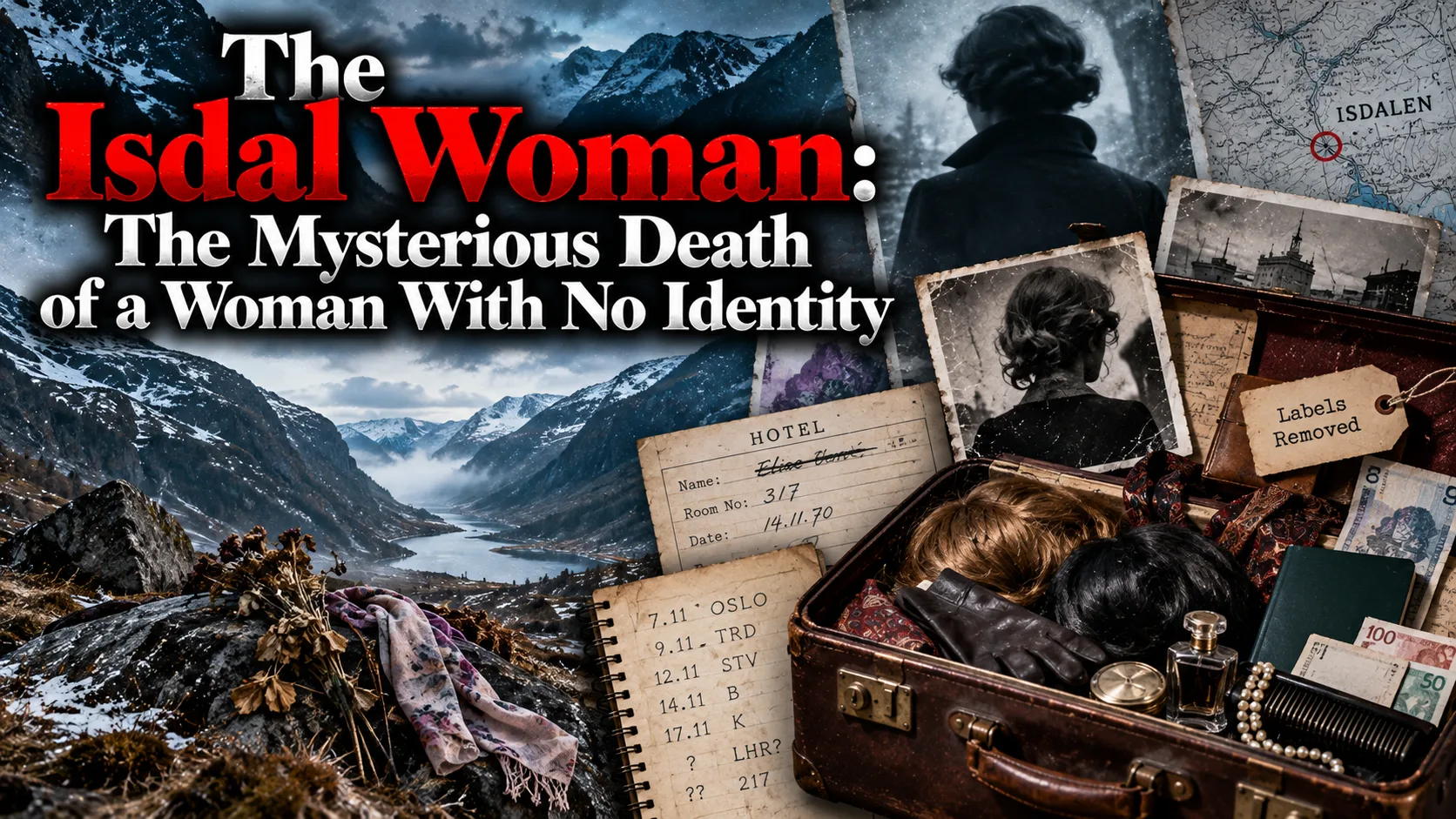
The Isdal Woman: The Mysterious Death of a Woman With No Identity
In 1970, a badly burned woman was found dead in Norway’s Isdalen Valley. The labels on her belongings had been removed, her luggage contained wigs and clues to extensive travel, and her notebook recorded movements under multiple aliases. Investigators reconstructed parts of her journey but never established her real identity. Decades later, forensic research offered new clues about her origins, yet her identity and the circumstances of her death remain unresolved.
The Isdal Woman: The Mysterious Death of a Woman With No Identity
On November 29, 1970, a woman was found dead among the rocks of a remote Norwegian valley. Her body had been badly burned. The labels on her clothing had been removed, her fingerprints offered little help, and two suitcases filled with disguises, foreign currency, and personal belongings would reveal a trail of travel under multiple names. Investigators could reconstruct parts of her life, but not the most basic fact about it. More than half a century later, the woman known as the Isdal Woman still has no publicly confirmed identity.
Introduction: A Woman Who Left Everything Except Her Name
Most people leave traces of themselves everywhere.
A name written inside a jacket. A receipt tucked into a wallet. A photograph in a drawer. A ticket showing where they travelled. A family member who remembers an argument, a birthday, or the last time they spoke.
These small details are unremarkable while a person is alive. After a death, they can become the difference between an identified individual and a stranger who disappears into the records.
The woman found in Norway's Isdalen Valley in 1970 seemed to have left behind an unusually complicated trail.
She had travelled through several Norwegian cities and stayed in hotels using different names. Her belongings contained foreign currency, cosmetics, wigs, and clothing. Labels that might have revealed where her possessions had been purchased had been removed. Her movements could be reconstructed from hotel records, yet the identities she had supplied could not be reliably connected to a real person.
Then came the circumstances of her death.
On November 29, a man and his two young daughters were hiking in Isdalen, a valley near Bergen in western Norway. They discovered a badly burned female body among the rocks.
The scene was disturbing. Personal objects lay nearby, and there was no straightforward explanation for why the woman had been there. Investigators found evidence of barbiturates and carbon monoxide, while the fire had destroyed much of the physical evidence that might otherwise have helped establish what happened.
The woman had no identification documents that could establish her real name.
Police eventually reconstructed parts of her travel history. Witnesses described a woman who had stayed at hotels under several aliases. Two suitcases found at Bergen railway station contained belongings connected to her, including wigs and other items that suggested she had taken care to control her appearance and conceal her identity.
A notebook recorded journeys through combinations of letters and numbers. At first glance, it seemed to contain a secret code. Closer examination suggested that much of it was a travel record.
Every discovery seemed to answer one question while producing another.
Who was she? Why had she used so many names? Why had identifying labels been removed? Was she involved in espionage? Had she deliberately concealed her identity for personal reasons? And did the strange circumstances of her death indicate suicide, murder, or something investigators could no longer reconstruct?
The case became known as the Isdal Woman mystery, named after the valley where her body was discovered.
The Cold War atmosphere of the period made espionage an attractive explanation. The aliases, international travel, and apparent attention to concealment seemed to fit the image of a secret agent.
But a compelling story is not necessarily an accurate one.
The evidence supports the conclusion that the woman concealed her identity. It does not establish that she was a spy. Her death was officially treated as a probable suicide, but the surviving evidence has continued to attract debate.
Modern forensic work has narrowed the possibilities surrounding her geographical origins, yet it has not produced a publicly confirmed name.
This is the unsettling heart of the case: investigators know considerably more about her movements than about the person who made them.
To understand how that happened, we must return to the valley where the mystery began.
1. November 29, 1970: The Discovery in Isdalen
Isdalen lies near Bergen, a coastal city surrounded by mountains and waterways on Norway's western coast.
The valley has a steep, rocky landscape. Although it is close to the city, parts of it feel isolated, particularly away from the main paths and developed areas.
The name Isdalen is often translated as “Ice Valley.” The area has also been associated with the darker nickname “Death Valley,” reflecting the local reputation and the unsettling circumstances of the woman's discovery.
On Sunday, November 29, 1970, a man hiking with his two daughters came across a badly burned body among the rocks.
The discovery was sufficiently disturbing that the family contacted the authorities.
Police arrived and began examining the immediate area. The woman had suffered severe burns, and the condition of her body made ordinary identification difficult.
Several objects were found nearby, including remnants of clothing and personal belongings. Investigators also documented bottles and other items that might help explain the circumstances of her death.
There was no passport or identity card that could provide her name.
At first, investigators faced a familiar problem: they had a dead person and a scene to examine, but no reliable way to connect the body to a known individual.
The severity of the burns made the task harder. Physical characteristics that might ordinarily help witnesses recognise a person had been damaged.
Yet the absence of identification was not the only unusual feature.
The circumstances suggested that the woman had travelled extensively, and her belongings appeared to have been stripped of identifying details. Her fingerprints were also of limited use because they had been damaged.
The scene raised the possibility that her identity had been deliberately concealed.
But the investigators could not immediately determine whether this concealment was connected to the death, had begun long before it, or had been carried out by someone else.
That distinction would become crucial.
If the woman had intentionally hidden her identity during her travels, the explanation might lie in her personal circumstances, employment, relationships, or activities.
If another person had concealed her identity after her death, the same evidence could point toward a different sequence of events.
The scene alone could not settle the question.
What the investigators found
The initial investigation documented the burned body, objects near the discovery site, and evidence relevant to the medical examination.
The woman had apparently been exposed to barbiturates and carbon monoxide. The fire had played a central role in the scene, but its precise relationship to the death was one of the questions investigators needed to assess.
There was no immediately identifiable weapon or obvious sign that conclusively established a homicide.
Nor did the scene independently prove suicide.
The absence of an obvious struggle does not establish that no other person was involved. Equally, a remote location and a burned body do not automatically indicate murder.
The investigators needed to establish the woman's identity, reconstruct her movements, and determine what the medical evidence could support.
The first two tasks would produce a remarkable amount of information.
The third would remain more uncertain.
🟢 Established Evidence: The woman's body was discovered in Isdalen on November 29, 1970. She had suffered extensive burns, and the investigation uncovered evidence of barbiturates and carbon monoxide.
🟡 Active Debate / Hypothesis: The scene has been interpreted in different ways, but its unusual appearance does not independently establish whether the death was suicide or homicide.
2. The Problem of a Woman With No Name
When police began searching for the woman's identity, they encountered a problem that became more puzzling with every new discovery.
There was no reliable name to follow.
Her clothing offered few useful identifying marks. The labels had been removed, making it harder to trace the garments through manufacturers or retailers. Her fingerprints were damaged, limiting the value of one of the most useful identification methods available to investigators.
No immediate family member came forward to identify her.
No missing-person report produced a conclusive match.
The investigators therefore had to work backwards from the surviving physical evidence.
They examined her appearance, estimated her age, studied her dental characteristics, and looked for information about people who might have been travelling through Norway at the time.
They also began examining hotel records.
This turned out to be one of the most productive parts of the investigation.
The woman had not simply appeared in Isdalen without a history. She had spent time in different places, interacted with hotel staff, and provided names when registering.
Those records survived even though the names she used did not lead to a confirmed identity.
Why the labels mattered
Clothing labels are mundane things. They rarely attract attention unless someone wants to know where a garment was manufactured or purchased.
In an unidentified-person investigation, however, labels can help investigators establish a geographical trail.
A particular brand may be sold mainly in one country. A manufacturer may have records that help narrow down when an item was produced. A shop label or tailor's mark might connect clothing to a specific place.
Removing those labels makes the trail harder to follow.
In the Isdal Woman case, the removal of labels from clothing and other belongings became one of the most widely discussed features.
It is reasonable to infer that someone wanted to make identification more difficult. The pattern was too significant to ignore.
But the evidence does not establish precisely who removed each label or why.
The woman might have done it herself. Another person might have removed them. Some labels might have been taken out at different times for different reasons.
The repeated removal of identifying marks makes deliberate concealment a strong interpretation, but it does not tell us what was being concealed.
A hidden identity could relate to intelligence work, criminal activity, a private relationship, fear of being found, or personal circumstances that were never recorded.
The evidence establishes the behaviour more securely than the motive.
That is the pattern that runs through the entire mystery.
We can observe what was missing. We cannot automatically know why it was missing.
3. The Suitcases at Bergen Railway Station
A few days after the body was discovered, investigators located two suitcases at Bergen railway station that were connected to the woman.
The luggage was important because it contained a much broader collection of personal belongings than the objects found near the body.
Inside were clothing, cosmetics, personal items, foreign currency, and wigs. Investigators also found objects that could help reconstruct her movements and possible appearance.
The contents suggested that the woman had travelled internationally and had taken care to manage how she presented herself.
The wigs attracted particular attention.
Changing one's hairstyle can make a person look different, especially when combined with different clothing, makeup, and accessories. In a period when identity checks relied more heavily on documents, witnesses, and physical descriptions than on modern electronic systems, altering one's appearance could make recognition more difficult.
But wigs are not proof of espionage.
They can be used for ordinary reasons, including fashion, hair loss, disguise, or personal preference. Their significance depends on how they fit into the wider evidence.
In this case, the wigs were found alongside multiple aliases, foreign currency, and clothing with identifying labels removed.
Taken together, those details suggested that the woman's travel arrangements were not entirely ordinary.
They did not establish her profession.
What the luggage told investigators
The suitcases helped investigators connect the dead woman with hotel records and travel movements.
They also provided evidence that the woman had possessed belongings beyond the items found at the scene.
The presence of foreign currency indicated that she had access to money from different countries. It was compatible with international travel, although it could not establish exactly where she had been or how she had obtained the currency.
The cosmetics and wigs suggested that she could alter her appearance.
The clothing labels reinforced the impression that identifying information had been removed.
The combined evidence made it increasingly difficult to treat the woman's anonymity as a simple accident.
However, it remained possible that the reasons for her secrecy were private rather than political.
A person living under an assumed identity might be escaping an abusive relationship, concealing an affair, evading legal consequences, participating in illegal trade, or engaging in intelligence work. The same outward behaviour can arise from very different circumstances.
The investigators had evidence of concealment, but not yet a reliable explanation for it.
The suitcases transformed the case from an unidentified death into a reconstruction of a life deliberately obscured.
4. The Woman Who Travelled Under Multiple Names
Hotel records revealed that the woman had stayed at several establishments in Norway using different names.
Investigators found at least eight recorded aliases associated with her travels. Some accounts of the case refer to nine names, depending on how the records and variations are counted.
The identities included different names, dates of birth, and other details that could not be verified as belonging to a real person.
The names were not enough to establish who she was.
Instead, they created the impression of a person moving through the country while avoiding a stable, traceable identity.
The woman had travelled through Norwegian cities including Bergen, Oslo, Stavanger, and Trondheim. Her movements could be partly reconstructed by comparing hotel registrations, dates, and other records.
The aliases allowed investigators to establish that several hotel stays likely involved the same woman, even though she had registered under different names.
This was a significant achievement.
The records did not tell investigators her true identity, but they showed that the mystery had a history extending beyond the valley.
Why use so many names?
There are several possible explanations.
One is espionage. An intelligence operative might use false identities to reduce the risk of being traced, protect contacts, or travel without revealing their real name.
Another possibility is criminal activity. Someone involved in illegal trade or fraud might use aliases to make it harder for authorities to connect transactions and movements.
A third possibility is a personal crisis. A person might conceal their identity because they were escaping a relationship, avoiding a dangerous acquaintance, or trying to separate different parts of their life.
It is also possible that the woman had a reason for secrecy that no longer fits neatly into any known category.
The difficulty is that an alias does not identify its purpose.
Investigators cannot infer a person's occupation from the mere fact that they used false names. The same method can serve many objectives.
What made the Isdal Woman unusual was not simply that she used an alias once. It was the pattern of multiple names, international travel, removed labels, and the absence of a confirmed personal identity.
That pattern suggests deliberate concealment.
It does not tell us whether she was a professional agent, a private individual in difficult circumstances, or someone involved in an activity that has left no surviving record.
How did investigators connect the aliases?
The hotel records provided dates, locations, descriptions, and other details that could be compared.
When the same woman appeared in different places under different names, investigators could look for consistencies in her appearance, travel timing, and behaviour.
The records also helped establish a chronology.
Rather than relying entirely on memory, police could compare documentary evidence from multiple locations.
But a chronology is not the same as a biography.
The investigators could reconstruct where the woman had stayed, yet they could not connect those stays to a verified birth record, family, or permanent residence.
She had left a trail of movement without leaving a reliable trail of identity.
🟢 Established Evidence: Hotel records linked the woman to multiple stays under different names, allowing investigators to reconstruct parts of her travels.
🟡 Active Debate / Hypothesis: The use of aliases suggests deliberate concealment, but the surviving evidence does not establish whether the motive was espionage, criminal activity, or a private matter.
5. The Notebook That Looked Like a Secret Code
Among the evidence associated with the woman was a notebook containing unusual combinations of letters and numbers.
The entries initially appeared cryptic.
Some sequences could be read as abbreviations, while others seemed to combine dates, places, or travel information. The writing did not resemble an ordinary diary written in complete sentences.
This created an obvious possibility: perhaps the notebook contained a secret code.
The idea was especially attractive in the context of the Cold War, when intelligence agencies relied on covert communications and false identities.
A woman travelling under multiple names, carrying wigs, and moving between countries seemed like a plausible candidate for a secret agent. A coded notebook appeared to reinforce the theory.
But closer examination suggested a more ordinary explanation for much of the writing.
The entries were interpreted largely as a record of travel, using abbreviated references to dates and destinations.
That interpretation matters because it changes the role of the notebook.
Instead of being proof of a secret intelligence operation, the notebook becomes a tool for reconstructing the woman's movements.
It can help establish where she went and when, even if it cannot tell us why she travelled.
What makes a code a code?
A genuine cipher uses a system to transform information into a form that is not immediately readable.
The system might replace letters with other letters, numbers, or symbols. It might rearrange the order of the message. It might use a key that determines how the information can be recovered.
A shorthand travel record can look cryptic without being a cipher.
People routinely abbreviate destinations, dates, names, and activities. A private notebook may use a mixture of letters and numbers that makes perfect sense to its owner but appears mysterious to anyone else.
The distinction is important.
If investigators can interpret entries as dates and destinations that match independently documented travel, the notebook may function as a travel log rather than an encrypted message.
That does not mean every entry has been conclusively explained. It means that the presence of unusual writing should not automatically be treated as evidence of espionage.
Why the spy interpretation persisted
The Cold War supplied a ready-made narrative.
The woman had false identities. She had travelled internationally. Her luggage contained disguises. She had no confirmed name. The notebook appeared coded.
Each detail could be fitted into a story about a covert operative.
But the theory depended on an additional assumption: that the details were all connected to intelligence work.
The same evidence could also be consistent with someone trying to avoid recognition for personal reasons.
A theory becomes stronger when it produces independently verifiable predictions, not merely when it can explain existing clues after the fact.
The notebook has helped researchers reconstruct the woman's travels. It has not provided a publicly established intelligence message that proves she was a spy.
🟢 Established Evidence: The notebook contained unusual letter-and-number entries that helped investigators examine the woman's travel history.
🟡 Active Debate / Hypothesis: Much of the writing has been interpreted as travel-related shorthand. The notebook has not been established as proof of an espionage operation.
6. A Trail Across Norway and Europe
Once investigators began comparing the hotel records, the woman's movements became easier to follow.
She had stayed in several Norwegian cities and appeared to have travelled beyond Norway as well.
The different names made the investigation complicated, but they also created a documentary trail.
Each hotel registration represented a moment when the woman had interacted with the ordinary world: she had checked in, supplied information, occupied a room, and eventually left.
Those interactions produced records that survived her death.
Investigators could compare the dates on the hotel cards with the notebook and other travel-related details.
They could also question staff members who remembered her.
Some witnesses described a woman who was reserved and cautious. Accounts of her language abilities suggested that she spoke German and French, while her English was less fluent.
Witness recollections were useful, but they had limitations.
A hotel employee might remember a guest's accent or behaviour without remembering every detail accurately. Descriptions made after a death can also be influenced by the knowledge that the person later became the subject of a mystery.
For this reason, witness accounts needed to be compared with documentary evidence rather than treated as definitive on their own.
Why the travel history matters
The travel records show that the woman had a life before the discovery in Isdalen.
She was not simply an unknown person who appeared in a valley one day. She had been moving between places, interacting with other people, and using names that could not be verified.
This information narrows the possibilities surrounding her identity.
A person who travelled through several countries may have left traces in immigration records, railway records, hotel registers, employment records, or personal correspondence.
However, those traces may be incomplete or recorded under false names.
In 1970, many everyday systems were still paper-based. Records were held by individual businesses and institutions rather than being instantly searchable through a connected digital system.
A name supplied at one hotel might never be compared with a name used at another. A record could be lost, misfiled, or destroyed. International information-sharing was far more limited than it is today.
The woman exploited, intentionally or otherwise, the gaps between those records.
Even when investigators found evidence of her travels, the names did not lead them to a confirmed identity.
The records showed where she had been, but not who she was.
7. Was She a Spy?
The espionage theory remains one of the most famous interpretations of the Isdal Woman case.
It is easy to understand why.
The woman travelled under multiple aliases. She appeared to take care with her appearance and identifying details. She had international connections, foreign currency, and a notebook that initially looked coded.
The death occurred during the Cold War, when Norway's geographical position made intelligence and military activity important to national security.
Norway shares a border with Russia and was a member of the Western military alliance. The wider region was strategically significant, and intelligence services were active across Europe.
The historical setting makes espionage a possibility worth considering.
It does not make it a proven explanation.
The argument for espionage
Supporters of the spy theory point to the combination of false identities, international travel, disguises, and concealed personal information.
They argue that these behaviours resemble methods used by intelligence operatives to protect their identities and movements.
The woman's apparent ability to move between countries while maintaining different names also seems compatible with a person accustomed to secrecy.
But compatibility is not confirmation.
Someone involved in intelligence work might use aliases and disguises. So might someone involved in other activities. The behaviours are not exclusive to espionage.
To establish the spy theory, researchers would need evidence connecting the woman to a particular intelligence organisation, operation, handler, or network.
No publicly confirmed evidence has conclusively established such a connection.
The problem with the theory
The spy hypothesis can become difficult to challenge if every missing record is treated as proof that the woman was a highly effective agent.
If no employer can be found, the theory suggests that the organisation concealed its records.
If no intelligence file identifies her, the theory suggests that the file remains classified or was destroyed.
If the notebook cannot be decoded as an operational message, the theory suggests that its code was exceptionally sophisticated.
These explanations are possible in the abstract, but they do not provide positive evidence.
A theory should not receive stronger support merely because the information needed to test it is missing.
The same caution applies to claims that the woman was involved in a particular military operation or intelligence mission. A geographical or chronological overlap is not enough to establish participation.
Could she have been connected to military activity?
The region around Bergen had military significance, and investigators and later researchers have examined whether the woman's movements might have intersected with sensitive sites or activities.
Such possibilities have contributed to speculation about intelligence work.
But proximity is not proof.
A person may travel through an area without being involved in whatever activities take place there. To establish a connection, researchers need evidence of contact, access, communications, or another reliable link.
The public evidence does not establish that the woman was travelling on behalf of a particular government or intelligence service.
The most defensible conclusion is that espionage remains a theory, not a confirmed fact.
🟢 Established Evidence: The woman used multiple aliases, travelled extensively, and took steps that made her identity difficult to trace.
🔴 Popular Myth / Unsupported Claim: The claim that she was definitely a spy, or that a specific intelligence agency arranged her death, has not been conclusively established.
8. The Medical Evidence: What Caused Her Death?
The condition of the woman's body made the medical investigation especially difficult.
The fire had severely damaged her remains, and the scene contained evidence of substances associated with burning.
The medical examination also identified barbiturates and carbon monoxide.
Barbiturates are a class of drugs that depress the central nervous system. Depending on the substance and dose, they can cause sedation, unconsciousness, respiratory depression, and death.
Carbon monoxide is a poisonous gas produced by incomplete combustion. It interferes with the blood's ability to carry oxygen effectively.
Both findings were important to the investigation.
However, detecting a substance is not always enough to reconstruct precisely how it entered the body, when it was taken or inhaled, or what sequence of events followed.
The investigators needed to determine whether the woman had taken the drugs before the fire, whether the carbon monoxide exposure contributed to her death, and whether the fire was deliberately set as part of a suicide or had another explanation.
The surviving evidence did not answer every question.
Did the fire kill her?
The body was badly burned, but the severity of the burns does not by itself establish whether she was alive when the fire began.
The medical evidence concerning carbon monoxide and the circumstances of the body helped investigators evaluate that question.
The fire may have contributed to her death, but reconstructing the exact sequence of events is difficult when the remains have suffered extensive damage.
The presence of carbon monoxide can indicate exposure to combustion gases. It does not, by itself, identify who started a fire or establish the circumstances in which the gas was inhaled.
Likewise, the presence of barbiturates does not automatically establish whether the drugs were taken voluntarily, administered by another person, or obtained through some other sequence of events.
The interpretation depends on the broader medical and circumstantial evidence.
Why poisoning does not automatically mean murder
The word poisoning often suggests that someone deliberately harmed another person.
Medically, however, poisoning can occur through accidental exposure, intentional self-administration, or administration by another person.
The finding of a toxic substance must therefore be separated from the question of intent.
In the Isdal Woman case, the medical evidence contributed to the conclusion that the woman had died in circumstances consistent with barbiturate and carbon-monoxide poisoning.
It did not independently identify a perpetrator.
Nor did it establish that an intelligence service or another organisation had been involved.
The limits of a decades-old investigation
Modern forensic science can sometimes extract information from evidence that earlier investigators could not analyse effectively.
But it cannot always recreate a complete event from old remains.
Biological material can deteriorate. Some tests were never performed at the time. Records may not preserve every measurement or observation. Investigators may have lacked the technology needed to answer questions that seem straightforward today.
The passage of time also creates practical problems.
Potential witnesses may have died. Memories fade. Documents disappear. A location can change over decades.
The Isdal Woman investigation has benefited from renewed forensic work, but the cause and circumstances of her death remain subjects of uncertainty.
🟢 Established Evidence: Medical findings included barbiturates and carbon monoxide, and the body had suffered severe burning.
🟡 Active Debate / Hypothesis: The exact sequence of drug exposure, carbon-monoxide exposure, fire, and death remains difficult to reconstruct conclusively from the surviving evidence.
9. Was Her Death a Suicide?
Police treated suicide as the principal explanation for the woman's death.
The medical findings and the circumstances of the scene were considered consistent with that interpretation.
However, the case has continued to attract questions about whether the evidence was sufficient to exclude other possibilities.
The distinction is important: a historical police conclusion is evidence of how investigators interpreted the case, but it is not the same as a modern, independently verified reconstruction of every event.
The official interpretation should not be ignored simply because alternative theories are more dramatic.
Nor should it be treated as beyond examination merely because it was the conclusion reached at the time.
Why investigators considered suicide
The presence of barbiturates and carbon monoxide, combined with the circumstances of the body and the absence of conclusively established evidence of an attacker, supported the possibility that the woman had died by suicide.
The scene appeared to involve fire, and the medical findings were compatible with a death involving toxic substances.
But the scene did not provide a complete account of her intentions or the events leading to her death.
No note explaining her motives supplied a definitive answer. Her identity remained unknown, leaving investigators without family members or close acquaintances who might have described her state of mind.
This was a major limitation.
When a person is identified, investigators may be able to examine their recent relationships, financial circumstances, health, communications, and behaviour. Those details can help establish context, although they still do not independently prove intent.
The Isdal Woman had no confirmed identity and no known personal history that could be reliably connected to her.
The investigators could examine her movements and possessions, but they could not fully reconstruct her private life.
Could another person have been involved?
Yes, it is possible in principle.
The secluded location and the unusual circumstances of the death have led some researchers to consider homicide.
But the possibility of homicide must be distinguished from evidence that homicide occurred.
To establish that another person caused the death, investigators would need reliable evidence of their involvement, such as forensic traces, credible witness testimony, a demonstrated motive supported by other facts, or a reconstruction showing that the death could not reasonably have occurred as officially interpreted.
The publicly known evidence does not establish a specific perpetrator or conclusively prove that another person killed her.
The fact that the woman had concealed her identity also does not establish that she was murdered.
People can conceal their identities for many reasons, and the reasons for that behaviour may have been unrelated to the circumstances of their death.
What about the missing identity?
Some theories argue that the woman's identity was deliberately erased by someone who wanted to prevent investigators from discovering her background.
That is possible, but the timing matters.
If the woman had been travelling under aliases and removing labels before her death, then the concealment may have been part of her own life.
If someone else removed or destroyed identifying information after her death, that would imply a different sequence.
The available evidence does not establish a complete timeline for every act of concealment.
Without that timeline, it is difficult to use the missing identity as proof of murder.
The responsible conclusion is that suicide was the principal historical police explanation, while the precise circumstances of the death remain unresolved.
🟢 Established Evidence: Police treated suicide as the principal explanation for the death.
🟡 Active Debate / Hypothesis: Questions remain about the exact sequence of events, but the publicly known evidence does not conclusively establish homicide.
10. The Clues in Her Teeth
The woman's teeth became important because they preserved information that could not be obtained from her clothing, travel documents, or hotel records.
Dental evidence can help identify a person through previous treatment, distinctive dental patterns, and comparison with known records.
In some circumstances, teeth can also preserve chemical information about a person's life.
The composition of dental enamel reflects aspects of the environment in which it formed. Elements and isotopes incorporated during childhood can provide clues about the geographical region where a person grew up.
This does not work like a GPS device.
It cannot usually identify a specific town or street. Instead, it can help researchers compare the remains with broad geographical patterns.
The Isdal Woman's teeth were examined using modern forensic methods, including isotope analysis.
The results pointed toward a childhood in a region of Europe that includes parts of what is now Germany, with findings suggesting a possible connection to the German-French border area.
This was an important development because it narrowed the range of possible origins.
But it did not provide a name.
How isotopes preserve geographical clues
Different environments have different chemical signatures.
Water, food, soil, and local geology can influence the isotopic composition of materials incorporated into the human body.
Dental enamel forms during childhood and does not remodel in the same way as many other tissues. As a result, it can preserve information about the environment in which a person lived while the teeth were developing.
Researchers can compare these chemical patterns with reference data from different regions.
If the results are more compatible with one geographical area than another, they can narrow the range of plausible origins.
But many regions share overlapping signatures.
A person may also have moved during childhood, and different teeth form at different stages of development. This means that interpretation requires care.
The analysis can suggest a geographical history without establishing the exact place where a person was born.
What the results do not prove
The isotope findings do not establish that the woman was a German citizen.
They do not prove that she was born in a particular town, worked for a particular government, or belonged to an intelligence service.
A geographical origin is not an occupation.
The findings provide a useful constraint on the investigation. Researchers can compare the likely region with historical missing-person records, language information, and other evidence.
But the result remains one piece of a larger puzzle.
The woman could have moved several times before reaching Norway. She could have held citizenship in a different country from the place where she grew up. Her aliases could have obscured her nationality as well as her name.
The dental evidence narrowed the search.
It did not finish it.
🟢 Established Evidence: Modern analysis of the woman's teeth provided information consistent with a childhood in continental Europe, with research pointing toward parts of Germany and the Franco-German border region.
🟡 Active Debate / Hypothesis: The results narrow her possible geographical background but cannot, by themselves, establish her exact birthplace, nationality, or identity.
11. DNA: A Powerful Tool That Has Not Yet Given Her a Name
DNA analysis has transformed the investigation of unidentified people.
A biological sample may contain genetic information that can be compared with relatives, missing-person records, or databases containing profiles from people who have consented to participate in relevant systems.
Even when a person's own DNA profile is not already recorded, genetic genealogy can sometimes identify distant relatives and help reconstruct a family tree.
The method has helped identify people who remained unknown for decades.
It is therefore understandable that researchers and the public have hoped DNA would finally solve the Isdal Woman case.
Modern forensic work has advanced the investigation, and a DNA profile has been developed from preserved material. However, no publicly confirmed identity has resulted from those efforts.
This is a reminder that obtaining DNA and identifying a person are two different achievements.
What happens after DNA is recovered?
The first challenge is producing a reliable profile from the available biological material.
Historical remains may be damaged by heat, moisture, environmental exposure, or the passage of time. Researchers must distinguish the person's DNA from contamination introduced during recovery or later handling.
Once a usable profile is obtained, investigators need something meaningful to compare it with.
A direct match to a close relative can provide powerful evidence. A match to a distant relative may require substantial genealogical research before it becomes useful.
Researchers must identify possible family branches, evaluate the degree of relatedness, and compare the resulting family tree with the historical evidence.
If no suitable relatives have provided comparable DNA, or if the relevant family records are incomplete, the process can stall.
The DNA may establish ancestry without establishing identity.
Why the Isdal Woman remains unidentified
The woman's aliases make the search more complicated because her recorded names cannot reliably connect her to a family.
The geographical evidence points toward a broad region rather than a single location. The available historical records may be incomplete, and potential relatives may not know that they are connected to the case.
A genetic profile is not automatically matched against every person's DNA on Earth.
The process depends on available comparison material, legal and ethical restrictions, the quality of the profile, and the presence of informative relatives or records.
Even a full DNA profile may not produce a name if no useful match is available.
Could DNA eventually solve the mystery?
It could.
A new family match, an independently verified missing-person report, or a newly discovered record might create the connection investigators have lacked.
A relative might recognise a historical photograph. A family could discover that a woman disappeared under circumstances that fit the case. A genealogical match could identify a branch that researchers had not previously considered.
The important point is that DNA offers a path toward identification, not a guarantee of it.
As of October 2026, the Isdal Woman remains publicly unidentified despite decades of investigation and modern forensic work.
Her DNA may help answer the question one day.
For now, it has not supplied the final link.
12. Could She Have Been Involved in Smuggling or Other Illegal Activity?
Espionage is not the only explanation for a person travelling under multiple names.
The same behaviour could be associated with smuggling, fraud, the movement of restricted goods, or other illegal activity.
Foreign currency, travel across national borders, and aliases might fit such a scenario.
However, the evidence does not establish that the woman was involved in any particular crime.
This possibility is useful mainly because it reminds us that the spy theory is not the only explanation for the available clues.
A person who wants to avoid being traced might use false names for many reasons. Some could be criminal. Others could be personal or protective.
Why this theory is difficult to test
A theory about smuggling would need evidence of transactions, contacts, goods, or routes connected to a specific illegal activity.
The presence of foreign currency does not establish smuggling. Travellers routinely carry money from different countries, especially when moving between them.
Similarly, the use of aliases does not prove fraud. An alias can be used to conceal almost any kind of activity, lawful or unlawful.
The woman’s belongings show that she had travelled and taken steps to obscure her identity.
They do not establish what she was doing during those travels.
Without a confirmed identity, investigators also lack an obvious starting point for examining employment records, financial history, known associates, or criminal investigations that might have involved her.
The theory remains possible in the broad sense that it cannot be excluded, but it is not supported by a demonstrated chain of evidence.
The problem with unlimited possibilities
Once a case remains unresolved for decades, almost any imaginable explanation can be attached to it.
The woman could have been a spy, a smuggler, a fugitive, a private traveller, or someone escaping a dangerous relationship.
But a list of possibilities is not an investigation.
A useful theory must explain the evidence better than competing explanations and provide a way to test its claims.
Without that standard, the mystery becomes a collection of stories that cannot be distinguished from one another.
The Isdal Woman's case deserves better than an endless parade of dramatic guesses.
13. What Her Language and Appearance Can Tell Us
Witnesses described the woman as speaking German and French, with less fluent English.
Such observations can be useful in an unidentified-person investigation because language proficiency may help narrow down a person's background.
However, language does not establish nationality.
A person can learn languages through education, work, family, travel, or long-term residence abroad. Someone born in one country may grow up in another and later use several languages professionally.
The woman's apparent language abilities were compatible with the possibility that she had spent time in continental Europe.
They were also compatible with her extensive travel history.
But they could not identify a particular person.
Witness descriptions of her appearance were similarly useful but limited.
People who encountered her in hotels could describe her general features, clothing, manner, and behaviour. Those descriptions could be compared with photographs and other records.
Yet memories are imperfect.
A witness may remember a striking detail but forget a face. A person may appear different under different lighting or after changing their hairstyle. If the woman used wigs or altered her appearance, descriptions could vary even when witnesses had encountered the same individual.
The danger of building a biography from fragments
Researchers can combine language, appearance, dental evidence, travel records, and clothing to construct a profile of the unknown woman.
The profile may become increasingly detailed.
She may have spoken certain languages, grown up in a particular region, travelled through specific cities, and used a recurring pattern of false names.
But a profile is not the same as a confirmed identity.
Several people may fit the same broad description. Historical records may contain gaps. The woman's aliases may be deliberately misleading.
The evidence can narrow the field without identifying the individual.
That is why the case has remained unresolved despite the unusual quantity of surviving clues.
The problem is not that the woman left no evidence.
It is that the evidence has not yet been connected to a verified personal identity.
14. The Cold War Context: Why Every Clue Looked Suspicious
The Isdal Woman was found during a period when international security concerns shaped public understanding of mysterious events.
The Cold War involved political rivalry, military planning, intelligence operations, and the possibility of covert activity across national borders.
Norway's strategic location made security concerns especially relevant.
When an unidentified woman appeared to be travelling under multiple names, carrying wigs, and removing labels from her possessions, it was natural for investigators and later observers to consider espionage.
The notebook appeared to strengthen that possibility.
But the historical setting can influence interpretation as well as provide context.
When people know that intelligence operations were taking place, they may interpret ordinary secrecy as evidence of spying.
A person with false documents may appear to be an agent. A cryptic note may appear to be an encrypted message. A journey through a strategically important region may appear to be an operational mission.
Each interpretation can seem plausible in isolation.
The challenge is to establish whether the details are actually connected.
How historical context can mislead
Imagine finding a person who used several names during the 1970s.
If the person lived in an era associated with espionage, researchers might assume that the aliases were operational.
If the same person lived during a period of political upheaval, researchers might interpret them as evidence of political persecution.
If the person travelled during a time of widespread migration, the same behaviour might be understood as an attempt to cross borders or escape personal danger.
The historical context changes which explanations appear plausible, but it does not independently establish which one is true.
In the Isdal Woman case, the Cold War makes espionage worth considering.
It does not transform the spy theory into a fact.
The woman may have been involved in intelligence work. She may also have been concealing a private life that had nothing to do with governments.
Until reliable evidence establishes the connection, the distinction must remain.
15. Could She Have Been Escaping Someone?
A less dramatic possibility is that the woman was attempting to escape a person, a relationship, or a situation she believed to be dangerous.
People sometimes change their names or move between places because they fear being found.
They may remove labels from belongings, avoid using consistent personal information, and limit the records that connect them to a previous life.
This behaviour can resemble the secrecy associated with espionage, even when the motive is personal safety.
The Isdal Woman's case does not establish that she was fleeing abuse or a dangerous relationship. There is no confirmed personal history that allows that conclusion.
But the possibility is worth acknowledging because it illustrates how easily secrecy can be misinterpreted.
Concealment does not tell us whether someone was a threat or was threatened
When investigators encounter a person who has deliberately hidden their identity, they may naturally ask what that person was trying to conceal.
But there is another question: from whom were they trying to conceal it?
A false identity can be used to avoid accountability. It can also be used to avoid an individual who poses a threat.
The same outward behaviour can reflect very different circumstances.
Without a verified identity or a reliable account of the woman's relationships, investigators cannot determine which interpretation fits her life.
This is one reason to avoid assuming that a person who uses aliases must have been involved in criminal or intelligence activity.
The behaviour is evidence of concealment.
The motive remains unknown.
16. Why the Investigation Has Lasted for More Than Half a Century
The Isdal Woman case has persisted because several independent obstacles have reinforced one another.
First, the woman was not identified at the scene.
Second, the condition of her body made ordinary recognition difficult.
Third, her fingerprints were damaged, reducing the usefulness of a major identification method.
Fourth, her belongings had been stripped of identifying details.
Fifth, she had used multiple names that could not be connected to a confirmed personal identity.
Finally, the circumstances of her death were difficult to reconstruct conclusively.
Each problem made the others harder to solve.
If investigators had known her name, they might have located relatives, employment records, photographs, or medical history.
If they had known her family, they might have obtained DNA comparisons or dental records.
If they had known her occupation, they might have identified the reason for her travel.
If they had known her recent relationships, they might have reconstructed her final days.
But the lack of a name blocked many of those paths.
The limitations of the 1970 investigation
In 1970, investigators did not have the digital databases and genetic tools available today.
Hotel records were often paper-based. Information was scattered across businesses and institutions. International records were not instantly searchable, and cross-border investigations could be slow.
The woman appears to have moved through several places using names that did not correspond to a confirmed identity.
That made it difficult to connect one hotel stay with another or trace her movements through a single, consistent record.
The investigators still managed to reconstruct a substantial portion of her travel history.
That is an achievement in itself.
Yet reconstructing movements did not lead to a family or a birth record that conclusively established her identity.
The limitations of modern technology
Modern forensic science has improved the situation, but it cannot eliminate every obstacle.
DNA comparison depends on suitable reference material. Isotope analysis identifies patterns rather than exact addresses. Dental evidence is most useful when it can be compared with records. Historical documents may be incomplete or unavailable.
A forensic result can narrow a search to a region without identifying a specific individual.
A genetic profile can exist without matching a known relative.
A detailed travel chronology can reveal where someone went without explaining why.
The Isdal Woman case is not unresolved because modern science has done nothing.
It is unresolved because the available evidence has not yet produced the final link between the unknown woman and a verified identity.
17. What We Know, What We Suspect, and What Remains Unknown
The case becomes easier to understand when the evidence is separated into different levels of certainty.
🟢 Established Evidence
A badly burned woman was found in Isdalen near Bergen on November 29, 1970.
The woman's identity was not established by the initial investigation.
Investigators found two suitcases at Bergen railway station connected to her belongings.
The luggage contained personal items, including wigs, clothing, cosmetics, and foreign currency.
Hotel records linked the woman to multiple stays under different names.
Identifying labels had been removed from clothing and other belongings.
Her notebook contained unusual entries that helped researchers examine her movements.
Medical findings included barbiturates and carbon monoxide.
Modern forensic research has narrowed aspects of her likely geographical background.
No publicly confirmed identification had emerged by October 2026.
🟡 Active Debate / Hypothesis
She may have deliberately concealed her identity for personal, criminal, or professional reasons.
Her aliases and international travel may have been connected to espionage, but this has not been established.
The exact sequence of events leading to her death remains uncertain.
She may have died by suicide, consistent with the principal historical police interpretation, but questions about the circumstances have persisted.
The geographical findings may help narrow the search for her family, but they do not establish a precise birthplace or nationality.
🔴 Popular Myth / Unsupported Claim
The woman was definitely a spy.
A specific intelligence agency ordered her death.
The notebook has been conclusively decoded as an espionage message.
The removal of labels proves that someone murdered her.
The discovery of barbiturates proves that another person poisoned her.
Modern DNA analysis has already revealed her identity.
These claims go beyond what has been publicly established.
The case remains compelling precisely because the evidence is unusual. It does not need unsupported conclusions to be fascinating.
Myth vs Reality
Myth: The Isdal Woman was definitely a Cold War spy.
Reality: Her aliases, travel history, and concealed identity have encouraged espionage theories, but no conclusive public evidence establishes that she worked for an intelligence service.
Myth: Her notebook contained a secret spy code.
Reality: The entries initially looked cryptic, but much of the writing has been interpreted as travel-related shorthand. The notebook has not been established as proof of intelligence activity.
Myth: The missing clothing labels prove she was murdered.
Reality: The removed labels suggest deliberate concealment, but they do not establish who removed them, when they were removed, or whether another person caused her death.
Myth: Her DNA has solved the mystery.
Reality: Modern forensic work has advanced the investigation, but no publicly confirmed identity has resulted.
Myth: The woman had no traceable past.
Reality: Investigators recovered hotel records, travel clues, luggage, and other evidence. The difficulty was connecting those traces to a verified name.
Myth: Because police considered suicide, murder is impossible.
Reality: Suicide was the principal historical police explanation, but the exact circumstances have remained subjects of debate. At the same time, suspicion alone does not prove homicide.
Myth: The Isdal Woman's identity was deliberately erased by a government.
Reality: The evidence suggests that her identity was concealed, but it does not establish that a government or intelligence organisation was responsible.
Frequently Asked Questions
1. Who was the Isdal Woman?
She was an unidentified woman found dead in Isdalen near Bergen, Norway, on November 29, 1970. Investigators reconstructed parts of her travel history but never publicly established her real identity.
2. Why is she called the Isdal Woman?
The name comes from Isdalen, the valley where her body was discovered. Because her identity remained unknown, the location became the name used to refer to her.
3. How many false names did she use?
Investigators connected her to at least eight recorded aliases. Some accounts refer to nine, depending on how the names and records are counted. None has been conclusively established as her real name.
4. Was she a spy?
That remains an unproven theory. Her aliases, international travel, wigs, and concealed identity have fuelled speculation, but no conclusive public evidence establishes that she worked for an intelligence agency.
5. What was in the suitcases?
The two suitcases found at Bergen railway station contained clothing, wigs, cosmetics, foreign currency, and other personal belongings. Their contents helped investigators connect the woman to her travel history.
6. What did the coded notebook say?
The notebook contained combinations of letters and numbers. Much of the writing has been interpreted as travel-related shorthand, but it has not produced a widely accepted explanation of the woman's identity or motive.
7. How did she die?
The medical findings included barbiturates and carbon monoxide, and the body had suffered severe burns. Police treated suicide as the principal explanation, but the complete sequence of events has not been conclusively reconstructed.
8. Did DNA identify her?
No publicly confirmed identification had emerged by October 2026. Modern forensic research has provided additional information about her possible background, but a definitive name remains unavailable.
9. What did scientists learn from her teeth?
Dental and isotope analysis provided clues about her likely geographical origins. The findings point toward a childhood in continental Europe, with research suggesting a possible connection to parts of Germany and the Franco-German border region. They do not identify a precise birthplace.
10. Could she still be identified?
Yes. New DNA matches, genealogical research, historical records, or information from relatives could eventually establish her identity. However, the existence of modern forensic tools does not guarantee that a conclusive match will be found.
Final Thoughts: A Trail of Evidence Without a Person
The Isdal Woman left behind an extraordinary amount of evidence.
There were hotel registrations, aliases, suitcases, wigs, foreign currency, clothing, a notebook, dental remains, and a body found in a remote valley.
Each item offered investigators another opportunity to understand her life.
Yet the most important piece of information remained missing.
Her name.
The mystery is not simply that the woman died under unusual circumstances. It is that investigators could reconstruct so much of her movement without establishing who had made those journeys.
They could identify hotel stays but not a confirmed home. They could document the use of aliases but not determine the reason for them. They could examine the remains and recover clues about her geographical origins, yet they could not connect those clues to a verified family.
The result is a strange imbalance.
The woman is unusually well documented for someone whose identity remains unknown, but the records describe fragments of a life rather than the life itself.
That gap has encouraged the most dramatic theories.
The Cold War setting makes espionage an attractive explanation. The wigs and aliases seem to fit a spy story. The notebook looks mysterious. The removed labels suggest deliberate concealment. The death in a secluded valley appears to invite a darker interpretation.
But the evidence does not require a secret-agent narrative.
The woman may have been involved in intelligence work. She may have been concealing a private relationship, avoiding someone, or living under an assumed identity for reasons that had nothing to do with governments. Her death may have occurred as police concluded, or the surviving evidence may not preserve enough information to establish exactly what happened.
We cannot honestly choose among those possibilities simply because one makes a better story.
What we can say is that the woman appears to have taken steps to conceal her identity, that she travelled under several names, and that she died in circumstances that investigators could not fully explain.
Modern forensic research has narrowed the search for her origins, demonstrating that even a case more than half a century old can yield new information.
But a geographical clue is not a name. A DNA profile is not automatically a family. A travel record is not a biography.
The final step requires a connection between the evidence and a real person whose identity can be independently verified.
Perhaps that connection will emerge through a relative who recognises an old photograph, a genealogical match, or a record that has remained overlooked for decades.
Perhaps it will take another generation of researchers.
There is also the possibility that the evidence will never be enough. Historical records disappear, families lose connections, and witnesses die. Some mysteries survive not because the truth was impossibly complicated, but because the information needed to establish it no longer exists.
The Isdal Woman's story reminds us that concealment and identity are not the same question.
We have evidence that someone concealed her identity. We do not know why.
We have evidence of her travels. We do not know what she was doing.
We have a historical police explanation for her death. We do not possess a complete reconstruction of her final hours.
And we have modern forensic clues that point toward a possible geographical past, but not a confirmed name.
The Isdal Woman remains a person whose traces survived while her identity did not.
That is the real mystery. Not the certainty that she was a spy, not the assumption that she was murdered, and not the belief that every strange object must conceal a secret message.
It is the uncomfortable fact that a person can leave behind dozens of clues and still remain unknown.
More than fifty years after her death, investigators can follow her trail through hotels, luggage, and forensic evidence. They can narrow the possibilities and challenge old theories.
But until the evidence connects those fragments to a verified identity, the woman found in Isdalen remains without a publicly confirmed name.
The trail continues.
The person at its centre is still waiting to be identified.