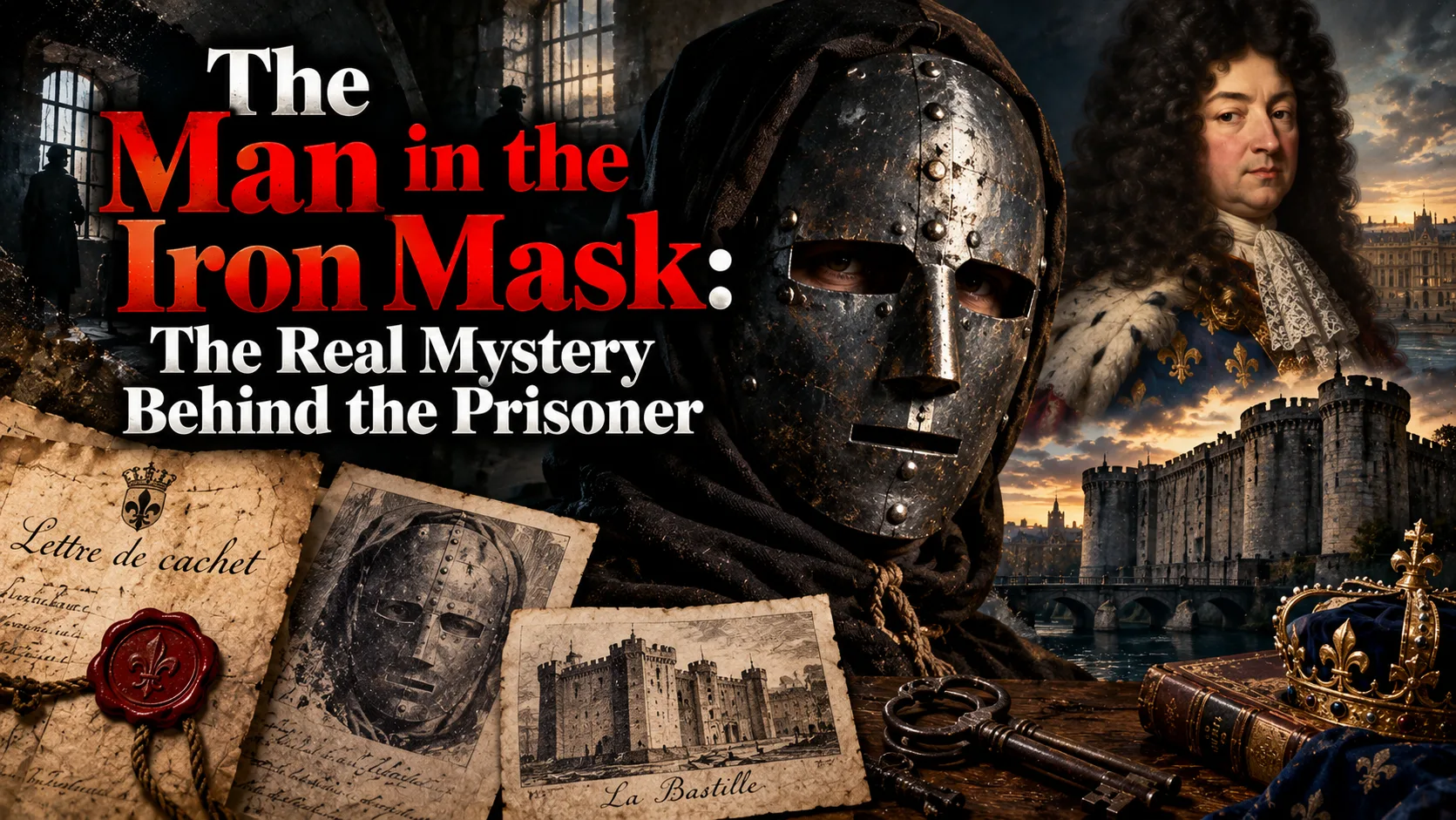
The Man in the Iron Mask: The Real Mystery Behind the Prisoner
For decades, a mysterious prisoner lived under strict secrecy during the reign of France’s King Louis XIV. His identity was concealed, his movements were controlled, and a legend grew around the mask he supposedly wore. Was he a forgotten political prisoner, a man who knew dangerous secrets, or a member of the royal family? Explore the historical records, competing identity theories, and the truth behind one of history’s most enduring mysteries.
The Man in the Iron Mask: The Real Mystery Behind the Prisoner
Imagine being locked away for decades, guarded by men who receive orders directly from the king. Your face becomes a secret. Your past is erased from public view. Nobody is allowed to reveal who you are, and even your name becomes a source of suspicion.
Then, one day, you die.
Your possessions are removed. Your cell is prepared for another prisoner. Your identity remains concealed, and the people responsible for guarding you take the secret to their graves.
Centuries later, the world is still arguing about who you were.
This is the story of the Man in the Iron Mask, one of the most enduring mysteries of European history.
During the reign of Louis XIV, France's famously powerful monarch, an unidentified prisoner was held in a succession of royal prisons under extraordinary secrecy. He eventually died in the Bastille in Paris in 1703. Historical documents establish that the prisoner existed, that his treatment was unusual, and that the authorities went to considerable lengths to control information about him.
But they do not provide a definitive answer to the question that made him legendary:
Who was the man behind the mask, and why was the French crown so determined to conceal his identity?
Was he a disgraced nobleman? A diplomat who betrayed a dangerous secret? Someone connected to the royal family? Or was the real story less dramatic than the legends suggest?
The mystery is complicated because the strongest evidence does not quite deliver the most satisfying answer. The historical prisoner is real. His supposed iron mask is far less certain. And the most famous theories about his identity have frequently revealed more about the imaginations of their authors than about the man himself.
To understand what happened, we must separate the surviving records from the stories that grew around them.
Section 1: France Under the Reign of the Sun King
To understand why an ordinary prisoner could become the center of such an extraordinary mystery, we first need to understand the world in which he lived.
In the late seventeenth century, France was ruled by Louis XIV, widely remembered as the Sun King. His reign became associated with royal magnificence, military ambition, strict court etiquette, and the concentration of political authority in the hands of the monarch.
Louis XIV was not simply a ceremonial ruler. His government worked to strengthen royal control over the nobility, the military, the administration, and the country's political life.
His court at Versailles eventually became the great stage on which aristocrats competed for royal attention and influence. Yet behind the elaborate ceremonies existed a less glamorous reality: political opponents could be imprisoned, correspondence could be monitored, and individuals who became inconvenient to powerful people could disappear from public life.
Royal authority was especially important in matters of detention.
A person could be imprisoned through an order known as a lettre de cachet, a document authorizing detention by royal authority. Such orders could be used in a range of circumstances, including family disputes, political conflicts, and efforts to suppress people considered troublesome.
The system did not operate according to the modern expectation that every prisoner must receive a public trial and a transparent explanation of the evidence against them.
That does not mean every secret prisoner was a political mastermind. Governments have always had mundane reasons for secrecy as well as dramatic ones.
A person might know sensitive information, possess documents, have offended a powerful official, or simply be involved in a situation the authorities did not want discussed publicly.
In Louis XIV's France, secrecy could itself be a method of punishment.
A prisoner whose name was hidden could not easily turn imprisonment into a public cause. Friends and relatives might struggle to discover where the person had been taken. Rumors could circulate without verification, while officials retained control over the little information available.
This was the political environment in which the mysterious prisoner entered the historical record.
Why secrecy matters
🟢 Established Historical Evidence
The Man in the Iron Mask was held under unusually restrictive conditions, and surviving correspondence between royal officials and his guards gives us evidence of the care taken over his confinement.
However, secrecy alone does not establish that he was a royal relative or that he possessed information capable of destroying the monarchy.
It establishes something narrower but important: the authorities wanted to control his circumstances and the information surrounding him.
That distinction will become crucial when we examine the competing theories.
Section 2: A Prisoner Appears in the Records
The mystery begins in 1669.
Correspondence from that year discusses the arrival of a prisoner who would become central to the story. One of the names associated with him in the surviving records is Eustache Dauger.
The prisoner was placed in the custody of Bénigne de Saint-Mars, a French officer responsible for guarding state prisoners at the fortress of Pignerol, then under French control.
The instructions surrounding the prisoner's confinement were unusually strict. The correspondence indicates that his communication with others was severely restricted and that Saint-Mars was expected to exercise close supervision over him.
The authorities were not treating this as an ordinary imprisonment.
Yet the documents leave important questions unanswered.
Who was Eustache Dauger? Was that his actual name, an administrative label, or a name used to conceal his identity? What exactly had he done? And why did the government believe such strict precautions were necessary?
The available evidence does not settle these questions.
The name is an important clue, but it should not be mistaken for a complete identification. Records can tell us what officials called a prisoner without necessarily telling us who that person really was.
That problem has encouraged historians to investigate the backgrounds of possible candidates, compare prison records, and examine the political circumstances of the period.
The difficulty is that several candidates fit portions of the story, while none has been conclusively established as the man behind the legend.
Was he an important person?
The prisoner's treatment suggests that his case required special handling. But how important was he?
It is tempting to assume that extraordinary secrecy must indicate extraordinary status.
Perhaps a royal relative had been hidden away to prevent a succession crisis. Perhaps a diplomat knew of a secret agreement. Perhaps a nobleman had embarrassed the king.
These are possible explanations, not established facts.
A government may impose strict controls because information is sensitive, because officials fear scandal, or because an individual has become entangled in a political matter that cannot be discussed openly.
It is also possible that the guards themselves contributed to the atmosphere of mystery. A prison officer entrusted with an unusual assignment could gain prestige by implying that his prisoner was more important than anyone knew.
The surviving record leaves room for several interpretations.
We know that the prisoner was treated as a special case. We do not know exactly why.
That gap between documented events and uncertain motives is where the legend began to grow.
Section 3: The Guard Who Carried the Secret
Saint-Mars is one of the most important figures in the mystery.
He was not merely a guard standing outside a cell. His career connected him to the prisoner's movements over several decades, making him one of the few people positioned to know the details of the case.
He supervised prisoners at Pignerol, later served at other fortresses, and eventually became governor of the Bastille. The mysterious prisoner remained associated with him through these changes.
This continuity is significant.
When Saint-Mars received a new appointment, his prisoners and responsibilities did not simply vanish. The transfer of the masked prisoner between locations meant that the secrecy surrounding him could be maintained across different prisons.
Saint-Mars thus became the central link between the man in confinement and the government that had ordered his imprisonment.
But the officer's role also creates a problem for historians.
He helped protect the prisoner, yet his actions and reports also shaped the mystery. Information about the case passed through officials who could choose what to communicate, how to describe their prisoner, and which details to emphasize.
The more unusual the prisoner appeared, the more remarkable Saint-Mars's assignment could seem.
We cannot establish that he deliberately invented the entire legend. But it is reasonable to consider whether the secrecy surrounding the prisoner was reinforced by the people responsible for maintaining it.
A mystery does not require a conspiracy to grow. Sometimes it needs only a few missing facts, a powerful institution, and people who are unable or unwilling to explain what they know.
Section 4: The Journey Through the Prisons
The Man in the Iron Mask was not confined to one cell for his entire imprisonment.
His recorded history is connected to several locations, each marking a different stage in his long captivity.
Pignerol: Where the trail begins
Pignerol, in the Piedmont region, was the first major setting associated with the prisoner.
It was a fortified location used to hold people whom the French authorities considered important or dangerous enough to require special confinement.
Here, Saint-Mars supervised the prisoner under restrictions that limited communication and access to the outside world.
The early documents are among the most important evidence we have because they connect the prisoner to a specific period, a named custodian, and the identity label Eustache Dauger.
Yet they do not reveal a straightforward biography.
They tell us much more about how the government wanted the prisoner guarded than about the life he had lived before arrest.
It is a curious imbalance. We have traces of the administrative machinery surrounding the man, but very little reliable information about the man himself.
Exilles: The mystery moves
Saint-Mars's career subsequently took him to Exilles, another fortress, and the prisoner's story is associated with that transition.
These movements matter because they help researchers distinguish the historical prisoner from the many people later proposed as candidates.
A theory about the man's identity must fit the chronology of his confinement. It must account for the known custodians, dates, and transfers rather than simply offer an entertaining explanation.
That requirement rules out or weakens some suggestions, particularly those that rely on events that do not fit the documented timeline.
A convincing theory must explain not just one mysterious detail but the entire sequence of known events.
Sainte-Marguerite: A prisoner surrounded by rumors
In 1687, Saint-Mars became governor of the prison on the island of Sainte-Marguerite, off the southern French coast. The mysterious prisoner was transferred there.
The location contributed to the legend.
An island prison offered physical isolation as well as the administrative restrictions already imposed on the man. Access depended on controlled movement between the mainland and the island, and the prisoner remained under the supervision of officials loyal to the royal government.
The prisoner was becoming a long-term secret.
By this stage, he had already spent years in custody. His movements had been controlled, his contact with other people restricted, and his identity concealed from ordinary public view.
The combination was almost designed to produce speculation.
What had a man done to deserve this? Why was he still alive? Why had the government not simply executed him if he was genuinely dangerous? And why preserve him for so many years?
Those questions invite the assumption that his continued existence served a specific purpose.
But even that assumption requires caution. Long-term imprisonment could be used when execution was politically undesirable, when authorities lacked a reason to kill someone, or when they preferred to prevent a person from speaking rather than create the consequences of a public death.
The prisoner's survival is a clue to the nature of his treatment, but it does not reveal his identity by itself.
The Bastille: The final chapter
In 1698, Saint-Mars took up his position as governor of the Bastille in Paris, and the masked prisoner accompanied him.
The Bastille has since become one of the most famous symbols of royal imprisonment and arbitrary authority in France. During the prisoner's lifetime, however, it was a functioning institution used to detain people under the authority of the monarchy.
The man remained imprisoned until his death on November 19, 1703.
His burial record used a name commonly rendered as Marchioly or a similar spelling. This detail later helped fuel the theory that he was the Italian diplomat Ercole Antonio Mattioli.
It did not, however, conclusively identify him.
The record might preserve a clue about the man's identity, or it might reflect an alias or an administrative distortion. Without independent evidence linking that burial name to a known individual, it cannot settle the mystery on its own.
After his death, the authorities reportedly took measures to prevent objects associated with his confinement from becoming a source of investigation or curiosity.
The man who had spent decades under controlled secrecy was gone.
His identity remained concealed, and the questions surrounding him outlived the prisoner's lifetime by centuries.
Section 5: Did He Really Wear an Iron Mask?
This is where history and legend part ways most dramatically.
The popular image of the Man in the Iron Mask is familiar: a prisoner whose entire face is hidden behind a heavy metal covering, condemned to carry the secret of his identity until death.
It is an unforgettable image.
It is also not an established description of his actual prison life.
The surviving evidence does not demonstrate that the prisoner wore an iron mask at all times. Historical accounts associated with the case support the idea that his face was sometimes concealed, especially in circumstances where other people might see him. Later traditions transformed that limited detail into the image of a man permanently imprisoned behind iron.
The material of the mask is especially uncertain.
The familiar account of an iron face covering developed through retellings and literary embellishment. The historical tradition more closely associated with the prisoner includes a black velvet mask rather than an iron one.
That distinction might appear minor, but it changes the nature of the mystery.
A metal mask suggests a grotesque, almost medieval form of punishment. A cloth covering could have served a more practical purpose: concealing someone's features during a transfer or preventing witnesses from recognizing them.
Neither possibility independently tells us who the prisoner was.
Why conceal a prisoner's face?
Several explanations are possible.
First, the government may have wanted to prevent recognition. If the prisoner had once moved in political or diplomatic circles, someone who recognized his face might reveal his identity.
Second, concealment could have protected officials from awkward questions. A prisoner whose identity could not be verified was harder to connect publicly to the actions of the state.
Third, the covering itself may have become a symbol of the secrecy surrounding him. Once a story had spread, every detail could be interpreted as evidence of an even greater secret.
The crucial distinction is between an explanation that makes sense and one supported by surviving evidence.
We cannot simply choose the most dramatic explanation and treat it as historical fact.
🟢 Established Historical Evidence
The prisoner was real, and his face was associated with concealment in the historical tradition.
🔴 Popular Myth or Misconception
There is no firm basis for claiming that he spent every moment of his imprisonment wearing a heavy iron mask, or that removing it would automatically have exposed him as a royal twin.
The iron mask belongs primarily to the legend. The identity of the real prisoner remains a separate question.
Section 6: The Most Famous Theory: The King's Secret Twin
Of all the explanations proposed for the Man in the Iron Mask, none has captured the public imagination more powerfully than the idea that he was the secret twin brother of Louis XIV.
The theory transforms a mysterious prisoner into a threat to the monarchy itself.
Imagine two brothers born into a royal family. One becomes king, while the other is hidden from public view. If both possessed an equally legitimate claim to the throne, the existence of the second brother could create an extraordinary political crisis.
The solution, according to the legend, was to imprison the unwanted sibling and conceal his face so that nobody could identify him.
It is an elegant plot.
Unfortunately for anyone hoping that history behaved like a suspense novel, elegance is not evidence.
How the twin theory developed
The theory became especially influential through eighteenth-century writers, including Voltaire, who helped popularize the idea that the prisoner had a connection to the royal family.
Later authors developed the possibility into stories involving a royal twin, a secret brother, and a monarch determined to eliminate any threat to his authority.
The idea gained further popularity through Alexandre Dumas, whose fiction helped cement the image of a concealed royal relative in the cultural imagination.
The appeal is obvious.
A royal twin would explain why the government was so protective of the prisoner's identity. It would provide a motive for prolonged concealment. It would also transform an obscure historical case into a direct challenge to the legitimacy of one of Europe's most powerful kings.
But the theory depends on a chain of assumptions.
It assumes that the prisoner had royal parentage, that this parentage created a political threat, that the government concealed him for that reason, and that the masking tradition was connected to preventing recognition.
The fact that these assumptions form a coherent story does not make them true.
What does the evidence say?
There is no conclusive historical evidence establishing that the prisoner was Louis XIV's twin brother.
The surviving prison correspondence does not provide a reliable royal genealogy for him. Nor does the known record establish a credible chain connecting the prisoner to an alternate claim to the French throne.
A secret royal child is not impossible in the abstract. But a serious historical identification needs more than the possibility of secret births and succession anxieties.
It would require evidence that the individual existed, that he was the prisoner, and that the chronology matched.
Without that evidence, the twin theory remains a legend rather than a demonstrated historical explanation.
🟡 Historical Hypothesis
The royal-relative theory is significant because it shows how later generations interpreted the prisoner's extraordinary secrecy. It is not, however, the best-established explanation of his identity.
The most famous theory is not automatically the most likely one.
Section 7: Eustache Dauger: A Name, Not Yet an Answer
One of the most important clues in the case is the name Eustache Dauger, which appears in the correspondence associated with the prisoner's early confinement.
For many researchers, this is the starting point for reconstructing his identity.
But there is a catch.
The presence of a name in a record does not guarantee that we know the person's complete identity. Officials could use aliases, abbreviated forms, or deliberately obscure labels. A name could also have been copied or interpreted differently across later records.
The historical prisoner is therefore often described as Eustache Dauger, but it remains important to distinguish the name recorded by the authorities from a conclusively established biography.
The problem of Eustache Dauger de Cavoye
A separate historical figure, Eustache Dauger de Cavoye, has attracted attention because of the resemblance of his name to that associated with the prisoner.
He was connected to the French nobility and has been linked in historical discussion to scandals and misconduct. This has led some writers to suggest that he might have been the mysterious inmate.
It is an attractive connection, but the two should not be casually treated as the same person.
The identity theory has encountered serious difficulties, including problems connecting the nobleman's known life to the prisoner's documented chronology. The apparent similarity between their names is not enough to establish that they were identical.
This is a classic challenge in historical investigation: a candidate may seem convincing because one clue matches, while other details resist the identification.
A good theory must account for contradictions rather than ignore them.
Was Dauger a servant?
Some interpretations of the correspondence suggest that the prisoner may have been a servant or valet rather than a prince or leading aristocrat.
That possibility receives attention because descriptions in the records have been interpreted as placing him in a subordinate role.
But even this is not a complete answer.
The term used in correspondence may not resolve his background, and the limits placed on his communication do not reveal precisely what information he possessed.
If he was a servant, he might have witnessed something that powerful people wanted concealed. Alternatively, he could have been connected to a sensitive administrative or political matter in another way.
Yet we cannot simply decide that a servant must have been imprisoned because he witnessed a royal crime.
The historical record does not give us sufficient grounds to establish that narrative.
Eustache Dauger remains an important clue because the name appears close to the beginning of the documented story. Whether it reveals the prisoner's true identity is another matter.
Section 8: The Italian Diplomat Theory
Another major candidate is Ercole Antonio Mattioli, an Italian diplomat involved in a political affair with France during the reign of Louis XIV.
Unlike the royal-twin theory, this explanation is rooted in a specific historical conflict.
It provides a possible motive for secret imprisonment without requiring a hidden prince or a succession crisis.
A deal that went wrong
Mattioli was connected to negotiations concerning Casale, a strategically important fortified city in northern Italy.
The city mattered because control of it carried military and diplomatic consequences. For Louis XIV, acquiring influence over Casale would strengthen France's position in the region.
Mattioli participated in negotiations relating to a proposed transfer of control to France. The arrangement was sensitive, and its success depended on secrecy and cooperation.
But the negotiations did not proceed as the French crown had hoped.
Mattioli became associated with the failure of the plan and the exposure of information the French government had wanted kept confidential. French officials consequently had reason to view him as someone who had undermined their diplomatic objectives.
In this interpretation, the authorities had a motive for severe punishment: the diplomat had compromised an important political operation.
Why he seems like a plausible candidate
The Mattioli theory offers several advantages.
It gives the prisoner a potential identity connected to a genuine diplomatic dispute. It supplies a plausible reason for the French monarchy to conceal him. And the name appearing in the prisoner's burial record resembles a form of Mattioli's name.
These are meaningful points of comparison.
They are also not conclusive proof.
A similarity between names may be significant, but it cannot independently establish identity. Historical burial records may contain aliases or transcription errors, and the details of the prisoner's life must fit the broader chronology.
The theory must explain why Mattioli would have remained imprisoned under the particular conditions associated with the masked man. It must also address uncertainties in the documentary record and the fact that the prisoner's earliest recorded name differs from Mattioli's.
The possibility is worth taking seriously. It should not be presented as a solved case.
🟡 Historical Hypothesis
Ercole Antonio Mattioli is one of the notable candidates because a diplomatic conflict could explain why the French crown might have wanted a prisoner isolated from public attention.
However, the surviving evidence has not established beyond reasonable doubt that Mattioli and the Man in the Iron Mask were the same person.
The theory offers a plausible motive, but a motive is not an identification.
Section 9: Could the Prisoner Have Been a Disgraced Nobleman?
The royal-twin and diplomatic theories are not the only possibilities.
Other explanations have linked the prisoner to aristocratic rivalries, political disputes, military affairs, and individuals who fell out of favor with the monarchy.
The sheer number of proposed identities is revealing.
Over time, the mysterious prisoner became a kind of historical blank canvas. Authors could place almost any sufficiently intriguing figure behind the mask, provided the story explained why the person might have been hidden away.
A disgraced nobleman would fit the political environment of Louis XIV's France. Aristocrats could become embroiled in disputes with royal ministers, rival courtiers, or the crown itself.
A person who possessed sensitive information might also have been imprisoned without any royal ancestry.
This kind of explanation is less spectacular than the twin theory, but it does not require us to invent an undocumented member of the royal family.
Still, plausibility alone is not enough.
A proposed nobleman must fit the dates, places, and records associated with the prisoner. His known death, movements, and political activities must be compatible with the prisoner's life.
Some proposed candidates fail because their documented biographies conflict with the evidence. Others remain difficult to evaluate because the available information is incomplete.
The problem is not that historians have never thought of possible identities.
It is that the evidence has not produced a decisive match.
Could it have been someone who knew a secret?
This is perhaps the most flexible explanation.
The prisoner might have witnessed an event, carried information, or become involved in a political matter that the crown wanted kept confidential.
Such a possibility could explain why officials controlled what he said and who might see him.
But it also risks becoming impossible to test.
If we do not know what the alleged secret was, nearly any political scandal could be proposed as the reason for the imprisonment.
A strong historical explanation must be more precise. It should identify the alleged secret, connect it to the prisoner, and demonstrate why the known authorities had the means and motive to conceal him.
Without those connections, the secret-witness theory remains a broad category rather than a settled conclusion.
Section 10: The Prisoner's Treatment Tells Us Something
Even without knowing his identity, we can learn from the way the man was treated.
The restrictions surrounding his imprisonment were not simply a matter of physical confinement. They were also a form of information control.
The authorities limited access to him and controlled the circumstances under which he could be seen or communicate. These measures reduced the possibility that his identity might become known to outsiders.
This matters because imprisonment can serve several different purposes.
A conventional prison sentence is usually intended to punish a person or prevent further harm. Secret detention can additionally prevent communication, limit public knowledge, and keep information away from people who might use it.
In a seventeenth-century monarchy, a prisoner might be dangerous because of what he had done, what he knew, whom he knew, or what others believed about him.
The Man in the Iron Mask case is consistent with an effort to control a person whose circumstances were considered sensitive.
It does not tell us which of these explanations was correct.
Why not execute him?
One common question is why the crown would preserve such a prisoner for decades if he was genuinely dangerous.
It is tempting to assume that a person who threatened the king would simply have been executed.
But political punishment does not operate according to a single formula.
Execution could create a martyr, reveal that a sensitive individual had existed, or attract attention to the very matter officials wanted concealed. Long-term imprisonment could provide greater control with fewer immediate consequences.
The prisoner might also have been serving a punishment for which the authorities saw no reason to arrange an execution.
Or the danger he presented might have been limited to communication rather than physical action.
All of these are possible explanations. None has been demonstrated as the specific reason for this man's continued imprisonment.
His long confinement is therefore a striking fact, but it should not be converted into proof that he was a royal rival.
Why not release him later?
His decades in captivity also raise the opposite question. If his imprisonment resulted from a temporary political dispute, why did he remain there for so long?
Political decisions can outlive the circumstances that produced them. Officials may be reluctant to reverse a secret detention if doing so could expose previous actions, revive an old scandal, or undermine the authority of the government.
A prisoner could also remain confined because the original order was never reconsidered or because no successor wished to take responsibility for changing it.
The passage of time may therefore have deepened the mystery without requiring that the prisoner remained uniquely dangerous until the day he died.
Again, these are general possibilities, not a documented explanation of the man's fate.
Section 11: How the Mystery Became a Legend
The prisoner's historical existence and the legend surrounding him are two different things.
The historical story is built from records of imprisonment, correspondence, official movements, and a death in 1703.
The legend adds a different set of elements: an iron mask worn constantly, a royal twin kept alive to protect the throne, and a secret so dangerous that it could never be spoken aloud.
Some of these details arose through speculation, retelling, and literary invention.
As the years passed, the gaps in the historical record made the story more attractive to writers. Every unanswered question offered an opportunity to supply a new explanation.
The mystery began to belong not only to French history but to popular culture.
Voltaire's contribution
Voltaire played a major role in popularizing the story.
Writing in the eighteenth century, he brought attention to the extraordinary secrecy surrounding the prisoner and promoted theories about his identity, including the possibility that the man was connected to the royal family.
His account helped make the case famous beyond the circles of people studying court and prison history.
But Voltaire was not a neutral recorder of every event. His writings often combined historical discussion with criticism, interpretation, and rhetorical argument.
His claims therefore require the same scrutiny as those of any other writer.
A vivid account written by an influential thinker can shape public understanding without necessarily resolving the facts.
In this case, the royal-family theory gained cultural power even though the evidence for it remained incomplete.
Alexandre Dumas and the masked twin
Alexandre Dumas later helped popularize the royal-twin story through his fiction, particularly the narrative associated with The Vicomte de Bragelonne and its well-known imprisoned-twin episode.
Fiction offered something the historical record could not: a fully developed explanation.
The prisoner had an identity. The king had a reason to conceal him. The mask served a clear purpose. The consequences of revealing the truth were enormous.
It was exactly the kind of story readers could remember and retell.
Dumas's influence helped make the twin theory inseparable from the popular image of the Man in the Iron Mask.
The problem arises when fictional details are later repeated as if they came from historical documents.
A story can preserve the atmosphere of a real mystery while reshaping its details to make the plot more satisfying.
That is what makes the distinction between history and entertainment so important here.
🔴 Popular Myth or Misconception
The familiar image of the prisoner as the king's identical twin, hidden from the world behind an iron face covering, is not an established historical account.
It is a powerful literary interpretation built around a genuine but unresolved case.
Section 12: What the Historical Record Actually Establishes
At this point, it is worth setting aside the theories and returning to the evidence.
The Man in the Iron Mask mystery is unusual because the prisoner's existence is not in serious doubt. The uncertainty concerns his identity, the exact nature of his concealment, and the reasons for his treatment.
The distinction matters.
A genuinely unidentified historical person is not the same thing as a fictional character whose existence is uncertain. We have records of a prisoner who moved through the French prison system and died in the Bastille.
The surviving material establishes several broad facts:
A prisoner was associated with the name Eustache Dauger in records from 1669.
He was held under strict restrictions while under Saint-Mars's supervision.
He was connected to a succession of prison locations, including Pignerol, Sainte-Marguerite, and the Bastille.
His face was associated with concealment in the historical tradition, but the popular claim that he wore an iron mask continuously is not securely established.
He died in the Bastille in 1703, and the name recorded at his burial helped generate further speculation.
These points provide the framework for serious investigation.
They do not prove that he was Louis XIV's twin, Mattioli, a particular nobleman, or an individual known to us under another name.
Why the documents are not enough
It may seem strange that so much surviving correspondence has failed to solve the case.
The problem is that historical documents rarely answer every question that later generations want to ask.
The records may have been written to manage a prisoner, not to preserve his biography for historians. They emphasize orders, movements, and administrative responsibilities rather than explaining the full circumstances of his arrest.
Even a detailed document can leave the most important question unanswered if it was never intended to address it.
A letter telling a guard to prevent a prisoner from speaking reveals a security policy. It does not necessarily reveal the reason for that policy.
A burial record gives us evidence about a death. It does not independently prove that the name written in it was the prisoner's true identity.
A list of transfers can reconstruct a person's movements. It cannot tell us what he was thinking or what secret he may have known.
The case demonstrates the limits of historical reconstruction when the surviving evidence is narrow, indirect, and sometimes ambiguous.
More speculation cannot automatically compensate for missing documentation.
Sometimes the responsible answer is simply that the evidence does not allow a definitive conclusion.
Section 13: Could Modern Forensics Solve the Mystery?
Modern forensic methods have transformed investigations involving unidentified people, including cases that have remained unresolved for many decades.
DNA analysis, genetic genealogy, chemical analysis of bones and teeth, and improved methods of examining historical remains can sometimes answer questions that earlier investigators could not approach.
Naturally, the Man in the Iron Mask case invites the same question.
Could modern science finally reveal who the prisoner was?
In principle, forensic investigation could provide useful evidence if suitable remains or authenticated biological material could be identified and compared with reliable reference samples.
DNA might establish relationships to known families. Chemical analysis of teeth or bones might provide evidence about geographical origins or aspects of an individual's life. A comparison with independently identified remains could potentially strengthen or eliminate particular theories.
But these methods have limits.
The problem of finding the right remains
Before investigators can identify a person, they must establish which remains belong to that person.
This is not a trivial detail.
Centuries-old burial records may be incomplete. Human remains may have been moved, mixed, damaged, or lost. Even when a historical burial location is known, it may be impossible to establish that a particular set of remains belongs to the individual under investigation.
The Man in the Iron Mask presents an especially difficult problem because the central dispute concerns the relationship between a recorded prisoner and several possible identities.
Researchers would need a reliable chain of evidence linking the relevant remains to the historical prisoner.
The problem of comparison
DNA is most useful when there is an appropriate comparison.
If researchers wanted to test whether the prisoner was related to the French royal family, for example, they would need suitable reference material with a secure and independently established connection to that family.
Even then, a genetic relationship would need to be interpreted alongside historical records. A match might establish ancestry or kinship without proving the individual's precise identity or explaining why he was imprisoned.
Likewise, isotope analysis might help establish aspects of geographical origin, but it could not directly determine that someone was a particular diplomat or a royal twin.
Science can answer some questions very effectively. It cannot transform every historical possibility into a testable hypothesis.
🟡 Active Investigative Possibility
Modern forensic methods could potentially help if suitable, authenticated material became available. However, no universally accepted forensic result has conclusively established the prisoner's identity.
It is misleading to suggest that a simple DNA test could automatically settle the case.
The first challenge is not just testing a sample. It is proving that the sample belongs to the right person.
Section 14: Why the Mystery Continues to Fascinate Us
The Man in the Iron Mask has survived as a popular mystery for more than three centuries.
That longevity is not explained by the historical evidence alone. It also reflects the kind of story people find compelling.
The prisoner is an individual whose life appears to have been deliberately separated from his identity. His name is uncertain, his face is concealed in legend, and the reason for his imprisonment remains unresolved.
These elements create a powerful sense of injustice.
A person is known to have existed, yet the world cannot confidently say who he was. Government officials controlled the circumstances of his life, and the surviving record provides only fragments of his story.
There is something unsettling about this.
Modern societies often assume that identity is documented and recoverable. We have records, photographs, personal accounts, family histories, and institutions responsible for preserving information.
But historical identity is not always so secure.
Documents can disappear. Names can change. Records can be deliberately obscured. People can be forgotten, especially when their lives were controlled by institutions with little interest in preserving their perspectives.
The Man in the Iron Mask embodies that problem.
He was important enough to be guarded for decades, yet the historical record has not delivered a reliable account of who he truly was.
The temptation of a perfect answer
The royal-twin theory remains attractive because it resolves every uncertainty in one dramatic stroke.
It explains the secrecy, gives the prisoner an extraordinary identity, supplies a reason for concealment, and creates a conflict worthy of a historical drama.
But real historical cases rarely cooperate so neatly.
The truth might be politically significant without being spectacular. The prisoner might have been an individual caught in a diplomatic dispute or a person whose connection to the royal government is no longer recoverable.
Or he may have had an identity that no surviving theory has correctly recognized.
The absence of a perfect answer does not mean the investigation has failed. It means the evidence has limits.
The responsible approach is to preserve those limits rather than replace them with a more satisfying story.
Mystery as a form of cultural memory
The legend also reveals something about the relationship between history and entertainment.
When a historical record contains gaps, later generations often fill them with narratives that reflect their own interests and fears.
In an age fascinated by royal secrecy, a hidden prince becomes a natural explanation. In a period of distrust toward powerful institutions, a prisoner concealed by the state can become a symbol of arbitrary authority.
The mask provides a visual representation of everything the public cannot know.
The result is a mystery that can be retold in different forms while retaining its central appeal.
Yet the real prisoner deserves more than an endlessly recycled fictional identity.
His historical significance lies partly in what the case demonstrates about secrecy, power, and the fragile relationship between a human life and the records left behind.
Section 15: The Most Likely Explanation
Can we identify the Man in the Iron Mask today?
The honest answer is that his identity has not been conclusively established.
The surviving evidence gives us a documented prisoner whose confinement began well before his death in 1703. The name Eustache Dauger is associated with the early records, while the burial name Marchioly has contributed to the theory that he was the Italian diplomat Ercole Antonio Mattioli.
Those clues deserve attention.
Neither one, however, supplies a final answer that resolves the major uncertainties.
The twin-brother theory is culturally famous but lacks decisive historical evidence. The Mattioli theory has the advantage of a possible political motive and a suggestive name in the burial record, yet it remains disputed. Other candidates face the same fundamental requirement: they must fit the chronology and documentary evidence, not merely provide an entertaining explanation.
A cautious assessment should therefore distinguish between three different questions.
First: Did the prisoner exist?
Yes. The historical evidence establishes that he did.
Second: Was his treatment unusually secretive?
Yes. The surviving record points to strict controls over his confinement and communication.
Third: Do we know his real identity and the exact reason for his imprisonment?
No. The evidence available does not provide a universally accepted solution.
That is not as satisfying as discovering that a secret royal twin spent decades behind an iron mask.
It is, however, a more reliable account of what history can establish.
The mystery may eventually become clearer if new documentary or forensic evidence emerges. But until such evidence is available, the most defensible conclusion is that the prisoner remains unidentified.
Myth vs. Reality
Popular Claim | What the Evidence Supports |
|---|---|
He was definitely Louis XIV's secret twin brother. | No conclusive evidence establishes a royal sibling connection. |
He wore a heavy iron mask throughout his imprisonment. | The continuous iron-mask story is not securely established; later retellings shaped the familiar image. |
His name was certainly Eustache Dauger. | That name appears in the early records, but it does not conclusively establish his full identity. |
He was definitely the Italian diplomat Mattioli. | Mattioli is a notable candidate, but the identification remains disputed. |
His imprisonment proves he knew a secret that could destroy France. | The secrecy suggests the authorities wanted his circumstances controlled, but the exact reason is unknown. |
Modern DNA testing has already solved the mystery. | No universally accepted forensic identification has conclusively settled the case. |
Frequently Asked Questions
1. Who was the Man in the Iron Mask?
He was an unidentified prisoner held in French custody during the reign of Louis XIV. He was associated with several prisons and died in the Bastille on November 19, 1703. His real identity has not been conclusively established.
2. Was he really wearing an iron mask?
That is uncertain, and the familiar story exaggerates what the historical record establishes. The prisoner was associated with concealment of his face, but there is no firm evidence that he continuously wore a heavy iron mask. The tradition of a black velvet covering is more closely associated with the historical accounts.
3. Was the Man in the Iron Mask Louis XIV's twin brother?
There is no conclusive evidence supporting that claim. The royal-twin theory became famous through writers such as Voltaire and Alexandre Dumas, but its popularity should not be confused with historical proof.
4. Who was Eustache Dauger?
Eustache Dauger is the name associated with the prisoner in early correspondence from 1669. Whether this was the prisoner's actual name or an alias is not definitively established. A separate nobleman named Eustache Dauger de Cavoye has also been proposed as a candidate, but the two identities should not be assumed to be the same.
5. Was he the Italian diplomat Ercole Antonio Mattioli?
Mattioli is one of the major candidates. His connection to a failed diplomatic arrangement involving France provides a possible motive for secret imprisonment, and the prisoner's burial record contains a suggestive name. However, these clues have not conclusively proven that Mattioli was the masked prisoner.
6. How long was he imprisoned?
The prisoner appears in records from 1669 and remained in custody until his death in 1703. That represents roughly 34 years between the early documentary record and his death, although the exact beginning of his imprisonment and the details of every stage are not fully resolved.
7. Where was he imprisoned?
His recorded history is associated with Pignerol, Exilles, Sainte-Marguerite, and finally the Bastille in Paris. His movements were connected to the career of his long-serving custodian, Saint-Mars.
8. Why did Louis XIV keep his identity secret?
The exact reason remains uncertain. The restrictions suggest that the authorities considered his circumstances sensitive, but they do not establish whether this involved diplomacy, a political conflict, personal scandal, or another matter.
9. Could modern DNA testing identify him?
Potentially, if suitable remains could be authenticated and reliable reference samples were available. But DNA alone would not automatically explain the prisoner's history or prove his identity without supporting evidence.
10. Has the mystery been solved?
No universally accepted identification has settled the case. Some candidates have plausible arguments in their favor, but the historical evidence remains incomplete.
Final Thoughts: The Man History Could Not Name
The Man in the Iron Mask spent years, perhaps decades, as a prisoner whose identity was concealed from the outside world.
He died in 1703.
The French crown continued without him. Saint-Mars's career ended. The prisons that had confined the man carried on with their other prisoners and duties.
But the mystery survived.
Over the centuries, the unidentified prisoner became a secret prince, a political victim, a betrayed diplomat, and a character in some of the most memorable stories inspired by French royal history.
Each version supplied an answer that the surviving records did not.
The most famous explanation remains the most dramatic: that the prisoner was a royal twin whose existence threatened the throne. Yet there is no decisive evidence establishing that claim. Other theories, including the possibility that the prisoner was Mattioli, offer more specific historical connections but remain unresolved.
The real story is less conclusive and perhaps more revealing.
A powerful government controlled a man's movements, limited his communication, and maintained secrecy around his confinement. The records preserved fragments of that system while leaving the prisoner's identity uncertain.
We can reconstruct parts of his journey. We can study the officials who guarded him. We can examine the theories that grew around his name.
But we cannot responsibly claim to know who he was.
That is the enduring lesson of the Man in the Iron Mask.
Sometimes history preserves the evidence that a person existed while losing the information needed to tell us who that person really was.
The mask made the prisoner famous. The missing identity made him unforgettable.
And after more than three centuries, the man himself remains hidden behind the one thing no legend can replace: an answer supported by evidence.