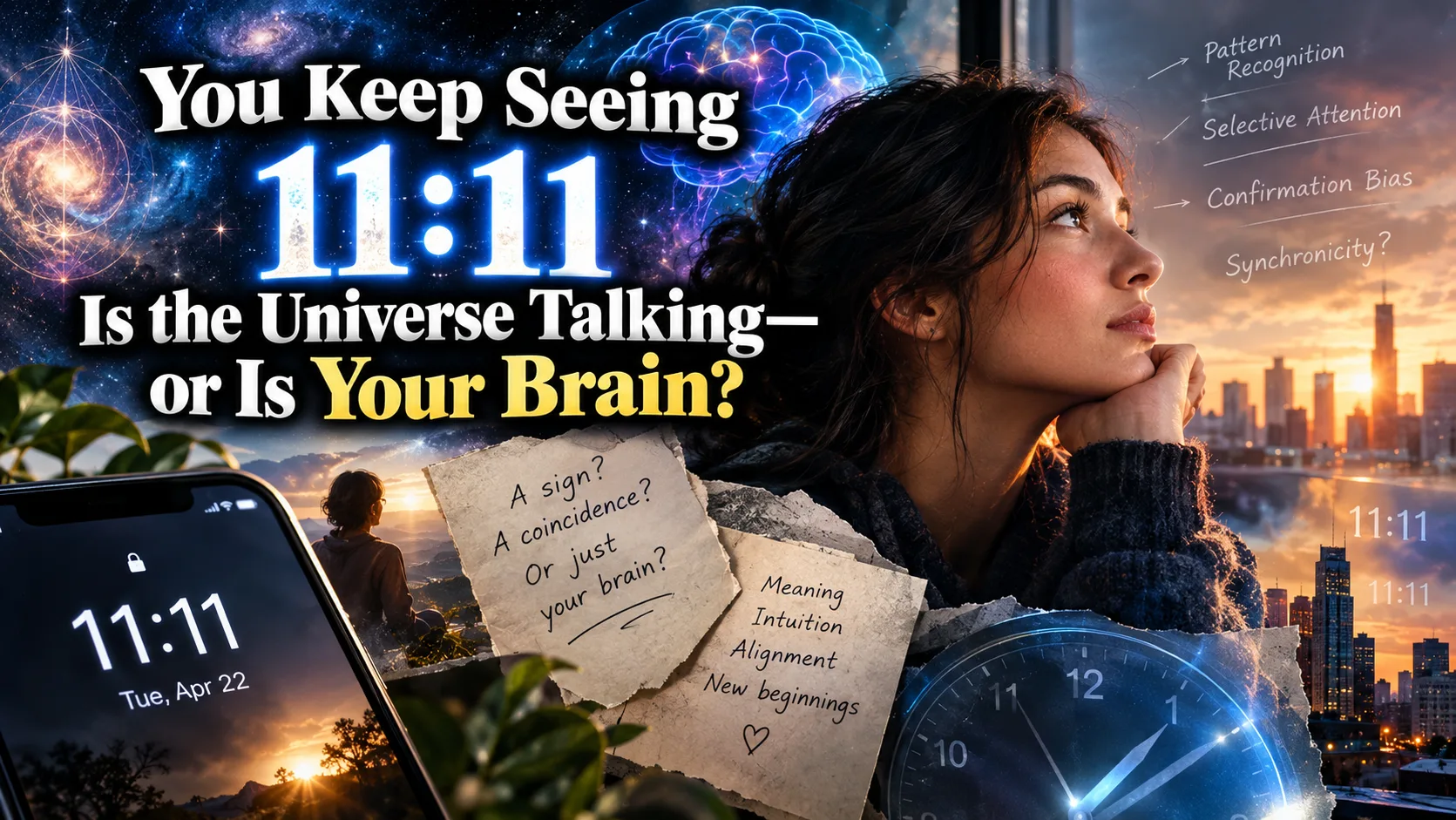
You Keep Seeing 11:11. Is the Universe Talking—or Is Your Brain?
You glance at your phone and see 11:11. Then it happens again the next day, and suddenly the number seems to follow you everywhere. Is it a message from the universe, a meaningful coincidence, or your brain becoming better at noticing a pattern? Explore the psychology of repeated numbers, selective attention, confirmation bias, and why ordinary coincidences can feel strangely personal.
You Keep Seeing 11:11. Is the Universe Talking—or Is Your Brain?
You check your phone.
11:11.
Nothing unusual. You put it away and continue with your day.
The following morning, you glance at the clock again.
11:11.
This time, you notice it.
A few days later, it happens again. Then you see the same number on a receipt, in a video timestamp, or somewhere else you weren't expecting.
Eventually, the coincidences start to feel like something more.
Why this number?
Why does it keep appearing?
And why does it seem to be happening precisely when you're thinking about your future, struggling with a decision, or hoping that something in your life will finally change?
Perhaps it's a sign. Maybe the universe is trying to tell you something. Perhaps 11:11 represents alignment, awakening, or a new beginning.
Or perhaps something equally fascinating is happening inside your brain.
Your attention has changed. Your memory is selecting certain events over others. Ordinary coincidences are beginning to look connected, and a number that once meant nothing has acquired a strange personal significance.
The experience feels mysterious because it sits at the intersection of two things humans are exceptionally good at: finding patterns and searching for meaning.
But there is an important distinction between experiencing something as meaningful and demonstrating that it was sent to you by an external force.
Seeing 11:11 is real. Feeling that it means something is real. Whether the universe is deliberately sending you a message is a separate question.
To understand why this simple arrangement of four digits can become so captivating, we need to explore how attention works, why coincidences feel personal, what psychology can explain, and where scientific evidence ends.
Because the most interesting mystery may not be why 11:11 appears on your clock.
It may be why, once you notice it, your mind finds it so difficult to ignore.
Section 1: Why 11:11 Feels Different From Other Numbers
Consider the number 10:47.
You look at your phone, register the time, and forget it almost immediately.
Now consider 11:11.
Four identical digits. A perfectly repeating visual arrangement. A pattern that is instantly recognizable without requiring any calculation.
You don't need to study the display to understand why it catches your attention.
It looks organized.
And the human brain is exceptionally responsive to recognizable patterns.
A random collection of numbers usually requires more effort to remember than a symmetrical arrangement. The sequence 11:11 is simple, distinctive, and easy to recognize at a glance.
The same principle explains why repeated digits, symmetrical shapes, familiar faces, and unusual visual arrangements can stand out in an environment filled with ordinary information.
Your brain does not process every detail of your surroundings with equal priority. It constantly filters information, emphasizing some features while allowing others to fade into the background.
A visually distinctive number can therefore attract attention even when nothing unusual has happened.
But 11:11 has another advantage: it appears on clocks.
You may check your phone dozens of times throughout the day. You might look at the time when waking up, leaving home, attending a class, receiving a message, or wondering how long you have been scrolling.
Each glance gives you another opportunity to encounter a recognizable arrangement.
Most of those times are quickly forgotten.
11:11 is different because it is memorable before you have even decided what it means.
The number that remembers itself
Imagine checking your phone at 10:43.
You probably don't think about the event again.
At 11:11, however, you might pause, smile, make a wish, take a screenshot, or send the time to a friend.
You have transformed an ordinary glance into a memorable experience.
This matters because the two events will not be stored in memory equally.
The first becomes part of the background noise of your day. The second receives extra attention and may be remembered long after it occurs.
Later, when you think about how frequently you see 11:11, you are not consulting a complete record of every time you checked the clock.
You are relying on memory.
And memory is selective.
It preserves some moments more vividly than others, particularly moments that surprise us or seem personally relevant.
This creates the first important piece of the puzzle: the number is unusually easy to notice, and the experience of noticing it is unusually easy to remember.
Neither requires a supernatural explanation.
But together, they can create the impression that something extraordinary is happening.
🟢 Established Psychological Evidence
Distinctive patterns attract attention, and memorable experiences are easier to recall than ordinary ones. These processes can make certain numbers feel much more frequent than other numbers, even when their actual occurrence has not changed.
Section 2: The Frequency Illusion: When Something Suddenly Appears Everywhere
Have you ever learned a new word and then started seeing it everywhere?
Perhaps you discovered a particular car model, heard a new song, or learned about an unfamiliar medical condition.
Before you noticed it, the thing seemed rare.
Afterward, it began appearing everywhere.
The world may not have changed at all. What changed was your awareness of it.
This phenomenon is known as the frequency illusion, sometimes called the Baader-Meinhof phenomenon.
It provides one of the simplest explanations for why people begin noticing 11:11 repeatedly after deciding that the number is significant.
Your brain has a limited attention budget
Every day, your environment contains an enormous quantity of information.
Numbers appear on clocks, receipts, invoices, phone screens, vehicle registrations, advertisements, account balances, and countless other objects.
You cannot consciously pay equal attention to every number you encounter.
Instead, your brain prioritizes what seems relevant.
If you begin thinking about 11:11, you are more likely to notice the sequence when it appears. Your attention becomes more sensitive to that particular pattern.
Meanwhile, the ordinary numbers you encounter continue receiving little attention.
You might check the clock at 9:26, 10:38, 11:04, 11:17, and 11:42 without remembering any of those moments.
But if you check it at 11:11, you may immediately register the event as noteworthy.
The difference is not necessarily in the number of times each time appeared in your day.
It is in the number of times you noticed and remembered it.
A simple experiment
Imagine that you have never paid much attention to the number 11:11.
For one week, your phone shows it at some point while you are going about your routine, but you do not attach any meaning to it.
You might forget seeing it entirely.
Now imagine reading an article about repeated numbers and learning that 11:11 is often interpreted as a spiritual sign.
The next time you encounter it, you pause.
The following time, you remember the previous encounter.
Soon, each new sighting connects to the ones you already remember.
The number begins to feel unusually frequent.
Nothing about this process requires you to be unintelligent, irrational, or especially superstitious. It is a normal consequence of attention and memory.
And it does not mean that every sighting is imaginary.
You really did see the number. You may simply be underestimating how many ordinary moments you forget in comparison.
Why the illusion feels so convincing
The frequency illusion is persuasive because it changes what you notice without necessarily making the change itself obvious.
You experience the result, not the filtering process.
The number genuinely appears in front of you. Your brain genuinely registers it. And the event genuinely feels unusual.
What remains hidden is the difference between encountering something frequently and paying attention to it frequently.
The moment you start looking for a pattern, you change the probability that you will notice it.
That is not evidence that the pattern is following you.
It is evidence that your attention has become interested in it.
Section 3: The Confirmation Bias Trap
Attention explains why you might notice 11:11 more often.
But another psychological process helps explain why repeated sightings can strengthen your belief that the number carries a message.
It is called confirmation bias.
Confirmation bias is the tendency to favor information that supports an existing belief while giving less attention to information that challenges it.
Once you begin suspecting that 11:11 is a sign, each additional sighting can feel like confirmation.
The sequence becomes:
You see 11:11.
You wonder whether it means something.
You see it again.
You feel that the first event has been reinforced.
You encounter it a third time.
Now the repeated appearances seem difficult to dismiss as coincidence.
But notice what is missing from this process.
You may not be counting all the times you checked the clock without seeing 11:11.
You may not be recording how many days passed without a sighting.
You may not be comparing the frequency of 11:11 with the frequency of other repeated numbers.
Instead, you are collecting examples that support the possibility that the number is special.
This can create a self-reinforcing belief.
The forgotten misses
Suppose you check your phone thirty times in one day.
You encounter 11:11 once.
You remember that encounter because the number feels significant.
The other twenty-nine glances fade into the background.
The following day, you encounter it again. You remember that too.
After several days, you might tell someone, "I keep seeing 11:11 everywhere."
From your perspective, the statement is sincere. You have several vivid memories of the number appearing.
But those memories do not tell you how frequently you failed to encounter it.
Nor do they tell you whether the number appears more often than would be expected from your normal clock-checking habits.
This is the important distinction between remembering a pattern and measuring one.
A collection of memorable examples can make a belief feel stronger without providing enough information to establish that the pattern is statistically unusual.
The goalpost problem
Confirmation bias can become even more powerful when the meaning assigned to the number is flexible.
Suppose you believe 11:11 signals that something good is coming.
You see it in the morning, and later that day you receive good news.
You interpret the sequence as confirmation.
But what happens if nothing good occurs?
Perhaps the message was about personal growth. Perhaps it meant you should remain patient. Perhaps the positive change will arrive next week rather than today.
With each interpretation, the belief can survive another outcome that might otherwise have challenged it.
A prediction that can be reinterpreted to fit almost any result becomes very difficult to test.
This is not unique to spirituality. It occurs in everyday reasoning, politics, investing, sports predictions, and personal relationships.
People tend to remember the times they were right more clearly than the times they were wrong.
The lesson is not that 11:11 must be meaningless.
It is that a belief becomes more convincing when we examine only the experiences that support it.
To determine whether the number appears unusually often, we would need to record both the memorable hits and the forgettable misses.
Without that comparison, the feeling of repeated confirmation can be much stronger than the evidence itself.
Section 4: Does the Universe Send Messages Through Numbers?
The psychological explanation addresses how repeated sightings may happen.
But it does not fully address the question that makes 11:11 intriguing to many people:
Could the number still mean something beyond the ordinary process of looking at a clock?
People have interpreted numbers spiritually for centuries. In different traditions and modern belief systems, certain numbers are associated with harmony, luck, divine order, transformation, or guidance.
In contemporary numerology and some New Age spiritual communities, 11:11 is often associated with awakening, intuition, alignment, new beginnings, or the idea of being on the right path.
Some people describe it as an angel number. Others interpret it as a reminder to pay attention to their thoughts, intentions, or circumstances.
These interpretations can be personally meaningful.
The important question is whether personal meaning demonstrates that an external force deliberately produced the experience.
It does not, by itself.
A spiritual interpretation is not the same as scientific evidence
Science can investigate observable patterns.
Researchers can ask how often people report noticing a number, whether attention changes after people become interested in it, and how beliefs influence memory and interpretation.
They can also investigate whether a proposed effect occurs more often than would be expected by chance.
However, a claim that the universe deliberately sends a message through 11:11 requires more than demonstrating that people notice the number or find it meaningful.
It requires evidence that connects the sighting to an external intention or mechanism.
For example, if someone claims that seeing 11:11 predicts a major event, the prediction would need to be specific enough to evaluate. The results would need to be measured without selectively counting successful examples and ignoring failures.
Without such evidence, the claim remains a spiritual interpretation rather than an established fact.
🟢 Established Evidence: Human attention, memory, and pattern recognition can help explain why repeated numbers feel significant.
🟡 Open Question: People differ in how they experience meaningful coincidences, and research continues to investigate the cognitive processes associated with those experiences.
🔴 Unsupported as a Scientific Conclusion: There is no established scientific evidence demonstrating that seeing 11:11 is a message deliberately sent by the universe, angels, or another supernatural intelligence.
This distinction does not prove that every spiritual belief is false. It means that the specific claim has not been demonstrated through reliable evidence.
A careful investigation should not pretend to know more than it does.
Section 5: Synchronicity: When a Coincidence Feels Personal
There is a word for the experience of encountering events that seem meaningfully connected despite having no obvious causal relationship.
It is called synchronicity.
The concept is associated with the psychologist Carl Jung, who used it to describe coincidences experienced as meaningful rather than merely random.
Imagine thinking about an old friend you have not spoken to in years. A few hours later, that friend unexpectedly contacts you.
Or suppose you are struggling with a difficult decision and encounter a sentence that seems to address precisely the problem you have been thinking about.
The events may be genuinely surprising.
The question is what their significance tells us.
Why timing feels like a message
Human beings naturally pay attention to events that occur close together.
If you think about someone and then receive a message from that person, the timing creates a compelling connection.
You could have thought about dozens of people throughout the week without hearing from them. You may never have noticed the absence of a message because nothing happened to draw your attention to it.
But when the thought and the message coincide, the two events form a memorable story.
The same thing can happen with 11:11.
You are thinking about changing your life. You glance at the clock and see the number. The timing feels significant because it occurs during a moment when you are already searching for reassurance or direction.
The number becomes connected to the thought.
Yet temporal proximity does not establish causation.
Two events can occur close together without one causing the other. Similarly, an event can become personally meaningful without providing evidence that it was deliberately arranged for you.
Can coincidences still matter?
Absolutely.
Suppose you see 11:11 while thinking about a career change.
You interpret the moment as a reminder to take your ambitions seriously. You begin researching opportunities, updating your résumé, or developing a skill.
The number has now become part of a meaningful personal experience.
But notice where the practical effect comes from.
You assign the number a meaning, and that interpretation influences your behavior.
The number does not need to possess a supernatural mechanism for the experience to matter to you.
A photograph can remind someone of a loved one. A song can become associated with a life-changing memory. A familiar place can encourage someone to reflect on who they have become.
The meaning is real as part of the person's experience, even when it does not establish an external message.
This distinction offers a middle ground between two unhelpful extremes.
You do not have to dismiss every meaningful coincidence as foolishness.
Nor do you have to treat every coincidence as proof that an unseen force is communicating with you.
Something can be personally significant without being supernatural evidence.
Section 6: Why You Notice 11:11 at Important Moments
People often report seeing repeated numbers during periods of uncertainty, emotional change, or intense reflection.
They may notice 11:11 after a breakup, while considering a career move, when worrying about the future, or during a period when they are looking for direction.
This creates an interesting question.
Why does the number seem to appear precisely when life feels complicated?
One possible explanation involves the relationship between emotion and attention.
When something matters deeply to us, we become more sensitive to information that might be relevant to it.
If you are worried about an upcoming exam, you may notice conversations about exams more often. If you are thinking about a particular person, their name may suddenly seem to appear everywhere. If you are looking for signs that your life is changing, an unusual pattern can attract your attention more easily.
The experience may feel externally directed because the event and your emotional state fit together.
But the relationship may have developed through your own attention and interpretation.
When uncertainty increases the search for meaning
Uncertainty is uncomfortable.
When you do not know whether a decision will work out, whether a relationship will survive, or whether a difficult period will end, you may look for reassurance.
A repeated number can provide a moment of certainty.
Instead of thinking, "I have no idea what will happen," you might think, "Maybe this means I am moving in the right direction."
That interpretation can feel comforting because it turns an unpredictable situation into a story with a sense of order.
It gives an ambiguous event a role in your personal life.
This does not mean that everyone who sees 11:11 is distressed or searching for reassurance. Some people simply enjoy the number, and others notice it without attaching any deeper meaning.
But when a person is already looking for meaning, a memorable coincidence may carry more emotional weight.
Research on meaningful coincidences has found associations between these experiences and people's emotional states. Such findings help researchers investigate why coincidences sometimes feel especially important.
They do not establish that emotional experiences cause the universe to produce particular numbers.
The number may reflect what you are already thinking about
Imagine two people seeing 11:11 at the same time.
One is thinking about starting a business. Another is remembering a loved one. A third is simply waiting for lunch.
The digits are identical.
Their interpretations may be entirely different.
This reveals something important about the experience.
The number itself does not contain an obvious, universally agreed-upon message about each person's circumstances. Much of its personal significance comes from the thoughts and emotions that surround the sighting.
The mind supplies the context.
The event then becomes connected to that context in memory.
In this way, 11:11 can act as a psychological mirror. What it seems to mean may depend partly on what you were already hoping, fearing, or considering.
Section 7: Pattern Recognition: The Brain's Extraordinary Strength and Occasional Weakness
Humans are pattern-seeking creatures.
We recognize faces in crowds, notice changes in familiar environments, learn regularities in language, and detect relationships between events.
These abilities are essential to everyday life.
Without pattern recognition, learning would be far harder. We would struggle to predict outcomes, identify danger, understand speech, or make sense of the environment.
But the same ability that helps us detect genuine patterns can occasionally lead us to perceive connections that are not supported by the available evidence.
Psychologists use the term apophenia to describe the tendency to perceive meaningful patterns or connections in unrelated or random information.
The term can sound severe, but the basic experience of noticing apparent patterns is part of ordinary human cognition. Its significance depends on the context, the strength of the belief, and whether the perceived connection is supported by evidence.
Why random events can look organized
Imagine looking at clouds.
You see the outline of an animal, a face, or a familiar object.
The cloud has no intention of resembling anything. Its shape simply happens to fit a pattern your brain already recognizes.
A similar process occurs when people notice faces in inanimate objects, shapes in random arrangements, or connections between events.
The mind is capable of extracting meaning from incomplete information.
With 11:11, the pattern is not even particularly difficult to identify. The sequence is objectively symmetrical and visually distinctive.
The uncertainty begins when we move from recognizing the pattern to explaining why it appeared.
There is a meaningful difference between these statements:
"I saw a recognizable pattern."
"The pattern caught my attention."
"The pattern felt relevant to my life."
"The universe deliberately sent me the pattern."
Each statement adds a different claim.
The first three describe an observation or personal experience. The fourth proposes an external cause that requires its own evidence.
Confusing these levels allows a perfectly ordinary observation to become evidence for a much larger conclusion.
Pattern recognition is not a flaw to eliminate
It would be a mistake to conclude that pattern recognition is something the brain should simply stop doing.
The ability is useful precisely because it helps us detect relationships quickly.
The challenge is knowing when a perceived pattern deserves further investigation.
A doctor who notices a pattern in symptoms may discover an important diagnosis. A researcher who recognizes an unexpected relationship in data may develop a useful hypothesis.
But the initial pattern is not the end of the investigation.
It is the beginning.
The same standard should apply to repeated numbers.
Seeing 11:11 can inspire a question. It cannot, by itself, settle the answer.
Section 8: The Mathematics of Coincidence
One of the most common reactions to repeated numbers is simple:
"What are the chances of that happening so many times?"
It sounds like a statistical question, and statistics can help. But the calculation is less straightforward than it first appears.
To understand why, consider a digital clock using the familiar twelve-hour format.
The time 11:11 occurs twice each day, once in the morning and once at night.
That means there are two opportunities each day for someone to notice it simply by looking at a clock.
Whether they actually see it depends on their habits.
Someone who works with a computer all day may check the time frequently. Someone who rarely looks at a clock may have fewer opportunities. A person who uses their phone every few minutes might naturally encounter many more displayed times than someone who checks it only occasionally.
The probability of noticing 11:11 therefore depends on more than the number itself.
It depends on how often you look, when you look, what clocks you use, and which sightings you remember.
The problem of counting only the surprising result
Suppose someone checks their phone thirty times a day and happens to see 11:11.
They may consider the event extraordinarily unlikely.
But the thirty checks were not thirty isolated attempts to predict that exact time. They were part of a routine, and the person was looking at many possible times.
If the claim is that one specific event happened by chance, its probability must be considered differently from the probability of noticing any one of many possible patterns during an entire day.
This is a common problem in judging coincidences.
An event can seem extremely unlikely when described after it occurs, while becoming much less surprising when we account for all the other patterns, numbers, and events that could have caught our attention.
For example, you might notice 11:11 today, a repeating vehicle number tomorrow, and an unexpected encounter next week.
Each event can become part of a personal story. But the more possible events you are willing to interpret as meaningful, the more opportunities you have to experience something that feels like a significant coincidence.
Why a single probability does not settle the question
You cannot determine whether 11:11 is appearing unusually often simply by declaring that a random glance has a small chance of landing on that exact minute.
You would need to define the claim precisely.
How often does the person check the clock? What counts as seeing the number? Are morning and evening sightings counted separately? What time period is being examined? Which other patterns would also have been considered meaningful?
Most importantly, are all sightings being recorded, or only the memorable ones?
Without these details, a dramatic probability calculation can create an illusion of mathematical certainty.
The math might be correct for a particular assumption while the assumption itself fails to describe the person's actual behavior.
🟢 Established Mathematical Principle
An unlikely event does not automatically imply an extraordinary cause. To judge whether a coincidence is genuinely surprising, we must consider the number of opportunities for it to occur and the way the event was selected or noticed.
The correct question is not merely, "What are the odds of seeing 11:11?"
It is, "What are the odds of noticing a pattern like this, given how often I look at clocks and how many patterns could catch my attention?"
That is a much harder question, but also a much more useful one.
Section 9: The Meaning of 11:11 in Numerology
Psychology explains several ways people may begin noticing a number repeatedly.
It does not explain every cultural or spiritual interpretation attached to it. Those interpretations arise within belief systems that give numbers symbolic significance.
Numerology, in broad terms, assigns meanings to numbers and uses those meanings to interpret aspects of life, personality, or events.
Within modern spiritual interpretations, 11:11 is often associated with themes such as awakening, intuition, alignment, or new beginnings.
Some people view it as an invitation to reflect on their intentions. Others associate it with spiritual growth or the idea that they are being guided.
There is no single interpretation shared by everyone. Meanings vary between traditions, communities, and individual beliefs.
Why the interpretations resonate
Many of the meanings associated with 11:11 concern experiences that are common to human life.
People want reassurance when making difficult choices. They want to believe that their struggles are leading somewhere. They seek signs that change is possible and that their decisions have meaning.
An interpretation about new beginnings may feel especially relevant to someone starting a career. A suggestion to trust intuition may resonate with someone facing uncertainty. An idea about alignment may appeal to someone attempting to bring different parts of their life into balance.
These interpretations offer language for experiences people already recognize.
They can also encourage reflection.
For example, someone who sees 11:11 and decides to reconsider their goals may benefit from the reflection itself. They might realize that they have neglected an important ambition or continued with a plan that no longer suits them.
But the usefulness of the reflection does not prove that the number was assigned to them by a supernatural source.
A person can use a symbol to think more clearly without treating the symbol as a verified prediction.
Symbolism versus prediction
Consider two different ways of interpreting 11:11.
The first is:
"When I notice this number, I use it as a reminder to pause and consider what matters to me."
The second is:
"When I notice this number, it proves that the universe guarantees my plan will succeed."
The first interpretation is a personal practice. Its value can be evaluated by whether it helps the person reflect or act more thoughtfully.
The second makes a factual claim about future events. It requires evidence that the sighting predicts outcomes reliably.
Those are very different standards.
A symbol can be useful even when it does not predict anything.
And a prediction is not reliable simply because it carries emotional significance.
The distinction allows people to maintain meaningful rituals without confusing personal symbolism with scientific verification.
Section 10: Why 11:11 Became a Modern Spiritual Favorite
Many repeated numbers can attract attention, but 11:11 has several features that make it especially suited to modern digital life.
First, it is visually simple. Four identical digits are easy to spot on a clock, phone, or screen.
Second, it appears twice every day on a standard twelve-hour clock.
Third, digital devices display time constantly. People carry phones, wear watches, work on computers, and encounter timestamps across daily life.
Finally, social media allows people to share and reinforce interpretations of the number.
Someone who sees 11:11 may post a screenshot, mention it in a conversation, or encounter a video explaining its alleged spiritual meaning.
Other people may share similar experiences.
The result is a feedback loop between individual attention and collective belief.
Shared experiences feel more credible
Suppose you notice 11:11 repeatedly but are unsure whether the experience means anything.
Then you discover that many other people report seeing it too.
The shared experience can make your own sightings feel less isolated.
You may conclude that the pattern deserves special attention because other people also consider it meaningful.
But popularity does not establish causation.
Millions of people use digital clocks. Large numbers of people are likely to encounter visually distinctive times. When those encounters are memorable, people may share them, creating the impression of a widespread phenomenon.
The same process can make many ordinary experiences seem like evidence of something extraordinary.
The existence of a community that interprets 11:11 spiritually demonstrates that the symbol has cultural significance. It does not establish that the number is an external message.
The internet amplifies the recognizable
A photograph of an ordinary clock showing 10:47 is unlikely to attract much attention.
A photograph of 11:11 is more likely to be recognized immediately by people who attach significance to the pattern.
The number is visually distinctive, easy to reproduce, and simple to discuss.
Once people know what it represents in a particular community, it becomes easier for them to recognize it and share it with others.
This can reinforce the frequency illusion at a social level.
People do not merely notice the number themselves. They repeatedly encounter posts and conversations that remind them to pay attention to it.
The pattern becomes more visible in their personal and digital environments.
Again, nothing about this requires deception. People can sincerely share an experience while collectively strengthening the attention given to it.
Section 11: Can Seeing 11:11 Change Your Life?
There is an interesting possibility here.
Even if seeing 11:11 does not demonstrate that the universe is communicating with you, the experience can still influence your decisions.
The effect may come from what you do after noticing it.
Imagine that you have been postponing an important goal. You keep telling yourself that you will start when life becomes less complicated.
One afternoon, you see 11:11.
You decide to interpret it as a reminder to stop procrastinating.
You spend the next thirty minutes working on the goal.
The number did not need to possess supernatural power to trigger a useful action. It became a cue that interrupted your routine.
Psychology offers several ways to understand this.
A recognizable event can remind you of an intention. A repeated ritual can encourage reflection. A personal symbol can help you reconnect with a goal that has slipped out of your attention.
These are ordinary mechanisms, but ordinary does not mean ineffective.
The difference between a reminder and a command
The most useful interpretation of a repeated number may be one that encourages you to think rather than telling you what to believe.
For example, if you notice 11:11 while considering a career decision, you could use the moment to ask yourself:
What decision am I actually trying to make?
What evidence do I have?
What information am I missing?
What small action could help me move forward?
The number does not answer those questions.
It simply becomes the occasion on which you ask them.
This approach preserves the personal meaning of the experience without giving the digits authority over your decisions.
It also protects you from a more dangerous interpretation: the belief that a number guarantees an outcome or instructs you to make a major choice.
A clock cannot evaluate your finances, judge your relationships, or determine whether a medical treatment is appropriate.
A meaningful coincidence should not replace evidence, planning, or sound judgment.
Turning symbolism into action
Suppose you want to improve your health.
Whenever you notice 11:11, you decide to pause and consider whether your recent choices support that goal.
You might use the moment to remember an appointment, take a short break, prepare a meal, or return to an exercise routine.
Over time, the number can become a reminder associated with a behavior.
The practical benefit would come from the habit you develop, not from evidence that the clock has chosen to communicate with you.
The same principle applies to studying, creative work, personal reflection, and other goals.
A symbol can prompt action.
But it cannot guarantee success.
Use the moment as a reminder to make a decision, not as a replacement for making one.
Section 12: When Looking for Signs Becomes Unhelpful
For most people, noticing 11:11 is harmless.
They may enjoy the coincidence, make a wish, or share it with a friend. It adds a small moment of curiosity to an ordinary day.
There is no reason to treat every spiritual interpretation as a problem.
However, any belief can become unhelpful when it begins controlling decisions, creating distress, or replacing evidence.
Consider someone who repeatedly checks the clock because they are afraid of missing a special number. Instead of noticing 11:11 occasionally, they begin arranging their day around it.
Or imagine someone who sees the number before making a risky financial decision and treats the sighting as proof that success is guaranteed.
In these situations, the issue is not the number itself. It is the degree of authority given to the interpretation.
The difference between curiosity and dependence
Curiosity sounds like this:
"I keep noticing 11:11. I wonder why it stands out so much."
A flexible spiritual interpretation might sound like this:
"I like treating the number as a reminder to reflect on my life."
Dependence looks different.
Someone may feel that they cannot make a decision without receiving a sign. They may repeatedly check clocks, become anxious when the number does not appear, or interpret ordinary events as instructions they must obey.
The belief has shifted from something that adds meaning to everyday life into something that restricts it.
If noticing patterns begins causing significant anxiety, disrupting sleep, or interfering with daily activities, it may help to step back from the habit and discuss the distress with a qualified mental health professional.
That does not mean that enjoying numerology or spirituality is inherently unhealthy. It means that a belief should not be allowed to make ordinary life frightening or impossible to navigate.
A grounded approach to uncertainty
When facing an important decision, it is natural to want reassurance.
But reassurance obtained from a random number is not the same as information about the decision itself.
If you are deciding whether to change careers, examine the opportunities, financial risks, and requirements.
If you are deciding whether to trust someone, consider their actual behavior.
If you are worried about your health, use appropriate medical advice.
You may still find personal meaning in seeing 11:11 during these situations. The important thing is not to confuse the moment with evidence that determines what you should do.
A useful symbol can coexist with careful reasoning.
It should not replace it.
Section 13: A Simple Way to Test Your Own Experience
If you genuinely want to discover why you keep seeing 11:11, you can conduct a small personal experiment.
The goal is not to prove or disprove the existence of the universe's intentions through a week of clock-watching. It is to separate what you remember from what you actually observe.
Step 1: Write down every sighting
For a week or two, record each time you notice 11:11.
Include the date, whether it was morning or evening, what you were doing, and whether you had been thinking about the number shortly beforehand.
Do not rely on memory at the end of the day. Write down the event when it happens.
This creates a more reliable record of your observations.
Step 2: Record your opportunities to notice it
If you want to understand how frequently you encounter the number, you also need information about your clock-checking habits.
You could record roughly how often you check your phone or clock, or use a simple observation log that includes the ordinary times you encounter.
Do not deliberately check the clock at 11:11 just to produce a sighting. That would change the behavior you are trying to observe.
The aim is to capture your normal routine, not manufacture a result.
Step 3: Decide what counts before examining the results
One of the easiest ways to misinterpret coincidences is to change the rules after something happens.
If you count 11:11 as meaningful, but also count 1:11, 11:01, 111, 1111, or any event involving the number eleven, you have created many more opportunities to find a match.
Those patterns may be interesting in their own right. But combining them changes the question.
Decide in advance what you are measuring.
Are you examining the exact clock time 11:11? All repeated digits? The number eleven appearing anywhere? Or events that feel personally meaningful?
Different questions require different evidence.
Step 4: Record the misses
This is the part people often overlook.
Count the ordinary clock checks that do not produce the pattern.
Record days when you do not see 11:11 at all.
Compare the sightings with the number of opportunities you had to notice them.
The point is not to make the experience feel less special. It is to understand how much of the apparent frequency comes from actual occurrences and how much comes from selective memory.
Step 5: Be careful about what the result proves
You might discover that you see 11:11 more often than you expected.
That would be an interesting observation.
But you would still need to understand your viewing habits and compare the result against a reasonable expectation before concluding that anything unusual had occurred.
You might also find that you see it much less often than you remembered.
That would not mean your previous memories were fabricated. It would show that vivid events can occupy a disproportionately large place in our recollection.
And even if you found a pattern that you could not immediately explain, the next step would be to investigate possible causes.
An unexplained observation is a reason to ask better questions, not automatic proof of a supernatural explanation.
What this experiment can teach you
You may discover that your experience changes when you begin recording it.
Perhaps you realize how many ordinary times you forget. Perhaps you become more aware of when you tend to check your phone. Perhaps you find that the number feels less frequent once you compare memorable sightings with the rest of your day.
Or perhaps the exercise simply helps you understand your own attention.
That is already useful.
The goal is not to strip every coincidence of wonder.
It is to understand the difference between what happened, how you experienced it, and what you concluded from it.
Section 14: What Science Knows, What It Is Studying, and What Remains Unproven
A balanced account of 11:11 should not pretend that every question has already been answered.
Psychology provides well-established mechanisms that help explain why a distinctive number can attract attention and become memorable.
Other aspects of meaningful coincidences are still subjects of research. Researchers investigate why some people report these experiences more frequently than others and how attention, memory, emotion, and individual differences may contribute.
But these findings must be interpreted carefully.
Research into why people experience meaningful coincidences is not the same as evidence that every coincidence has an external purpose.
The distinction can be summarized in three categories.
🟢 Established Psychological Evidence
Selective attention: People cannot pay equal attention to every part of their environment. Information that seems relevant or distinctive can receive disproportionate attention.
Memory selection: Unusual or emotionally significant moments are often easier to recall than routine events.
Confirmation bias: People can favor examples that support an existing belief while overlooking examples that challenge it.
Pattern recognition: Human cognition is highly responsive to regularities and recognizable arrangements, although perceived relationships are not always evidence of a causal connection.
These principles provide a credible explanation for why 11:11 may begin to feel unusually frequent after someone notices it.
🟡 Active Scientific Research
Researchers continue to investigate individual differences in the experience of meaningful coincidences.
Some studies have explored the relationship between perceived coincidences and attention, working memory, emotion, and other cognitive processes.
The findings are useful for developing a more detailed understanding of the phenomenon, but they do not justify reducing every person's experience to one universal cause.
People can notice the same pattern for different reasons and interpret it in different ways.
More research is needed to understand the full range of these experiences and the factors that influence them.
🔴 Unsupported as an Established Scientific Claim
The claim that 11:11 is objectively transmitted as a message from the universe, guarantees a positive outcome, or predicts a person's future has not been established by reliable scientific evidence.
This does not amount to a scientific proof that no spiritual interpretation could ever be meaningful to an individual.
It means that the specific external-message claim has not been demonstrated.
The most responsible position is to distinguish what people experience from what evidence establishes about the cause of that experience.
Frequently Asked Questions
1. What does it mean if I keep seeing 11:11?
There is no single proven meaning. Psychologically, you may be noticing a distinctive number more often because your attention has become tuned to it, and memorable sightings are easier to recall. In numerology and some spiritual traditions, 11:11 is associated with ideas such as awakening, intuition, alignment, and new beginnings. Those are interpretations rather than scientifically established meanings.
2. Is 11:11 really a message from the universe?
There is no established scientific evidence demonstrating that the number is a deliberate message from the universe or a supernatural intelligence. You may personally use it as a symbol or reminder, but the sighting itself does not verify an external message.
3. Why do I see 11:11 when I am thinking about someone?
The timing may feel especially meaningful because your thoughts make the experience more memorable. You might also remember the occasions when a thought and a coincidence occur together more readily than the many occasions when your thoughts are not followed by a matching event. The coincidence can feel personal without proving that the two events are causally connected.
4. What is the frequency illusion?
The frequency illusion is the experience of noticing something more often after it has become prominent in your awareness. Once you become interested in 11:11, your attention is more likely to register it whenever it appears.
5. Does 11:11 mean my manifestation is coming true?
There is no reliable scientific evidence that seeing 11:11 predicts whether a desired outcome will occur. If the number reminds you to act toward your goal, it may be useful as a personal cue. The outcome will still depend on the circumstances, decisions, and actions involved.
6. Is seeing 11:11 a sign of spiritual awakening?
Some spiritual communities interpret the number that way. However, no scientific test establishes spiritual awakening from seeing a particular clock time. You can explore what the experience means to you without treating the number as proof that a specific spiritual process is occurring.
7. Why does 11:11 feel so much more significant than other times?
Its repeated digits create a visually distinctive and memorable pattern. You are more likely to notice and recall it than an ordinary time such as 10:47. Cultural and spiritual associations can make it even more noticeable.
8. Is it bad to believe in angel numbers?
Not necessarily. People differ in their spiritual beliefs, and a personal symbol can be harmless or comforting. Problems are more likely when the belief creates distress, interferes with daily life, or replaces evidence and sound judgment in important decisions.
9. Should I make a wish when I see 11:11?
That is a personal choice. You can use the moment to pause, reflect on a goal, or appreciate an interesting coincidence. There is no established evidence that making a wish at that time makes it more likely to come true.
10. What if I see 11:11 almost every day?
Start by considering how often you look at clocks and how readily you remember the number. Because 11:11 occurs twice daily on a standard twelve-hour display, frequent clock-checking creates regular opportunities to encounter it. Keeping a simple record of sightings and ordinary clock checks may help you understand the pattern more accurately.
11. Is there a difference between 11:11 and 1111?
The numbers can carry different meanings within particular numerological or cultural traditions. From a psychological perspective, both can be distinctive patterns that attract attention. Neither arrangement has an established universal meaning supported by scientific evidence.
Final Thoughts: Perhaps the Message Is Not What You Think
You look at your phone.
11:11.
For a moment, the ordinary world seems to pause.
Perhaps you think about someone you miss. Perhaps you remember a goal you have neglected. Perhaps you feel reassured that something good is coming.
Whatever happens in that moment, the experience belongs to you.
The number is real. The surprise is real. The sense of personal meaning can be real, too.
But none of these experiences automatically establishes that the universe deliberately arranged the sighting.
Your brain is continuously filtering information, recognizing patterns, connecting events, and deciding which experiences deserve to be remembered. When a distinctive number becomes important to you, those processes can make it appear far more significant than an ordinary glance at a clock would suggest.
That explanation does not make your experience foolish.
It reveals how powerfully the human mind can transform a simple observation into something worth thinking about.
And there is a subtle irony here.
When you see 11:11, you may immediately wonder whether the universe is trying to communicate with you.
But an equally interesting question is why you have become so interested in hearing a message at all.
Are you hoping for reassurance?
Are you searching for direction?
Are you waiting for permission to make a difficult decision?
Are you trying to believe that your present circumstances are leading somewhere meaningful?
Those questions may tell you more about your life than the number can.
You do not need a supernatural explanation to examine them.
You can treat the sighting as a reminder to pause, consider what matters, and make a more deliberate choice. You can appreciate the coincidence without pretending that its cause has been established.
And you can remain open to questions that have not been conclusively answered without treating every unexplained event as proof of something extraordinary.
Perhaps 11:11 is nothing more than a distinctive number that your brain has learned to notice.
Perhaps its significance comes largely from the meaning you attach to it.
What the evidence does not establish is that the universe has selected those four digits to deliver a personal message.
The next time you see 11:11, you do not have to dismiss it. You also do not have to obey it.
Pause if it helps. Reflect if you feel like it. Then return to the actual decisions, relationships, and goals that shape your life.
A coincidence can give you a moment to think. It cannot, by itself, tell you what to believe.
And perhaps the most useful question is not whether the universe is talking.
It is whether, in searching for a message, you are finally paying attention to something in yourself that deserves to be heard.