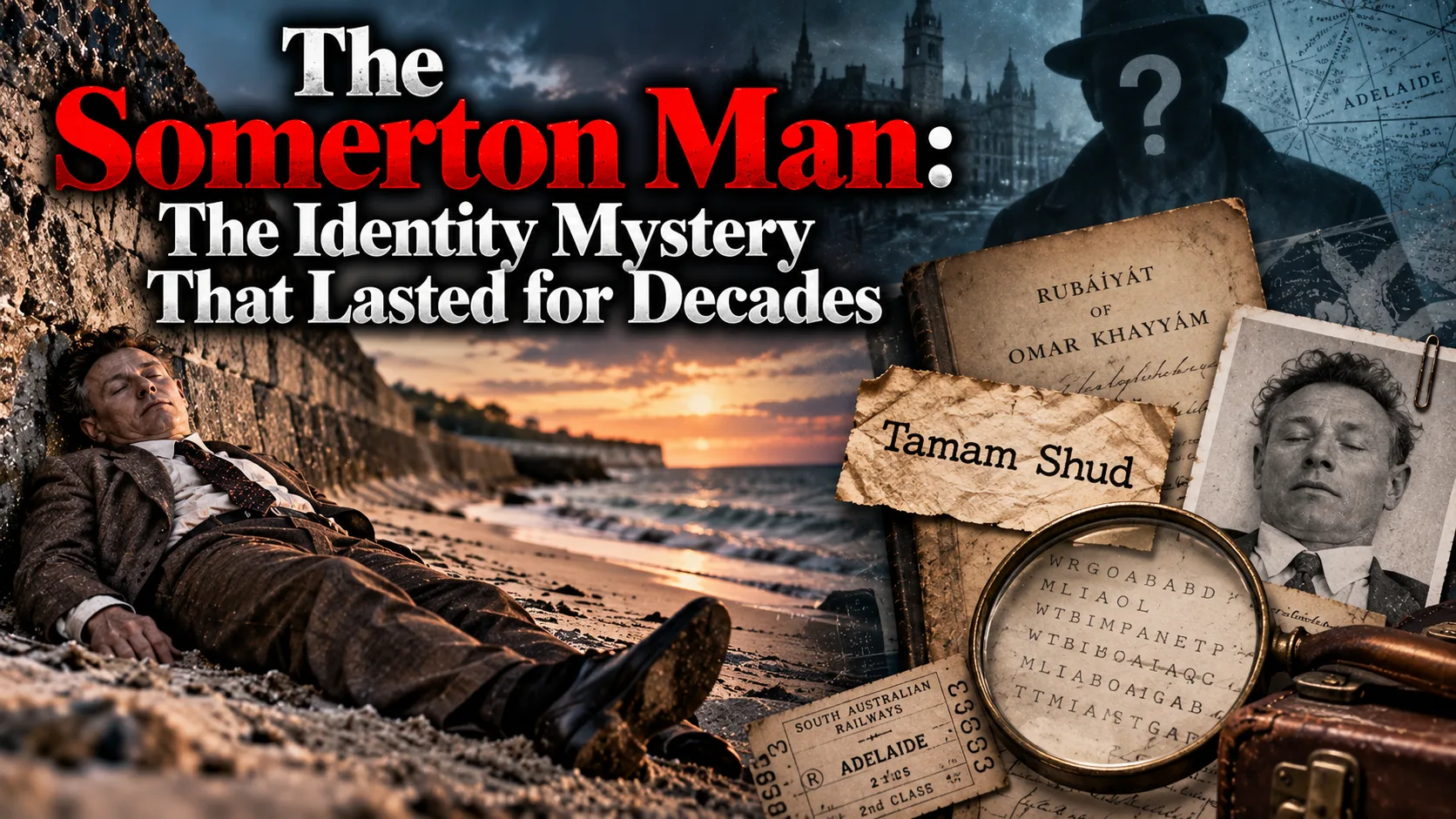
The Somerton Man: The Identity Mystery That Lasted for Decades
On December 1, 1948, an unidentified man was found dead on an Australian beach, with no identification and a mysterious scrap of paper bearing the words “Tamam Shud.” For decades, his identity, possible connections to espionage, and unexplained death fascinated investigators. DNA and genealogical research later pointed to Melbourne engineer Carl “Charles” Webb, bringing a major breakthrough while leaving questions about the man's final days, the cryptic clues, and the cause of his death unanswer
The Somerton Man: The Identity Mystery That Lasted for Decades
On a quiet Australian beach in 1948, an unidentified man was found dead against a seawall. His clothing labels had been removed, common poison tests revealed no answer, and a tiny scrap of paper bearing the words “Tamam Shud” opened a mystery that would survive for generations. DNA research eventually pointed toward a name: Carl Webb. But identifying the man is only part of the story. What happened to him remains a separate and unsettling question.
Introduction: The Man Who Had a Name, but No Story
Imagine walking along a beach early in the morning and noticing a man sitting against a seawall.
He appears to be resting. His legs are extended, his head is tilted slightly, and his clothes look remarkably tidy. He wears a suit and polished shoes. Nothing about the scene immediately suggests that you are looking at a mystery that will occupy investigators for decades.
Then you realise the man is dead.
There is no identification in his pockets. His clothing labels have been removed. Nobody nearby can identify him, and no missing-person report immediately resolves the question of who he is.
The man has no obvious history that investigators can follow. No family comes forward. No employer is able to identify him. No official document links him conclusively to a known person.
At first, this appears to be an unidentified death.
Then the details begin to accumulate.
The man had died under circumstances that puzzled medical investigators. Tests for common poisons did not reveal a clear cause. A small piece of paper was later found hidden in a pocket of his trousers. It carried two words that seemed almost deliberately chosen for their finality: Tamam Shud, a Persian expression meaning approximately “ended” or “finished.”
The words led investigators to a copy of a collection of Persian poetry, the Rubáiyát of Omar Khayyám. Inside that book were handwritten letters, a telephone number, and a trail of associations that seemed to point toward people who might have known the dead man.
None of those discoveries produced a complete explanation.
The unidentified man became known as the Somerton Man, named after the beach near Adelaide, South Australia, where his body was discovered on December 1, 1948.
For decades, his identity remained unknown. The mysterious note, possible poison, a suitcase containing clothing with identifying labels removed, and rumours of espionage transformed the case into one of Australia's most famous unsolved mysteries.
Then, in 2022, DNA and genealogical research led Professor Derek Abbott and forensic genealogist Colleen Fitzpatrick to identify the man as likely being Carl “Charles” Webb, a Melbourne instrument maker born in 1905.
Family photographs, historical records, and DNA matches strengthened that identification.
But a crucial distinction remains. As of October 2026, the identification had not yet received a publicly reported final confirmation from South Australian coronial authorities. A July 2026 update described the police investigation and report to the coroner as still ongoing. The circumstances of the man's death remain unexplained.
The Somerton Man's story is therefore no longer quite the same mystery it was in 1948.
We may finally have a convincing answer to who he was.
We still do not know exactly why he died, why he was on that beach, or what the cryptic clues were meant to reveal.
To understand what remains mysterious, we must first revisit the morning that began it all.
1. December 1, 1948: A Body on Somerton Beach
Somerton Beach lies south of central Adelaide, in a coastal area that was relatively quiet during the late 1940s.
On the morning of December 1, 1948, a man's body was discovered resting against a seawall beneath the esplanade.
The discovery attracted the attention of local authorities. The man appeared to be around forty years old, was approximately five feet eleven inches tall, and had a strong physique.
He was neatly dressed in a brown suit, a white shirt, a tie, trousers, and polished shoes.
There was no immediate indication of his identity.
The body was not accompanied by a passport, driver's licence, or other obvious document that could establish his name. His pockets held only a modest collection of everyday objects.
Investigators recorded items including combs, cigarettes, matches, chewing gum, and transport tickets.
One ticket suggested that the man had travelled by bus toward the beach. Another was an unused railway ticket, a detail that would later attract attention because it indicated a journey he may have intended to take but never completed.
The body was also found in a position that seemed unusual to some observers. Rather than lying sprawled on the sand, he appeared to be sitting or reclining against the wall, his legs extended.
His clothing was sufficiently tidy that the scene did not immediately resemble a violent struggle.
But appearances can be misleading. A body can be carefully positioned by chance, by the circumstances of collapse, or by actions that occurred before death.
The investigators could not determine from the scene alone whether the man had died naturally, suffered a medical emergency, taken poison, or been killed by someone else.
The missing labels
One of the more intriguing features of the man's clothing was that many of the labels had been removed.
In ordinary circumstances, a clothing label might identify the manufacturer, country of origin, or sometimes the owner.
Removing labels could make tracing the clothing more difficult, although it would not necessarily eliminate every identifying clue.
The discovery raised a question: had the labels been removed deliberately to conceal the man's identity?
That was one possible explanation, but it was not the only one.
Labels can be removed for personal reasons, to avoid irritation, to tailor clothing, or because garments have been altered or repaired. It was also possible that the clothes had passed through several owners.
Without knowing who removed the labels or when, investigators could not establish a motive.
The detail nevertheless became part of the larger puzzle.
Here was a man carrying almost no personal identification, dressed in clothes whose labels had largely disappeared, found dead in a public place.
It seemed as though the ordinary traces people leave behind had been stripped away.
The investigators now needed something more reliable than appearance.
They needed biological evidence, medical examination, fingerprints, dental records, personal possessions, or a witness who could connect the man to a known identity.
For years, none provided a definitive answer.
2. The Autopsy: What Happened Inside His Body?
The post-mortem examination produced some of the most troubling findings in the case.
The man had internal bleeding, and his spleen was markedly enlarged. Investigators also examined his stomach and its contents, liver, urine, and blood for possible toxic substances.
At the time, forensic toxicology was far less capable than it is today.
Laboratories could test for a range of known poisons, but their ability to identify unfamiliar compounds or detect substances that had broken down after death was limited.
The investigators tested for common poisons, including cyanides, alkaloids, barbiturates, and carbolic acid.
None was detected.
This was an important negative result, but it did not establish that poison was absent.
A substance may be difficult to detect because the testing method does not target it, because it has decomposed, because too little remains in the sampled tissue, or because the available evidence is insufficient to identify it reliably.
Conversely, the inability to identify a poison does not prove that poisoning occurred.
The medical evidence therefore created an uncomfortable situation.
The man had died under circumstances that raised suspicion, but the laboratory examinations did not supply a clear answer.
Some medical witnesses believed that poisoning was a likely explanation. Others involved in the investigation considered whether his death might have been caused by an unknown natural or non-natural process.
The inquest was unable to establish a definitive cause of death.
Why was a poison never identified?
The phrase undetectable poison became one of the most dramatic parts of the story.
It encouraged speculation about sophisticated chemical agents, secret intelligence operations, and substances known only to governments.
But that conclusion goes beyond the evidence.
Failure to detect a poison is not proof of a specially engineered substance. It can reflect the limits of testing, the passage of time, uncertainty about what compounds to search for, or the possibility that poisoning was not the cause in the first place.
The investigators were working in 1948 and 1949, with the techniques available to them.
They did not have today's analytical instruments or comprehensive reference databases. Modern forensic toxicology can detect many compounds at very low concentrations, but even current techniques cannot identify every substance under every circumstance, particularly when the original biological material is limited or has deteriorated.
The historical evidence does not identify a specific poison responsible for the Somerton Man's death.
Nor does it conclusively establish that poison was involved at all.
This distinction matters because a theory about a mysterious chemical can easily become a self-reinforcing explanation: the substance was supposedly undetectable because it was secret, and its supposed secrecy is then offered as proof that secret agents were involved.
That reasoning reverses the burden of evidence.
A proposed poison should be supported by evidence that it existed, was present in the victim, and was responsible for the death.
In this case, those questions remained unanswered.
🟢 Established Evidence: The original medical investigations failed to establish a definitive cause of death, and testing did not detect common poisons.
🟡 Active Debate / Hypothesis: Poisoning remained one possible explanation, but neither a particular poison nor a clear method of administration was established.
3. The Inquest That Failed to Solve the Case
An inquest was opened in June 1949.
Its purpose was to examine the available evidence surrounding the man's death, including the medical findings, the items recovered from his body, and statements from people who had encountered him.
The investigation had already established that the man had been seen on Somerton Beach before the body was discovered.
Some witnesses had noticed him on the evening of November 30, 1948. Others had seen him earlier that day or had interacted with him during his movements around Adelaide.
However, nobody provided a reliable identification.
The transport tickets offered clues about his movements, but the people who issued them did not remember him clearly enough to establish his identity. By the time investigators questioned them, they were being asked to recall an ordinary workday from months earlier.
A person buying a ticket at a busy station is not usually memorable unless something unusual happens.
The investigators also faced the difficulty of working without a confirmed identity.
Without a name, it was hard to locate medical records, trace relatives, compare dental information, or determine where the man had lived.
Without relatives, investigators lacked a source of information about his medical history, personal relationships, recent behaviour, or possible reasons for travelling to Adelaide.
The case became circular.
Investigators needed an identity to find a history, but they needed a history to establish an identity.
Why the inquest could not deliver a verdict
The medical evidence raised concerns that the death had been unnatural, but the available evidence could not establish a complete explanation.
The inquest was adjourned without a conclusive finding about who the man was or precisely how he died.
This was not the same as proving that a murder had occurred.
An unresolved inquest means that the available evidence did not support a definitive conclusion. It does not automatically establish homicide, suicide, espionage, or any other specific cause.
The result was deeply frustrating for investigators because the case seemed to contain clues pointing toward a deliberate mystery.
The missing clothing labels suggested concealment. The absence of identification prevented an ordinary investigation into the man's background. The uncertain cause of death left open the possibility of poisoning.
And then came the scrap of paper.
It would turn a puzzling death into a global mystery.
4. “Tamam Shud”: The Two Words That Changed Everything
A small piece of rolled paper was eventually discovered hidden deep in a fob pocket of the man's trousers.
It carried the words “Tamam Shud.”
The phrase is Persian and is commonly translated as “ended,” “finished,” or “it is over.”
The words appear at the end of the Rubáiyát of Omar Khayyám, a collection of poetry attributed to the Persian poet Omar Khayyám and popular in English through several translations.
The discovery was extraordinary because it seemed to connect the unidentified death with a specific literary work.
At first, the meaning of the scrap was uncertain.
Was it a note left by the man himself? Had someone placed it in his pocket? Was it a private message, a symbolic statement, or merely a piece of paper he happened to possess?
The phrase's association with endings made it tempting to interpret the note as a message about death.
Some observers viewed it as a possible suicide clue. Others wondered whether it could have been deliberately placed in the man's clothing by someone involved in his death.
Both interpretations were speculative.
A phrase can carry personal significance without establishing how a person died. Someone might keep a line of poetry for emotional reasons, as a private reminder, or simply because the words interested them.
Alternatively, the paper might not have belonged to the man at all.
Without an established connection between the note and its owner, investigators could not reliably determine what it meant.
Why was the paper so deeply hidden?
The scrap had been placed in a pocket that was not immediately obvious during the first examinations.
That detail encouraged the belief that the note had been concealed deliberately.
It is possible that the man placed it there himself. It is also possible that someone else inserted it.
The location does not identify the person who put it there or establish when it was placed in the pocket.
A hidden note can be evidence of deliberate concealment, but concealment alone does not tell us the reason.
The discovery created an additional question: if the scrap had been torn from a book, could investigators find the book itself?
That question eventually led them to another set of clues.
5. The Book of Poetry
Investigators traced the words on the scrap to the final page of a copy of the Rubáiyát of Omar Khayyám.
A man later handed such a book to police in July 1949. He said he had found it in the back of his car in November 1948, around the time the Somerton Man was discovered.
The book contained the missing final section from which the words “Tamam Shud” had been torn.
It also contained handwritten letters and a telephone number.
Suddenly, investigators had more than a mysterious phrase.
They had a book that might have been connected to the dead man, a possible code, and a number that could be traced to a living person.
The book was not simply a literary curiosity. It had become a potential link between the victim and the world beyond the beach.
Was the book definitely his?
Not conclusively.
The matching torn page established a connection between the scrap and the book, but that did not automatically establish who owned the book or who had removed the page.
The person who handed it to police said it had been found in a car. That account provided a lead, but it could not fully reconstruct the book's movements before its discovery.
The book could have belonged to the Somerton Man. It could have been handled by another person. It might have been deliberately placed or accidentally left in the car.
The same uncertainty applied to the writing.
Without a confirmed writer, investigators could not know whether the letters were a message, a private shorthand, an enciphered communication, or something else.
Nonetheless, the combination of the book and the scrap made a compelling possibility seem increasingly likely: the man had left behind clues that were meant to be found.
But possibility is not proof.
The book gave investigators more material to examine, not a clear answer.
6. The Mysterious Code
On the back of the book, investigators found a handwritten sequence of letters arranged in several lines.
The arrangement looked deliberate.
It did not resemble ordinary prose, and the letters appeared to form groups that might have been created according to a rule.
The obvious interpretation was that the writing was a code.
During the years following the Second World War, codes and secret communications were closely associated with intelligence work. The Cold War was intensifying, and the public was increasingly aware that governments used agents, hidden messages, and confidential networks.
A cryptic sequence of letters in a book connected to an unidentified man seemed to fit that atmosphere almost perfectly.
But the fact that writing resembles a code does not establish that it is one.
It could be an enciphered message. It could be a personal mnemonic, a sequence generated by a private system, an incomplete note, or writing unrelated to the death.
No accepted interpretation has conclusively established what the sequence means or who wrote it.
Could modern computers solve it?
It is tempting to assume that a code that defeated investigators in 1949 should be easy to solve using modern computing.
Computers can test enormous numbers of possible patterns, compare letter frequencies, search for known encryption structures, and examine candidate transformations far faster than a human could work manually.
However, a computer cannot always solve a code when essential information is missing.
If a message is too short, if the underlying method is unknown, if the writer used an unusual personal system, or if the letters are not actually an encrypted message, automated analysis may produce many possible interpretations without identifying the correct one.
A short sequence is particularly difficult because there may not be enough information to distinguish a meaningful pattern from coincidence.
A system that transforms ordinary text into code can often be tested against possible plaintexts, but a meaningful result needs to be independently validated.
It is easy to find a few letters that can be made to fit a proposed phrase. It is much harder to demonstrate that the same method reliably explains the entire sequence and has a credible connection to the victim.
The danger of finding meaning in randomness
Human beings are natural pattern detectors.
When confronted with mysterious writing, we instinctively search for initials, names, abbreviations, words, or hidden instructions.
The more important the case seems, the more determined we become to find a message.
But a convincing interpretation must do more than look interesting.
It should explain the full sequence, use a defensible method, and ideally produce information that can be tested independently.
To date, the handwritten sequence has not yielded a generally accepted explanation that conclusively solves the case.
🟢 Established Evidence: A handwritten sequence of letters was found in the book linked to the “Tamam Shud” scrap.
🟡 Active Debate / Hypothesis: The writing may have been a code, but its purpose, authorship, and meaning remain unproven.
7. The Telephone Number and the Woman Known as “Jestyn”
The book contained a telephone number that investigators traced to a woman who later became known in public discussions as “Jestyn.”
Her identity was eventually established as Jessica Harkness, later known as Jessica Thomson.
She had lived in the Adelaide area, not far from Somerton Beach, and became one of the most closely examined people associated with the case.
Her connection to the mystery was intriguing but difficult to interpret.
Why had a number associated with her appeared in a book linked to an unidentified man who had died nearby?
There were several possibilities.
She might have known the man personally. She might have been associated with someone who knew him. The number could have been written by another person. Or the connection might have been unrelated to the death.
Investigators questioned her, but no conclusive evidence established that she had caused the man's death or that she possessed information explaining it.
Over time, she became central to one of the most elaborate theories about the case.
Was she involved in espionage?
Because of the cryptic writing and the atmosphere of the early Cold War, some researchers suggested that the woman and the Somerton Man might have been connected through intelligence work.
The fact that a telephone number had been traced to someone associated with the area seemed to offer a potential link between the man and a network of people who might have had reasons to conceal their identities.
But the existence of a telephone number does not establish an espionage relationship.
A person can know someone for countless ordinary reasons. A number might be copied into a book because of a friendship, a casual acquaintance, a private exchange, or an entirely different chain of events.
To demonstrate an intelligence connection, investigators would need evidence of the relevant contacts, communications, operations, or organisations.
The available public evidence does not establish that Jessica Harkness or the Somerton Man was part of an espionage operation.
What about the man she might have known?
One name frequently associated with the case is Alf Boxall, an Australian army lieutenant who had known Harkness during the Second World War.
Boxall survived the war and was later located by investigators. He possessed a copy of the Rubáiyát, which helped fuel theories that the literary clue connected a wider circle of people.
However, the existence of another copy of the same work does not establish that Boxall was directly involved in the death.
Nor does an association between two people automatically establish a secret operation.
The precise connection between Boxall, Harkness, the book, and the Somerton Man has never been conclusively established.
The theory remains interesting because it offers possible links among several clues. It remains unproven for the same reason: the links do not add up to a demonstrated explanation of the death.
8. The Suitcase at Adelaide Railway Station
Another important clue emerged in January 1949.
A suitcase believed to have belonged to the Somerton Man was found at Adelaide Railway Station.
Its contents included clothing, grooming items, and other personal belongings.
Some clothing labels had been removed. Other items carried the name “T. Keane.”
The suitcase seemed to fit the wider pattern. Here was a man found without identification, with labels removed from clothing, and now a collection of belongings that might have belonged to him had emerged from a railway station.
But whose name was Keane?
The answer was not immediately obvious.
The label could have belonged to a previous owner, a person who had lent or given the clothing to the man, or someone whose possessions had become mixed with his.
It did not establish that the man himself was named Keane.
The suitcase nevertheless became an important part of the case because it provided researchers with a more extensive collection of personal objects.
It also became unexpectedly relevant decades later when genealogical research began pointing toward Carl Webb.
Why “Keane” mattered again in 2022
The DNA-based genealogy investigation identified a man who appeared to fit the Somerton Man's age and circumstances: Carl Webb.
Researchers examining the family connections found that Webb was related by marriage to the Keane family.
This did not prove that the suitcase belonged to him. But it offered a possible explanation for why the name Keane had appeared on some of the clothing associated with the mystery.
A label that had once seemed like a possible clue to the man's hidden identity could be understood in a different way: the clothing may have come through a family connection.
That is an important lesson about historical evidence.
A clue can be genuine without meaning what investigators initially assumed it meant.
For decades, the name Keane encouraged speculation about whether the unidentified man had adopted an alias. Later genealogical work made it possible to interpret the label through a family relationship that had not previously been established.
The label did not independently identify the man.
Instead, it became one detail that could be reconsidered after new information emerged.
🟢 Established Evidence: A suitcase believed to be connected to the Somerton Man contained personal belongings, including items marked with the name “T. Keane.”
🟡 Active Debate / Hypothesis: The clothing may have reached the man through a family relationship, but the suitcase's complete ownership history has not been established beyond doubt.
9. The Spy Theory: A Mystery Born in the Cold War
The Somerton Man was discovered in December 1948, only a few years after the end of the Second World War.
International tensions were increasing, intelligence agencies operated under secrecy, and governments were increasingly concerned about espionage.
Against that backdrop, the case seemed tailor-made for a spy story.
The unidentified man had no obvious personal documentation. His clothing labels were missing. A handwritten code had been found in a book associated with him. A telephone number led investigators to a woman whose relationship with him was unclear. His death had not been conclusively explained.
Each detail appeared to support the possibility of a covert identity.
The spy theory proposed that the man was an intelligence agent, perhaps travelling under an assumed name, who died during an operation or after meeting someone connected to a secret network.
Some versions suggested that he was a foreign agent. Others suggested connections with Soviet intelligence or Western security services.
The theory became especially compelling because it seemed to explain the apparent secrecy surrounding the man.
But it has a serious evidential weakness.
There is no verified record establishing that the Somerton Man was an intelligence officer, that the letters in the book were an operational code, or that his death was connected to a specific espionage activity.
The labels, code, and telephone number are suspicious only if they can be connected through additional evidence to the same deliberate scheme.
Without those connections, the clues remain ambiguous.
A person may remove clothing labels without being a spy. A sequence of letters may look like a code without containing intelligence. A telephone number may connect two people without establishing a covert relationship.
The spy theory became popular because it offered one dramatic explanation for many uncertain facts.
Its popularity is not evidence that it is true.
Why the theory survived for so long
Espionage stories have a special advantage in mysteries involving missing information.
If investigators cannot find documents, the theory suggests that the documents were destroyed.
If no witnesses can identify the man, the theory suggests that his identity was deliberately concealed.
If no one can explain the code, the theory suggests that it was meant to remain secret.
Each unanswered question becomes evidence for the same hypothesis.
This creates a problem. A theory that interprets every missing piece of evidence as proof of secrecy becomes difficult to test.
The absence of proof is converted into the thing the theory claims to explain.
A credible intelligence explanation would need positive evidence linking the man to a specific operation, organisation, or network.
The public record has not established such a link.
🟢 Established Evidence: The case contained unexplained clues that appeared unusual in the context of the early Cold War.
🔴 Popular Myth / Unsupported Claim: No conclusive evidence has established that the Somerton Man was a spy or that his death resulted from an intelligence operation.
10. The Long Search for an Identity
For decades, investigators and independent researchers tried to establish who the Somerton Man was.
They examined his physical characteristics, dental information, clothing, belongings, travel movements, possible acquaintances, and the mysterious writing.
Hundreds of names were proposed.
People compared photographs, investigated missing-person reports, and explored theories about the man's nationality, profession, relationships, and possible reasons for travelling to Adelaide.
Some proposals suggested that he was a foreign visitor. Others connected him to military personnel, intelligence services, or people with complicated private lives.
The difficulty was that the evidence could support several stories without decisively identifying any one person.
A person might resemble the body in a photograph but have no matching dental information. A missing person might have been the right age but have no geographic connection to Adelaide. Another candidate might fit the clothing or circumstances but have a documented death elsewhere.
Each lead required careful evaluation.
Why the physical evidence was not enough
The Somerton Man had distinctive physical features, including an unusual dental pattern.
He was also described as physically fit, with particular development in his calf muscles and feet.
Such observations might help narrow the field, but they could not independently establish a name.
Many people share the same general build, hair colour, and apparent age. Dental characteristics can be more distinctive, yet they still need to be compared with reliable records.
The investigators did not have a confirmed identity from which to obtain family medical records or direct biological comparisons.
For many years, the available methods could not bridge that gap.
The man became one of the most famous unidentified people in the world precisely because the case contained so many clues without delivering a conclusive identification.
The puzzle persisted because each discovery generated new possibilities rather than eliminating them all.
Then forensic genetics began to change what was possible.
11. DNA Changes the Investigation
In May 2021, authorities exhumed the Somerton Man's remains from West Terrace Cemetery in Adelaide.
The purpose included obtaining material that could be used for modern forensic testing and potentially establishing his identity.
This was a major development, but the DNA breakthrough that made headlines in 2022 involved an older object: a plaster death mask created from the man's head, neck, and shoulders before burial.
Hair had become embedded in the plaster during the process of making the mask.
Researchers were able to extract DNA from a hair shaft and use it for genealogical analysis.
This work was undertaken by Professor Derek Abbott, who had studied the Somerton Man mystery for years, working with forensic genealogist Colleen Fitzpatrick.
The results pointed toward Carl “Charles” Webb, a Melbourne man born in 1905.
How does genetic genealogy work?
Traditional forensic DNA identification often compares a sample from an unknown person with a sample from a known individual or a database of established profiles.
Genetic genealogy approaches the problem differently.
Instead of requiring a direct match to the missing person's own DNA, researchers can identify genetic relatives and use their family relationships to reconstruct a family tree.
Imagine finding a biological sample from an unidentified person.
The DNA contains inherited patterns that can be compared with those of people who have submitted their own genetic data for genealogy.
Some matches may be distant cousins. Others may be connected through grandparents, great-grandparents, or more complicated branches of a family.
Each match supplies another piece of information.
By combining the relationships, researchers can build a family tree and look for people who fit the unknown person's estimated age, sex, geographic history, and other known characteristics.
The work involves more than finding one matching name.
Researchers must examine which family branches could account for the relationships, whether the proposed person fits the available historical evidence, and whether alternative candidates can be excluded.
In the Somerton case, the researchers found numerous genetic matches and reconstructed a large family network.
A branch connected to the Webb family emerged as a strong candidate.
The fact that Carl Webb had no clearly established record of death after the late 1940s made him particularly interesting.
He was the right approximate age. He had lived in Melbourne. Historical records provided a plausible life history, and the genealogical relationships could be tested through living relatives.
Why the result was a breakthrough
The new approach provided a way to move beyond resemblance and speculation.
Rather than saying that the unknown man looked like a particular person, the researchers could examine inherited biological relationships between the DNA sample and living relatives.
They then compared this genetic evidence with historical records and family information.
That convergence made the proposed identification much stronger than earlier guesses.
In 2022, Abbott and Fitzpatrick announced that the Somerton Man was almost certainly Carl “Charles” Webb.
The announcement fundamentally changed the case.
For decades, investigators had been searching for a name. Now they had a candidate supported by a combination of DNA analysis, family-tree reconstruction, and biographical evidence.
But the identification still required formal assessment by the relevant authorities.
What DNA can and cannot tell us
DNA can provide powerful evidence of biological relationships.
It does not automatically explain every event in a person's life.
Even a reliable identification would not establish why Carl Webb was in Adelaide, why he died on Somerton Beach, whether he knew Jessica Harkness, or what the handwritten code meant.
Genetic evidence can reconnect an unknown person to a family. It cannot reconstruct a conversation that was never recorded or reveal an unobserved event without additional evidence.
The DNA breakthrough answers a question about identity.
It does not automatically solve the cause of death.
🟢 Established Evidence: DNA recovered from hair embedded in the death mask was used in a genealogical investigation that identified Carl Webb as the leading candidate for the Somerton Man.
🟡 Active Debate / Hypothesis: The identification has substantial supporting evidence, but formal public confirmation by South Australian authorities was still pending in the latest public reporting located for October 2026.
12. Who Was Carl “Charles” Webb?
Carl Webb was born on November 16, 1905, in Footscray, a suburb of Melbourne, Victoria.
He was the sixth child of Richard August Webb and Eliza Amelia Morris Grace.
Historical records indicate that he worked as an instrument maker, a profession requiring technical skill and familiarity with precision equipment.
In October 1941, he married Dorothy Jean Robertson.
The couple lived in the Melbourne area, but their marriage later broke down. Researchers examining the case noted that Webb appeared to have disappeared from the readily available record after the late 1940s.
This was an important detail.
Many proposed identities for the Somerton Man could be eliminated because the person had a documented later life or a known death elsewhere.
Webb presented a different situation. The absence of a clear subsequent record was compatible with the possibility that he had died under another name or in circumstances that had never been connected to his family.
That absence was not sufficient by itself to prove the identification.
People disappear from incomplete historical records for many reasons. A missing record can indicate death, a change of residence, incomplete documentation, or a failure to link records that already exist.
But the combination of Webb's age, family relationships, unknown final fate, and genetic connections made him a much stronger candidate than a random name pulled from a list.
The family photographs
After the identification was announced, members of the Webb family discovered photographs that appeared to show Carl as a young man.
The images were important because, for decades, the most familiar pictures of the Somerton Man had been taken after death.
They showed a face that had become famous through mystery rather than through any known account of the person's life.
The family photographs offered a different perspective.
Instead of an unidentified body against a seawall, viewers could see a young man among relatives, participating in ordinary family life.
The photographs did not independently prove that Webb was the Somerton Man, but they provided a human context for the proposed identification.
The unknown man was no longer only a collection of forensic details, cryptic notes, and theories.
He may have been a son, brother, husband, and working man whose life had once been ordinary.
His death became more personal when descendants learned that a relative whose fate had been uncertain for generations might be the man at the centre of the mystery.
That discovery also changed the meaning of the investigation.
For researchers, it represented a potential breakthrough in a historical puzzle.
For the family, it offered the possibility of recovering someone who had effectively vanished from the record.
13. Has the Somerton Man's Identity Actually Been Confirmed?
This question requires careful wording.
In 2022, researchers publicly announced that the Somerton Man was Carl Webb based on DNA and genealogical analysis.
The research was supported by genetic relationships with living relatives and by historical records that fit the proposed identity.
This was a major breakthrough, and it made Webb the strongest publicly proposed candidate.
However, a research identification and an official coronial determination are not the same thing.
The authorities responsible for the original death investigation need to assess the relevant evidence under their own procedures. They may need to consider the biological evidence, the chain of custody, supporting records, and any additional forensic work.
As of October 2026, I found no published final coronial determination formally confirming the identification. In July 2026, South Australian police described the investigation as ongoing and indicated that a report would be provided to the coroner when complete.
This does not mean the researchers' identification is necessarily wrong.
It means the status of the claim needs to be stated accurately.
The scientific and genealogical evidence makes Carl Webb the leading identification, but a final official public confirmation had not appeared in the latest reporting available for this article.
Why the distinction matters
Historical mysteries often acquire new claims that are described as definitive breakthroughs.
Sometimes they really do resolve the central question. Other times, the evidence is persuasive but still requires independent confirmation.
This case illustrates why the distinction is important.
A probable identity can fundamentally change how we understand a case without resolving every remaining question.
Even after formal identification, investigators would still need to establish what can be known about Webb's final days and death.
The question would no longer be simply “Who was the Somerton Man?”
It would become a more specific set of questions:
Why did he travel to Adelaide? What was his relationship, if any, to the person connected to the telephone number? Did the book belong to him? Was he poisoned, and if so, by whom? Why was his clothing stripped of identifying labels?
An identity provides a foundation for investigating those questions.
It is not a substitute for answering them.
14. The Strange Connection Between Webb and the Name Keane
One of the more satisfying aspects of the proposed identification is its possible connection to a clue that puzzled investigators for decades.
The suitcase associated with the Somerton Man contained clothing marked with the name “T. Keane.”
For years, the name encouraged speculation that the unknown man might have used an alias or possessed clothing belonging to someone else.
Genealogical research into Carl Webb's family revealed a relationship with the Keane family through marriage.
This created a possible explanation for the label.
The clothes could have been acquired through family connections rather than through a deliberate attempt to adopt a false identity.
But the exact history of the suitcase and every item inside it has not been established with complete certainty.
It would be too strong to claim that the Keane label alone proved Webb was the Somerton Man.
Its value lies in how it fits the broader picture.
The DNA evidence suggested a particular family. Historical records showed that Carl Webb had the right general background and age. The family relationships offered a plausible way to understand a name that had been found among the man's possessions.
Evidence becomes more persuasive when independent details converge.
One clue may have several interpretations. Multiple clues that support the same explanation can make the explanation considerably stronger.
That is what made the Webb identification a substantial advance over earlier proposals.
15. Did He Die by Suicide or Was He Murdered?
Even if Carl Webb is formally confirmed as the Somerton Man, the cause and manner of his death remain unresolved.
This is one of the most important distinctions in the entire case.
The man was found dead under circumstances that raised suspicion. The medical investigators believed poisoning was possible, but no common poison was detected. The inquest could not conclusively establish how he died or whether another person was involved.
Several explanations remain possible.
The suicide hypothesis
One historical interpretation was that the man had deliberately taken poison.
The phrase “Tamam Shud,” meaning approximately “ended” or “finished,” was seen by some investigators as consistent with the possibility that he intended to communicate a sense of finality.
But this interpretation is not proof.
The phrase could have had a personal meaning unrelated to suicide, or it could have been placed in his pocket by another person.
No definitive evidence establishes that he intentionally ended his life.
The homicide hypothesis
Another possibility is that the man was killed by someone else.
The missing identity, unusual clothing, and uncertain cause of death prompted suspicion that another person might have been involved.
However, the public evidence does not establish a particular suspect, a motive, or a method of killing.
A mysterious death is not automatically a murder.
For homicide to be established, evidence must support the conclusion that another person caused the death. Suspicious circumstances can justify investigation, but they do not independently prove criminal responsibility.
The possibility of a natural death
The medical witnesses were concerned by the man's condition and the circumstances of his death, but the historical investigations did not deliver a definitive conclusion.
It is important to leave room for uncertainty rather than assuming that every puzzling detail requires a criminal explanation.
The original inquest did not establish a clear cause of death.
Even with modern technology, determining the exact cause after so many decades may be difficult, particularly when the original toxicological tests were inconclusive and the biological evidence has deteriorated.
The most responsible conclusion is that the Somerton Man's death remains unexplained.
His probable identity does not change what can be established about the medical evidence.
🟢 Established Evidence: The historical investigation did not establish a definitive cause of death, a specific poison, or a conclusive finding of suicide or homicide.
🔴 Popular Myth / Unsupported Claim: Claims that a particular intelligence agency, named suspect, or secret chemical definitely killed the Somerton Man go beyond the evidence publicly established.
16. What Happened to the Rubáiyát, the Code, and “Jestyn”?
The identity research changed the way investigators can approach the case, but three major mysteries remain intertwined.
First, who owned the book from which the “Tamam Shud” fragment was torn?
Second, what did the handwritten sequence of letters mean?
Third, what was the true connection between the telephone number and Jessica Harkness, later known as Jessica Thomson?
These questions are related, but they are not necessarily parts of one coordinated plan.
The book might have belonged to Webb. It might have been handled by someone else. The paper could have been a personal possession or a message placed there by another individual.
The code might have been a genuine cipher, but its meaning has not been established. It could also have been a personal system whose context has been lost.
The telephone number could have led to a person who knew Webb, a person who knew the book's owner, or someone who had an entirely different connection to the circumstances.
The difficulty is that the evidence does not independently connect all three elements to one explanation.
Why this matters after the DNA breakthrough
Before the identification, researchers could reasonably examine the code, the phone number, and the book as potential clues to the man's identity.
Now that genetic genealogy points toward Carl Webb, those clues can be evaluated against a more concrete biography.
But the new identity does not automatically reveal what the clues meant.
A family tree cannot decode a message without additional information. A DNA match cannot establish whether the man knew a particular woman. A suitcase label cannot prove that the book was his.
Each question needs evidence suited to answering it.
The identity breakthrough should narrow the investigation, not encourage researchers to force every old clue into the same story.
Some details may turn out to have been connected to the death. Others may have been ordinary possessions whose significance grew because investigators lacked a name.
Until that distinction can be made, the code and the book remain unresolved parts of the story.
17. Why the Case Became an Obsession
The Somerton Man mystery combines several elements that encourage speculation.
There is an unidentified person. There is an unexplained death. There are removed clothing labels, a hidden scrap of paper, a book of poetry, a possible code, a telephone number, and rumours of espionage.
Each element provides a new question.
Because they appear together in the same case, people naturally search for a single explanation connecting them all.
That instinct is understandable, but it can also be misleading.
Human beings are very good at building narratives from fragments. When the fragments are unusual, the narratives become increasingly elaborate.
A removed label suggests concealment. A code suggests secret communication. A phone number suggests a personal connection. An unexplained death suggests foul play.
When assembled, those details can appear to describe a carefully designed operation.
But the interpretation depends on assumptions that have not necessarily been verified.
A label might be removed for an ordinary reason. A code-like sequence might not contain a meaningful message. A telephone number might have been copied for an everyday purpose. A death can remain unexplained without involving a conspiracy.
The challenge is to avoid treating all the clues as proof of the same theory.
The power of an unresolved question
The mystery also survived because every major discovery seemed to promise a final answer.
The scrap of paper led to a book. The book led to a code and a telephone number. The telephone number led to a woman. The woman led to theories about relationships and intelligence work.
Each clue opened another door, but no door led to a complete explanation.
The result became an investigative maze.
A new hypothesis could be constructed whenever an existing theory failed to account for the evidence.
The DNA breakthrough was different because it introduced biological relationships that could be tested against family records.
Instead of relying mainly on how a clue felt or what it might symbolise, researchers could use genetic evidence to narrow the field of possible identities.
This was a genuine methodological change.
It showed how modern tools can resolve a historical question that resisted decades of traditional investigation.
But the breakthrough also demonstrated the limits of a solution.
DNA can identify a person without explaining the events that led to their death.
The case became famous because it appeared to contain several intertwined mysteries. Solving one of them has not automatically solved the others.
18. What We Can Reasonably Conclude Today
The Somerton Man case now has a stronger explanation for the man's identity than it did for most of its history.
Genetic genealogy led researchers to Carl “Charles” Webb, a Melbourne instrument maker born in 1905. The DNA relationships, family history, and surrounding biographical details make him the leading candidate.
However, formal public confirmation from the relevant authorities had not been reported in the latest material available for October 2026.
The cause of death remains unresolved.
The original medical investigators could not identify a definitive poison or establish precisely how the man died. The historical inquest did not settle whether his death was natural, self-inflicted, or caused by someone else.
The Rubáiyát connection remains intriguing, but its complete significance is unknown. The handwritten code has no generally accepted solution. The relationship between the telephone number, Jessica Harkness, and the dead man has not been conclusively established.
The suitcase and the name “T. Keane” may be interpretable through the Webb family connection, but they do not independently prove the entire sequence of events.
These distinctions allow us to separate three different levels of the mystery.
The first is identification. Modern DNA-based genealogical work points strongly toward Carl Webb.
The second is cause of death. No definitive explanation has been established.
The third is the meaning of the clues. The book, code, telephone number, and clothing remain open to interpretation unless new evidence establishes their connections.
This is a more precise picture than the popular claim that the case has either been completely solved or remains exactly as mysterious as it was in 1948.
It has changed.
One major question has a strong proposed answer. Several others do not.
Myth vs Reality
Myth: The Somerton Man was definitely a spy.
Reality: The Cold War setting and mysterious clues encouraged espionage theories, but no conclusive evidence establishes an intelligence connection.
Myth: “Tamam Shud” proves that the man committed suicide.
Reality: The words mean approximately “ended” or “finished,” but their presence does not establish who placed the scrap in the pocket or what it meant to the man.
Myth: Investigators found a poison that no modern scientist could identify.
Reality: The original tests did not detect common poisons. No specific substance has been conclusively identified as the cause of death.
Myth: DNA has solved every part of the case.
Reality: DNA and genealogical research point strongly toward Carl Webb's identity, but the cause of death, his final movements, and the meaning of the code remain unresolved.
Myth: The telephone number proves Jessica Harkness was involved in the death.
Reality: The number led investigators to her, but no conclusive evidence establishes that she caused the death or was part of an espionage operation.
Myth: The name Keane proves the Somerton Man was using a false identity.
Reality: The label appeared on clothing associated with the case, and Webb's family connections offer a possible explanation. The label does not independently establish the man's identity.
Myth: The case is either fully solved or completely unsolved.
Reality: The identity has a strong DNA-based explanation, while the circumstances of the death remain unresolved. Different parts of the mystery have different evidential statuses.
Frequently Asked Questions
1. Who was the Somerton Man?
DNA and genealogical research announced in 2022 identified the man as likely being Carl “Charles” Webb, a Melbourne instrument maker born in 1905. The identification has substantial supporting evidence, though final public confirmation by South Australian coronial authorities had not been reported in the latest information located for October 2026.
2. When was the Somerton Man found?
His body was discovered on Somerton Beach, near Adelaide in South Australia, on December 1, 1948. Witnesses had reportedly seen him on the beach the previous day.
3. What does “Tamam Shud” mean?
It is a Persian expression meaning approximately “ended,” “finished,” or “it is over.” The words appear at the end of the Rubáiyát of Omar Khayyám and were found on a small scrap of paper hidden in the man's trousers.
4. Was the Somerton Man poisoned?
Poisoning was considered a possible explanation, but no common poison was detected in the original tests. The precise cause of death remains unresolved, and no particular poison has been conclusively identified.
5. What was the mysterious code?
The book associated with the scrap contained a handwritten sequence of letters. It has often been treated as a possible cipher, but no generally accepted solution has established its meaning or purpose.
6. Was Jessica Harkness involved?
Her telephone number was connected to the case, and investigators questioned her. However, the available evidence does not conclusively establish that she caused the man's death, knew him personally, or was involved in espionage.
7. How did DNA research identify Carl Webb?
Researchers extracted DNA from hair embedded in a plaster death mask and used genetic genealogy to identify relatives and build a family tree. Carl Webb emerged as the leading candidate because his age, family relationships, and historical records fit the evidence.
8. Why has official confirmation taken so long?
The authorities have to assess the evidence through their own investigative and coronial processes. In July 2026, police described the case as ongoing and said a report would be provided to the coroner. A final publicly reported determination had not been located for this article.
9. Will we ever know how he died?
It is possible that further evidence could clarify some details, but a definitive cause of death may remain difficult to establish after so many decades. The original examinations were inconclusive, and the circumstances of the death have never been fully reconstructed.
10. Is the Somerton Man mystery solved?
Partly. Carl Webb is the leading identity proposed through DNA-based genealogical research. The cause of death, the meaning of the code, and the precise circumstances surrounding the man's final days remain unresolved.
Final Thoughts: A Name Is Not the Same as an Answer
For more than seventy years, the Somerton Man was remembered as a mystery without a name.
He was a body on a beach, a carefully dressed stranger, a collection of peculiar clues, and a death that medical investigators could not explain.
People looked at his clothing and wondered why the labels were gone. They looked at the scrap of paper and wondered why it carried a phrase about endings. They examined the book and wondered whether its writing concealed a message intended for someone who would know how to read it.
The possibilities multiplied because the basic question remained unanswered.
Who was this man?
The DNA-based identification of Carl Webb changed the investigation because it replaced a field of guesses with a biologically supported family connection.
It also restored something important that the legend had obscured: the man had a life before the beach.
He was born in Melbourne. He grew up in a family. He trained for a technical profession. He married. He existed in records created long before anyone knew that his name would become part of a famous mystery.
He was not born as an unsolved case.
He was a person whose final movements were lost from the historical record.
The family photographs that emerged after the identification helped make that distinction visible. A face previously seen mainly in death could now be connected to a young man among relatives, living an ordinary life.
Yet the identification has not answered everything.
We still do not know why Webb travelled to Adelaide, what happened during his final days, or precisely how he died. The words “Tamam Shud” remain open to interpretation. The code has not yielded a widely accepted answer. The telephone number and the woman associated with it have not been conclusively tied to the death.
Those gaps matter because an identity can make a story feel complete before the evidence actually supports that conclusion.
Once a name emerges, the temptation is to force the remaining clues into a neat narrative.
Perhaps Webb was a spy. Perhaps he was involved in a secret relationship. Perhaps the book was a message intended for someone he trusted. Perhaps he died by suicide or was killed by another person.
Each possibility can be imagined.
None should be presented as fact without evidence that supports it.
The real achievement of the investigation is more specific. Genetic genealogy appears to have brought us much closer to identifying the man, demonstrating how modern science can recover information that once seemed permanently lost.
The remaining questions may be harder.
A DNA sample can establish a biological connection. It cannot automatically explain the final decision a person made, the last conversation they had, or the contents of a message whose meaning depended on a private history that has disappeared.
The Somerton Man's identity may eventually be formally confirmed. His cause of death may remain unknown even after that point.
And if it does, the case will still teach us something important about evidence.
Solving who someone was is not the same as solving what happened to them.
For decades, the Somerton Man had neither an identity nor a clear explanation for his death. Genetic research has supplied a compelling answer to the first question, but the second remains open.
Perhaps the story's most enduring mystery is no longer whether the man had a name.
He almost certainly did.
It is whether the surviving fragments of his final days will ever be enough to tell us why he ended up on that beach, and what happened before the world found him there.