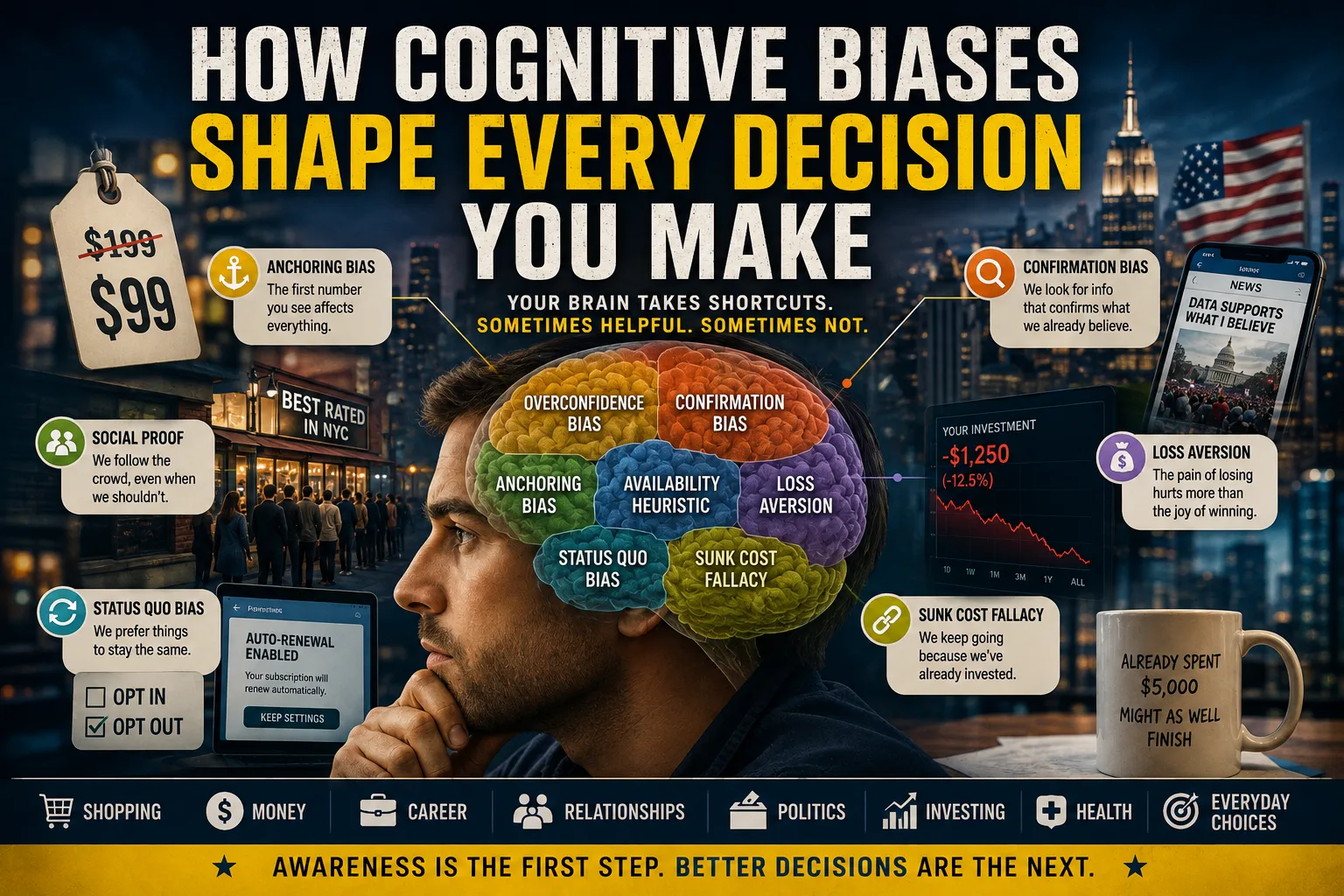
How Cognitive Biases Shape Every Decision You Make
From what you buy to whom you trust, cognitive biases quietly influence everyday choices. Explore the mental shortcuts that shape decisions, judgments, risks, and beliefs without us realizing it.
How Cognitive Biases Shape Every Decision You Make
You walk into a store intending to spend $50.
A jacket catches your attention.
The price tag says:
Was $180. Now $95.
Suddenly, $95 feels like a bargain.
But would you have considered the jacket worth $95 if you had never seen the $180 price?
Later, you're choosing a restaurant.
One place has thousands of positive reviews.
Another is unfamiliar.
You choose the popular one.
That evening, you read an article supporting something you already believe.
It seems convincing.
Then you encounter another article challenging your position.
Immediately, you begin searching for flaws.
Who wrote this?
What was their methodology?
Can this source really be trusted?
Something interesting is happening in all three situations.
Your brain isn't simply processing information.
It is interpreting that information through cognitive shortcuts and biases.
And those biases influence far more than shopping.
They affect:
Money.
Careers.
Relationships.
Politics.
Investments.
Business decisions.
Risk.
Memory.
Trust.
Even what you believe to be true.
What Is a Cognitive Bias?
A cognitive bias is a systematic tendency in thinking that can influence judgment and decision-making.
That doesn't mean your brain is defective.
Human cognition operates under severe constraints.
You have limited:
Time.
Attention.
Information.
Memory.
Processing capacity.
Yet you make thousands of judgments every day.
You cannot perform a comprehensive statistical analysis every time you choose breakfast cereal.
So the brain uses shortcuts.
These shortcuts are often associated with heuristics.
Heuristics allow fast decisions without analyzing every possible variable.
Usually, that is useful.
But shortcuts can also produce predictable errors.
Those recurring distortions are where cognitive biases become important.
🟢 Established Psychological Evidence
Decades of research in cognitive psychology and behavioral economics show that human judgment frequently relies on mental shortcuts and can exhibit systematic biases, particularly under uncertainty, limited information, and time pressure.
Bias Does Not Mean Stupidity
This distinction matters.
Cognitive biases are not problems reserved for unintelligent people.
Experts experience them.
Doctors experience them.
Investors experience them.
Judges experience them.
Scientists experience them.
CEOs experience them.
You experience them.
So do the people writing articles about cognitive biases.
Intelligence can help people detect flawed reasoning.
But intelligence can also provide more sophisticated tools for defending conclusions they already prefer.
Knowing that biases exist does not magically uninstall them.
Human brains, regrettably, do not include a Disable Biases button under Settings.
Anchoring: The First Number Changes Everything
Return to the jacket.
Original price: $180
Sale price: $95
The $180 figure creates an anchor.
Your brain now evaluates $95 relative to $180.
The relevant question should perhaps be:
"Is this jacket worth $95 to me?"
Instead, the comparison becomes:
"$95 versus $180."
And suddenly you feel like you're saving $85.
But spending $95 is not saving $85 if you otherwise would have spent nothing.
Retailers understand this extremely well.
Anchoring Goes Far Beyond Shopping
Imagine negotiating salary for a job in New York.
The employer begins:
"$80,000."
That number can influence the negotiation.
Even if you eventually negotiate upward, the conversation began around $80,000.
Now imagine the first number mentioned was:
"$105,000."
The psychological landscape changes.
Anchors can influence judgments involving:
Prices.
Salaries.
Property values.
Negotiations.
Estimates.
Legal damages.
Financial forecasts.
Even arbitrary numbers can sometimes influence subsequent numerical judgments.
🟢 Established Psychological Evidence
The anchoring effect is one of the most extensively studied judgment biases. Initial numerical information can influence subsequent estimates even when the anchor is imperfect or only weakly relevant.
Confirmation Bias: We Don't Judge All Evidence Equally
Suppose you strongly believe remote work makes employees more productive.
You find a study supporting remote work.
You think:
"Interesting."
Then you find research suggesting productivity declines in certain remote environments.
Now your scientific standards suddenly awaken from hibernation.
How large was the sample?
Which companies participated?
How did they define productivity?
Was the study funded by anyone?
These are excellent questions.
But did you ask them about the evidence supporting your position?
If not, you may be applying different standards depending on whether information agrees with you.
That is one way confirmation bias operates.
Confirmation Bias Can Affect What You Search For
Suppose you buy shares in a company.
You believe the stock will rise.
Now compare these searches:
"Why Company X stock will rise"
versus:
"Risks facing Company X"
The first search invites supporting evidence.
The second invites challenges.
Search engines can retrieve information for either position.
So confirmation bias can begin before you've even read anything.
It can influence the question you ask.
The Availability Heuristic
Which is more dangerous in the United States:
A dramatic event that dominates national news?
Or an ordinary risk responsible for far more deaths but receiving little coverage?
Humans often estimate probability partly by how easily examples come to mind.
This is associated with the availability heuristic.
Events that are:
Recent.
Vivid.
Emotional.
Memorable.
Frequently reported.
can feel more common than they really are.
Why News Can Distort Risk Perception
Imagine seeing repeated coverage of a rare but terrifying event.
The footage is dramatic.
Victims are interviewed.
Videos circulate online.
For days, the event dominates discussion.
Your brain now possesses several highly accessible examples.
Meanwhile, statistically larger but less dramatic risks may receive little attention.
The brain asks:
"How easily can I remember this happening?"
But the question we often need is:
"How frequently does this actually happen?"
Those are not the same thing.
🟢 Established Psychological Evidence
The availability heuristic describes the tendency to judge frequency or probability partly according to how easily relevant examples can be recalled or imagined.
Loss Aversion: Losing $100 Doesn't Feel Like Gaining $100
Imagine two outcomes.
Scenario A
You unexpectedly gain $100.
Scenario B
You unexpectedly lose $100.
The amounts are identical.
Psychologically, they often aren't.
Research in behavioral economics has shown that people frequently respond more strongly to losses than equivalent gains.
This phenomenon is known as loss aversion.
Loss Aversion Changes Decisions
Suppose an investor bought a stock for $50.
It falls to $35.
Selling means converting the paper loss into a realized one.
So they wait.
The company deteriorates.
Revenue weakens.
The original investment thesis collapses.
Still:
"I'll sell when it gets back to $50."
But the stock does not know what the investor paid.
The relevant question is:
"Given what I know today, is this still where I would choose to invest my money?"
The purchase price may be psychologically powerful while being irrelevant to the future return.
The Endowment Effect
Imagine receiving a coffee mug for free.
Later, someone offers to buy it.
You demand $10.
Before owning it, perhaps you would have paid only $5 for the same mug.
Ownership changed the valuation.
This phenomenon is associated with the endowment effect.
Once something becomes ours, giving it up can feel like a loss.
That can affect decisions involving:
Possessions.
Investments.
Homes.
Business ideas.
Projects.
Even beliefs.
Status Quo Bias
Suppose your employer automatically enrolls workers into a retirement plan unless they opt out.
Participation may be substantially different from a system where employees must actively opt in.
Why?
Because defaults matter.
Humans often prefer maintaining the existing state rather than actively changing it.
This is known as status quo bias.
The current option feels normal.
Changing requires effort.
And change introduces uncertainty.
Defaults Quietly Shape Behavior
Think about how many decisions are effectively made for you through defaults.
Retirement contributions.
Software settings.
Privacy options.
Subscription renewals.
Insurance selections.
Organ donation systems.
Notification preferences.
The default can become the decision.
That means whoever designs the choice architecture may influence behavior without explicitly forcing anyone to choose anything.
The Framing Effect
Consider two descriptions of the same medical procedure.
Option A
90% survival rate.
Option B
10% mortality rate.
Mathematically, these describe the same outcome.
Psychologically, they may not feel identical.
This is the framing effect.
How information is presented can influence decisions even when the underlying facts remain unchanged.
Businesses Use Framing Constantly
Consider:
$1 per day
versus:
$365 per year.
Same approximate annual cost.
Different psychological presentation.
Or:
Save $20
versus:
Avoid losing $20.
Or:
95% fat-free
versus:
5% fat.
The information may be mathematically equivalent.
The emotional framing isn't.
🟢 Established Psychological Evidence
Research on framing demonstrates that decisions can change depending on whether equivalent outcomes are presented in terms of gains, losses, survival, mortality, or other reference frames.
The Sunk Cost Fallacy
You've paid $40 for a concert ticket.
On the evening of the concert, you're exhausted.
The weather is terrible.
You genuinely don't want to go.
But you think:
"I already paid $40. I can't waste it."
The problem is that the $40 is already gone.
Whether you attend or stay home does not recover it.
The rational decision should depend on which option gives you greater value from this point forward.
Yet past investment influences the decision.
This is the sunk cost effect.
Businesses Make the Same Mistake With Bigger Numbers
A company spends $2 million developing software.
Testing reveals that customers don't want it.
Management says:
"We've already invested $2 million. We can't stop now."
But the $2 million is gone regardless.
The real question is:
"Should we spend another $1 million?"
Past investment can explain how you arrived somewhere.
It does not automatically justify continuing.
Survivorship Bias
Imagine studying successful entrepreneurs.
You discover that many:
Dropped out of college.
Took enormous risks.
Ignored critics.
Worked obsessively.
You conclude:
"These behaviors create billion-dollar companies."
There is a problem.
Where are all the people who did exactly those things and failed?
They aren't on magazine covers.
This is survivorship bias.
We study the winners because they remain visible.
The failures disappear from the dataset.
Silicon Valley Is Full of Survivorship Stories
For every famous founder who ignored conventional advice and built a massive company, there may be thousands who ignored conventional advice and built nothing.
If we examine only successful companies, risky behavior can appear safer than it actually was.
The same problem appears in:
Investing.
Careers.
Sports.
Entertainment.
Startups.
Self-help.
Historical analysis.
You cannot estimate success probability by studying survivors alone.
Hindsight Bias
After an event happens, it often feels predictable.
A stock crashes.
"The warning signs were obvious."
A company succeeds.
"Anyone could see this was the future."
An election produces an unexpected result.
Suddenly commentators explain why the outcome was inevitable.
Before the event, uncertainty existed.
Afterward, the brain reconstructs the past with knowledge of what happened.
This is hindsight bias.
Why Hindsight Bias Is Dangerous
If every failure seems obvious afterward, we learn the wrong lesson.
Suppose a startup failed despite making a reasonable decision based on available evidence.
Afterward:
"They should have known."
But should they?
The proper question is:
"Given the information available at the time, was the decision reasonable?"
Outcome knowledge contaminates judgment.
A good decision can produce a bad result.
A terrible decision can occasionally succeed.
The Halo Effect
Imagine interviewing a candidate.
They're charismatic.
Well-dressed.
Confident.
Graduated from a prestigious university.
You may begin judging unrelated characteristics more positively.
More intelligent.
More disciplined.
Better leader.
More trustworthy.
This is the halo effect.
One positive characteristic spills into judgments about others.
The opposite can happen with negative impressions.
One undesirable trait can contaminate the entire evaluation.
Social Proof
You open Amazon and see two similar products.
Product A:
4.8 stars, 18,000 reviews.
Product B:
4.9 stars, 47 reviews.
Which feels safer?
Many people gravitate toward the option chosen by thousands of others.
This is related to social proof.
When uncertain, we often use other people's behavior as information.
That isn't inherently irrational.
If thousands of people independently prefer something, their behavior may contain useful information.
But crowds can also be wrong.
Herding in Financial Markets
Suppose everyone appears to be buying a particular stock.
Prices rise.
Social media fills with screenshots of profits.
Friends begin discussing it.
The fact that others are buying becomes evidence that you should buy.
Then your purchase contributes to the same signal observed by someone else.
This can create feedback loops.
People buy because prices rise.
Prices rise because people buy.
At some point, social information can overpower independent evaluation.
The Dunning-Kruger Effect Is Often Oversimplified
The internet loves the phrase:
"Stupid people think they're smart."
That is an oversimplification.
Research associated with the Dunning-Kruger effect concerns relationships between performance and people's ability to accurately evaluate their performance.
People with limited knowledge may sometimes lack the information necessary to recognize their own mistakes.
But the phenomenon is more complicated than a universal rule that incompetent people always possess enormous confidence.
🔴 Common Myth / Misconception
The Dunning-Kruger effect does not simply mean that unintelligent people universally believe they are geniuses. The underlying research concerns calibration between actual performance and self-assessment, and the size and interpretation of the effect remain subjects of scientific discussion.
Overconfidence
Humans frequently overestimate:
Their knowledge.
Their forecasting ability.
Their driving skill.
Their ability to complete projects on schedule.
Their understanding of complex systems.
This becomes especially dangerous when confidence determines risk.
A person who knows they are uncertain may act cautiously.
A person who is wrong but extremely confident may take enormous risks.
Confidence feels like information.
But confidence itself requires calibration.
The Planning Fallacy
How long will your project take?
Two weeks?
Make it three.
Then watch reality introduce itself.
The planning fallacy describes our tendency to underestimate the time, costs, or difficulties involved in future tasks.
People often focus on the ideal sequence:
Design.
Build.
Test.
Launch.
They forget:
Unexpected bugs.
Illness.
Delays.
Revisions.
Supplier problems.
Administrative nonsense.
One tiny dependency deciding today is its day to become sentient.
Why Outside Views Help
Suppose your team estimates a project will take four months.
Instead of asking only:
"How long should our project take?"
ask:
"How long did similar projects actually take?"
This is an outside view.
Your project feels unique because you know every detail.
But historical outcomes from comparable projects may provide a better baseline than your internal narrative.
Cognitive Biases Interact
Real decisions rarely involve one bias at a time.
Imagine buying a fashionable stock.
You first hear about it because everyone online is discussing it.
Availability.
Thousands of investors are buying.
Social proof.
You purchase at $120.
Anchoring.
The stock falls to $80.
You refuse to sell because you'd realize a loss.
Loss aversion.
You search for bullish analysis.
Confirmation bias.
You remember investors who became rich by holding through crashes.
Survivorship bias.
Six months later, you explain why the collapse should have been obvious.
Hindsight bias.
The brain has assembled an entire committee.
Unfortunately, nobody appointed a risk manager.
Biases Are Not Independent Villains
It is tempting to imagine cognitive biases as bugs we can identify and eliminate individually.
Reality is more complicated.
Many biases emerge from cognitive processes that are usually useful.
Pattern recognition.
Memory.
Emotion.
Learning from others.
Using reference points.
Avoiding losses.
Simplifying complex decisions.
The same systems that create mistakes also allow humans to function efficiently.
The goal is therefore not:
Eliminate every heuristic.
It is:
Recognize situations where shortcuts are likely to produce costly errors.
How Cognitive Biases Affect Your Money
Money should be one of the easiest areas for rational decision-making.
Numbers are measurable.
Prices are visible.
Returns can be calculated.
Costs can be compared.
And yet humans have somehow managed to make money one of the most emotionally complicated things on Earth.
Financial decisions combine several ingredients that biases particularly enjoy:
Risk.
Uncertainty.
Fear.
Greed.
Social comparison.
Loss.
Future prediction.
The result is an environment where even intelligent people can make decisions that look completely irrational afterward.
The Reference Price Trap
Imagine shopping for a laptop.
One model normally sells for $1,499.
Today it is advertised for:
$999
You immediately see:
SAVE $500
But what is the laptop actually worth?
Perhaps competing models with similar specifications sell for $850.
The original $1,499 price becomes an anchor.
Instead of comparing the laptop against alternatives, you compare:
$999 versus $1,499.
Retailers understand that a discount feels valuable only relative to something.
This is why reference prices are everywhere.
"Only $29 a Month"
Another framing technique is breaking large costs into smaller units.
Suppose a service costs:
$348 per year.
That sounds substantial.
Now present it as:
Only $29/month.
Same annual expense.
Different psychological experience.
Or:
Less than $1 per day.
Now it sounds almost trivial.
None of these descriptions is necessarily deceptive.
But framing influences how expensive something feels.
A useful habit is converting recurring expenses back into their annual cost.
Twelve small payments occasionally reveal one surprisingly large number.
Credit Cards Separate Buying From Paying
Cash creates an immediate physical loss.
You hand over money.
Your wallet contains less.
Digital payments reduce some of that friction.
Credit cards can separate the pleasure of purchasing from the pain of actually paying the bill.
This does not make credit cards inherently bad.
They can provide convenience, rewards, consumer protections, and credit-building benefits when managed properly.
But reduced payment friction can influence spending behavior.
The easier purchasing becomes, the easier it becomes to stop noticing individual expenditures.
Loss Aversion and Investing
Suppose you invest $10,000.
A few months later, the investment is worth:
$7,500.
Selling means acknowledging a $2,500 loss.
So you wait.
Then:
$7,000.
$6,500.
$6,000.
Your reasoning becomes:
"I'll sell once I get back to $10,000."
But why should $10,000 matter to the asset's future?
It matters because you paid $10,000.
The market does not care.
The relevant question is:
"If I had $6,000 in cash today, would I buy this investment?"
If the answer is no, refusing to sell simply because of the original purchase price deserves scrutiny.
The Disposition Effect
Behavioral-finance research has documented a tendency known as the disposition effect.
Investors may be inclined to sell winning investments relatively quickly while holding losing investments longer.
Why?
Selling a winner creates psychological satisfaction.
You were right.
Profit secured.
Selling a loser forces recognition of a mistake.
So people sometimes realize gains while postponing losses.
But whether an asset should be sold should depend primarily on its expected future risk and return, not on whether the number beside it happens to be red or green.
🟢 Established Psychological Evidence
The disposition effect has been documented in behavioral-finance research, although its magnitude varies across investors, markets, and circumstances.
Mental Accounting
Imagine receiving:
$1,000 from your salary
and
$1,000 from a tax refund.
Economically, both are $1,000.
Psychologically, they may feel different.
Salary money might become:
Bills.
Savings.
Rent.
Groceries.
The tax refund might become:
Vacation.
New phone.
Entertainment.
Humans frequently divide money into mental categories.
This is known as mental accounting.
Money Is Fungible, Your Brain Often Isn't
Suppose someone has:
$5,000 in savings earning modest interest
while carrying:
$3,000 of expensive credit-card debt.
They may refuse to touch the savings because:
"That's my emergency fund."
The label has psychological power.
Sometimes keeping emergency liquidity is sensible.
But mental categories can also prevent people from evaluating their finances as one connected system.
A dollar does not remember whether it came from:
Salary.
Bonus.
Refund.
Gift.
Investment profit.
The brain does.
Cognitive Biases in Shopping
Retail environments are basically laboratories for behavioral psychology.
Consider:
LIMITED TIME
ONLY 2 LEFT
BESTSELLER
20,000+ PURCHASED
WAS $199, NOW $99
FREE SHIPPING OVER $100
Each message interacts with different psychological tendencies.
Scarcity.
Anchoring.
Social proof.
Loss aversion.
Framing.
Urgency.
None necessarily forces a purchase.
But together they alter the environment in which the decision occurs.
Scarcity Makes Things Feel More Valuable
Imagine two identical products.
Product A:
Available anytime.
Product B:
Only three remaining.
Which feels more desirable?
Scarcity can increase perceived value.
Sometimes scarcity is informative.
A concert genuinely has limited seats.
A collectible genuinely has limited supply.
But artificial urgency can exploit the same response.
Sale ends in 09:47!
Then tomorrow:
Another countdown.
A timer is considerably less impressive after discovering it has achieved immortality.
Social Proof Reduces Uncertainty
Suppose you're visiting Chicago and need dinner.
Restaurant A is nearly empty.
Restaurant B has a line outside.
Without knowing anything else, Restaurant B may seem better.
Why?
Other people's behavior contains information.
Perhaps locals know something you don't.
Social proof is particularly powerful when:
You are uncertain.
The situation is unfamiliar.
Many people appear to agree.
The other people seem similar to you.
This shortcut is often useful.
But popularity and quality are not identical.
Reviews Create Their Own Biases
Online reviews appear objective because they contain numbers.
4.8 stars.
12,437 reviews.
But interpretation still requires care.
Who leaves reviews?
Were incentives involved?
Are the reviews recent?
Did the product change?
Are extremely satisfied and extremely angry customers disproportionately represented?
A numerical average can look scientifically precise while concealing messy underlying data.
Cognitive Biases in Hiring
Imagine two candidates for a software-engineering position.
Candidate A:
Graduated from a famous university.
Polished résumé.
Confident speaker.
Excellent interview presence.
Candidate B:
Less prestigious school.
More reserved.
Stronger technical assessment.
The prestigious university can create a halo.
Confidence can be mistaken for competence.
Similarity to the interviewer can create affinity.
A memorable first answer can anchor the rest of the interview.
Hiring therefore provides several biases with opportunities to operate simultaneously.
Similarity Bias
People often feel more comfortable with people who resemble them.
Same hometown.
Same university.
Similar interests.
Similar personality.
Shared hobbies.
The conversation flows naturally.
That interpersonal comfort can quietly influence professional evaluation.
The interviewer may think:
"They'd fit perfectly with the team."
Perhaps.
But:
"I enjoy talking to this person"
and
"This person will perform the job exceptionally well"
are different claims.
Structured Decisions Reduce Noise
One way organizations can reduce these effects is by deciding evaluation criteria before meeting candidates.
For example:
Technical ability: 35%
Relevant experience: 25%
Problem solving: 20%
Communication: 10%
Role-specific knowledge: 10%
Then candidates are evaluated against the same framework.
This does not eliminate bias.
But it makes it harder for:
"I just really liked them"
to quietly become the entire hiring methodology.
Cognitive Biases in Business
Business decisions are especially vulnerable because outcomes are uncertain.
Suppose a CEO strongly supports launching a new product.
The company invests:
$3 million.
Initial results disappoint.
What happens?
The CEO may interpret weak performance as temporary.
Marketing needs more time.
Customers need education.
The economy is difficult.
Competitors distorted the market.
Any of these explanations might be correct.
But now several biases may be operating.
Confirmation bias protects the original thesis.
Sunk costs encourage continued investment.
Overconfidence supports optimistic forecasts.
Status concerns make admitting failure expensive.
Escalation of Commitment
Sometimes people increase commitment after evidence suggests the original decision is failing.
More money.
More time.
More resources.
The reasoning becomes:
"We've already come this far."
But past investment cannot justify unlimited future investment.
A better question is:
"If we had not started this project, would we choose to begin it today given what we now know?"
If the answer is no, continuing requires a stronger reason than:
"We've already spent too much to stop."
Confirmation Bias Can Infect Entire Teams
Suppose leadership believes a product will succeed.
Employees notice.
Now imagine a junior analyst discovers worrying customer data.
Will they aggressively challenge the strategy?
Maybe.
But organizational incentives matter.
People may hesitate to deliver information contradicting senior leadership.
Soon the company risks creating an information environment where positive evidence travels upward faster than negative evidence.
Leadership becomes increasingly confident.
Not because the evidence improved.
Because inconvenient evidence stopped reaching them.
Red Teams Can Help
One solution is deliberately assigning people to challenge major decisions.
A red team asks:
What assumptions could fail?
What evidence contradicts the plan?
What would competitors do?
What risks are being underestimated?
Why might customers reject this?
The purpose isn't pessimism.
It's creating structured opposition before reality provides a considerably more expensive version.
Pre-Mortems
Imagine your project is one year in the future.
It failed catastrophically.
Now ask the team:
"What caused the failure?"
This exercise is known as a pre-mortem.
Instead of asking whether the plan will succeed, participants imagine that failure has already occurred and generate plausible explanations.
That framing can make it psychologically easier to identify risks that enthusiasm might otherwise suppress.
Cognitive Biases in Relationships
Biases don't disappear when spreadsheets do.
Suppose your partner forgets something important.
If you're already frustrated:
"They never listen to me."
Now memory begins searching.
Another forgotten conversation.
That incident three months ago.
Something from last year.
Confirmation bias can build a case.
But contradictory evidence may receive less attention.
The dozens of times they remembered something important are less emotionally vivid.
Fundamental Attribution Error
When someone else behaves badly, we often explain it through personality.
They arrive late.
Irresponsible.
They snap at someone.
Rude.
They forget something.
Selfish.
When we behave similarly, circumstances suddenly become extremely relevant.
Traffic.
Stress.
Sleep deprivation.
Work pressure.
Miscommunication.
We know our own context.
We see other people's behavior.
That asymmetry can distort relationships.
Negativity Bias
Negative experiences can command disproportionate attention.
One insulting comment may remain memorable long after ten compliments disappear.
One terrible customer interaction can dominate your impression of an entire company.
One mistake by a colleague can outweigh months of competent work.
Negative information deserves attention because threats matter.
But when negativity receives too much weight, our overall judgment can become distorted.
Cognitive Biases in Politics
Politics combines several ingredients that make unbiased reasoning difficult:
Identity.
Emotion.
Group membership.
Competition.
Moral values.
Social status.
Information overload.
People may evaluate identical behavior differently depending on whether it comes from:
"our side"
or
"their side."
Confirmation bias encourages favorable interpretation of supportive information.
Motivated reasoning can help defend preferred conclusions.
Group identity can make changing opinions socially expensive.
Political Bias Isn't Something Only Other People Have
One of the easiest beliefs to hold is:
"Other political groups are biased. My group simply understands reality."
Convenient.
But cognitive biases do not check voter registration before operating.
A useful test is:
Would I evaluate this evidence the same way if it supported the opposing side?
If the answer changes depending on who benefits, reasoning may have become partisan defense.
Cognitive Biases in Medicine
Medical professionals must make difficult decisions under uncertainty.
Symptoms can overlap.
Information may be incomplete.
Time may be limited.
This creates conditions where cognitive biases can matter.
An early diagnosis may anchor later thinking.
A memorable recent case may influence probability estimates.
Evidence supporting the initial diagnosis may receive more attention.
This is one reason systematic diagnostic procedures, differential diagnoses, testing, and second opinions can be valuable.
Expertise Helps, But Does Not Create Immunity
Experience can improve pattern recognition dramatically.
An experienced physician may notice signals a novice misses.
An experienced investor may recognize familiar financial risks.
An experienced engineer may anticipate common failure modes.
But expertise does not eliminate bias.
Sometimes expertise produces greater confidence.
And confidence can make reconsideration harder.
The best experts therefore combine intuition with mechanisms for checking intuition.
How Do You Actually Reduce Cognitive Bias?
Knowing the names of fifty biases is not enough.
You can memorize:
Anchoring.
Confirmation bias.
Loss aversion.
Availability.
Framing.
Sunk costs.
Halo effects.
And still fall for all of them before lunch.
What helps more is changing the decision process.
1. Slow Down High-Stakes Decisions
Most everyday choices don't require extensive analysis.
But when the consequences are large:
Buying a home.
Hiring an executive.
Making a major investment.
Choosing medical treatment.
Signing a business contract.
Slow down.
Time creates room to examine assumptions that intuition may have skipped.
2. Write Down the Decision Before the Outcome
For important decisions, record:
What do I expect?
Why?
How confident am I?
What evidence supports the decision?
What could prove me wrong?
What risks am I accepting?
Later, compare the prediction with reality.
This protects against hindsight bias.
You cannot easily claim:
"I knew that would happen."
when your own notes politely disagree.
3. Ask for the Opposite Case
If you believe:
"This investment is excellent."
Ask:
"Why might this investment be terrible?"
If you believe:
"This candidate is exceptional."
Ask:
"What evidence suggests they might struggle?"
If you believe:
"This strategy will work."
Ask:
"What would make it fail?"
You are forcing the brain to search outside its preferred conclusion.
4. Use Base Rates
Suppose someone pitches a startup.
The founder is brilliant.
The presentation is extraordinary.
The product looks revolutionary.
Before predicting enormous success, ask:
What happens to companies in this category generally?
Base rates provide an outside view.
Your specific case matters.
But starting with the historical frequency of similar outcomes prevents a compelling story from completely replacing statistics.
5. Separate Decision Quality From Outcome Quality
Imagine betting $1,000 on a coin landing heads ten times consecutively.
It happens.
You win enormous money.
Was that a brilliant decision?
No.
You were extraordinarily lucky.
Now imagine making a carefully researched investment with favorable expected returns.
An unpredictable event causes a temporary loss.
Was the original decision necessarily stupid?
Also no.
Judge decisions based on the information and probabilities available when they were made.
Otherwise luck masquerades as skill.
6. Create Rules Before Emotions Arrive
Investors can define:
Maximum position size.
Loss limits.
Diversification rules.
Exit conditions.
Businesses can define:
Minimum retention.
Maximum acquisition cost.
Project kill criteria.
Hiring teams can define:
Scoring rubrics.
Required competencies.
Predetermined rules reduce the ability to rewrite standards after emotions become involved.
7. Seek Independent Opinions
Suppose five people discuss a decision together.
The first person confidently supports Option A.
Everyone else may become anchored.
Instead, ask each person to evaluate independently before discussion.
Now you obtain five initial judgments rather than one judgment followed by four reactions.
This can improve the diversity of information entering the decision.
8. Use Checklists
Checklists sound painfully boring.
That is part of their charm.
Aviation.
Medicine.
Engineering.
Investing.
Operations.
High-risk fields often use checklists because human memory and attention are unreliable.
A checklist doesn't need to be intelligent.
It simply needs to remember the thing your brain forgot while feeling intelligent.
Can Cognitive Bias Ever Be Eliminated?
Probably not.
And that isn't really the goal.
Human cognition evolved to make useful decisions efficiently, not to behave like a perfectly calibrated statistical engine.
Heuristics save enormous amounts of mental effort.
Without shortcuts, ordinary life would become absurd.
Imagine calculating expected utility before deciding whether to order pizza.
The goal is therefore selective intervention.
Use intuition for low-stakes, familiar decisions.
Use structured reasoning when:
The stakes are high.
The situation is unfamiliar.
Emotions are strong.
Evidence is ambiguous.
The decision is difficult to reverse.
Your incentives might distort judgment.
That is where bias becomes expensive.
Frequently Asked Questions
What is the most common cognitive bias?
There is no scientifically meaningful single "most common" bias. Different biases become more influential under different conditions.
Are cognitive biases always irrational?
No.
Many arise from mental shortcuts that are useful in ordinary environments. A heuristic can produce good decisions frequently while still generating systematic errors in particular situations.
Can intelligent people avoid cognitive biases?
Intelligence and expertise can improve reasoning, but neither makes someone immune. Highly intelligent people can still anchor, seek confirming evidence, become overconfident, or rationalize preferred conclusions.
Is confirmation bias the same as lying?
No.
Confirmation bias can occur without deliberate deception. Someone may sincerely believe they are evaluating evidence fairly while unconsciously treating supporting and opposing information differently.
How can I recognize my own biases?
Look for situations where you are emotionally invested, unusually certain, defending a previous decision, following a crowd, reacting strongly to losses, or evaluating evidence differently depending on whether it supports your existing view.
Does learning about biases remove them?
Not reliably.
Awareness helps, but structured decision processes such as checklists, independent evaluations, pre-mortems, written predictions, base rates, and predetermined criteria are generally more useful than relying on awareness alone.
Final Thoughts
Cognitive biases are often presented as a collection of amusing psychological mistakes.
They are much more important than that.
They influence:
What you buy.
Who you hire.
What you believe.
How you invest.
Which risks frighten you.
How you judge strangers.
How you interpret relationships.
How companies allocate millions of dollars.
And how societies understand complicated events.
But the lesson isn't:
"Never trust your brain."
That would be both impossible and rather inconvenient.
Your brain performs extraordinary amounts of processing with limited information, limited time, and limited attention.
Mental shortcuts make that possible.
The problem appears when a shortcut designed for efficiency is mistaken for objective truth.
The sale price feels cheap because of an anchor.
The popular choice feels correct because everyone else chose it.
The losing investment feels worth holding because selling hurts.
The familiar argument feels more convincing because you already believe it.
The charismatic candidate feels more competent because one positive impression spills into everything else.
And because these processes often happen automatically, the resulting judgment simply feels like:
"My decision."
That may be the most important thing to understand about cognitive bias.
Bias rarely announces itself.
It doesn't appear in your thoughts saying:
"Hello. I'm confirmation bias. I'll be handling your reasoning today."
It simply feels reasonable.
The solution is not becoming perfectly rational.
Nobody is.
The better goal is building systems that catch your reasoning when the consequences matter.
Ask what would prove you wrong.
Look at base rates.
Separate past costs from future value.
Write predictions before outcomes.
Seek independent disagreement.
Use objective criteria.
Slow down when emotions are strong.
And remember that confidence is not evidence.
You will still make biased decisions.
So will everyone around you.
But if you can recognize the situations where your brain is most likely to mislead you, you gain something far more useful than perfect rationality:
A better chance of noticing when your first answer shouldn't be your final one.