How Your Brain Tricks You Every Day: The Hidden Biases Controlling Your Decisions
Your brain constantly filters, predicts, simplifies, and reconstructs reality. Discover the cognitive biases and mental shortcuts that quietly influence your memories, purchases, relationships, risks, and everyday decisions without you realizing it.
How Your Brain Tricks You Every Day
Right now, your brain is hiding information from you.
Your eyes are receiving more visual detail than you consciously notice.
Background sounds are being filtered.
Memories are being reconstructed.
Your expectations are influencing what you perceive.
And dozens of tiny judgments are being made without deliberate thought.
Yet your experience feels continuous.
Complete.
Objective.
It isn't.
What you experience as reality is partly a model of reality constructed by your brain.
That sounds alarming.
It shouldn't be.
Without this system, everyday life would be almost impossible.
The brain has limited processing capacity, while the world contains vastly more information than we can consciously analyze.
So it cheats.
It predicts.
Filters.
Simplifies.
Fills gaps.
Uses previous experience.
And makes quick assumptions.
Most of these shortcuts are extremely useful.
Occasionally, however, they produce remarkably predictable mistakes.
Psychologists call many of these systematic patterns cognitive biases.
And once you know what to look for, you begin finding them almost everywhere.
Your Brain Is Not a Camera
It feels as though your eyes continuously record the world around you.
They don't.
Your visual system receives information, but perception requires interpretation.
The brain determines:
What deserves attention?
What can be ignored?
Which objects matter?
What probably exists outside the current focus?
What does previous experience suggest should be there?
The result is an incredibly efficient representation of your surroundings.
But it is not a perfect recording.
One dramatic demonstration comes from experiments involving change blindness.
People can fail to notice surprisingly large changes in a scene when their attention is disrupted.
An object changes color.
A building disappears.
A person is replaced.
And observers sometimes notice nothing.
🟢 Established Psychological Evidence
Research on change blindness demonstrates that people can fail to detect substantial alterations in visual scenes, particularly when changes occur during interruptions such as eye movements, cuts, or brief visual disruptions.
Selective Attention: The Invisible Gorilla
One of psychology's most famous demonstrations asks participants to watch people passing basketballs and count the passes made by one team.
While they concentrate on the task, something extraordinary happens.
A person wearing a gorilla costume walks directly through the scene.
Many viewers fail to notice.
Their eyes received the information.
Their attention did not prioritize it.
This phenomenon is called inattentional blindness.
It demonstrates something profoundly important:
Looking directly at something does not guarantee consciously noticing it.
Attention is selective.
And whatever receives attention can dramatically influence what becomes part of our experienced reality.
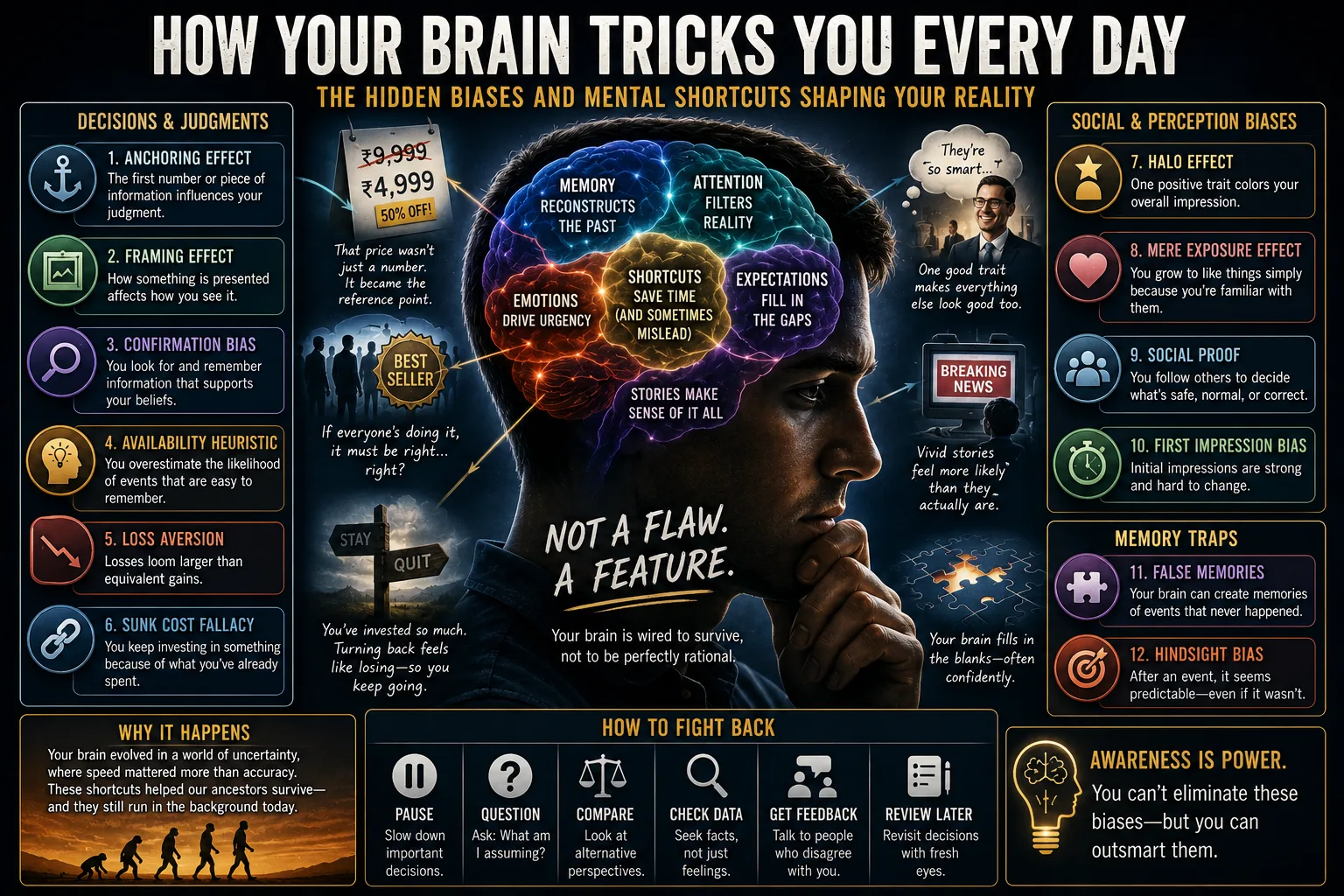
Trick #1: Anchoring
Imagine you're considering buying a jacket.
The price tag says:
₹9,999
Below it:
₹4,999 TODAY
₹4,999 suddenly feels like a bargain.
But imagine seeing the exact same jacket somewhere else simply priced at:
₹4,999
Would it feel equally attractive?
Perhaps not.
The original ₹9,999 creates a reference point.
Your brain begins evaluating the new price relative to that number.
This is called anchoring.
An initial value influences subsequent judgment.
And anchors don't always need to be logically relevant.
🟢 Established Psychological Evidence
Anchoring effects have been repeatedly demonstrated in judgment and decision-making research. Initial numerical values can influence later estimates, valuations, negotiations, and other judgments.
Why Discounts Feel So Powerful
Retailers understand reference points exceptionally well.
Consider:
₹2,499
versus:
₹4,999 → 50% OFF → ₹2,499
The amount leaving your bank account is identical.
Psychologically, the second option contains something extra.
A perceived gain.
You're not merely spending ₹2,499.
You feel as though you're saving ₹2,500.
The reference price changes the story surrounding the purchase.
Whether that original price represents meaningful market value is an entirely different question.
Your bank account, being annoyingly literal, still loses ₹2,499.
Trick #2: The Framing Effect
Consider these two medical descriptions:
Treatment A has a 90% survival rate.
Treatment B has a 10% mortality rate.
If the underlying data are identical, these statements describe the same outcome.
Yet they do not necessarily feel identical.
One emphasizes survival.
The other emphasizes death.
This is the framing effect.
People can respond differently to equivalent information depending on how it is presented.
🟢 Established Psychological Evidence
Behavioral research demonstrates that logically equivalent outcomes can produce different preferences when framed in terms of gains versus losses or other contrasting reference points.
Framing Is Everywhere
Businesses frame prices.
Politicians frame statistics.
Advertisers frame product benefits.
News organizations frame events.
Individuals frame arguments.
Consider:
"95% fat-free."
versus:
"Contains 5% fat."
Mathematically equivalent.
Psychologically different.
The numbers remain unchanged.
The interpretation surrounding them moves.
Trick #3: Confirmation Bias
Suppose you believe electric cars are unreliable.
You encounter an article about an EV battery failure.
You think:
"Exactly."
The next day, you encounter data showing high reliability across several models.
You immediately begin examining:
Who funded the study?
How large was the sample?
Which models were included?
Were long-term failures measured?
Those are excellent questions.
But there is another question worth asking:
Did you interrogate the evidence supporting your belief just as aggressively?
Confirmation bias involves our tendency to seek, interpret, remember, or give greater weight to information that fits existing beliefs.
The danger is not simply ignoring contradictory information.
It is applying different standards of skepticism depending on whether we like the conclusion.
Trick #4: The Availability Heuristic
Which is more dangerous?
A shark?
Or falling household furniture?
People often estimate risk partly by asking how easily examples come to mind.
Dramatic events are memorable.
Plane crashes.
Shark attacks.
Terrorist attacks.
Lottery winners.
Rare diseases.
Ordinary risks receive less attention precisely because they are ordinary.
This shortcut is known as the availability heuristic.
If examples are easy to recall, the event can feel more common or probable than it actually is.
🟢 Established Psychological Evidence
Research on the availability heuristic shows that people often judge frequency or probability partly according to how easily relevant examples can be retrieved or imagined.
News Can Distort Your Mental Map of Risk
Imagine watching repeated reports about a rare violent event.
You encounter:
Videos.
Interviews.
Breaking-news banners.
Expert discussions.
Social-media posts.
Your brain now possesses numerous vivid examples.
The event begins feeling common.
Meanwhile, far more frequent but less dramatic causes of harm receive little coverage.
This doesn't mean news reporting is inherently deceptive.
It means visibility and probability are different variables.
Something can dominate your attention while remaining statistically rare.
Trick #5: Loss Aversion
Imagine I give you ₹1,000.
Feels good.
Now imagine losing ₹1,000.
For many people, the emotional impact of the loss feels considerably stronger than the pleasure produced by an equivalent gain.
This asymmetry is associated with loss aversion.
Losses often carry disproportionate psychological weight compared with equivalent gains.
That can influence:
Investing.
Negotiations.
Insurance.
Purchasing.
Career decisions.
Relationships.
And our willingness to take risks.
Why Investors Hold Losing Positions
Imagine buying a stock at ₹1,000.
It falls to ₹700.
New information suggests the original investment thesis is no longer strong.
The rational question should be:
"Given what I know today, is this still the best place for my ₹700?"
Instead, another thought appears:
"I can't sell now. I'd lose ₹300."
But economically, the ₹300 has already disappeared from the position's market value.
Refusing to sell doesn't restore it.
The decision should concern future expected outcomes.
Emotion keeps looking backward.
Trick #6: The Sunk Cost Fallacy
You buy an expensive ticket to a terrible movie.
Forty minutes later, you're miserable.
You could leave.
But then you think:
"I paid for this. I should finish it."
The money is already gone.
Whether you leave or stay cannot recover it.
The only remaining decision concerns the next ninety minutes of your life.
Yet past investment influences the choice.
This is the sunk cost fallacy.
We continue investing resources because of what we have already spent rather than evaluating whether continuing is worthwhile.
🟢 Established Psychological Evidence
Sunk-cost effects have been observed across experimental and real-world decision contexts. Previous investments of money, effort, or time can influence people's willingness to continue even when those resources cannot be recovered.
The Startup Version
A company spends two years developing a product.
Customers don't want it.
Market research is increasingly negative.
Better opportunities appear elsewhere.
Management refuses to stop.
Why?
"We've already invested ₹2 crore."
That ₹2 crore matters for understanding how the company reached its current position.
It should not automatically determine where the next ₹2 crore goes.
Past expenditure cannot be recovered by making additional bad investments.
This sounds obvious when written down.
Inside an organization after two years of work, careers, pride, identity, and reputation have become attached to the project.
Suddenly the obvious becomes considerably less obvious.
Trick #7: The Halo Effect
Imagine meeting someone who is:
Attractive.
Well-dressed.
Confident.
Articulate.
Without realizing it, you may become slightly more inclined to assume they are also:
Intelligent.
Competent.
Trustworthy.
Successful.
One positive characteristic can influence judgments about unrelated characteristics.
This is known as the halo effect.
The opposite can occur too.
One strongly negative impression can contaminate other judgments.
Why First Impressions Matter So Much
First impressions create an interpretive framework.
Once you believe someone is competent, ambiguous behavior may be interpreted generously.
A mistake becomes:
"Everyone slips occasionally."
If you already believe someone is incompetent, the identical mistake becomes:
"See? I knew it."
The event is the same.
The prior model changes its interpretation.
Human judgment is rarely performed on a perfectly blank page.
Trick #8: The Mere Exposure Effect
Have you ever disliked a song when you first heard it...
Then heard it repeatedly...
And eventually found yourself enjoying it?
Repeated exposure can increase liking for certain stimuli.
This is known as the mere exposure effect.
Familiarity can feel comfortable.
Brands understand this.
Political campaigns understand this.
Advertisers definitely understand this.
Sometimes the purpose of an advertisement isn't to convince you immediately.
It is simply to make the name familiar.
Months later, standing in a store, one brand feels strangely safer.
You may not remember the advertisement.
Your brain remembers the familiarity.
🟢 Established Psychological Evidence
The mere exposure effect describes the tendency for repeated exposure to certain stimuli to increase positive evaluations under many conditions, although the size and direction of the effect depend on context.
And Then There Is Memory
So far, we've seen the brain distort:
Attention.
Prices.
Risk.
Choices.
People.
But perhaps the most unsettling illusion involves something even more personal.
Your past.
We naturally treat memories as records of what happened.
Yet remembering is not simply opening a stored video file.
Memory is reconstructive.
Details can weaken.
Later information can become incorporated.
Expectations can influence reconstruction.
And confidence in a memory does not guarantee that every detail is accurate.
Which means your brain doesn't merely interpret the world you're experiencing now.
Sometimes it quietly edits the world you remember experiencing yesterday.
When Your Memory Rewrites the Past
Memory feels personal.
That makes it feel trustworthy.
You remember where you were.
What someone said.
What happened next.
How you felt.
The memory may even appear vivid enough that doubting it feels absurd.
But vividness is not the same as accuracy.
Human memory is reconstructive.
Each time we remember an event, the brain rebuilds it from stored fragments rather than replaying a perfect recording.
That reconstruction can be influenced by:
Later information.
Expectations.
Suggestions from other people.
Emotional state.
Repeated retelling.
What we now believe probably happened.
The result is unsettling.
A person can remember something confidently and sincerely...
While still remembering parts of it incorrectly.
🟢 Established Psychological Evidence
Decades of memory research demonstrate that recollection is reconstructive rather than perfectly reproductive. Later information, suggestion, and context can alter what people remember about earlier events.
The Misinformation Effect
Imagine watching a video of a minor car accident.
Later, someone asks:
"How fast were the cars going when they smashed into each other?"
Another person is asked:
"How fast were the cars going when they contacted each other?"
The wording seems trivial.
It isn't.
Classic experiments found that stronger verbs could influence participants' estimates of speed and even affect later memories of details that were not actually present.
This became known as the misinformation effect.
Information encountered after an event can alter the way the original event is remembered.
Why Witnesses Can Disagree Honestly
Suppose five people witness the same argument.
Later, their stories differ.
It is tempting to assume somebody must be lying.
Perhaps.
But memory differences can arise even when everyone is trying to be truthful.
Each person noticed different details.
Each interpreted the situation through prior expectations.
Later conversations may have introduced additional information.
Over time, those elements become integrated into reconstructed memories.
Eyewitness testimony can therefore be valuable.
It is not infallible.
Trick #9: Hindsight Bias
After something happens, the outcome often begins to feel obvious.
A company collapses.
People say:
"The warning signs were everywhere."
A team wins unexpectedly.
Suddenly:
"You could see they had momentum."
A financial crash occurs.
Commentators explain why it was inevitable.
Before the event, however, multiple outcomes may have been plausible.
After the result becomes known, the brain quietly reorganizes the story.
This is hindsight bias.
Also known as the:
"I knew it all along" effect.
🟢 Established Psychological Evidence
Hindsight-bias research shows that once people know an outcome, they often perceive that outcome as having been more predictable beforehand than it actually was.
Why Hindsight Bias Is Dangerous
This matters far beyond trivia.
Imagine reviewing a failed business decision.
If the failure now seems obviously predictable, you may conclude:
"The manager was incompetent."
But perhaps the decision was reasonable given the information available at the time.
The opposite also happens.
A risky decision succeeds.
Now it looks brilliant.
But perhaps the decision-making process was terrible and luck saved it.
Good learning requires separating:
What was knowable then
from
what became obvious afterward.
Otherwise, hindsight teaches the wrong lesson.
Trick #10: Social Proof
Imagine arriving in an unfamiliar city.
Two restaurants sit beside one another.
Restaurant A is nearly empty.
Restaurant B has a queue outside.
Which seems better?
Probably B.
You know almost nothing about either restaurant.
But other people's behavior provides information.
This is social proof.
Humans often use the actions of others as evidence about what is correct, safe, popular, or valuable.
Usually, this is efficient.
If thousands of people trust something, perhaps they know something you don't.
But crowds can also be wrong.
Popularity Is Not Evidence of Truth
Social media transforms social proof into visible numbers.
4.8 million views.
900,000 likes.
120,000 shares.
Our brains interpret these numbers as social information.
A claim with huge engagement feels more significant.
A product with thousands of reviews appears safer.
An opinion repeated everywhere begins to feel normal.
But attention can be manufactured.
Popularity can result from controversy.
Bots can amplify posts.
People can share information specifically because they disagree with it.
The crowd measures what attracted the crowd.
Not necessarily what deserves belief.
Why Everyone Looking Up Makes You Look Up
Social proof works at extremely basic levels.
If several people suddenly stare toward the sky, others nearby often look up too.
Why?
Because ignoring group behavior can be costly.
Maybe everyone noticed something dangerous.
For most of human history, copying others could save time and sometimes lives.
The same instinct now operates in environments involving viral videos, restaurants, investments, products, and opinions.
The setting changed.
The psychology largely remained.
Trick #11: The Placebo Effect of Price
Imagine researchers give people the same product but describe one as expensive and another as cheap.
Would people experience them differently?
Sometimes, yes.
Expectations can influence subjective experience.
A wine described as expensive can be rated more favorably.
A product presented as premium may feel more effective.
This does not mean price magically improves the physical product.
It means expectations can influence perception.
🟡 Context-Dependent / Active Research
Studies across consumer psychology and neuroscience suggest price, branding, and expectations can influence subjective judgments and sometimes measurable responses. The strength of these effects varies substantially by product, context, and experimental design.
Why Branding Changes Experience
Suppose two drinks are chemically identical.
One arrives in plain packaging.
The other appears in a premium bottle with elegant typography and a respected brand name.
Before tasting anything, the brain has already constructed expectations.
Premium.
High quality.
Carefully made.
Those expectations can influence attention and interpretation.
The tongue sends sensory information.
The brain decides what that information means.
Human experience is rarely generated by sensory input alone.
Marketing Doesn't Need to Control Your Mind
People sometimes describe advertising as though marketers possess secret psychological powers capable of overriding free will.
Reality is less dramatic and more interesting.
Marketing works partly by shaping:
Attention.
Familiarity.
Reference prices.
Expectations.
Social proof.
Perceived scarcity.
Emotional associations.
None guarantees a purchase.
But tiny influences across millions of consumers can be commercially enormous.
You don't need mind control.
A 2% shift in purchasing behavior can pay for a very expensive advertising campaign.
Humans industrialized cognitive nudging because apparently ordinary capitalism wasn't complicated enough.
The Scarcity Effect
Consider two messages:
Available now.
and
ONLY 2 LEFT.
The product didn't change.
Its usefulness didn't change.
But scarcity introduces urgency.
Humans often assign greater value to opportunities perceived as limited.
This makes sense.
Rare resources can genuinely be valuable.
Limited opportunities can disappear.
But scarcity signals can also be strategically manufactured.
Countdown timers.
Limited releases.
"Only three rooms remaining."
"Sale ends tonight."
Sometimes these reflect real constraints.
Sometimes they are simply designed to move your decision from careful evaluation toward immediate action.
Trick #12: Present Bias
Would you prefer:
₹1,000 today
or
₹1,100 one year from now?
People frequently place disproportionate value on immediate rewards.
This tendency is related to present bias.
Future benefits feel psychologically weaker than immediate ones.
That helps explain why people:
Delay exercise.
Overspend.
Procrastinate.
Avoid saving.
Choose immediate entertainment over long-term goals.
Your future self wants many things.
Unfortunately, your present self controls the keyboard.
Why Knowing About Biases Doesn't Fix Them
At this point, a reader might think:
"Excellent. Now I know these biases, so they won't affect me."
That itself deserves suspicion.
Knowledge helps.
But many cognitive processes operate automatically.
You can know anchoring exists and still be influenced by the first number you see.
You can understand confirmation bias and still prefer evidence supporting your beliefs.
You can teach the sunk cost fallacy and still struggle to abandon something you've invested years into.
Cognitive biases are not simply facts we forget.
They arise from underlying mechanisms of attention, memory, emotion, and decision-making.
Learning their names does not uninstall them.
🔴 Common Myth / Misconception
"Once you learn about cognitive biases, you stop being biased."
False.
Awareness can improve decision-making, especially when combined with structured methods, but knowledge alone does not eliminate automatic cognitive tendencies.
Build Systems, Not Superhuman Brains
If biases cannot simply be switched off, what can we do?
Use systems.
For important decisions, write your reasoning down before learning the outcome.
This helps reduce hindsight distortion.
When comparing options, decide evaluation criteria before seeing the candidates.
This reduces the influence of irrelevant anchors.
Before making a major purchase, ask:
"Would I buy this at this price if I had never seen the original price?"
Before continuing a failing project, ask:
"If I hadn't already invested anything, would I start this today?"
Before accepting a belief, ask:
"What evidence would make me change my mind?"
Good systems create friction between intuition and action.
Use Outside Views
Your own story about a situation can become extremely persuasive.
The outside view asks a different question.
Instead of:
"Why will my startup succeed?"
Ask:
"What percentage of similar startups succeed?"
Instead of:
"How long do I think this project will take?"
Ask:
"How long did similar projects actually take?"
Your individual case matters.
But base rates provide information that personal narratives often ignore.
The inside view tells a story.
The outside view reminds you that statistics exist solely to ruin beautifully optimistic schedules.
Slow Down High-Emotion Decisions
Strong emotions narrow attention.
Fear.
Anger.
Excitement.
Urgency.
Euphoria.
These are exactly the moments when deliberate checking becomes valuable.
Before:
Sending the message.
Making the trade.
Buying the product.
Sharing the headline.
Ending the relationship.
Approving the deal.
Create a delay.
Even ten minutes can change the quality of a decision.
Not because emotions are bad.
Because emotion and evidence answer different questions.
Ask Someone Who Disagrees
One of the most powerful debiasing tools is another brain.
Preferably one that isn't trying to make you happy.
Ask someone:
"What am I missing?"
Not:
"Do you agree?"
The first invites criticism.
The second invites validation.
Organizations sometimes formalize this through:
Red teams.
Devil's advocates.
Pre-mortems.
Independent reviews.
The objective is not endless argument.
It is exposing assumptions before reality does it more expensively.
Run a Pre-Mortem
Imagine your decision has already failed.
Now ask:
"What most likely caused the failure?"
This is called a pre-mortem.
Suppose you're launching a product.
Imagine that twelve months later it failed badly.
Possible reasons:
Customers didn't care.
Acquisition costs were too high.
The product was unreliable.
Competitors reacted.
Regulation changed.
The team couldn't execute.
Thinking from the hypothetical failure can reveal risks that enthusiasm hides.
Optimism asks:
"How can this work?"
A pre-mortem asks:
"How could this die?"
Useful plans need both.
Frequently Asked Questions
Are cognitive biases signs of low intelligence?
No.
Cognitive biases arise from normal human information-processing mechanisms and affect people across intelligence and education levels.
Can we eliminate cognitive biases?
Probably not completely.
However, structured decision processes, statistical reasoning, external feedback, deliberate reflection, and awareness of specific biases can reduce their influence in many contexts.
Is intuition unreliable?
Not inherently.
Intuition can become remarkably accurate when people develop expertise in environments providing repeated, reliable feedback.
The problem arises when intuition is used confidently in noisy or unfamiliar environments.
Are marketers manipulating cognitive biases?
Marketing frequently uses psychological principles involving framing, scarcity, social proof, anchoring, familiarity, and expectations.
That influence is real, but it is not literal mind control and does not guarantee consumer behavior.
Can memories be completely false?
Research demonstrates that memory can contain distortions and, under some circumstances, people can develop memories of events that did not happen as remembered. However, this does not mean all memories are unreliable or fabricated.
Final Thoughts
Your brain does not trick you because it is defective.
It tricks you because it is efficient.
Every day, it converts an overwhelming stream of information into something manageable.
It decides what deserves attention.
Predicts what is probably happening.
Reconstructs the past.
Estimates risk.
Judges people.
Evaluates prices.
And makes countless decisions without demanding conscious analysis.
Most of the time, this machinery works astonishingly well.
But efficiency comes with trade-offs.
The same shortcuts that let us navigate everyday life can make irrelevant numbers influence prices, vivid stories distort risk, past investments trap us in bad decisions, crowds substitute for evidence, and memory rewrite details while preserving complete confidence.
The goal is therefore not to distrust your brain.
That would be inconvenient, given the lack of alternative equipment.
The goal is to understand where intuition works well and where important decisions deserve additional structure.
Because cognitive biases become most dangerous when they are invisible.
Once you begin recognizing them, you gain something more useful than perfect rationality.
A small gap between:
"This feels right."
and
"Is it actually right?"
Sometimes that gap is all good judgment needs.